Carrerahill
-
Posts
2132 -
Joined
-
Last visited
-
Days Won
10
Everything posted by Carrerahill
-
Did you just batten out on top of the joists and then screed or did you cover the joists first with ply or something then pipes with batten supports directly over joist positions and screed infill?
-
Sort of my plan too! But with good guidance and advice.
-
I am still going with mine. Not sure which parts of the UFH system are giving you grief but I am sure it can be solved, or you will end up convincing me not to fit it either! For the record I am going to buy one of these for the kitchen as it will be tiled: https://www.thefloorheatingwarehouse.co.uk/acatalog/Small_Room_Radiator_Add-on_System.html OR a pumped option: https://www.thefloorheatingwarehouse.co.uk/acatalog/Single-Room-Warm-Water-Underfloor-Heating-Complete-Packs-10m---28m.html Suspended timber floor, 450 mm c/c, batten bottom edges, 100mm PIR to top of joists, pipes fastened across the top of it all, batten out tops of joists with gaps for pipes to pass over top of joist, biscuit screed over the lot, then I will worry about the next stages when I get that far. One additional layer may be to put 11mmOSB over the top of the insulated joists, then fit pipe to that and batten over the joist positions - need to check my details book as I sketched it up from info on here and the internet. I will fit rad's elsewhere.
-
Your Home Base Load / Background Power Draw
Carrerahill replied to MrMagic's topic in Photovoltaics (PV)
7.2W for the Alarm 11W for the Wifi Routers etc. 0.5W for garge door opener 3W for the Microwave 1W for oven clock 5W for the TV/Virgin Media box 3W for the boiler (not running) 11W for outside light. So total constant power consumption is: 41.7W Then you need to add: Intermittent 136W for the Chest Freezer Intermittent 198W for the fridge/freezer So it can be: 375.70W - chest freezer runs much less in winter (it is in the garage). There are always some other little parasitic loads from chargers left plugged in etc. but generally it's not bad. This is about to increase with MVHR addition and a media server. -
Expiry of Planning Permission (Scotland)
Carrerahill replied to davidc's topic in Planning Permission
Are you talking about planning or building warrant? Planners don't inspect a build (unless their is a complaint or issue), they just expect a notice of completion so they can update their records (and eventually your new building gets added to land registration plans etc.) however building control do inspections. If your warrant expires while building, but not yet complete you need to extend it - however, this does actually vary between councils and some will simply accept a phone-call advising you need more time. -
The slab details I suggested are more for future proofing your build if you ever go for a new brick/block build. In all honesty the slab make-up has more to do with the ground it sits on and use of the space rather than the build. If you consider you can build, in plenty of situations a house on 200mm x 600mm (less than 8inches) which will take a block cavity wall then your garage slab on the right ground conditions could be 150mm thick. If you confirm exactly what you want this slab to do now and in the future I can help with a spec (I sit opposite one of our practise partners who is a structural engineer) but I would also need to know a bit about the ground make-up and the conditions locally.
-
I would run in anything likely to be useful or easier to do now. Even if never used its a small cost that may save you big later.
-
Determination drives me. Dreams usually lead me astray a bit then realism kicks in and brings me back down to earth, but, I do dream, I love to dream but I find separating dreams from reality keeps me sane else I get carried away with dreams that are unachievable (just now - anything is possible) and that can dishearten you. You must manage your expectations - my wife and I have often discussed our ideal lifestyles - 1 is not far off what we have, but it requires enough income and hard graft to generate it, however it makes life a bit easier, it removes certain stresses, but at the same time, in doing so adds stresses but which is worse? Another life is simple, quiet, small, inexpensive (so we can work as few hours as possible) and would be in the sticks, but creates schooling issues, having to drive everyday to schools - then you therefore really do need a good reliable car, probably two so you don't end up stuck in the sticks with no transport if one breaks down so before you know it your cheap life is adding up again. Then the fuel costs to drive up and down to see family and friends you left behind in the city. I think if I had ended up on my own at this stage, I would have gone for a simple country life, man and his dog and an old land rover for when you do need to go somewhere - mind you, I would need to convert it to electric eventually at great cost!
-
This is all good and well, but are you proposing to settle into this small house you build now, in your 20's and your situation will never change? You will never need more space? Are you on your own, do you have a GF/wife what space do you foresee you needing? Kids? I am not being rude but I think perhaps you should be on a lifestyle or life coaching forum first and work it all out. In your late 20's you will still probably be a dreamer and things seem "possible" and sadly the older you get the more you start to realise life often cannot be simplified that much. In reality unless you can end up living in a shack on a beach collecting bottles for deposit money and eating fish from the sea your not going to just create bill-free accommodation. If it was easy, everyone would do it. Example: I reckon I could get a barn from a close friend of mine for about £25,000 - so I could buy that outright now and start to convert it, I could then sell my house and put those proceeds in the bank or to continue turning the barn into a beautiful house and I could live mortgage free. But this is due to the fact I have a friend who would do this for me (although it has major complications), however, it's not where I want to be, it's too far away from my "life" just now, it wouldn't be big enough for my family and it would have all the issues of getting change of use and planning and then there would be the issue of carving out a little plot to separate away from what he owns, then if he ever sold up I would have new owners that would surround me and live across a farm yard blah blah. Which is why I have not done it. Maybe if I was a little older, on my own, no wife, no kid, no dog and I could work locally I may have done this, worked it all out but I want more and this thirst will grow. I don't get the issue of a house not feeling like yours - perhaps you need to get to the bottom of this. Renting is owning nothing, having nothing to show for it. At least with a mortgage you can sell up at any point and get your money back and hopefully more unless there is a financial crisis at the time of sale. You are going to need to buy land and build, as cheap as you can make a new build they always cost money, you will need to pour money into it for long enough, so in the end you always pay. If you can afford a mortgage and your career is sustainable then that is a good option. Depending on what you earn and what you want you could get something with a short mortgage - how cheaply do you think you can get land for and build something? Do you have savings or sufficient salary to pay out every month to buy materials as your materials bill will usually outweigh your salary unless you are very slow at consuming them or earn a good 4-6k a month in which case why would you worry about a mortgage. Lots of thinking and I don't think it starts here unfortunately.
-
I would just prepare and pour a good slab. My garage is 100mm block, 2.4 high with a tiled pitch roof. Slab was 10" thick with 10mm rebar sitting on some 40 odd tons of type 1 compacted in 75mm layers. I allowed 50mm scarcement around the whole slab - edges are possibly a little thicker as I let the type 1 run down a little at the edge.
-
How thick is a 100mm block? Not a trick question.
Carrerahill replied to epsilonGreedy's topic in Brick & Block
Mine appear to be about bang on 100mm. I had a lintel on Sunday that was 100mm at one end and 110mm at the other! -
Readymade 1/4 blocks? Getting fed up cutting.
Carrerahill replied to epsilonGreedy's topic in Brick & Block
No, it is not "ideal" but there is no serious or even intermediate concern with this in this circumstance - see my post just above to Brickie. In the end it will never compromise the build or give issue. In the first image, if you look closely the bottom two courses are out in relation to the rest which was my fault, I had to get those courses up for various reasons so I built them myself - when my bricklayer came to build the rest he set the coursing up properly to suit the walls he was about to build thus creating the difference between the bottom 2 and top. Throughout the rest the other 450 odd blocks coursing is bang on. -
Readymade 1/4 blocks? Getting fed up cutting.
Carrerahill replied to epsilonGreedy's topic in Brick & Block
It is common to mix commons and block to make up lintel heights and sills etc. Yes, brickettes (coursing bricks) should be used but many merchants don't have any so for the sake of 10-20 bricks a common is used. The CTE (although without figures it may be a null point) may slightly differ between clay commons and concrete block in practise it is not going to make a blind bit of different and as I say is done all the time. The actual reason you are not supposed to do it is not because of different CTE but because of cold spots and that is why the NHBC would not accept it - however, in plenty of circumstances it would not be an issue to have this cold spot and therefore it is perfectly acceptable practise - as for the load bearing capacity of the block and brick, the blocks were 7N and the bricks I bought were 25N/mm² so the bricks although on end can actually bear more load than the block. For the OP building a garage, a common on end will be fine and I have never seen render fail due to mixed commons and block. -
Which product did you use? DIY or contractor?
-
Readymade 1/4 blocks? Getting fed up cutting.
Carrerahill replied to epsilonGreedy's topic in Brick & Block
My brick layer splits all his blocks with a 4 inch bolster and club hammer - measures, scores first side, spins it 90°, scores again, spins it 90° and this time scores first then repeats, at this the block usually splits cleanly where he wants it - if not he spins it onto the first face and works the score line. I actually started splitting blocks for him on Sunday as it saved him going up and down the scaffolding. I need to buy myself a 4" bolster! Until now I always just used a 4 1/2" diamond disc and put in a 1/2" score all round then bopped it - as you say a lot of dust and also much more dangerous.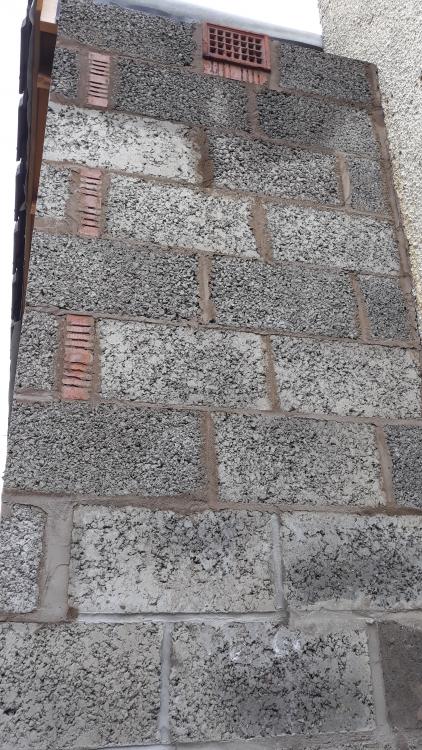
-
Readymade 1/4 blocks? Getting fed up cutting.
Carrerahill replied to epsilonGreedy's topic in Brick & Block
Use a common on its end. -
Wish I could use the table saw for mine (while wearing a mask) but at 150mm I am a bit out of the max depth of cut! I am also thinking about putting some of the left over 150mm stuff between the joists in the loft in the eaves over the master - we currently have 50mm EPS so I think I will take that out, put in the PIR, then put the EPS back down and use some of my left over OSB to floor it. Toasty!
-
OK thanks guys. It all makes sense, all of the stuff outside is in it's wrapping - they are just a bit torn up. I'll look out tarps later. I might even start installing some!
-
Exactly what I see/thought. But I wanted to be sure I don't ruin a small fortune worth of the stuff!
-
All the insulation arrived today, does it need to be under cover? It would take a lot of effort and a lot more effort to clear a space to put it indoors so it wasn't in the way and the garage is full of timber and tiles and cement just now. I don't want to double handle the PIR boards, so, can it just stay put outside until I use it? Probably a couple of weeks tops - it's just it does have a symbol showing a umbrella with rain which is the keep dry symbol. It's closed cell so I cannot see how rain would upset it. Thanks
-
Merchants and trade/credit accounts
Carrerahill replied to eandg's topic in General Self Build & DIY Discussion
They will do credit accounts but it is only till the end of the month for the statement then 14, 21 or 28 days to pay so it's not a massive bridge. If you need help with financing these things you may be better taking out a personal load or even better a 0% on first 60 days purchases card - but remember, this can be a slipperly slope particularly if it is this early on in a build. The merchants will do stringent credit checks and it is not even them that do it, any organisation that offers credit now must protect themselves and to have the insurance needed etc. they all use a credit agency or third party credit checking business. Particularly in the building game where many unscrupulous cowboys run off with money and without paying bills it is now ever more difficult and often they won't give you credit till you have some history with them. -
I would be interested to know the actual internal dim's of the actual barb through the mains pipe and the type of valve, looking at the 32mm pipe and the size of the main body of the saddle valve it looks like there is a restriction in there anyway. It is only a short length of reduced diameter pipe so I would be tempted to leave well alone - can you test the flow at your house yet? Also, do you know what the pressure is on that mains and at your house? Some mains can be very good some not so good, if your on good mains pressure then that will help too. I'd let them write it off and just plumb the house carefully to suit if you think there will be an issue.
-
It looks to me like a case of, that is the saddle valve they had in the van, so that is what they were going to use!
-
If the upstairs soil pipe comes into the left branch, I would be tempted to use a decent bend on it, or else you will get lots of splattering noises - OK if it is going to be outside. I know soil 90° are always bends rather than elbows like you can get on waste fittings but the bends are still quite sudden. I know someone who has lots of bends and things before a soil stack in their kitchen and I kid you know, you can audibly track the progress of the poop as it makes it's way along and down the internal stack which in the kitchen, is rather off putting!
-
Help - can this door handle be converted? Pics included
Carrerahill replied to Roz's topic in Doors & Door Frames
I'd just use the stop plate with the lug ground/cut off as it will have a square hole in it and therefore be a decent fit and the correct thickness.