


Carrerahill
-
Posts
2132 -
Joined
-
Last visited
-
Days Won
10
Everything posted by Carrerahill
-
Help - can this door handle be converted? Pics included
Carrerahill replied to Roz's topic in Doors & Door Frames
If the square shaft which goes into the multipoint lock will be held in position by the lock mech itself then you can remove the stop plate, grind the stop lug off and refit without it also remove or modify the action of the spring. The handle will then go both ways but will have no integral position hold mechanism - but as I say, the lock mechs "home position" should hold the handle where you want it i.e. 9 or 3 o'clock position. Many UPVC door handles just swing round and round when off the door and rely on the "home position" from the lock itself. If not you would need to alter the stop plate and spring arrangement. In a word, yes it will be possible - but it comes down to a bit of luck or your ability to modify it. -
Does the master and living room have windows to the side or only the front?
-
All this talk makes me wonder if I should just backfill the lot and screed over.
-
building a house....with future extension in mind
Carrerahill replied to Amateur bob's topic in Introduce Yourself
I would do a stage 2 design for the whole house but only take the part you will build now to detailed design which will include parts of the future ext. - I would then incorporate all the lintels and openings just now, then brick them up so that come extension time you can just remove those bricks and you are through. On the founds I would pour founds some way into the extension and take into consideration any utility runs like pipes or electric etc. I would run the founds out so far with some rebar sticking out so you can continue them at a later date and connect into the existing easily - paint the ends and backfill with gravel so it is well drained and easy to excavate. I would run in the required cabling and things that may be needed to a convenient point and leave enough of a coil to get it well into the first socket or light switch etc. If you are going for a slab found then I would do the whole slab in one go and just deck over it or something for now. -
depth of biscuit mix? direct tile onto this?
-
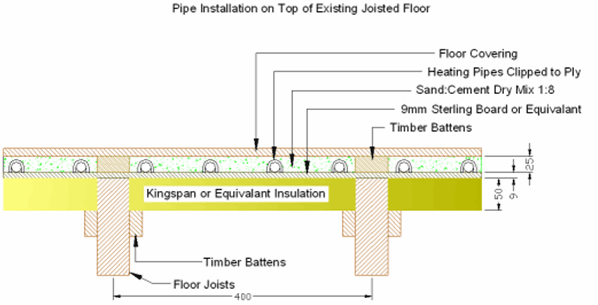
I think I am going to lower my joists 19mm and batten out on top now. I do have a clear run home down one side the way the perimeter of the floor works out (joist change direction) but I prefer the idea of running them as I want and NOT in the confines of the joists. Good call! I have not been shown this detail before and it makes perfect sense! Glad I didn't nail in all my joists a couple of weekends ago!
-
This is how I am doing it - but I could do it as per prodave as I could just remove a 19mm piece of the plate the joists sit on and use 19x38mm battens over the top - hmm!
-
This is what I have been advised to do but without the OSB directly above the Celotex. - but I think I will run the battens under the joists and let the PIR sit lower, I also suspect this will be stronger (I will need to get good fixings and use plenty support).
-
Ah got you. Could you post progress pics please and let us know how you get on? Please note my edit in my post, I hit 5 rather than 2 - 120*145mm for a 5x2 - ish.
-
When are you doing yours? Are your joists only 5x2? Note, if so you will only get 20mm above 100mm PIR as 5x2's are 120x45/47. So your PIR will sit level with bottom of the joist? Or do you mean 1x1 level with the bottom and the PIR sits on that so it's about 25mm up and 20mm from the top?
-
Using old Bricks as Gravel under Block and Beam Foundation
Carrerahill replied to Patrick's topic in Foundations
Seems fine, this sort of thing is now very common in large civil engineering projects, it helps with SKA ratings and BREAM etc. that is, of course, if they can be used on site. I contemplated hiring a crusher to crush the old garage and concrete, it may have been cheaper than skips at £500.00 for the weekend but I didn't event see the need. My civil engineer helped me with the clever reuse of most materials and how to best re-purpose them. It was noted early on that very little waste would need to leave site. In the end I decided just to use the brick as first cover over the garage site before 8 tons of 6F2 and type 1 and staged compaction. Part of my old garage is also now down a 4m deep hole under the lawn. The bits of wall left of my garage is going to be spread over about 30m^2 then have hardcore compacted over it all before I pour an apron for the garage and granite setts over it all (which I found under my old garage!). Parts of my house were laid like cobbles between the extension walls, sand blinding run in between them then concrete over the lot, also about 10 x 9'x2' toughened glass roof panels broken into a pile of "aggregate" which will remain forever under 100mm of over-site concrete. I have so far removed all the waste from my site in the back of a Volvo estate! We are due to have a wood burn which will be within the confines of part of the cold garage to control it and I will keep it small and let it burn all day long for as long as I need - it is all untreated waste timber so will burn cleanly enough. I mutually de-nailed and prepared 100's of meters of timber to be kept - it will end up as planters or shelf's in the garage or something. -
I am going to do the exact same thing in about 3-5weeks. Have you thought about additional support for the Celotex so that when you do the biscuit mix screed the Celotex is well supported? I am thinking of setting the joists and then nailing roofing battens to the underside of the joists to create a grid to help support it all. Most details only show a support batten but I am not convinced by this being enough. The mix is not very strong either so although it should then self support across the battens if it cracked at the centre the weight would then forever be pushing down on the middle of the PIR which would cause it to bow.
-
I think that sounds OK - unless you really are not prepared for the pour at all or VERY heavy rain causes major issues before a pour or you have an issue with moving the concrete (pump is late or not enough bodies with barrows) then I cannot see you ever being much more than 20-30mins over which for £30.00 (£36 with VAT) is not really too bad. Just make sure that you're ready a day or two before the crete is due, then check again just before the pour so that you can literally just have the guy start screwing it out when he arrives. If you have others doing the pour and finish then tell them they are responsible for any late charges which you will deduct from their agreed price if they cause it.
-
OK then, in the interests of rounding off this post may I steer this discussion in the direction of, effective CO2 mitigation measures or more generally effective house ventilation. I cannot easily install a full house MVHR system because our house has been fully restored and most decoration works done, when we open into the extension the adjacent access rooms will be reconfigured and decorated that then "ends" the house works (in theory). So I am not disturbing all of that now. My plan therefore would be to mechanically vent the extension and some rooms in the existing building. An area being the kitchen, my intention is just to vent the hood externally as I cannot have that smoke/grease going via a MVHR unit, so I will just vent it - I also though that I could just have some background ventilation from something like a Vent-Axia HR100R that could take some air from the new living room and the dining area of the new kitchen and the replenish air could be ducted into the hall of the original house. That would in effect create an airflow from the hall through a small, as yet undecided purpose room and into the kitchen meaning a low volume airflow to just keep things fresh. My house is 1960's - the house it pretty well insulated and sealed up by retrofit standards but it's still got draughty bits that let the house breath, and frankly I don't object to that. So do I just install a couple of extract vents with a CO2 sensor that kick in when levels are high and let the air leaks in the house draw in the fresh air. Does the system need to be complicated to achieve good results?? I just think it would be great to have the open window freshness without the need for all the windows to be open i.e. when we are away out or if we go away.
-
Depends if you will see a ROI, which he has. He could have probably gone cheaper but that is his kettle and oven too. It's cost him about £100 in 12 years to run it so I would say that is very economical. As for cost of the Bosky - at today's prices: 5k / 12 / 12 £34.72 a month but he paid about £2800 at the time. So £19.44 p/m and falling with every month that passes.
-
Ouch! The first time I did mine I was in my early 20's if not maybe even 19, I was lucky a friend had a 4-post in his barn, so I did it all from underneath, it was still bloody tough, the next time I didn't have access to the ramp as there was a long term restoration project on it so I took the engine out as I had a block and tackle and a big beam in the barn. Third time was when the gearbox packed in, it was stranded so I did it where it was, floors and seat-box out with my brother and dad called in as human-cranes apart from being December and freezing it was not too bad that time. Fourth time I needed to do the crank seal, I had the body off so was able to straddle the gearbox and literally pull it off the back, wriggle it onto the chassis then climb out the middle of the chassis and lower it to the deck. I then stupidly agreed to change one for a friend, discovered that someone had welded everything in, cross-member, gearbox mounts everything so needed to cut it all out!
-
Simple really, just match up your system components suitably. My friend has a Bosky Thermorossi which feeds two 100/120?litre water tanks for DHW and his C/H system with an injection Tee on the return - which he tuned by reducing the radiator diameter return pipe by crimping slightly which gives him the perfect balance for his needs. The tanks have there own cisterns and are vented. They thermosyphon so the pump only kicks in when demand for heating is required or the system needs to dump heat which is done with a fairly simple yet clever set of thermostats and pump controls. The underfloor heating aspect I believe always receives a trickle so that the slab temp cannot drop too low. The system is very simple, works like a dream and as he has unlimited supply of firewood it is the most economical thing in the world for him to run. In summer he can heat DHW with plate heaters in the tanks which interestingly is connected into a waste oil generator system so that is free too. His system was so successful he also designed and advised on the install of a identical system for a farmhouse where the couple were paying £1000's for gas delivery's. They now certainly buy poles (not yet logged) and prepare it themselves but I think it costs him £200 a year and the local farmer stores it for him dry and he only takes what he can split and store at any given time.
-
Having had the gearbox in and out my Landy several times I am hearing you!! I quite like my back, so drive it very carefully!
-
You are measuring the thread of a union all the measurements are based on the pipe size. Take a 15mm compression joint, it's bigger than the 15mm pipe itself but it's still a 15mm joint. Your tape is a little off at the left but a 3/4inch BSP thread will be 1.041".
-
Exactly my thoughts. I suspect we are creating a housing stock with disastrous issues in the wrong hands. It's like new drivers, they are so used to new cars just doing so much for them and being easy to drive, they are quiet so they drive like idiots all the time too fast because they are not getting all the feelings of speed like we used to (and they are looking at their phones not the speedo). Give them an older car and they can't cope, they would literally mechanically destroy it and probably end up in an accident. It is the same with houses. Explain to them that gearboxes didn't have synchromesh! I am one of these people where almost everything I do I take into consideration the machine or structure or item I am about to use. I am just programmed as "engineer" so everything is assessed and consideration taken to protect or prolong it's serviceable life. A primary example is that I have always been a mechanically very sympathetic driver because I know mechanically how every push rod, con rod, crank shaft, flywheel, clutch plate, clutch cover, input shaft, lay shaft, output flange, drive shaft CV joint etc. all work while a vehicle is being driven. So I know why slamming it into a low gear and gunning it isn't really very good for a car, or why going along a bumpy road in a low gear puts massive moments of inertia onto the whole system all the way back to the crank. Give people a technically or scientifically engineered house then you need the owners or "operators" to know how to run it and I think, generally, people are not willing to think or consider things and believe items, mechanical or structural with just work or exist. We are a different breed on a forum like this, we get it and we take an interest because we are building homes for ourselves, good homes that we spend years thinking about and years planning and years executing and we want the best.
-
Your quote is broken, the OP wrote what you replied to.
-
This is what happens - again, a lack of understanding of how buildings breath. I don't get people who won't ventilate their houses, with windows or by running a mechanical system. It is just not natural to have a house sealed up all the time with no fresh air movement. We have windows open more or less all the time it is reasonable to do so, which is really most of the time, even in the winter a window or two will be opened for a short while. When we wake up, within 5 minutes, about 5 windows are open, I am in my home office right now with fresh summer air in the room and the bedrooms are all fresh. We were away from Friday till Monday just there and when I walked into the house the first thing I noticed was how stale the air in the house felt, before I even started to unpack the car I had windows flung open. Ours is a 1960's build and the extension will have MVHR which will be tied into some rooms in the existing building as I like the idea of ventilation all the time especially during the winter.
-
I think you take this evidence and get your mother educated in these matters. People have funny ideas and it is generally through a lack of understanding. They are now feeling ill, saving money is fine but don't make yourself sick over it if you can afford it. Can I assume they can afford it? It might be worth trying to work out what it costs her a year to run and prove it is not too bad (if it is bad then... well I don't know). The flat has this system so am I right in thinking it is a new/newly renovated place probably with good insulation?
-
Level tolerance for hardcore under a concrete slab.
Carrerahill replied to epsilonGreedy's topic in Floor Structures
Sounds fine. Have some big pieces of clean concrete or slabs handy - can be a saviour if your order runs a bit short. If you were close I would come and help you on pour day, I love concreting! You know, with all this concrete talk, I think I will order a 750Kg bag of all in one sand/ballast next week with my next materials order so I can do some little pours around my new garage for the slab at the side door etc. -
Level tolerance for hardcore under a concrete slab.
Carrerahill replied to epsilonGreedy's topic in Floor Structures
Are the containing blocks on a solid foundation with the intention of building up from them? If so then there is no benefit to thickening the edges much as they will not be load bearing. I formed my slab with 8x2's and then thickened the edges as the block walls were then built on the edges of the slab (50mm setback).

