


Carrerahill
-
Posts
2132 -
Joined
-
Last visited
-
Days Won
10
Everything posted by Carrerahill
-
Just as a little anecdote about this sort of thing. About 20 years ago I ran an Ethernet cable between two houses via a telegraph pole electrical taped it to the CW1128 BT cable! The run was about 125m plug to plug. It aways maintained a full speed link without issue or a high rate of packet drop. We used bog standard cheap cable and it's still there, no physical degradation or even signs of UV damage.
-
Yes.
-
Just run in a piece of CAT5e/6. 5e is limited to 328' to mainatain top speed so you are sorted. Ethernet is the only surefire connection. I am wired in my house and never have issues, with more and more wireless gadgets WiFi is just becoming a pest.
-
I just use good quality silicone like Everbuild 825 - I used a lot of this around new windows about a year ago and it is all still brilliant white.
-
Square edge worktop - mitre or butt...
Carrerahill replied to Carrerahill's topic in Kitchen Units & Worktops
Worktops are already in the garage! I also see potential major issues with having them pre-mitred. I am fairly sure my kitchen is fairly square and my cabinets are sitting as square as possible but I'd expect a small variation in angle at joins which a factory mitre wouldn't allow for... or do you feed them that info? -
Drainage lintel strength and bearing
Carrerahill replied to MortarThePoint's topic in RSJs, Lintels & Steelwork
That is even worse... The best a type A can achieve on a 600mm span with 5 courses is about 3000Kg... Who spec'ed the lintels? For the sake of £50 I think I'd pop those out, remove the coursing brick, (maybe use pieces of the old lintel as pad stones) and get a G8 in there, which on it's own without any other courses is just shy of 600Kg/m. If you have a few courses then this could drop to a type F or K9. All advice above is without having full facts and details, but at a basic level is accurate. -
Square edge worktop - mitre or butt...
Carrerahill replied to Carrerahill's topic in Kitchen Units & Worktops
I am into woodwork and I like to do everything myself too. Having said that, I cannot see me installing kitchen counters that regularly, I'm more of a cabinetry or custom storage solutions sort of a guy. Mind you, I am tempted to quit my business and start a building firm doing extensions, so maybe I need to learn this now! I am just off the phone to a chap I like the sound of, £200 for fitting the tops, I have scrutinised his workmanship on his Facebook page and note lots of masons mitres executed neatly. -
Square edge worktop - mitre or butt...
Carrerahill replied to Carrerahill's topic in Kitchen Units & Worktops
Nice work. I have no doubt that with patience I could do it, I am however wondering if for speed and what not, I pay a man! A good jig will be what £75 then a couple of good cutters say £30 - so there is £105 then I need to acquire a suitable router for the job. If a man wants £200 to come and basically do two joints do I just pay him? -
Drainage lintel strength and bearing
Carrerahill replied to MortarThePoint's topic in RSJs, Lintels & Steelwork
I second this - that would have given @MortarThePoint more like the 6000Kg per meter he needs. -
Drainage lintel strength and bearing
Carrerahill replied to MortarThePoint's topic in RSJs, Lintels & Steelwork
What is that? Type A? 100x70? What is the clear span? about 800mm? Permissible load assuming at least 5 layers of brick would be around 3000Kg per meter... -
Change to design after permission granted
Carrerahill replied to Field_of_Dreams's topic in Planning Permission
Just email or phone your planning officer and ask them what they will accept. I spoke to my officer, she told me to email it over and alter drawings to suit and she's put it through as a non-material variation. Not sure if moving a wall 2 meters would count... -
I am ready to fit the worktops, I am now therefore in a bit of a predicament. I like mitred counters, I think it looks smart, I don't know if it's just the geometry of perfectly jointed counters I like because it's clever or if I do actually really care about the joint at an aesthetic level. I like nice engineering and nicely made things so I can sometimes be swayed by something well engineered. I have a 1/4" collet router, which isn't really big enough to take a long enough cutter to do counters and with end float being an issue on long cutters on smaller shafts I just ain't going to risk it. Best case scenario I ruin £500 piece of worktop, worst case I lose an eye. So my thinking was, I will call in the joiner chappy who has done work for my brother and I trust to do the job correctly and well and also to be careful working in my kitchen - then came along the bug from Wuhan! After doing a fair bit of image searching I found that many square edge counters appear just to be butt jointed and clamped (my router will easily deal with the "T" cuts for the clamps) and I have a professional saw that I'd get a brand new fine tooth blade for. However, I suspect that it may actually be laziness and or a lack of skill that many "kitchen fitters" don't take the time to do a mitre. I am tempted to try it myself, I could buy a jig and borrow a 1/2" collet router, buy a couple of good quality cutters and go for it. I could always cut the male piece initially too long as a trial cut.
-
It depends what you like/want. I like creating scallops of light down walls, I like creating interesting light, my attitude is an office should simply be lit whereas a home should be bathed in light. Light is a medium and lights are light artist tools of the trade. Look at the lighting in this hallway - it is subtle but very cleverly thought out. So you need to consider, the optics employed, colour temperature, sharp or soft cut off's etc. Also bear in mind, that when lighting a space, you must consider what your eyes are going to be looking at, no point in having the floor of a room lit highly yet the walls are dark because that automatically makes the room feel dark. Some rooms benefit from the walls and task areas being lit but very little attention to general light. Restaurants are often lit like this - very low ambient level, but tables, bars and areas of importance picked out in light. You have only lifted the cover of this book!
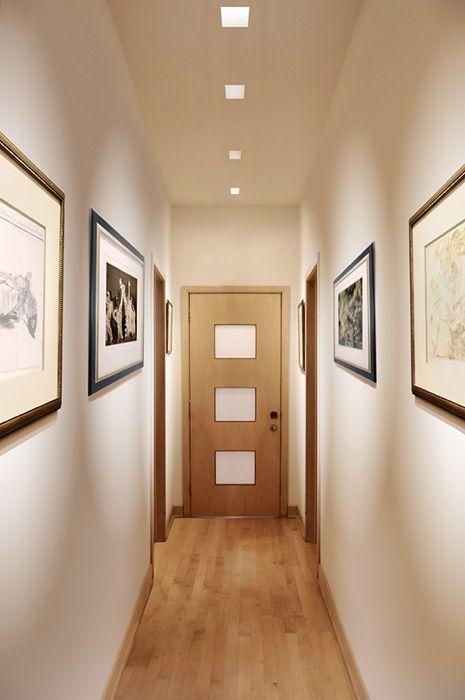
-
Hmmm. The whole thing? I hate with a passion people who have drives/carbays with gravel and most of the gravel ends up on the pavement/road which just get ground into the running surface and wears it down, planners know this also and often the first section should be solid, however, I am surprised they are looking for a whole drive to be bound as that is not conducive to draining your drive within your own land. Bound means "bound" in as much as the stuff is held together, tarmac is a bound surface.
-
That is just a little surface rust.
-
You know what would work, add another piece to the existing bit. Assuming the ceiling area is small and you have spare board.
-
That is a nicely executed curve to be fair!
-
Reclaiming underfloor insulation (built 2010)
Carrerahill replied to MortarThePoint's topic in Demolition
POST REMOVED AS I WAS TOO LATE TO THE PARTY! -
In that case, take those piece down (for all they are) slide the diagonal up till it hits the horizontal timbers then re-cut the ceiling PB to suit.
-
Plasterers can cover up almost anything to be honest, however, here it looks like the diagonal piece should have been a bit higher and the horizontal piece cut back a bit so the join was level, the issue you will have here is if he plasters that out, he will end up having to build up the material across the horizontal sheet a fair bit to get the level looking right, and you will always then have a uneven section which may show against the wall depending on finishing and eye lines etc. Personally I would have done that in a single piece by scoring and snapping the piece but not broken it off to get a really nice straight line. Straight sharp lines look better, curved lines look like you were trying to hide a mess and he will not than you for that if he is there to do a skim coat as that will need built up.
-
You guys were all quite interested in this at the time and John's nudge has prompted me to do a model of the kitchen and calc the lighting, this is mainly for you @SteamyTea as I know you were keen on the theory and calcs and I know @ragg987 you were interested on lighting levels. When I posted this at first I did not have the kitchen design finalised so I can now use the kitchen layout drawing to create a good model of the space (complete with kitchen and worktops) where I can then check the theoretical light level on the surface (lighting calcs are always prepared with a carefully calculated reduced light source to allow for many factors up to and including dust in the room) which will in fact be slightly less than real world light levels on day one. Once done I will post it all and let you know on this post so you can find it.
-
Hi John, the kitchen ceiling has been done and the kitchen is now in but things have slightly run aground due to Corona so lighting has been delayed a bit as it will be a custom solution. I have however got the LED boards that will go into the suspended up-lighter, so my plan, when I get a minute, was to wire them up and get them into the kitchen sitting on top of the cabinets for now just to give us light until we get the real thing in. At present we are using 100% daylight - which interestingly, at this time of the year meets all out needs unless its post 21:00. So quite pleased that this kitchen will not really need lit a lot of the time and I suspect daylight dimming will be well worthwhile.
-
Sealing floorboard edges against the weather. What potion?
Carrerahill replied to epsilonGreedy's topic in Floor Structures
I used some left over varnish and painted them all, had about 4 shades, tipped them all into one pot and used as a general sealer for many things during the build. -
Only in large volumes, he only needs a cupful, it's not going to deplete the oxygen of an entire quarry or loch.
-
I assume it must spring up from a water hole further down the hill rather than just form at the old quarry?

