


Carrerahill
-
Posts
2132 -
Joined
-
Last visited
-
Days Won
10
Everything posted by Carrerahill
-
Send me your address and I will send you a pocket ruler!
-
Measure your opening at several positions, take the smallest size then deduct another 5mm per side minimum, even 10 depending on what you are going onto. Be careful to tell the window manufactrer your true size and required size because our manufacturer had a policy that they would automatically remove 10mm from side and height (so take it 5mm each side) I personally, looking back on it now, would have rather they took 20mm off because I was building into a new build I could set them into the TF opening then have the brickie lay up to the window, instead I ended up with 5mm all round which on big windows is nothing and means they need to slide in dead straight and level or they snag and the whole thing was a bit tight actually. I could easily have set them in with room all around and then used spacers and then had the block and concrete sill taken up to the to suit. You live and learn.
-
price increases.. where do they end
Carrerahill replied to Barryscotland's topic in Building Materials
I read the same stories on some construction news website I get articles sent from, needing to build some final garden structure to finish the build I panicked and ordered a load of material, the guy said that availability was normal - so it's very regional. The stuff our mech stocks is Quinn Cement in green bags - still £3.49 a bag. They also had sarking board and loads of concrete block, but then there is a block factory about 15 miles away and I think they are supplying it to their regular customers as a priority. I wanted 10 blocks a few weeks ago so I could lay out a outside kitchen footprint and went to B&Q - no block, no 10mm or 20mm gravel, no ballast, no slabs - it was empty, well they had shed loads of cement! I asked the girl on the counter how long until they had it in, out of interest rather than relying on them for stock and she said 3 weeks, so the issue is B&Q are probably using sources for all this down south yet the place is awash with the stuff. So if you are really stuck, come up to a merchant in Scotland! -
Alarm system
Carrerahill replied to Russell griffiths's topic in Networks, AV, Security & Automation
Sounds like our neighbours who when they are on holiday leave all the blinds and curtains wide open, have no lighting at all internally or externally and park their car right at the mouth of the drive. As soon as it is dusk it a very clear no one is home. -
Alarm system
Carrerahill replied to Russell griffiths's topic in Networks, AV, Security & Automation
How do you interface between that and your phone? Do you use an app or something? Did you install it yourself? -
I think the first thing I would do is ascertain what I was going to build then look at how the two can co-exist - if it would add significant cost to my build to solve then I would look for another solution or investigate input from next door, if it was going to be negligible or a small cost I would just get on with it and accept some water. I can help but thinking that in an ideal world you would drop that wall, form one gulley running to the rear and then build your roof like theirs having created a central gulley for you both but I am almost sure your neighbour is not going to want to rip their part up and redo it - unless you opted to pay for it as part of your works because it probably won't alter cost much, you need to do something their regardless. My initial thoughts are, if you built a matching extension, you could possibly leave that wall, build an identical gulley on your side (with no central upstand!) and ensure sufficient fall to the rear of the your building and deal with that water in a conventional way. You are going to need to deal with the upper roof run-off anyway as it stands because you are currently discharging over your section of roof, so I think I would not get to hung up about this. I would say that trying to get them to change things at their cost on their side to deal with their run-off is probably going to sour your good relationship and that I don't think it would be a costlier exercise to build a roof to suit this - I also think a near mirror image of this extension would work well and keep some continuity between the properties even keeping them looking all original, with the only exception of your roof gulley being 5-10mm lower at the top and falling away sufficiently to drain the gulley. Another thing to consider is that anything you do that impedes their run-off and leads to leaks or issues on their side will probably become your problem because you touched it. Could you post an image of how the rear elevation looks, how does that gulley interface with the rear wall, guttering etc.
-
As per the title, I built a little shed, the roof is 11mm OSB, I wrapped the rest of the structure in membrane before I clad it and decided just to throw some membrane onto the roof to dry it in, I went a little bit over the top and ended up with a fully membraned roof all tucked in and stapled down looking good - if I was putting on tile or slate I would be sorted - however after much deliberation I have just gone for bog standard roofing felt - I got some IKO stuff - question is, do I leave the membrane on? A couple of things I have considered, breathable membrane under felt, I know will do nothing useful, but it may help protect the shed further in the future when the felt starts to fail. The membrane is designed to have a gap for breathability, being sandwiched in between OSB and felt might impact how it performs but I do wonder if it could rot, or somehow degrade... I wonder if the membrane will allow to much slip between that and the felt and may aid in it falling off in the future, I have bought the IKO felt adhesive for the joints but had considered a bead here and there to help bond it to the OSB to reduce slip. So, answers on this would be good thanks.
-
Make consideration for lighting, we have a very similar roof makeup but I opted to use indirect light sources for all our lighting - our whole kitchen is lit from light sources on top of cabinets up-lighting the ceiling which in turn reflects down giving a good quality of light which is nearly impossible to create shadows in and creates a very clean look. So the ceiling is totally bare which is what we wanted. If you use the above makeup then start trying to punch downlights into it just forget it and think about a battened out service void and second sheet of PB or something which also then gives it some fire rating.
-
I honestly think the next kitchen I do (a while off as our kitchen is not even 1 year old) I will build myself. Friend did this, he built all the cabinets and ordered doors from a shopfitter/cabinet business - they look really good and the whole lot is DIY except for the door/drawer fronts. Not a small kitchen either, he did it on his own over a few weeks with a Fes TS55 and some fairly simple tools! I got MDF CNC cut a few years ago for a fairly precision custom cabinet making project and it struck me that given carcasses use the same side panels over and over the best way would be to draw up a panel then using foil faced ply get however many needed CNC cut, then cross braces could be cut at home or if all say 600mm carcasses order those too, then work out shelf sizes and have a stack of them cut. Starting with the precision sides, all drilled with standard fixing points etc. you have basically taken out a massive margin of error and will assemble cabinets better than the staple and glue gun wielding assembly staff at Wren, Howdens etc.
-
Charred timber cladding - anyone used it?
Carrerahill replied to goatcarrot's topic in Building Materials
My dad has been making his own for about a year now, just for his own cladding and fences (Lockdown no doubt played a part in this). It seems very water resistant, easy to work with, can be done in various ways, lacquered or not lacquerer etc. I am going to use it for my shed. -
Unlucky, probably some know it all reporting him. I am all for a bit of DIY roadworks, as long as what is being done is done well, safely etc. I don't see why dropping some kerbs, if done well, is an issue. Given your friends trade I suspect he would have known exactly how to do it all properly and being his house he would have made sure, even more so, it was spot on. If I saw someone doing some sort of roadworks or alternations to pavements that was just going to end up in a potholed mess or dangerous I would probably speak up but not just because someone is trying to improve something that will have near enough no impact on anyone else.
-
Correct, we installed bollards on the pavement once to stop parking on the corner, 6 immediate neighbours all agreed to it and we also agreed to see or know nothing if ever questioned, we knew someone (friend of a neighbour) with a big white van with a yellow stripe down the side. Parked to obscure our work and wearing high vis jackets I cut a square into the pavement with a diamond disc while another neighbour broke it out and barrowed it away. Concrete bollards were set into some hardcore and Postcrete which gave it the initial hold then we back filled with a barrow of concrete with black dye in the last bit to make it look more like tar - once it all went off I drizzled roofing tar into the crack. No one ever said a thing!
-
Did this for a neighbour, we just did it. Took a Sthil saw to the kerb, cut into it and hammered the pieces out, ground smooth(ish) with a diamond disc. Basically it left a little ramped section, job done. Other option is just to put a piece of 2x6 against the kerb and bang it in with some 8 inch nails. No one is every going to say boo.
-
‘Packing out ‘ plasterboard
Carrerahill replied to Pocster's topic in General Self Build & DIY Discussion
I would go and cut myself a pile of 5mm and 11mm ply spacers. Rip a piece to 6 inches then slice it into 1-3 inch pieces. A big pile of them will be great for sorting out all sorts. My brother had a real craftsman of a joiner working in his 1900's house a few years ago, while my brother was away for 2 weeks holiday I was to go in and check things were going OK - the first day I arrived to check I noted the guy had done a brilliant job of 12mm exterior ply lining all the wonky floors, what struck me was the massive pile of various thickness ply spacers he had cut for the next stages of the work. As I came in each day I noticed these perfect little packed out bits and all sorts using all his spacers he had cut. They were all equal size and very very neat. I did the same when I was renovating bits of our house and trying to fit square stuff into squint rooms! -
Dimmable LED strips running off the lighting circuit
Carrerahill replied to gravelld's topic in Lighting
Just buy a correctly rated proper power supply. I hate these kits from Ikea and the like because they sell them with inappropriate wallwart style PSU's which as you are finding are no good to hardwire in correctly. Most of these tapes are 24V - some domestic market ones are 12V - just work out the watts per meter, multiply up by your run length and that gives you the power, then get the right voltage to suit your LED's - so if you need 34.8W and 24V go find a 45W power supply or what not. I have used these guys a lot: https://www.sunpower-uk.com/product-category/led-lighting-power-supply/constant-voltage-led-drivers/ Only additional issue you have is your using RGB - you are going to need to control each channel separately to achieve the colours you want, so you will need to incorporate a little dimmer for those - you can also put each colour onto a separate power supply and use a 3G dimmer - 1 for each channel but that might get a bit clunky. I'd probably use a little LED colour scene controller or put it onto a Shelly controlled via my phone. -
Dimmable LED strips running off the lighting circuit
Carrerahill replied to gravelld's topic in Lighting
You get mains dimmable LED power supplies. Very common. Got a box of the 24V units in my loft. -
Building Control advising against ICF
Carrerahill replied to bradders3109's topic in Insulated Concrete Formwork (ICF)
I think have spent the better part of 2 weeks trying to get council departments to see reason and logic, however I have failed and it has left me in a highly judgmental mood! They have consulted us for advice, they don't like the advice, so decide to proceed how they think it should be done but want us to "design" it to their spec. Makes one a bit annoyed to say the least. -
Yes.
-
I will have a go at the weekend. Thanks.
-
Do you think I need to score the base? Issue is, I cannot really move it to score the bottom...
-
I have this sandstone: What is the best way would you think to section it up into 4" blocks? My plan was to use a diamond disk to scribe round it, then just use a 4" bolster and split it off like you would split concrete block. They are to be used as a feature facing brick.
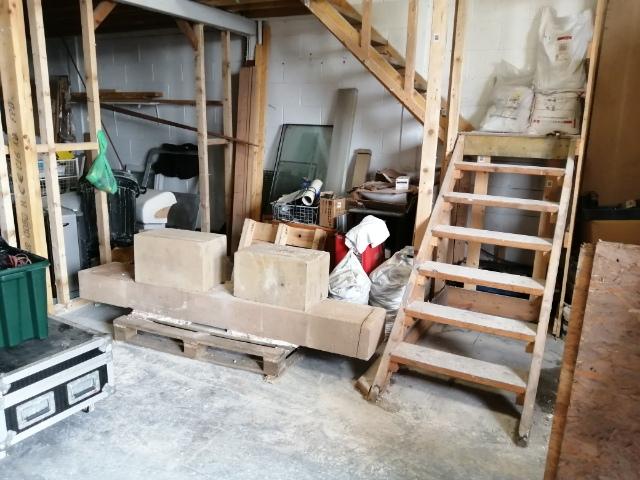
-
Building Control advising against ICF
Carrerahill replied to bradders3109's topic in Insulated Concrete Formwork (ICF)
They are just ignorant. Get it spec'ed up properly and submit it, basically they are holding you back because they don't know. If they were smart, they would let you do it and learn. Typical public sector worker. -
I prefer to do it one of 2 ways, proper brick back and pointed up, or use a cast insert piece. It looks like brick behind there, I would chip the render off and just redo the brick properly. It will look nicer. If a real mess pull them out and rebuild it. I don't think render ever works that well in the firebox.
-
In the process of making my tool wall and bench area up in my new garage! Some food for thought there (I love useable workshop and garage photos - always gives me inspiration).
-
How long is the run, is it in duct? Are we talking 25m here or 250m? Is the ground above the trench still just rough made up ground - i.e. no reason why you cannot re-dig it easily enough? Personally I'd probably just dig it up, lay in a 32mm and leave the 25mm next to it just in case there is a future benefit to it being there - you never know - could even be repurposed for something else.


