


Gus Potter
-
Posts
2383 -
Joined
-
Last visited
-
Days Won
34
Everything posted by Gus Potter
-
Noninvasive flow measurement
Gus Potter replied to Beelbeebub's topic in Air Source Heat Pumps (ASHP)
Yes that would work I think to help you identify the loops that are not performing... which is what we would do normally.. we just walk round the house and put out hand on the radiators.. and go.. hey.. that radiator is not working that well. But if I was going for a 10k plus heat pump I would want to know more about my existing pipework so I don't get shafted by the installer. -
Assume they are off the xmas card list and on the "I hope it goes shit for them next year" list.
-
Lots of good points regarding type of grinder but preparation is the key to a good job. I used to be a builder before I got into SE stuff so here is how I would cut a raggle in a nice stone wall that is compliant and is going to look good and professional. Stone walls often have a tendency to disintegrate when you start to cut chase for lead, but you want your lead work to look good and not leak. I would start by fixing a level bit of 100 x 25mm thick timber to the wall using screws and rawl plugs where I want the top of my chase to be. Next I favour a 9" grinder with a standard diamond disc, I think the kerf width is about 2.0 - 3.0 mm.. the kerf is the width of slot that the disc cuts. The 9" grinder has more power but is also much more controllable (I have two of these 9" grinders but only one smaller grinder for this reason) as it has big handle to grab onto and a bit of self weight that stops it jumping about. Mark the disc with a pen to give you the depth of cut. Go for 25 -30 mm on average into the stone if you have a good thick wall. Now you have to judge this as the stone will not be flat but you are looking for a penetration into the stone of 25.0mm to comply with the regs.. and the Cookson / Calder good leadwork guide.. which is your Bible on this. Download the Cookson or Calder guide to good lead work... if that is the only thing you do... it will save you money and grief! The main thing is that the depth of cut will vary.. this is because when you come to fold your lead into the chase it needs to be straight to look good but the wall will be in and out a bit! That is part of the reason for the 100 x 25 timber. Next move your 100 x 25 timber down by 20mm and repeat the above. You'll find that the timber has "suffered" a bit when you cut the top but that is ok, and that is why I cut the top chase first.. which is the bit you see. Now you have two cuts in the masonry. Get a chisel and carefully break out the stone between the two cuts and clean the back of the chase out, then brush / clean off dust. You should now have a cracking good looking chase for your lead that has not damaged the stone. The next bit is preparing the lead flashing and fixing it into the chase. This is a diferent skill and can be done in a couple of ways not least. With my traditional hat on I use little strips of lead rolled, folded and wedged in to anchor the flashing, then point up with mortar to seal completely. The flashing need a good bit of preparation so you have a task ahead if you want to start dressing and folding the flashings. How you fold the lead into the chase is really important. I could try and describe but it would take ages.. try looking on U tube. This is a skill that is passed down the generations, I learnt it form a lead worker hands on... It's not in a book! See the Cookson guide. I form the bends that go into the wall a bit like a cavity tray... hard to describe here without writing a massive essay. I think if you are asking about a grinder size and discs then you have a bit more to learn about how you do these flashings to make them last and water tight. Lead working is a skill that takes many years to perfect so please don't take this the wrong way. Keep asking questions! If you do this and grasp the basics then your grinder question will resolve it's self. One last thing.. make sure you get Patination oil and treat both sides of the lead or you will end up with massive stains down the roof!
-
It's a fair point until you look at the extra cost particularly labour wise of installing the glass wool under the warm roof. For the glass wool layer to work properly it needs to be really carefully fitted and that take time = cost. Can you just make your PIR 200 mm thick and it will have probaly the same effect as you do away with the repeating bridges of the roof joists. I have done this on my own house where the warm roof is fixed together with glue not mechanical fixings. But lots of folk want a mechanical fix.. finding the fixings it a bit tricky for 200 mm PIR.. but it can be done.
-
In some cases it is perfectly legal to bury asbestos. But why? Well, I'll take an example. Say you have soils containing mercury or say chromium. Now once you get a handle on this and you weigh up the the risk of disposal vs burying you find often that burying is the way to go. The same rules apply for asbestos pretty much. Asbestos is actually a nice thing to bury as it is inert and does not contaminate the ground water where as Mercury and Chromium does. Remember that asbestos often comes out of the ground as a natural mineral from Austraila. There was a court case in England where contaminated material was taken off site, it blew off uncovered lorries and polluted a load of villages along the route to the waste disposal site. It was really bad, kids suffered. There are a surprising amount of houses that have been build over the last few decades where the top layers of soil have been stripped off, the contamination buried deep, a membrane placed on top, the removed soil placed back on top of the membrane and house built on top of that. We do this in the UK and there are examples of this being done safely worldwide, Australia is one case I know a bit about. When I mean deep.. I mean deep.. so you home owner can go digging it up accidentally. 1.8m buried depth is a good number for burying asbestos. But if you want to do this then you need to have a contamination strategy, a risk register and other documentation that you need to include in your deeds. If you don't do this then you are breaking the law. You may find that to do this right that the cost of compliance is greater than just getting in a licensed asbestos removal contractor. Also remember that it won't look good to the average punter if you want to later sell your house. In summary.. Yes it is legal to bury asbestos in certain circumstances. You are not the "devil" You could chance you arm and just do it.. but see if you sell and get caught.. you are looking at a potential massive liability.. and your insurance won't cover that. I would play this off a straight bat and do it right.
-
Noninvasive flow measurement
Gus Potter replied to Beelbeebub's topic in Air Source Heat Pumps (ASHP)
By all means give that a go. Much will depend on you enthusiasm for getting stuck into this bit of your project and if you have the time to play about with it. In the last post I mentioned doing calculations etc. But if you want to just check that your loops to each rads work ok ish then you could just do the first part with the hose thing.. that at least will let you identify any really bad loops if there are any. The heat pump thing is a big outlay. How are you on diy plumbing? if you want post some photos of the boiler pipework you have and folk will chip in as to how you can break into the pipework easily using DIY plumbing fittings. Oh I forgot to mention. If you are flushing the system to investigate make sure you top up the inhibitor to keep things ok in the short term. -
Good question. Hard water often occurs when the water that comes in from the mains supply is extracted from a chalk aquifer or run off from chalk bearing soils. The South Downs are a good example of this. This makes the water that comes into your house a little alkaline and it has a lot of mineral salts in it too. In parts of Scotland the water is off peat soils which makes it a little acidic. What folk do is to have water "filters" that compensate for the alkaline water and capture the mineral salts.. so your kettle and hot water system don't get firred up. In Scotland in peaty areas the water can be a bit brown when it comes out the tap so the filters clean that up a bit. But in both cases the PH value is close enough to 7.0 so as not to impact on the bacteria in a septic tank. However.. if you are talking about the things you hang on the side of the toilet then they are toxic to the bateria in the septic tank, just like toilet bleach.
-
Noninvasive flow measurement
Gus Potter replied to Beelbeebub's topic in Air Source Heat Pumps (ASHP)
A few random thoughts from me. If you are upgrading to a heat pump than that it some serious expenditure. I would want to make sure that my existing pipes supplying the rads are clean as I can get them so that means a good flushing... which is kind of what you are thinking about.. making sure the pipework is able to support the heat pump system. What if you start by flushing your existing system and where the flush water comes out attaching a filter ( magnetic) so you can see how much crap is in the system. You can use the mag filter later on anyway. This is good for the sole not least. Next if you get a hose pipe and run that off the mains water supply to where the outlet of the pump is going to be then you can measure the flow rate that comes out the hose with a bucket. You could do this with three rates of flows out the hose. Call this the inlet hose... the idea is you calibrate the flow rate out of the hose. You could just use a gate valve and say.. one turn open gives me x litres per sec.. two turns y flow rate. Just check what pressure variation the waterboard supply at.. could be pretty constant if you do it the same time each day. Next isolate all the rads (which you are going to change anyway?) apart from one. Put a pressure gauge on the flow just after the existing pump (flow side) so you know the pressure just after the water from the hose enters the system. Buy gauges that you are going to use later. Attach another hose to the return side close to say where the return for the boiler is and run that into another bucket outside. Attach a pressure gauge here to just where the water comes out the return side so you don't capture the losses in the exit hose. Now turn on the hose and measure the flow rate and pressure on exit. I have to go back to my Hydraulics for the equations but if you know the inlet pressure and the exit and flow pressure you can calculate the losses in the loop you are examining. Do this for the three different inlet hose flow rates you have calibrated the hose for. In terms of flow what goes in has to come out the other end so I think from memory you have three variables and from that you can calculate the losses in the loop you are looking at..the losses gives you the head loss in the loop which you need to size the pumps etc. If you do this with the three different flow rates from the inlet hose it lets you then see how the different inlet pressure = pump head which impacts on the performance of the loop. Now you know about your existing system with the rads you have. If you swap out all the rads then the short bit between the rad inlet and outlet should not make much difference.. its the pipes that you need to know about and if you change the type of TRVs at the rads. But if you swap all the TRVs for the same type it just shifts all the loop resistances by the same amount.. which you can adjust when you put in your the Heat pump system. The next bit is the hard bit maths wise. You now know the loop resistance of each loop when all the other rads are turned off. Go back and turn them all on and repeat the above but with all the rads open. This will give you the head loss for the whole heating system. If you then compare the losses for each loop (with all the other rads off) then you should be able to see if you have problem loops. Then you can work out what to do about that. But you also now know what the head losses are when all the rads are open.. so now you can start to design your heat pump system based on this is the worst it is going to be. You are going for larger rads and so on. The upside! 1/ You'll need or need to learn some basic plumbing skills. But if you do this then you will be well set when you come to look at the plumbers work, have a sensible discussion and keep costs down. 2/ You will get a huge amount of enjoyment playing about with it, even if it's just a case of cleaning crap out the existing system.. you'll save some money for good use later and learn enough so the plumber does not take the mickey out of you. 3/ You may find that you don't need a HP at all and can splash out on other things.. -
Insulated twin pipe, 32mm or 40mm
Gus Potter replied to HughF's topic in Air Source Heat Pumps (ASHP)
I wonder.. if you go back to how an old back boiler in coal fire works. Hot water rises, cold water falls.. the old back boilers could set up a good rate of convection flow. What happens if you apply these basic principles to you modern flow and return.. thus that means you put the pipes in with a fall so you are not fighting against the natural convection.. mind you think I might be splitting hairs here! Main thing for me would be to look say 20 -25 years ahead and think.. what if the pipes silts up a bit or I get a daft plumber in that lets unwanted bodies into the pipe. How easy would it be to flush it all out? Given the cost of excavating and preparation I would go for the larger pipe diameter 40mm as once in it's "there for life" ? -
A lot of good points and observations made here. Yes agree with all it does look like there is another roof framing in which will add a bit of a point load to the purlin. Also as others have noted there is a knot, shake in the timber right at the point of maximum bending stress. The purlin is something that can often be fixed. But you can see the roof must have dropped.. so that suggests that the roof may have spread, including the bit of roof coming off the purlin. I would want to understand if the roof has spread and if so what damage if any has been caused. Some roofs spread and don't impact on the rest of the structure too much.. at times spread can cause havoc = money. Often with something like this you just aim to stop further movement rather than trying to jack things back into position as jacking can often cause even more damage. Sometimes we want to add a bit of prestress to a remedial member. For example if you bolted a new bit of timber to that purlin before the new bit of timber starts to work it needs to carry load thus for load transfer to occur you need more movement... which you are trying to avoid. What you might do here is see if you can get a good length of new timber into the attic that spans nearly wall to wall. Bolt it in the middle where the existing purlin has split then jack the free ends of the new timber.. you pre stress it. Then finish the bolting and use some brackets or equivalent (there are some clever ways of doing this that don't require brackets per say, these work like gallow brackets but much more refined and made out of timber) to fix the ends of the new timber to the masonry.. to take some of the load and help to stop things from twisting. This is a bit of a simplification but hope I have conveyed the principle of my thinking. The main thing is to really examine the rest of the house for damage caused by possible roof movement, if none then it's down to just fixing the roof in a practical and as simple a way as you can find using off the shelf materials.
-
Yes it is. I have got into assessing roofs for PV in terms of making sure that they are still safe SE wise.. I ask questions.. Big learning curve and yes it is like the wild west. The problem I have is that once I explain what needs to be done to make the roof safe and water tight then a lot of the honest PV folk can't compete as it is a race to the bottom. Some roofs are fine and can take the extra loading. Many old roofs are already over stressed when compared with modern design codes but sometimes you can still make things work with a bit of pragmatism. My problem is that a lot of PV installers have no clue about what they are doing. Well a lot do and they don't give a jobby... it's a case of what can we get away with. Never mind the SE side.. lots of PV installers will notch the tiles to get their brackets in. If you go back to Marley tiles who stand by their 50 year warranty on their tiles and ask them .. is it ok to cut notches in your tiles and reduce the lap.. they will tell you.. (expletive deleted!) no. If they could reduce the lap they would have done so decades ago as the market is so competetive. If any PV supplier can't answer these basic questions that could compromise your house then why on earth would you part with several thousands of pounds to get a bit back on you leccy bill? For me know knowing a bit more about the PV market.. under the bonnet... oh dear! Hopefully things will pick up in terms of transparency ect.
-
Post a photo so we can see what is what. Folk will then chip in with suggestions.
-
Critique this Loopcad design & report
Gus Potter replied to Post and beam's topic in Underfloor Heating
That is a good start so well done. My thoughts are: 1/ It looks great on paper. 2/ UF heating is not an exact science.. have designed and built my own UF systems several times over the last 30 years.. learnt what works and what I could have done better. 3/ Your pipe spacing of 150mm should work well and give you a good bit of redundancy. That will serve you well. Say you want to put a rug on the floor.. your calcs are then shot to pieces. Big sofas trap the heat under.. you see the calcs are quickly invalid. 4/ Your loop lengths are not going to work in the long term. They vary too much. Yes you may say that the "experts know how to design" I say.. but what happens when you controls and valves start to get sticky in a couple of years time.. I have been there and worn the tee shirt. I'm not kidding you the valves and controls will get sticky and you will end up with your head up your bottom.. then remember you may want to sell the house! how do you explain that to a buyer.. well when it works it's great but you need to ... even if you don't you need consider the maintenance costs. Your loop lengths are not practical as when you actually see what happens on site and how folk bend the pipes.. your calcs are again shot unless you want to install youself. You have folk pouring concrete, tramping on the pipes.. one little dent in a pipe.. Keep it simple and accept the elegance of the simplicity. If you can embrace that you will do well. Advice. As others have said try and rationailse the zones. Accept that UF has its limitations and that from time to time some rooms may be a bit too hot or too cool.. too cool that is what the redundancy is for. You need to consider how a UF system is going to perform - 5 years after installation and how you operate and maintain that. I seems on BH that folk from time to time are trying to make UF into some kind of technical magic.. which it is NOT! the beauty lies in it's simplicity. For me I have gone for a max loop length of 75m. In my big rooms I have two loops in case one fails and it makes it much easier to balance. If I was you I would now go back to you Architectural design and review. Then make sure all this stuff on your UF can be practically intalled and how much that is going to cost you to maintain in 5 years time. Try this. On the ground floor have one set of loops that does the main living spaces then another that say does any ground floor bedrooms /office. Upstairs have another set. See how that works for you and cost it and only then start getting technical. You should start from the basics.. if you don't you will loose control of the cost and risk big dissapointment in a few years time. -
Yes sometimes it can be that simple.. no need to panic... easily fixed.
-
Yes once you can put your finger in it.. it is a structural crack! One thing that I have in mind is that the side walls of the extension are resting on the ledge (scarecement ) of the original house founds and the front of the extension has settled... hence the widening gap as you go up. But it may not be that obvious so I need to rule out all other reasonable causes as best I can. There are some trees lurcking about, different ages and varying depths of founds, leaking drains and Network Rail have been messing (piling for electrification) about near the site apparently.. will investigate next week but will put on a shirt etc and some head gear on so I "look official" before I go for a wonder around the public part of Network Rail property. I will go look at as many possibilties I can think of but want to check that they have been doing next door... very important. I'll keep posting when I can so folk can follow the process and how I reach a reasoned and evidence based conclusion.
-
Yes do that. Let the misting suppliers do the leg work for you and explain how their system is compliant or not with you requirements. Remember that it is in their interests to sell you their system. Send them the drawings and give them as much info as you can.
-
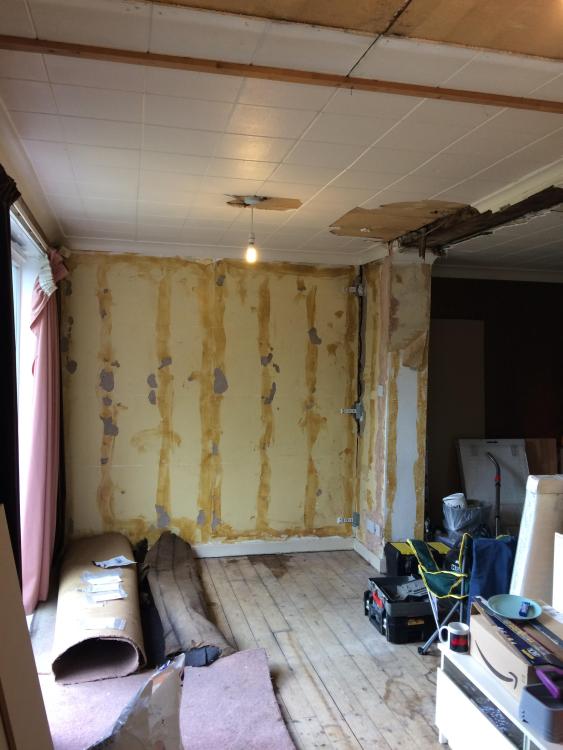
For BH folk that have "movement" Today I was installing tell tales to monitor movement or not. Have a Client that wants to refurbish and expand an existing rear extension. But the existing extension we want to upgrade has parted company with the existing house. You can see the "partin some 1.0 m to the right of the light bulb. I need to know if the movement has stopped or is relatively benign before I go ahead and design the upgrade. The extension is on CLAY soil so expect some seasonal movement. The photo below shows a smallish crack at low level and at the top there is some 14mm of separation. Now the Client wants to install a kitchen along this wall so if I don't get a handle on this then.. well.. trouble ahead! The house is semi detached... the neighbours have just introduced some kind of steel box frame next door as they have knocked out the back of their house.. I think they have added load to the party wall foundation. I want to make sure that my Client is protected as if later if something goes wrong.. my Client will get the blame to start with... best to be prudent as "last man on the job gets the blame" . I'm monitoring partly to see if the folk next door have caused an extra problem. You can get tell tales that do corners but they don't give you much room to get a drill in to fix them. Here I have cut brackets from offcuts of metal framing so have much more room to play with. The whole lot is screwed and fixed with construction adhesive.. so I can be sure the screws don't slip. The tell tales are actually quite fragile so you need to be gentle with them.. again the adhesive cuts you a bit of slack here and allows you to adjust the tell tale alignment. I installed six tell tales and it took me about six hours.. you need to take your time as the surfaces you are fixing to are rough and the tell tales need to align. But there was a bit before today. I spent time looking at the job and identified about six possible causes for the movement, there may be more, I need to sleep on it further. The main thing is to think of everything that could cause movement, be logical, look at probablilty and narrow the field down.. I think there may be more than just one cause here. The nity gritty of the tell tales. They have a cross hair that sits over a paper grid. They come with pins that lock the cross hairs over the zero point of the grid. While you screw them to the wall the screws can't be too tight as they crack the plastic tell tales. It's the adhesive that does the real work holding them in postition. I'll leave them for a couple of days for the adhesive to set and then take out the pins. Hopefully the wall is not moving that much that the pins shear or the tell tales fracture over the next couple of days..! When I take out the pins the cross hairs may shift, hopefully not, then I'll record what happens over the next few months while we get the planning permission in place and detailed drawings / structural calcs for the BC permissions. My gut feeling is that things will pan out ok.. but I need to do some monitoring to mitigate risk and be responsible. In posted this as I hope it helps BH folk see how we go about this and how you could do this for yourself as an excercise. If you go about it the right way, photograph and take records then who can doubt you?
-
Well that is a positive start and there is loads of great info in this thread. This sort of thing can cause concern but if you gather the facts the problem / concern can go away. I'll put my own slant on this so here goes. The legislation in Scotland works on the basis that the polluter pays.. last time I looked the same principles apply in the rest of the UK. Thus it is OK in some cases to have a septic tank..(they are not illegal in Scotland and certainly existing septic tanks in the rest of the UK) a big brick tank or glass fibre type bottle sunk in the ground. In Scotland when we want sell a house we need to register the tank.. it can be any tank.. spetic or a tank that treats the water to some degree often called a package treatment plant. In a septic tank the soil water from the house goes into this and settles out, heavy sediment on the bottom and fats on the top. There is an outlet that is designed to sit below the fat layer and this cleaner water goes into a soak away. Now you can see that the only "treatment" that occurs in a septic tank is a process of separating the fats and heavy material.. there is some Anaerobic digestion that takes place but ignore that for now. A septic tank is designed to make sure the water exiting from it does not block a soakaway, the biological oxygen demand, the ammonia content and potential "pathogen" content is not a consideration as this water soaks away safely into the ground. The main consideration is that the soakaway is far enough away from a water course or potable aquifer so as not to pollute and designed well enough so that the water going into a soakaway does not appear somewhere else.. often occurs if you are on a hill. If was buying a house with a shared septic tank I would concentrate on the practical side then look at the legal: 1/ Where is the tank and what type is it? A septic tank, a packaged treatment plant... there are a few different kinds, the modern ones tend to need less maintenance = cost. Water flows down hill so if the tank is in someone else's garden then they will suffer first! Sounds awfull but if sewage is bubbling up in your garden and the neighbours are not playing ball then you can face an uphill struggle.. causes friction. 2/ Next.. a really important is to know about the soakaway. Where is it and how much space is there round about it. Sometimes you find that the soakaway is not within the curtilage of the dwellings that use it.. say in a farmer's field. Now often there is provision in the deeds that allow you to access the field for maintence of the soak away.. but once they get blocked.. which they do eventually then you often need to shift them a bit as the pores in the soil get filled up.. will the farmer let you do this? If the houses have big gardens and the soakaway is within the cutilage of the dwellings that use it then you have scope to relocate the soakaway to some extent. But again where is the soakaway.. in your garden or elsewhere. Who gets their garden dug up? Now it may be that you don't have a septic tank that discharges to a soakaway, rather you may have a treatment plant that treats the water like the public sewage works and discharges to a water course. This is different but not a problem once you know enough about it. In the round if you love the house then start having a look at the practical side first .. then check the legal stuff.. cheeper to use you own common sense before paying legal fees.
-
Can you bridle around the area like you would do a stairwell, now you don't need to hole the bottom truss chords? Maybe you need to double up the bottom chords or make the trusses if Engineered with a thicker flange or if standard trusses make these out of a thicker (not deeper) timber. That may make the problem go away and give you much more play vertically and horizontally when you actually install the WC.
-
Extracts from BS EN 12056 - 2:2000 For a WC the pipe diameter hinges on the outlet size.. which kind of makes sense..


-
Have you had a look at the cost of the water mist systems? Also they can be much less onerous in terms of water storage capacity and mains flow rate. There are a few companies on the internet that do them and you can send them your drawings to get a no obligation quote and some free technical advice. How many floors do you have? It sounds like you need something along the lines of an grade D system and the number of storeys will dictate whether you need and enhanced grade D or not, assuming a normal domestic dwelling. Main thing it to plan you fire strategy taking into account the early warning (heat and smoke detectors) and the fire suppresion system. This way you build confidence that you have the over all design right at a sensible cost.
-
Also ask about using a cluster of timber studs under the beam end.. much easier to fix timber to timber. Let us know how you get on and what solution you go for at the end of the day.
-
Can you post the drawing again as the notes are hidden a bit odd? Also can you post a ridge detail and what you are doing up there? Do you have dormers? what is happening there at that interface? Are you putting an ensuite in the attic? It does look like you have some kind of hybrid roof, I have nothing against them but you need to understand how the tiles are fixed, vapour control.. what you have posted looks far off what you need to certify the design is ok both in terms of insulation and tile fixing. Oh and lastly has anyone thought how all that is going to work structurally? Can you tell us a bit more about that?
-
Advice Needed - Bonnet Hip Tiles
Gus Potter replied to ProblematicPanda15's topic in Roofing, Tiling & Slating
My backside. A hip should be straight up the line of the apex, even and pleasing to the eye, who told you otherwise? But to make a cogent argument you need to start on the inside of the roof and see how the rafters frame into the hip timber. If the joiner has made a pigs ear of that then the poor roofer is fighting a loosing battle.. in fact the roofer should have told you.. I'll do my best but your timber roof is crap. If you can show that the timber roof is ok then next look at the tile battens and so on.. go through it step by step, if it transpires the roofer has cocked up then fair enough. However that hip is a mess. Try and understand what has gone wrong and then work with all the folk that had a hand in building the roof to make it look a bit better. I think geometrically the problem has started at the eaves as the roofer has not understood how the angles work. It is really hard to get your head round this so mistakes are common. But I think most of the problem lies in just bad workmanship, not using a stringline and not using the correct mortar. -
Ah what's the saying.. You can take the Engineer out of the Contractor .. but once a Contractor you can't take it out the Engineer. I think you just need to live with the fingers and that contracting is in your DNA..




