


Gus Potter
-
Posts
2383 -
Joined
-
Last visited
-
Days Won
34
Everything posted by Gus Potter
-
Avoiding steel wind frame with portal I-joist frame
Gus Potter replied to thaldine's topic in Timber Frame
You can potentially save yourself a pile of cash if you post some sketches. You seem to be at an early stage. Here we look at the overall design, areas of glazing and so on (this is for structural stability.. side ways wind loading for example) and try and look at the insulation strategy and how we do the SE work for this to make it buildable and economic. The rafter spans you are talking about are modest.. no need for expensive I joists unless these can save you money on insulation... you may have a preference for what kind of insulation and roof covering you want? Sometimes we over engineer things so we make the buildability and insulation less costly for example. The best advice I can give you on limited info is to try and figure out what stops your house moving sideways when the wind blows! If you have massive area of glass then these are sensitive to sideways movement and reduce the available walls that can resist the wind. If I was teaching student Architects..(I do teach some and they in turn reciprocate) I would say.. bear building stability in mind and you'll have a good chance of actually getting your design built! -
Help ma boab ( Scottish expression for surprise / aghast)! This needs investigating properly. Agree. Send them your marked up photo as I think this will grab their attention. Also send a photo unmarked. See what the NHBC and the manufacturer say first.. let them do some leg work before you get an independant SE involved.. which may not be required... but you may want a second opinion anyway.. will be cheeper for you if the donkey work is done by those who build it and underwrote it. Question is.. that's the bit you can see.. what about the rest that you can't see! Sorry to say it but..
-
Coldwells Passivhaus Turnkey Houses.
Gus Potter replied to TheMitchells's topic in New House & Self Build Design
Have had a look at their website and signed up for the download. "That’s why we're simplifying the path to Passivhaus ownership, by taking the complexity out of the build process." Now that would be refreshing if they can actually deliver what it says on the tin. From their website.. A People Centred Approach Founders Clare and Ross Booth share how their people-centred approach and compact Aberdeenshire team... Aberdonians tend to be of practical mind with their head screwed on the right way.. sounds hopeful. -
Agree. Disagree as there is a lack of understanding.. still in the building trade and by designers who have practical site experience. Its your money.. spend as you wish. Can be achieved.. so there! Ok to sum up. Look after your Thermalite et all blocks when they get delivered to site. Use the right strength of mortar with plasticiser. Use a brickie that is properly trained. Now we are getting technical. We call this aggregate interlock.. same thing happens in concrete floor slabs and how you can design joints in slabs taking advantage of the aggregate interlock. This is a clue.. but there are loads of other factors. Here lies a big clue! Depends on what kind of cement you buy. Most brickies unless properly trained have no clue, I caught one the other day with a bottle of Fairy liquid lying beside the mixer.. used to entrain air.. this is a no no!
-
Plus One!
-
Checking out a company at Companies House
Gus Potter replied to Alan Ambrose's topic in General Self Build & DIY Discussion
What a great piece of advice from @Alan Ambrose Now the next question is how do you find the right SE / Architect / Designer. I'm an SE / Architectural designer, to be honest I started out as a local builder, went to uni.. learnt about SE stuff. When I look back my education gave me the tools to teach myself.. and that changed my life. -
An introduction... Renovation + 1950s + subsidence = a challenge!
Gus Potter replied to alfaTom's topic in Introduce Yourself
Much appreciated. Your post is a mine of infomation. So that is a big thanks from me! -
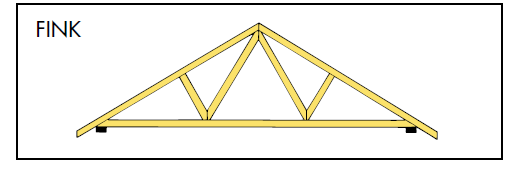
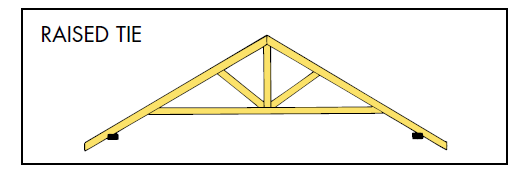
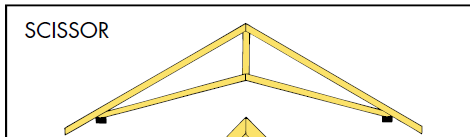
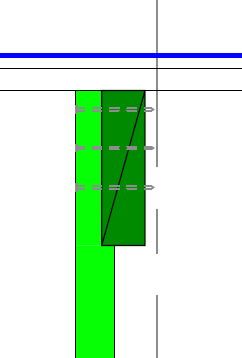
Hope this helps a bit.. but when we want to create a void above the wall head level the forces in the roof members change a lot . The following is very simplistic but intended to give folks an insight into some of the things we design for and hopefully give you all some ideas. Below is a standard fink truss. This fink truss is triagulated, very economic an importantly the loads at the supports are downwards.. and upwards when you get wind uplift. A lot of roofs can be "uplifted".. Below is what we call a raised tie truss. Here we have an extended leg. The ceiling tie and wall support create a lever arm... like having a long spanner to take off a wheel nut on your car. This type of truss depending on the length between the ceiling tie and the wall support causes other forces / sideways movement which can grow exponentially with a small increase in length. An important one is that this kind of truss can push the wall outwards (sideways movement).. so you often need to have "special" sliding truss clips at the wall head or a very strong wall.. and if you have a very strong wall then there are other options! Now the above truss generates some nasty forces at the connection between the ceiling tie and the sloping rafter. Timber connections can be quite weak and they are hard to design economically / buildability wise once you reach a tipping point.. which can be quite early on.. this can be a hard lesson for a Graduate Engineer / self builder. Below is a scissor truss Here you can see that the sloping ceiling tie stops the forces that want to spread the walls outwards as the bottom of the scissor is conneceted to the wall head. Often when we design timber roofs one of the problems is not the size of the timber but having enough timber to make the connections work ok. If you have an old house with a traditionally cut roof you'll see that the ceiling ties and soldiers (the short upright bits) are 1/3 to 1/4 checked. Below is a screenshot of one of my drawings that shows this. The dark green bit is the rafter, light green the soldier/ ceiling tie framing in. But there are only three nails! The one shown here is later detailed as having only 3 no 90x 3.1 mm dia Passlode ring shank galv nails. The three nails are there just to hold the soldier in place when there is say snow / access and roof self weight on the roof. The check in the timber allows for direct bearing.. timber to timber contact... much "stronger" than a few nails! Also we need to watch out for nail spacing and edge distance.. to many nails / to close to the timber edge and we weaken the timber so folks bear that in mind. The three nails are enough to hold the connection together when the wind is trying to suck the roof outwards. To sum up. Timber roof design is a bit of an art.. but hope the above gives some insight into what it is all about. The key thing is that often its the connections that govern the design rather than raw timber size. A good starting point is to go into some old buildings/ terraced houses and see how the roof is put together. @ProDave If you want to chew the fat then would be delighted to hear from you, mind you I'll want to pick your brains too so no free lunch!
-
Old Roof & Building Regs - Will it take the strain?
Gus Potter replied to RobertG's topic in Roofing, Tiling & Slating
To provide a bit of context to become an Architect takes about 7 - 8 years, a degree coupled with professional development and on the job training. As an SE / Designer I agree with your Architect. Your Architect is giving you good advice. If BC pick this up they may ask. But at the end of the day do you want a safe house or not? BC are not there to make sure your house is structrally safe or be SE's. There may be some way to strengthen the roof in a cost effective way to make it compliant.. don't despair. -
Ok have you sounded this out with the SE and buildings Engineer? They may be as equally frustrated as you are. If they are willing to support you then one of the two can often have a quite word with the Architect on your behalf (you keep it at arms length) along the lines of.. we don't want to make a big thing of this but what about if we certify our bit.. and you do your bit... by way of the Architect's certificate.. otherwise the Client may instruct us to look more closely at your work and delivery.. and we don't really want that to happen as we are all busy! If an agreement is made in principle then any oustanding fee element can often be "made to go away" Your Architect's certificate is often separate from the JCT.. and that will depend on what kind of JCT contract you have entered into.
-
The right compactor for Geocell floor???
Gus Potter replied to eros_poli's topic in Tools & Equipment
I did the structural and foundation design for @Russdl, just call him Russ. It was a great journey for me as a designer. At the outset Russ kind of knew that he wanted to use Geocell and he had good valid reasons for this, had researched widely and already has one self build at least under his belt. Key factors; the ground conditions, the shape of the structure (odd shape) drainage, boundary proximity, site access, muck away cost, the odd planning constraint and cost awareness. In summary this lead to a flat raft type foundation with masonry walls, EWI and cold formed steel roof joists supporting a warm flat roof. Russ build most of this himself and put in a lot of hard work sourcing and fine tuning the installation, his door insulated solution is remarkably good, I'm going to pinch some of this final (on site understanding) threshold detail off him! Ok the Goecell. Russ and I chewed the fat for a while. Me with my SE hat on, him with his practical hat and attention to detail. At the end of the day we ended up with a flat slab on the Geocell.. it is really simple. No edge thickening. His slab is pretty big so I added extra anticrack reinforcement near the doors and funny corners. The objective was to do the slab in one pour and avoid day / control joints as they would then translate up into the super structure.. and cause problems with the masonry design. Folks there is no free lunch and that is why all parts of the design need to be coordinated. What you do at foundation level can have a cost implication later on. At my end one trick was to use standard reinforcing mesh site bent at the ends to give the reinforcement anchorage. I selected the slab thickness to make it a structural slab (a raft) and no more. For the tecky.. my starting point was to have 0.13% of rebar which turns it into a structural slab (cf a ground bearing slab).. if you make the slab thicker is needs more rebar to comply with the minimum % for it to qualify as a structural (raft) slab.. I aimed for the thinnest slab.. and from memory this was driven by how flat you can get the Goecell and having enough of a bend on the reinforcing mesh to anchor it. Now the Goecell. It has a good bearing capacity cf a crappy CLAY soil. We know how the slab will impart the loads. We also know we just needed to provide enough compaction to consolidate the material.. no compacting it to death as this is counter productive. In summary, can be a bit hard to get your head around but you kind of need to lay Geocell in layers and give it a "shoogle" and not actually whack it to death. Russ is posting some of my drawings which I'm pleased about. I hope this helps give folk on BH some ideas / inspiration. Just remember that Russ' job is bespoke so just use them as a bit of food for thought. For old / historic buildings it is a pretty breathable matrix.. Historic England I think have a bit on this, lime floors floors and so on. In summary this sort of stuff floats my boat in terms of how as an SE /designer you make the best out of this type of product in a cost effective manner .. if the opportunity presents! -
SketchUp fantasy Garage. Drawings for building control
Gus Potter replied to Russdl's topic in Garages & Workshops
Thank you, much appreciated. Gus- 27 replies
-
- 1
-

-
- detached garage
- structural engineer
- (and 1 more)
-
LPAs playing around with 'validation' timescales?
Gus Potter replied to Alan Ambrose's topic in Planning Permission
Hope you are sure of your ground here @DevilDamo! Lets see how it pans out, every day is a skool day. -
Yes do that first and then just monitor the house to see house is still moving about between the winter and summer.. expect this in an old house. Attached is an old document I refer to that gives guidance on subsidance / settlement. Read this and hopefully it will allow you to relax! Start with pages 5 and 7! BRE Digest 251 Assessment of damage in low-rise buildings.pdf
-
Agree. I have a list of builders that I am ok.. ish to recommend. None however are perfect.. mind you neither am I!
-
Concrete screws for cladding batons ?
Gus Potter replied to Firsttimer's topic in Insulated Concrete Formwork (ICF)
Nick (fixings) they won't commit to. This is not part of their design liability. This is completely understandable, they are just giving a representative example. Fixings are rated in two not least general ways. One is the exposure rating.. your C4 wet dry.. near the sea (salt air for example) the other is strength. The ICF folk can't be expected to recommend fixings for all the different combinations of insulation and wall cladding. For all. Most structural fixings these days are based on the Eurocode design and have what is call a European Technical Approval (ETC). Hilti et al have a link on their web site to which states how their fixings are tested and in what environment they are appropriate for. These are hard reading and difficult to navigate if you are not familiar with the terms and notation. Your easy way around this is to treat the fixings like a dowel supporting a flying shelf. The compressive strength of the insulation can be neglected for the most part. The higher the compressive strength of your insulation the lower the thermal resistance.. think of insulation like cells in the body.. the cell walls are more conductive. A higher strength insulation needs more and smaller cell walls. Now maybe you don't need millions of fixings? .. which technically could introduce repeating thermal bridges. Can you design the cladding like a curtain wall / rain screen panel where the panels are supported at the bottom ( carries the weight) and the top fixings just stop it pealing off in the wind? Maybe look at this in a different way? -
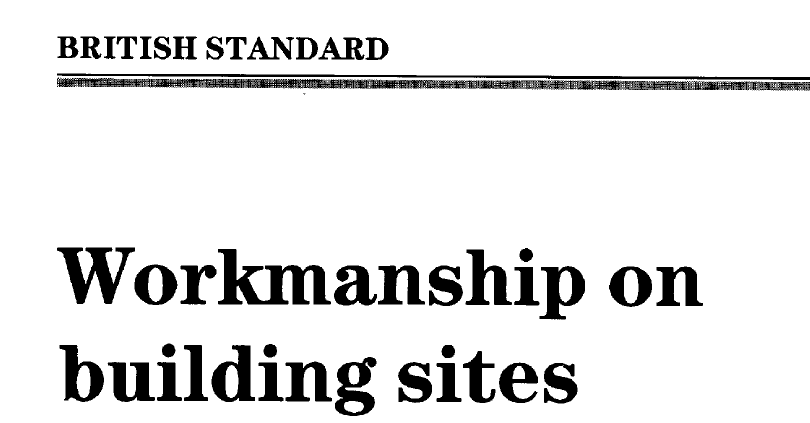
Feel for you! Sometimes there is a way of recourse. Let's not focus on the cost to start with. Rather, look at the workmanship, the advice you were given by the builder and what could be reasonably expected by you as a domestic Client when you employ a builder. I often use the same basis of arguement when I do Claims against big builders / the NHBC etc. Roughly under the consumer protection act you are covered as you are domestic Client. The easy way to explain this is that anyone who comes to work on your house has a duty of care. Also if they carry out defective work then this could compromise the structural integrity of the building! Now that may explain why I'm writing.. as my main day job is as an SE. Often it does not take me too long to make a convincing argument and this often circumvents all the aggro about cost ect. OK.. taking this forward a bit. There is a Bristish standard series called.. Now the courts will take the view that you as a domestic customer ( industrial / commerial ones are generally left to fend for themselves) should reasonably expect that any workmanship should comply with the above, caveat... in so far as reasonably practicable. This leaves an avenue open for folk that are doing renovations on historic and old houses as a case in point. Proving that you have been over charge is much more difficult. It sounds like your builder is a chancer and thus won't be affilated with any trade associations for example. Did you pay any of this in cash? Mull this over. But let's just say you didn't for now. To prove you've been heavily over charged will probably entail a bit of professional advice. Here is some for free. If you can find something that the builder has charged you for.. could be work they never did or used thinner lead ( the workmanship is covered above) for example then that is fraud! .. you can use other words but it's the same... a rip off. Often in a dispute with builders I'll lead them down a path where they drop themselves in a hole! I then point out.. never mind you workmanship.. here is where I've caught you thieving from my Client as you have charged them for something you never installed. You then go back and link what should have been installed to comply with the above standards. You catch them both ways. Then if you catch them doing something dangerous SE wise, threaten staturtory breach of the HSE regs and all sorts. A good example here is where the roof can be comromised by additional moisture content that impacts on the structural integrity. The timbers in the roof wil have been designed for a certain level of moisture content.. more moisture causes extra deflection / timber creep and so on.They may have compromised the ventilation to the roof.. as structural issue! Once you go to town.. you see? There may be some milaege in this for you. But make sure you get all you ducks in a row before you level any accusations. A lot of what I say above is an example of how you can put together a case. Don't panic but please monitor your roof for some of the things I mention. This may help you bring them back to the table to fix things. Don't lay it on too thick at the start.. give them enough rope to hang themselves on. At the end of the day they may walk away but at least you'll know you did your best. It's not your fault you are having a hard time.
-
LPAs playing around with 'validation' timescales?
Gus Potter replied to Alan Ambrose's topic in Planning Permission
This is a great point. I've experienced this where the planners have used this as a delaying tactic. They then go off and use their own terms. I've said NO.. your change of description could cause my Client difficulty when they come to sell. This is a legally binding process that not just involves you the planners so get a grip! The application must be treated as valid.. the submitted drawings clearly show what is intended as does all the other documentation which is compliant with the recognised submission format. The portal is not in it's self part of the true legal process.. you could send in paper drawings for example.. and just say I am submittting an application for a new house.. here are the drawings. -
Get a few tie straps in there to stop it lifting up in the wind. Make sure you get a good gutter detail to keep the rain away from the base as best you can.
-
Great post. These things let folk see what a site looks like, gives them ideas.. food for thought. Well done!
-
Flat renovation starting: payment schedule and contract?
Gus Potter replied to lb00's topic in Costing & Estimating
Be careful here and make sure non of the work requires BC permission. Drainage can be tricky.. are you messing with the fire protection / sound proofing between the flats or having to notch joists for example which are often commonly owned. Best to check as this can come back later to bite you. Your builder will probably run a mile if you mention a full on JCT contract on small works like this.. also these tend to need a professional to administer = cost. But avoid that you run more risk. Keep researching on the T & C's ! If you want to spend say £50 quid or a bit less you can get a copy of the minor works contract (RIBA can work) which may suit you. It's old hat but Which magazine has some legacy wording that may help you navigate this. Your builder seems to be front end loading this.. much will depend on what each staged payment means in terms of the amount of work effectively, competantly and compliantly has been carried out. -
Hi CaptainDram. Are you thinking about a plot in Scotland? If so plenty folk up here that can chip in with advice. Good advice.
-
Drainage pipe depth. Minimum 600mm or is that unnnecessary?
Gus Potter replied to saveasteading's topic in Boffin's Corner
I doubt that you've been doing it wrong! Aye and no.. depends on where it is and the loads on ground.. vehicle traffic or garden load for example. Yes I think so. Is this the kind of thing you are thinking about? Passed by Scottish BC... more than once. The main BS is BS EN 752.. the head code I'll not post it here for copywrite reasons. A good heads up is to look at the old Scottish regs. The detail below is based on these. I'll try and dig it out but a lot of the recent regs are silent on this.. they just refer you to the Eurocodes!
-
Concrete screws for cladding batons ?
Gus Potter replied to Firsttimer's topic in Insulated Concrete Formwork (ICF)
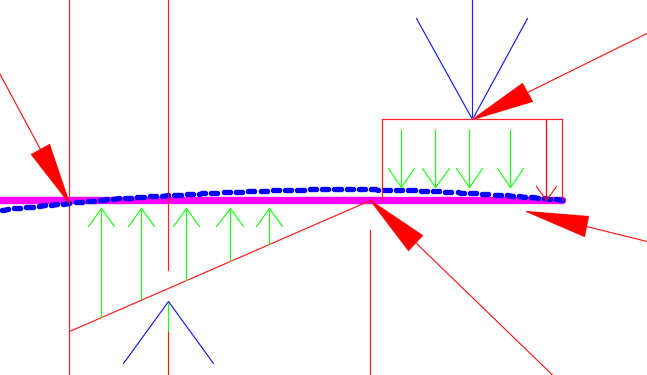
Just for you @steamy! Below is a knocked up (it's not prefect but hopefully gives you the jist) idealised model of some of the forces in the fixings. In real life they behave in a much more complex manner. Maths wise its pretty easy to solve this, quadratic equation or if lazy just use the goal seek function in excel. Now intially I would apply a lot of safety factors.. mostly to do with the local crushing of the masonry at the outside edge.. then wind them back by saying.. if I use a few more I can handle a few failures.. which is basically what a lot of builders do.. chuck in a few more if in doubt. For all the easy way if you are buying a lot of fixings is to contact say Hilti / Fischer et al and ask for advice. They may (and often do) send out a rep.. to do a few load tests on site.. On something that is a bit out the norm I would take a fag packet approach (idealised model) as above so I don't end up with too much egg on my face = being wildly wrong and also as a second qualitative check in case the rep gets it wrong.. which is sensible.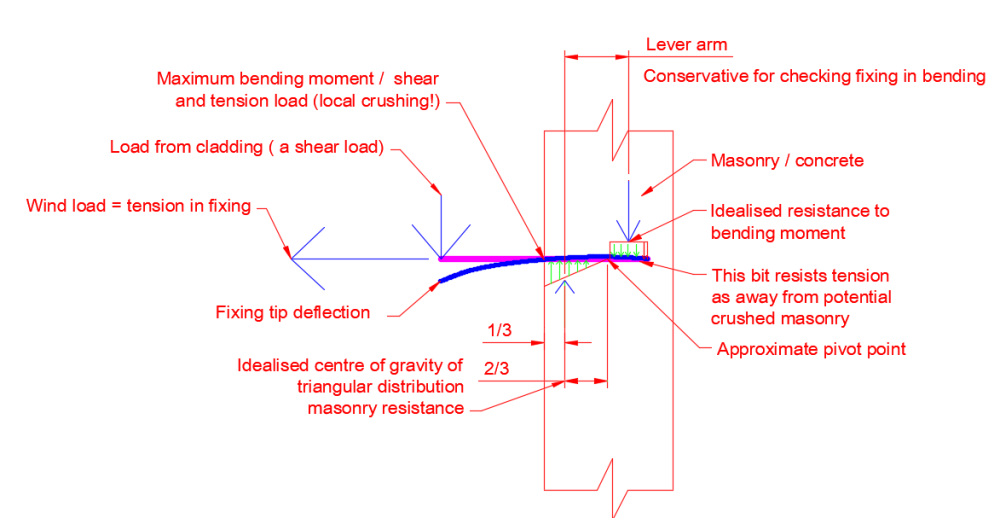
-
You probably did this many times.. so will know what your doing. To jog your memory they are Halfen channels or similar.


