
JohnMo
-
Posts
12465 -
Joined
-
Last visited
-
Days Won
179
Everything posted by JohnMo
-
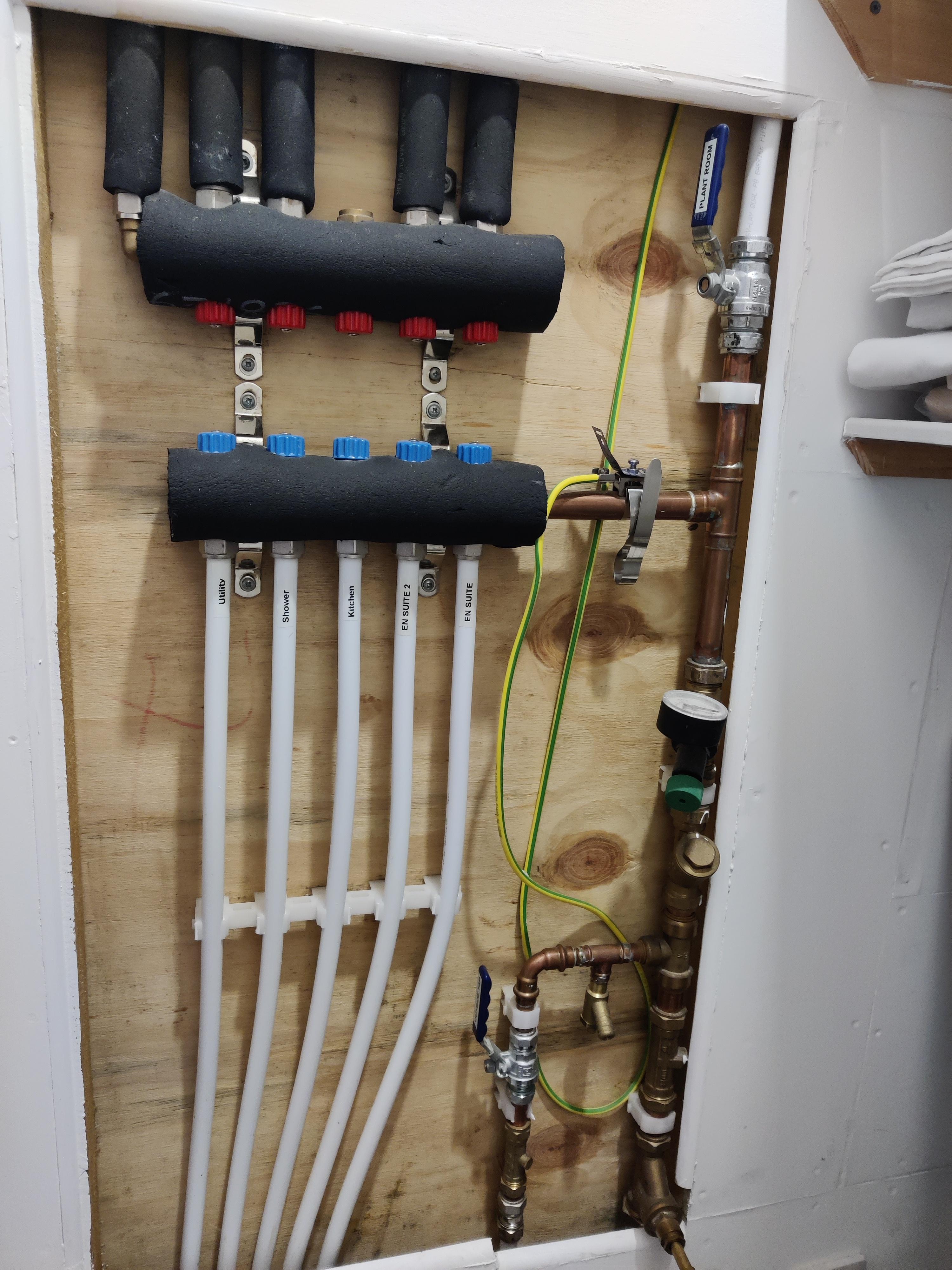
Our manifold isn't in the plant room, as it would have meant lots of long runs of pipes. So it's right in the middle of where it needs to be. Hot water Kitchen goes off to the left in the plant room and isn't on the manifold, manifold pipe goes right and it located in the utility cupboard. One supply to each room and branches of within the room. Cold water Manifold same place as hot, all room piping is under the floor insulation within the concrete (ducted). A supply branches off to plant room. I have secondary circulation to the furthest away room only, this heat the manifold up by default.
-
These are what I used. https://www.outsourcedenergy.co.uk/product-category/manifolds/plumbing-manifolds/
-
Take outside tap off first and include isolation and check valve so you cannot contaminate the rest of the system. Have you considered a manifold for cold and hot water, this allows each stream to be isolated. We found this great when we moved in as main parts of the plumbing was complete but ensuites not complete.
-
4kW requires around 120L system capacity. The capacity is the bits of the system that are active. So if everything was off except one bathroom you may need a 70 to 80L. So you need to couple together large proportion of the heating as a single zone. If you run as a single zone no buffer needed.
-
To quote you they will have done a heat loss calc, what are you u values for wall floor and roof, how do they compare with your architect drawing?
-
You would need an overall COP of 4 to be on running cost. Gas 7p electric 30p per kWh
-

Air source heat pump volumiser tank
JohnMo replied to blankton's topic in Air Source Heat Pumps (ASHP)
That could be the case. They may be charging extra for inverter heat pumps, which in reality have little turndown capabilities. It's strange that every gas boiler has these figures on the datasheet and in the advertising blurb. -
Air source heat pump volumiser tank
JohnMo replied to blankton's topic in Air Source Heat Pumps (ASHP)
You would, but as you will see on this forum plenty don't? -
If you are having to install two boilers you really do need to look the thermal properties of the building. Or rerun the heat calculations. If you are installing MVHR you are obviously taking airtightness seriously (or hope so), so I assume you have thought about the insulation also. Even though your building is massive, just over three times our build, we could still heat it with the gas boiler installed in our house. If your heat loss at -3 degC is more than 10kW you need to work on insulation, windows etc.
-
Air source heat pump volumiser tank
JohnMo replied to blankton's topic in Air Source Heat Pumps (ASHP)
You could and just run from one thermostat and also run weather compensation. -
Combining an air-water heat pump and solar thermal
JohnMo replied to Garald's topic in Solar Thermal (ST)
I will bow out, way to much effort being spent discussing the thermal properties of books and book shelves. No idea what that has to do ASHP or solar thermal. -
Air source heat pump volumiser tank
JohnMo replied to blankton's topic in Air Source Heat Pumps (ASHP)
That's where you need to get creative and join different circuits in to one or two zones, to keep the system capacity large enough to keep the buffer size manageable. -
Air source heat pump volumiser tank
JohnMo replied to blankton's topic in Air Source Heat Pumps (ASHP)
There is a heat loss calculator in the boffins corner on this forum. Volumiser and buffer are the same thing. Here is how you work out if you need one. You need to calculate your system volume for a start, also you need to know the turn down of the heat pump. Example 12kW nominal inverter controlled heat pump unit (at 7oC ambient and 35oC water flow) can provide an output of 4kW at maximum turndown (minimum output) at an ambient of 12oC and weather compensated flow temperature of 30oC. What is the minimum water content to ensure cycling does not exceed six starts per hour? Assume acceptable temperature drop of fluid is 5oC and the fluid has a SHC of 4 [kJ/oC kg] because it has antifreeze in it (normally 4.18[kJ/oC kg]) Total heat energy required: 4 [kW = kJ/s x 60/6] [minutes/number]x 60 [secs/min] = 2,400 [kJ] Mass of water required [kg] = 2400 [kJ]/(4 [kJ/oC kg] x 5 [oC] = 120 [kg] Assume 1 kg of water = 1 litre, therefore 120 litres required. Now compare to the capacity of your system, if system is bigger no buffer required, if smaller buffer required, size required is the difference between the two volumes -
Simple air changes per hour, ventilation rate calculator
JohnMo replied to MrMagic's topic in Ventilation
I missed looking at the previous link. That explains why I was missing something. -
Simple air changes per hour, ventilation rate calculator
JohnMo replied to MrMagic's topic in Ventilation
If too noisy just install a second one. As a matter of interest how is air being allowed in the office replace the air removed. Is natural leakage through the building fabric or a vent? -
MEV correct. dMEV decentralised. Fan in each wet room. Both uses cross flow ventilation through dry rooms, to wet rooms need a ventilator (can be trickle vent or a controlled opening in the wall. Condition based system will open the vent as required only. Stuffy rooms are a good indication that the CO2 levels may be higher than ideal.
-
Bonded floor screed - is it necessary if no UFH ?
JohnMo replied to maxdavie's topic in Surveyors & Architects
Not a single drop of screed in our house. floor build up is 160mm reinforced concrete, 200mm PIR, 100mm fibre reinforced concrete power floated. Tile, Oak and carpets in top of that. We have UFH but don't see why that would make any difference. Where areas were not level enough used self levelling compound. -
Noticed you posted in ventilation with heat recovery. The maths work against heat recovery with leaky houses as cost to install isn't proportional to the heat recovery when all other ventilation heat loss is considered Bottom line is if you are getting condensation, you need better ventilation. Condition based MEV or dMEV is worth looking into, way simpler and cheaper to install and will only ventilate when it's required. Some light reading on the merits or otherwise of different systems Atamate_SDAR+Paper+2019+(1).pdf
-
Combining an air-water heat pump and solar thermal
JohnMo replied to Garald's topic in Solar Thermal (ST)
Not sure if you are improving the insulation of the house. If you are the existing radiators would require less output, so the reduced temperature output of the heat pump, may work. Solar thermal, most people will heat domestic hot water, hence the throw away term, one trick pony. But there is no reason it cannot contribute to heating in the shoulder months also. In fact it's yield at lower heating temperature should be better, than high temp DHW. A drain back system for instance is very simple, it is not pressurised, it has a small vessel (10L) a small pump and a simple differential temperature controller and 2 or 3 temperature probes. Oversize the system for winter performance, to displace some winter heating, most shoulder months heating and all DHW for 60% of the year. When the system has done it job it drains the thermal panels, leaving no water in the panel to overheat or possibly freeze. Your light simulations, watch for the low sun in September/October and March/April which can lead to room over heating. -
I just went spray foam 256mm posi- rafter counter battened inside with 2x 50mm battens and full filled with 350mm foam. Vapour control airtight layer, further 50mm battens as service void then plasterboard. We have a large section of 12 degree roof and the normal (ish) 45 degree. 12 degree, outside rafter is covered with 18mm external ply and breather membrane, then Sarnafil standing seam, 45 degree 22mm sarking boards and breather membrane then slates
-
Your supplier will have to go back to the manufacturer and the manufacturer should be able to issue a certificate. Supplier is being lazy. Your lucky, we had a wind loading of 1.07kN/m requirement. So had to get structural engineering approval, prior to purchase. We ended up with triple glazed with each pane being 6mm thick toughened glass.
-
Simple air changes per hour, ventilation rate calculator
JohnMo replied to MrMagic's topic in Ventilation
But the document referenced is mentioning leaky anything. -
Simple air changes per hour, ventilation rate calculator
JohnMo replied to MrMagic's topic in Ventilation
Our living room is airtight and has MVHR, the ACH is set at 0.5, even with 6 people in the lounge for several hours the ppm CO2 stays below 1000. -
Simple air changes per hour, ventilation rate calculator
JohnMo replied to MrMagic's topic in Ventilation
Still really confused why you need that many ACH for an office. From the text above the table it is referring to intermittent rates, not continuous. If you read the last sentence on the sheet. "total extract airflow rate during normal operation of a continuous mechanical ventilator eg. MultiVent etc, should be 0.3 l/s/m2. This is based on the whole dwelling volume, with provision to increase the inlet volume, as required, in moisture generation areas. A quick calc on a room with a ceiling height of 2.4m gives an ACH of around 0.3.