


JohnMo
-
Posts
13292 -
Joined
-
Last visited
-
Days Won
200
Everything posted by JohnMo
-

Air Source Heat Pump - general question
JohnMo replied to 0llie's topic in Air Source Heat Pumps (ASHP)
No following the logic, unless a big ASHP the supply would be single phase. -
I have an Atag boiler, very few parts inside and really quite. As said any combi can be configured to run the way you want it. You can even add an on demand hot water circuit from the combi, so an outlet like the kitchen never runs out of hot water.
-
Air Source Heat Pump - general question
JohnMo replied to 0llie's topic in Air Source Heat Pumps (ASHP)
It really talking about air conditioning heat pumps, where there is a requirement to overcharged over a fixed pipe length between indoor and outdoor units. Same is true for a split ASHP, but not mono blocks. -
Air Source Heat Pump - general question
JohnMo replied to 0llie's topic in Air Source Heat Pumps (ASHP)
It's all to do with the way the compressor fluid and the compressor lube oil interact. If the compressor fluid is in a liquid state and can mix with lube oil, the lubricity of the lubricant is comprised, hence a need to heat the oil before startup. The heating drives the compressor fluid out of suspension. However some compressor designs limit or exclude the interaction between lube oil and compressor fluid, so no pre heat is required. Different design approach taken, one gives better standby performance, the better running performance. -
Filling in around base of vertical structural steel beam
JohnMo replied to Chanmenie's topic in General Construction Issues
I just painted mine with bitumen paint, if zoom in you can see what I did.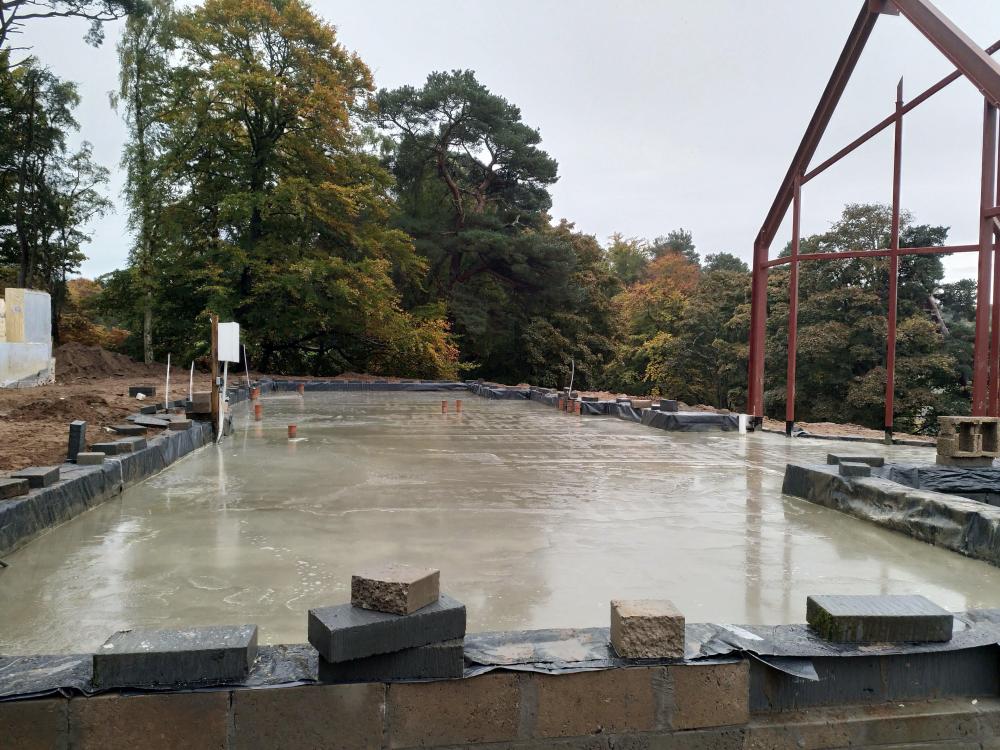
-
Also are there any graves?
-
The site we purchased the seller had taken about 6 years to get planning approved, due to special circumstances on our plot. They spent loads of money also. You could be in the same boat and still have to pay the seller a bunch of money at the end. Make an offer with the condition removed, even offer over the asking price if required and you want it badly enough.
-
How do you keep a half round fence posts straight…
JohnMo replied to Russdl's topic in Landscaping, Decking & Patios
Postcrete, set up everything as you need it before postcreting in. -
Any advice / thoughts re fence / guardrails
JohnMo replied to Modernista's topic in Garages & Workshops
Think you need a balustrade for that. Unless fenced off. As you have a fall greater than I think it's 400mm, it would need structural input for the design. You would not be allowed anything that includes horizontal bars, as kids can climb up and over. Or make it so no one can get on to the roof. Also notice you have a glazed area on the roof, if that hasn't been designed for foot traffic, you would be better excluding access. -
Jerry-rig an MVHR unit - how?
JohnMo replied to Dreadnaught's topic in Mechanical Ventilation with Heat Recovery (MVHR)
They don't even start MVHR units until you are painted - Passivhaus MVHR guidelines. You could easily mess up the heat exchanger and ducts for little or no gain. Get on with finishing the house, instead of jobs that shouldn't be done and certainly not started up until much later in the building process. -
I would say in your bike, but a little less politely. Find another plot, move onwards and upwards.
-
Air Source Heat Pump - general question
JohnMo replied to 0llie's topic in Air Source Heat Pumps (ASHP)
I suspect there are lots of really inefficient gas boilers out there. Not the boilers fault, oversized by the installer, running to hot, multiple zones, short cycling like no tomorrow. Just like lots of new heat pumps are going to be, but gas boiler poor quality install is hidden by the historical low price of gas and a customer base that doesn't know anything else. -
I was thinking of one these https://www.waterpump.co.uk/tallas-d-eboost-850-booster-pump
-
Drill out remaining bits. Then get your hands in there. Finish of with a hose pipe.
-
Just put an IBC on the drain pipe of our 60m2 garage. Heavy rain overnight filled it last week. So just collected another 2 and a bunch of connectors. Will look to wrap with a lean to sort of think made of pallets and then clad in wood. Just need to sort a pump out now, so I can pump through 200m of irrigation drip feed pipe which on the hill above the the IBC's.
-
Blending valve needed for UFH manifold with Ecodan pre plumbed set up?
JohnMo replied to jfb's topic in Other Heating Systems
Our UFH flow temp is around 27, not sure if huge rads would like that low a temperature. -
Air Source Heat Pump - general question
JohnMo replied to 0llie's topic in Air Source Heat Pumps (ASHP)
Confused, you have an ASHP sat on standby all year, why? -
How many (low-temperature) radiators are enough?
JohnMo replied to Garald's topic in Central Heating (Radiators)
Why? That's a 50% or more oversize for the coldest day. They are are rare, a few days a year. -
Air Source Heat Pump - general question
JohnMo replied to 0llie's topic in Air Source Heat Pumps (ASHP)
Some heat pump basics CoP is the coefficient of performance, basically how much energy you put in compared to how much energy you get out. The higher the temperature of the water the lower the CoP (not good). So low temperature water flow is good. For low water flow temps, you need big radiators or UFH. You also need an oversized hot water cylinder as you only heat it to about 48degs. The higher your home's heat demand, the more difficult it is to implement a high efficiency system. It can be done. Just be careful with sales men, you pay the bills when they've moved on and are nowhere to be found. -
How many (low-temperature) radiators are enough?
JohnMo replied to Garald's topic in Central Heating (Radiators)
It's an argument for a large system volume and low flow temps. Over calculation of heat demand is not good, as system has less room to modulate to lower setting. -
How many (low-temperature) radiators are enough?
JohnMo replied to Garald's topic in Central Heating (Radiators)
The more surface area you have of radiators the lower the temperature needs to be to get the same heat output. Also water volume is good for heat pumps. Other question is do you need to size the system for -10 degrees? -
Air Source Heat Pump - general question
JohnMo replied to 0llie's topic in Air Source Heat Pumps (ASHP)
Are you asking them for quote or are they making contact with you - cold calling? -
Air Source Heat Pump - general question
JohnMo replied to 0llie's topic in Air Source Heat Pumps (ASHP)
You can use a Combi in a small, medium or large house. You can get very good flow out of a combi if it big enough and you choose the right one. Performance varies quite a lot. -
How many (low-temperature) radiators are enough?
JohnMo replied to Garald's topic in Central Heating (Radiators)
I altered your wall U value, to 0.22 and it puts the heat loss at -10 degC at 1096W. Which sounds about right. Some perspective, my house 192m2 single storey, whole house heat loss is 3088W -
The other is measure the flow and return pipe temperature and adjust each loop to have the same temperature difference. But ABAs will be easier. UFH is generally slow to respond.



