


JohnMo
-
Posts
13296 -
Joined
-
Last visited
-
Days Won
200
Everything posted by JohnMo
-
If your UFH is being supplied via a thermal store, this will only have a header tank either built in or an insulated one above it. So your UFH is an open vented system, not a pressurised system. That is pretty much how ours is, and the UFH gauges register 0.2 bar pressure. Your gauges are showing how much pressure the pump is having to develop to pump water around. As the heating demand is switched off the drop is just pressure depleting to show the system head from thermal store header tank. 10m of head is 1 bar pressure on the gauge. If your UFH is taking it's feed from the thermal store, your pumps may need to be turned down. Keep reducing its speed until you see a change on the flow gauges, then take up to next speed.
-

Flow rates for Carpet, Wood ,Concrete and Tiles
JohnMo replied to Ben 64's topic in Underfloor Heating
I've played with many options. My system is heat pump ready, but on a gas boiler. Started last year with every room as a zone, a buffer that wasn't correctly plumbed, lots of short cycling. Slowly refined it, testing gas usage, flow temperature and comparing against a heat meter. Have tried batch heating, at high flow temps, fixed medium flow temp controlling heating on thermostats, and weather compensation. Some finding If you have some zones on and others off, in my house the flow temp is generally 2 degrees hotter, for the same overall house temp. I have run the buffer on a thermostat and the UFH on a fixed flow temp, gas to heat efficiency 95%. Also found that cheaper Reliance mixer isn't as good as an Ivar one. The benefit of the Ivar is the ability to adjust internal recycling proportion, so fine tuning is better. Basically now set up on full weather compensation, through Ivar mixer. All room thermostats moved to about 21 degrees (out of the way). Set flow temp to give main room 19 degrees and bedrooms 17/18 (Adjusted flow rate). Compensation curve varies between 25 at 10 degrees outside to 32 degs at -9 deg outside. Gas to heat efficiency now running at 102%. Have now added a nighttime setback of 2 degs for 7 hours to see how that goes. Currently I do not need the thermostats, they are just there to save decorating. -
Octopus Cosy - new tariff for ASHP owners
JohnMo replied to George's topic in Air Source Heat Pumps (ASHP)
Plus you have an anode to replace 😥 -
Octopus Cosy - new tariff for ASHP owners
JohnMo replied to George's topic in Air Source Heat Pumps (ASHP)
Think you may be disappointed looked at the user manual and it says with 5kW the reheat time is over 3hrs. Which may be down to the small surface area of the coil.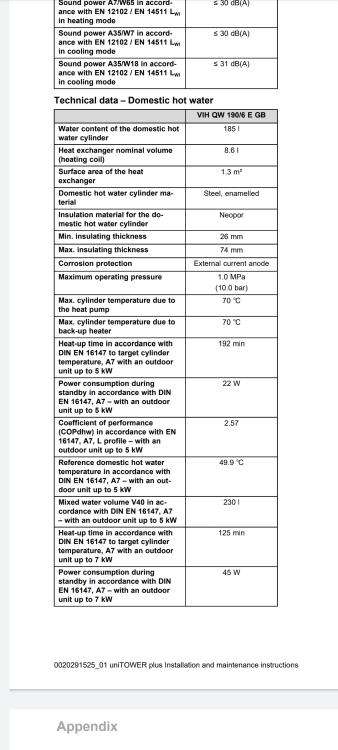
-
Octopus Cosy - new tariff for ASHP owners
JohnMo replied to George's topic in Air Source Heat Pumps (ASHP)
If your heat pump modulates down to 2.5kW and your system volume that remains always open to the heat pump is above 45L then you will have a run time over 10 mins with a load of only 0.5kW. so you are not short cycling. -
Flow rates for Carpet, Wood ,Concrete and Tiles
JohnMo replied to Ben 64's topic in Underfloor Heating
The simple maths For a given external and internal temperature, the heat input will match the heat losses. With a heat pump the lower the flow temp the better the CoP. I have a full set Midea performance data so will use that. For a 5 deg day So let's do 7 hours at 45 degs, so about 5.51kW X 7 = 38.6kWh of heat into the house, CoP of 3.27, so an electrical input of 11.8kWh. Spreading the heat over 24 instead of 7. 38.6/24=1.6kWh However the minimum output of the heat pump is 1.988kW. So run time would be 19.4 hrs. (38.6/1.988) instead of 24. Flow temp is now 30, CoP is now 5.23 and electrical input 380W. 19.4 hrs X 380W = 7.38kWh So 38% less electrical use for the same heat. So no it won't cost you more money. That's why they make a big thing about weather compensation. -
Octopus Cosy - new tariff for ASHP owners
JohnMo replied to George's topic in Air Source Heat Pumps (ASHP)
If it's running for 3 hours that's not short cycling. If it runs for less than 10 mins then possibly yes. -
Octopus Cosy - new tariff for ASHP owners
JohnMo replied to George's topic in Air Source Heat Pumps (ASHP)
But are pushing themselves as an installer - makes you wonder. Sounds like your heat pump is either too big, you need a buffer or bigger one, or you have the system flow constrained with too many zones closing down. -
Flow rates for Carpet, Wood ,Concrete and Tiles
JohnMo replied to Ben 64's topic in Underfloor Heating
The lower the flow rate, the higher the delta T and least amount of heat from the floor. So you end with high flow temps. I have Salus self regulating actuators on three of my loops with flow temp below 30 the DT is 4 and over 30 its 7. These loops are basically 100m and the flow rates are 2.5l/min. The other 4 loops are just adjusted to give the temp in the the other rooms that I want. So bedrooms are cooler, ensuite is warmer. As said 45 flow temp is hot, 1.5 l/min is low, unless you loops are short. Lower the temp considerably and up the flow rates and run for longer. This help CoP. -
Am I working this out correctly? Battery £4,826, plus install cost uplift £963 . You have 1 cycle per day if overnight charging. Warranty on battery is 10 years, but lets assume the battery is good for 20 years. 365*20 = 7300 cycles. (4826+963)/7300 = £0.79, per cycle cost for battery/install. Battery capacity can be fully drawn down, so 9.5kWh. Normal cost £0.34/kWh, so £3.34 per day at normal cost electric. Octopus Go night rate is £0.12/kWh, so 9.5kWh, so £1.14 per day at normal cost electric. Additional standing charge on split rate tariff - Octopus 0.4952, compared to a normal £0.44302, so 5p. Cost to have battery = Cost per cycle, plus standing charge = £0.79 + £0.05 = £0.84. Saving on energy cost = Normal cost of 9.5kWh - Cost to charge battery - cost to have battery = 3.34-1.14-0.84 = £1.36 per day saving or about £500/year. Without solar input and about a 11-12 year pay back. Is there a risk the battery just cancels out the benefit of the solar or visa versa? Your day time usage could be circa 10kWh, provided by the battery and in the summer by the PV, but you may need to charge the battery every day to ensure you get full benefits. Am I missing something?
-
Should I go with an MVHR?
JohnMo replied to anonymous's topic in Mechanical Ventilation with Heat Recovery (MVHR)
I'll throw this in to the mix, as MVHR (although I have it) isn't the be all, and end all solution, for everything. Atamate_SDAR+Paper+2019+(1).pdf -
My architect suggest this for a family home, thought
JohnMo replied to Tennentslager's topic in New House & Self Build Design
Sorry but looks ugly -
Non thermostatic/ bypass radiator not working
JohnMo replied to Nat16's topic in Central Heating (Radiators)
Have you tried bleeding? -
Home grown Douglas Fir exterior cladding
JohnMo replied to davidc's topic in General Construction Issues
Doesn't need pressurised treatment, but does need to be oiled to keep its colour -
Home grown Douglas Fir exterior cladding
JohnMo replied to davidc's topic in General Construction Issues
There's a mill at Nairn, that only does Douglas fir and Scottish larch. They may be able to help. I got larch in 4.8m lengths, so they can process good lengths. -
You've used your 50 pa ach as your infiltration rate, but it's all not. It should about a 1/4 of that. You are basically adding heat loss. I would be careful with your form factor, i.e. you seem to have a big wall/roof area compared to floor area. So the likelihood of meeting passivhaus specs becomes more difficult. As said the spreadsheet as is pretty much spot on. At -9 the daily heat losses is only a couple of kWh out.
-
Boiler Upgrade Scheme (BUS) - How to apply
JohnMo replied to thefoxesmaltings's topic in Air Source Heat Pumps (ASHP)
You are not included in the money loop. Your invoice just includes a credit against the total I believe, or the amount quoted to you is £xxxx, less £5k -
Slate Size - 500x250 or 600x300
JohnMo replied to Internet Know How's topic in Roofing, Tiling & Slating
I really would speak to the person responsible for installing, there are various things to consider I believe, roof angle, wind and snow loading etc all make a difference. -
Boiler Upgrade Scheme (BUS) - How to apply
JohnMo replied to thefoxesmaltings's topic in Air Source Heat Pumps (ASHP)
Looks like you should try a different supplier. That supplier would just charge you an extra £5k if your application was unsuccessful or the number of vouchers this year has been consumed. -
If it says 0 volt it normally means 0 volt. You may fry something otherwise. If you need 240v can you take a 240v jumper of the pump contacts, if the pump is running you have a call for heat.
-
That's how I did my battens, there is also one horizontally along the bottom, the OSB at the top, is running cables and fixing to.

- 1 reply
-
- 1
-

-
Mount the unit on a robust wall, if its to be mounted on timber frame wall (like one our units), we double skinned in 18mm ply and hung the unit directly to that. We also used Rockwool flexi in the internal stud walls for sound deadening, studs are 100mm, insulation is something like 60mm, so it doesn't touch the plasterboard. Ours is sited in a cupboard, between two bedrooms and is well oversized for it duty, so fan speed is as low as practical. You can hear nothing even in the middle of the night.
-
Why mess with it?
-
New member - stuck for what to do next to warm the house
JohnMo replied to Sparrowhawk's topic in Introduce Yourself
Just looked at my SAP report and for a house with a 7 ACH @50pa, the actual infiltration rate is 0.4217. So I would lower the ACH down to 0.5, instead of 1.5. that should lower your losses quite a bit. At the moment your lounge heat loss is 25% higher than my whole house, so doesn't look right. -
I should have qualified my statement, but the point was the 300L buffer is huge. And depending if direct or indirect heating could be part part of the issue.



