


JohnMo
-
Posts
13296 -
Joined
-
Last visited
-
Days Won
200
Everything posted by JohnMo
-

Avoid this if you still have to design your UFH
JohnMo replied to Adsibob's topic in Underfloor Heating
Pump to supply enough flow to the UFH system to overcome the loop resistance in the highest resistance loop. Flow meters to set flow rate through the loop, to give an appropriate rate heat transfer to floor. Can also be used to balance temperature distribution through different rooms with different heat demands, by altering DT. Mixer, work with the above, set the temp through the loop, to give an appropriate rate heat transfer to floor. -
Grant do a LLH, volumiser with integrated immersion, could be made to fit any heat pump. Looks really compact. https://www.grantuk.com/about/news/heat-pump-and-low-loss-header-are-a-winning-combination/ They also do an external mounted volumiser. Both could be made to fit other heat pumps grant-combined-volumiser-low-loss-header-installer-uk-doc-0184-rev-1-0-november-2022 (1).pdf grant-external-volumiser-installer-uk-doc-0183-rev-1-0-november-2022.pdf
-
Do a Google search and search on here, many opinions. Think I read a fairy rounded report on heat geek. Looked at all the sources and different storage temperature.
-
ASHP / Underfloor heating issue
JohnMo replied to Benpointer's topic in Air Source Heat Pumps (ASHP)
Is you circulation pump ok? -
A combi without the DHW bit connected becomes a system boiler. Is DHW fed from the cylinder or Combi, the cylinder could be a buffer? Some photos may help
-
Only thing come into my head after reading lots of threads. Above 16A so 3.6 kWp you move from G98 (tell DNO after install), to G99 ask DNO for permission before connection. Depend on where the batteries are in the system DC part or AC after you PV inverter, this either increases or doesn't change the kW you could export. Export potential is the measurement the DNO are interested in, not that you do or don't want to export.
-
I used this one also, have to say it is very good. On 10 degree days, it does say you need more heat that you actually do, but doesn't account for people or solar gain. However the last 24 hrs, with an average temp at about -6 and no solar gain, almost to the kWh over 24 hrs correct. Can't ask for better than that.
-
I would switch off the stop cock, but leave heating on low, say 17 or 18. Drain down the cold drinking water pipes, wouldn't hurt.
-
Nothing wrong with that, but they don't preach to bin all the thermostats, they do say to set your thermostats above your target temperature as limit stops though. Not really sure that's hardcore. They do say to limit the amount of zones you have, for a heat pump that keeps a large capacity of water available for the flow rates a heat pump needs and helps stop short cycling when heat demand is low. Limiting zone and using thermostats or Trvs at above the target temp are both things are exactly what what my Atag boiler manual says if running WC.
-
Avoid this if you still have to design your UFH
JohnMo replied to Adsibob's topic in Underfloor Heating
I would leave pump speed alone, just adjust one variable at a time. More flow is more heat, less flow less heat. Interesting that your reading room has no flow, or very little in the photo? -
Trouble with small you can't put the kettle on. We got one of these for £800 (now £1000) P1PE 7.9kW / 9.8kVA* Recoil and Electric Start Site Petrol Generator (Powered by Hyundai). One these to switch mains over to generator £38. https://www.amazon.co.uk/gp/r.html?C=2X8R0PK3LTH9J&K=34MIE1U6GOBVK&M=urn:rtn:msg:20220215092805432dc27e9784454aaa817bf54550p0eu&R=3L1EKYM8H7V8M&T=C&U=https%3A%2F%2Fwww.amazon.co.uk%2Fdp%2FB079Y3PJN8%2Fref%3Dpe_27063361_487055811_TE_3p_dp_1&H=F0W7TJ2VHJTNC41TRU0YCSGUQ4SA&ref_=pe_27063361_487055811_TE_3p_dp_1 You would just need an LPG conversation kit.
-
I have a combi, and tried running DHW at 55 degrees, routinely used 8kWh of gas on DHW alone, no CH on at that point. That was with some water preheat upstream of the boiler. Long story short, I ended up setting the DHW to 65, then routinely used 6kWh, so actually saved money. Not sure if that's because the boiler has flue gas heat recovery and upstream preheat also. Central heating, I am charging a buffer to 32 degs, flow temp max is set to 50, but generally doesn't go past 45 flow temp, with a return mid to low 30. Have energy meter just prior to the UFH heating. Monitoring the energy use, both gas and at the energy meter, shows an efficiency of converting gas to heat of 95%.
-
Go on to heat geek website read up on weather compensation, zones and system balancing. Spending a hour of your time, read and watch the videos. Get some basics understanding and then most of your questions will answer themselves.
-
ICF build, except the top of wall behind the cylinder which is timber frame. Walls 0.14 Floor 0.09 Roof 0.11 Windows 0.6 to 1.1.
-
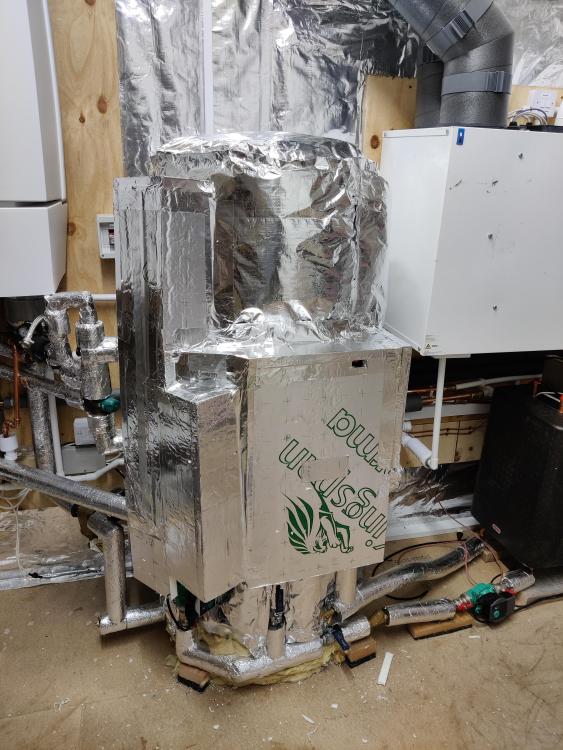
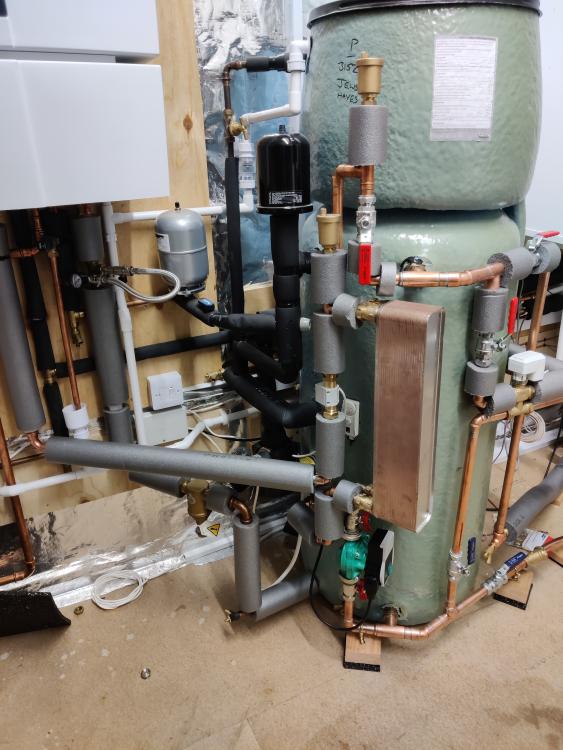
I am actually using a combi thermal store, mainly because I got it new very cheap. It is indirect with a coil inside. The coil is way too small for low flow temps (designed 80 deg flow temp), so have added a large 40 plate PHE and pump. In the summer it is charged by excess PV and goes a long way to reducing DHW gas usage. Photo prior to and after insulation
-
Will do low 20's Only goes down to 6.7kW at low flow temps, 6kW at high flow temps. Hence the need for a buffer. But DHW performance is why a bought it, 95.1% efficiency with flue gas heat recovery built in, 18.8l/min flow rate, using the buffer with a preheat coil in it. Will run two showers with ease and third if you are careful with temperature setting. It's not peak load that kills you with CH, it is low load short cycling. Have reduced last years gas consumption, by a considerable amount. Using big buffer is key. October 800kWh reduction (561kWh this year, 1370kWh last) November 600kWh reduction (1138kWh this year, 1753kWh last year) December looking to save over 1200kWh
-
I have a Atag A325ECX, super quite
-
Assume your heat load is at lowest temperature. So it will also need to 0.5kW when it's about 10 degrees. So basically you need a buffer. A decent combi of your choice with a good sized buffer. My heat demand is just over 3kW, boiler lowest modulation at low temp is 6.7kW. Have 180l buffer, with a thermostat set at 34 deg. UFH just draws it water from the buffer and pumps around UFH at 30. Currently getting 94% efficiency from the system - Gas in to heat water to heat taken from UFH via a heat meter.
-
Ice forming on intake
JohnMo replied to LA3222's topic in Mechanical Ventilation with Heat Recovery (MVHR)
Do you still have the fine mesh behind the coarse mesh? -
On the Ivar mixer, the part that connects to the hot part of the manifold has an integral isolation ball valve, have you checked this is fully open? Needs an Allen key to move I think.
-
Is there any hydraulic sepereration between the pumps? The buffer would normally be the hydraulic sepereration, the manifold pumps pulling/pushing from the buffer. The one in the middle of the buffer and UFH pump may be the issue It could be you have too many pumps. Can you switch of the buffer pump and see what happens?
-
Questions Are you running this on a single pump between the buffer and both manifold mixers, or do you 3 pumps, one on each of the manifolds and another at the exit of the buffer?
-
Fabdec Stainless Steel Cylinders
JohnMo replied to MortarThePoint's topic in Boilers & Hot Water Tanks
I may be wrong, but the coil sizes in the brochure look small for a heat pump? Could be a custom build heat pump cylinder with a larger coil, hence the slightly higher over all capacity of the cylinder? -
Couple of things Bigger DT means lower mean temperature, which means lower output. Mixer like the flow temp 10-15 hotter upstream than downstream of the mixer. Boiler condensing is a function of return temp not flow temp, if your return temp is below 53 deg your are condensing. You say it worked, then you changed stuff, put it back the way it was. If it reaches temp, all good. Then change things one at a time. If you reduce flow temp, to get the same heat out the floor you DT needs to reduce. If you decrease boiler flow your mixer may need adjusted to keep.the same floor flow temp.




