


JohnMo
-
Posts
13296 -
Joined
-
Last visited
-
Days Won
200
Everything posted by JohnMo
-
Screwfix do a liquid PTFE, quite easy to use and seem so far to water tight joints
-

Thermal bridge of vertical metalwork
JohnMo replied to MattMiller's topic in House Extensions & Conservatories
Same as @Conor -
If you divide 1/R you get the U value. U value is W/m2.k. You can then calculate how much heat transfer occurs. k is just the difference between the two temps, upstairs and down. So say 20-8=12. M2 is the ceiling area. 1/8= 0.125. Let's say 50m2 And 12 degrees W = U.m2.k = So about 75W or 1.8kWh per day will be lost to the cold space. Your insulation value better than most homes.
-
Thermal bridge of vertical metalwork
JohnMo replied to MattMiller's topic in House Extensions & Conservatories
That's pretty much how our windows where done on our steel frame. The internal surfaces of the steel had 10mm aerogel and PIR basically because the steels go down to the foundations and it stops the ground temp being transferred to the room. -
ICF Foundation Details - Thresholds
JohnMo replied to Jenki's topic in Insulated Concrete Formwork (ICF)
If you use PIR with aluminium layer, the membrane keeps the cement in the screed from a chemical reaction with the aluminium, which forms hydrogen and leaves bubbles in the screed. -
Around us new houses are more expensive than older housing stock, even on the same site. People want new, prepared to pay extra, even if it's smaller, they think there's no decorating etc, heating costs are low etc. even if the house has an EPC B or C rated. Decorating hopes soon fade when 12 months later the house is full of cracks.
-
Smart stuff, great until...
-
Another question does your UFH manifold have a mixer as well as a pump?
-
For me a unit that doesn't connect to a remote anything is best. It then becomes a pain to make adjustments, so you don't f**k about with it or its settings - as it should be install, commission, run, replace filters, run. Once installed and setup, except replacing filter and a general clean, there should be no need to touch it. Mine even just dumb switches for boost, press once, job done, boost is on for 20 mins.
-
Working correctly
JohnMo replied to Pocster's topic in Mechanical Ventilation with Heat Recovery (MVHR)
If the system isn't balanced, perhaps it just needs balancing? Any photos of the nozzle assembly, also the manifold? -
So how many kW is 46 panel?
-
There should really be little or no noise, when you go to your pump is it almost silent. If you get any random noise at the pump you have air in the system with will need to be removed.
-
There is talk of energy prices dropping below current levels in July. Not sure if that alters your calcs?
-
The install manual does contradict it's self all over the place. Stating you do and don't need insulation. You need to be careful with such statements as "Due to the thermal characteristics of a solid sub-floor downward heat loss is limited to between 6% and 10% of the total heat output, which represents a small percentage of the annual heating costs for the property." So does these actually mean, you are already loads of energy in to your floor, what does an extra 6 to 10% matter? Interesting in the solid floor part, it states "which include being able to run the heating approximately 1˚C lower than with traditional radiators and low flow temperatures that mean condensing boilers operate more efficiently". So you can run the UFH at 69 degC? Interesting my UFH at -2 the other week ran at 30 degC, 40 degC lower than traditional radiators! That does make the boiler run efficiently. Do you own maths. Make sure you are comfortable with your choice. So if you happy to increase your energy consumption from heating by 10% over the cost of radiators, fill you very warm boots, because your floor could be very warm.
-
Working correctly
JohnMo replied to Pocster's topic in Mechanical Ventilation with Heat Recovery (MVHR)
I can't feel anything at my extract points but if I put a sheet of toilet roll at the terminal the air flow holds it there. When did you last check the filters? Do you have filters in the extract terminals, if so you should be changing 6 to 12 monthly. -
UVC in basement plant room but no drainage for overflow
JohnMo replied to Thorfun's topic in Boilers & Hot Water Tanks
Watching a video on RED heat pumps and they mentioned their cylinder - Not a UVC http://www.red-limited.com/dhw-tank-info/ May not help yourself, but could help others looking -
Hope your ready for sweating in summer, there will be quite a bit of solar gain and heat loss in the winter Try - Roof Maker.
-
Not sure how they have worked out the R value (0.8) either, as at 6mm thickness that the equivalent to a vacuum insulation, which it isn't.
-
Heat demand too low for Vaillant Heat pump?
JohnMo replied to Ewan's topic in Air Source Heat Pumps (ASHP)
The 2 and 3 ports are using an oversized Tee, to act as hydraulic separation. Was operating mine (2 port) with a thermostat, the thermostat calling the boiler to heat. Boiler temp would go up into 40s flow temp, even though the buffer thermostat was set for 34 deg. Rewired things so boiler just ran straight WC and buffer acted by floating at what temp it wanted. Typical flow from boiler dropped to low 30s max. Average heating efficiency with an allowance of 5kWh for DHW went from 94% to 110%. Mostly due to the much lower firing temps and better condensing of the boiler. So same would be true for a heat pump. -
ICF Foundation Details - Thresholds
JohnMo replied to Jenki's topic in Insulated Concrete Formwork (ICF)
I have 5 opening in total. One is covered in heavy duty tiles, one in oak floor boards, the other three are self leveling compound and carpet. -
Heat demand too low for Vaillant Heat pump?
JohnMo replied to Ewan's topic in Air Source Heat Pumps (ASHP)
There Is also a difference in efficiency when the buffer is controlled by a thermostat and when not. So you could document that difference as well? -
ICF Foundation Details - Thresholds
JohnMo replied to Jenki's topic in Insulated Concrete Formwork (ICF)
This is pretty much how I ended up with mine. The pink block being replaced with 2x thermolite blocks, I also did the upstand in 70mm PIR. So the sidewards u value across the threshold, ends up in the region of 0.2.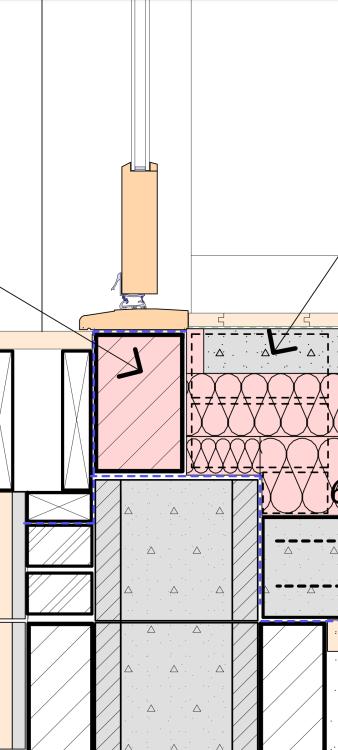
-
Heat demand too low for Vaillant Heat pump?
JohnMo replied to Ewan's topic in Air Source Heat Pumps (ASHP)
The report says, they used as low a HP temp as possible to get a steady 20 deg in the thermal store. To prevent over supply of heat and reduced performance etc. So in all cases the pump would be running, test 1 cycles off for less than an hour over the 6 or hours of the test so the pump would be running for the majority of the time anyway. -
Heat demand too low for Vaillant Heat pump?
JohnMo replied to Ewan's topic in Air Source Heat Pumps (ASHP)
As @JamesPa says mixing. A 4 port buffer will have little or no temperature difference between top and bottom so you get a different temperature profile compared to no buffer, as seen in the test. I run my 180L buffer as a two port, so only excess flow goes into the buffer, this can still lead to a 4 or 5 degree temp spike for 10 mins or so (gas boiler). I get a bit of a sine wave +/- a few degrees either side of the weather comp set point. -
It depends on how you operate the system, if all the other loops have thermostat, the thermostat will call for heat. The actuator will open the loop at the manifold and if the pump and boiler aren't on, start them up. Another alternative is a single thermostat can control one loop or multiple loops, depending on how the actuators are wired up in the wiring centre. As I see it, you would have one loop in each room, as you only have two ports free on your manifold. Each could have its own thermostat. An alternative control, is you leave a loop on a manual valve and always open, then when anywhere else calls for heat, that loop is always heated. No call for heat elsewhere, this loop is off also. Lots of differing ways, depending on what you want. I just have a single thermostat for the whole house, that starts the pump, all loops are always open, as I run on weather compensation.



