


JohnMo
-
Posts
12467 -
Joined
-
Last visited
-
Days Won
179
Everything posted by JohnMo
-

Internal doors - standard sizes v making bespoke
JohnMo replied to Tom's topic in Doors & Door Frames
We have all vaulted ceiling and used pre made standard size doors. They don't look odd or small. You may be other thinking. A previous house we renovated needed new doors and every one was a different width and height, cost a small fortune to replace, as each was made to order. -
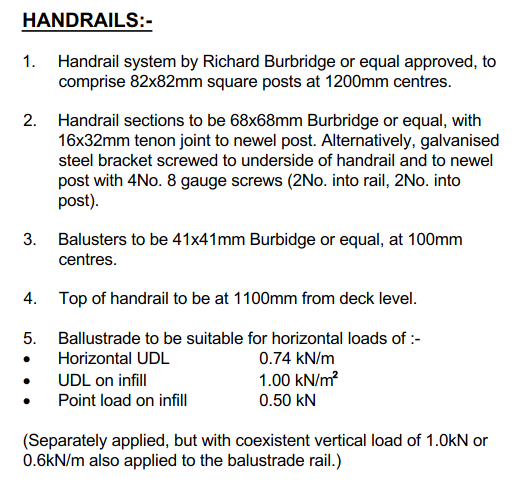
A bit of a brain dump The structural design of our decking, (part of my structural design certificate) with a big fall in some areas (7m drop), has 4x M16 bolts/stubs at 8.8 strength rating at each metal to wood interface. All wood is C24 with external preservative treatment. External framing is 220x45 all doubled up. All joists are on hangers. Long joists are 220x45 C24 and the shorter ones 170x45 C24. Balastrade design ratings depend on how far you can fall. But is all rated at 0.75 (forget the units) on ours.
-
My parge coat was a strong mix of soft building sand, cement and lime to give some flex. Water down to a double cream consistency the use a broom to apply to walls. An even think coat rubbed into the surface.
-
Pretty easy, just takes a while, when you're finished, your up to speed. You need some to cut with, I used a 115mm angle grinder and a smallish mitre saw both with diamond cutters. A trowel, and slotted trowel like you use for tiling. My windows were flush to the outer surface, so had no reveals,to speak of. I used a diamond cutter in a 115mm angle grinder and mitre saw, to give a nice clean cut on the stone to form a return.
-
Our balastrade designed for similar fall to your balcony, the structural engineer said I had to comply with this.
-
So your opening sentence is not correct, you are not replacing the cylinder, only a flange. From the image of the cylinder it looks like an internally coated cylinder, if it is would normally have an anode to protect the cylinder from corrosion. These are replaced annually or every two years depending on material. In the long term I would be replacing with stainless or copper cylinder. If the flange is corroded I would be looking closely everywhere.
-
Beginner insulation questions - Getting jobs done in the right order
JohnMo replied to Gill's topic in Heat Insulation
Windows depends on whether double or single glazed. Windows generally are quite small area, so may not be that high on the list of priorities. Concentrate your efforts on insulation first its way cheaper bag for your buck. Also important is elimination of drafts. Floor as suggested mineral wool between joists and sheet material under. 25mm sheet is easy to handle can be screwed to the joists with screws and penny washers. Between joists something like Rockwool Flexi will stay in place quite well while you sheet out. There's nothing wrong with storage heaters, as you reduce the heating demand, the storage heater start to perform better as they have to do less work. Loft get about 350mm in there, but don't close of vents at top and bottom of roof. -
Grundfos UPS2 speed selector not working
JohnMo replied to DannyG's topic in Central Heating (Radiators)
Have you tried bleeding the rads? Start with the basics. If they were ok last year why would you need to bump up the speed. -
Horses for courses. EWI if you are not doing a full internal refurbishment, would be less problematic to the owner. EWI would give you more stable internal temperatures as the internal blockwork would act a a buffer when heating and if you have solar gain. But a disadvantage is getting airtight. You may have to mess with door steps, window sills, facia and soffit s as they may look odd otherwise. IWI, better chance of making things airtight, if your ripping the house apart could be easier to install. Any buffering for solar gain or during heating season will be lost. You convert a thermally heavy building into a thermally light building. No messing with the outside of the building required. Many other advantages and disadvantages of both I suspect.
-
I'll say sorry now. Couldn't be bothered ready the 500 odd posts. All I can say is f*** me this thread started in June, slow progress, more time working, less time on forums, you may have it finished for Christmas. Otherwise you may miss next summer at this rate.
-
Go with as good an energy rating as you get your hands on. Also look at grease filter performance and noise. Availability could be the issue.
-
Where have defined your airtightness layer as? I would suspect it's not there. Where does the butt joint to wall land in relation to the insulation within the wall? You will need to bridge the gap between the wall and roof insulation with insulation between the joists (mineral wool for example).
-
That's interesting, may need to get bum in gear and get it treated
-
Confused, you say you have to replace the cylinder, but seem concerned where to get an immersion for the old cylinder. Wouldn't you buy a new cylinder, it either come with immersion or doesn't, if it doesn't you ask for one to be supplied with new cylinder.
-
Room 3.5m2, why would you bother with UFH, seems a complete waste of time. Just stick a small radiator or panel heater in there. Is a room that size even usable - its a cupboard.
-
I wouldn't be concentrating on make of heat pump that much, I would concentrate on the design of the system the heat pump feeds. That's the bit you need to get right, as any heat pump connected to rubbish system, will perform badly.
-
The wood is Scottish larch. Colour is natural, at the moment its untreated. The front of the house looks almost the same and its treated with cedar oil. The rear gable are faces North east so doesn't get the sun, so low on the priority list to coat.
-
Tracking heating usage with Heatmiser devices
JohnMo replied to jayc89's topic in Underfloor Heating
If you have a heat zone in each room, I would really consider looking at energy usage, with all these zones active for a week and then with all the zones per floor, operating from a single stat. Would suspect you are short cycling your boiler/heat pump and using more gas/electric than you should be. I found by monitoring my gas usage almost daily last year, how badly my heating system was performing and was able to reduce gas usage, by almost 50% by making thermostats inoperative. With further changes made during the summer I am hoping to reduce energy usage by another 20+%. If your demand frequency is more than once per heating period, your flow temp or flow rate in that zone is set correctly. Spend your time setting up your system by balancing the room flows at the UFH manifold and at the radiators. -
Our last house I moved all the radiators from below windows and external walls. Seemed to work well. Our house an 1830s house mostly single glazed, thick curtains full hieght, solid sand stone walls.
-
UFH and poor insulation are a match made NOT made in heaven (expect big heating bills). An alternative could be plinth heaters, design them to operate at the same temperature as the UFH would have, or radiators. For the suspended floor, you may find installing PIR a real pain. The gaps between joists may not be consistent and vary along the length, so getting a gap free install is not easy. You may be better using something like Rockwool Flexi or similar.
-
Welcome, plenty of common sense information freely available here.
-
Air Source Heat Pump - general question
JohnMo replied to 0llie's topic in Air Source Heat Pumps (ASHP)
I think you have to use an oil that is hydroscopic to the refrigerant gas. I know in industrial screw compressor that is the case. It's matter of clearing enough condensate to restore lubricity, you don't have to clear all of it. And also enough condensate so the fluid can makes its way through the compressor without undue load being placed on thrust bearings. As the the compressor increases pressure the refrigerant naturally phase changes back to gas. You often get operators that think they know better, and over ride the heat up timers, this does two things, accelerates bearing wear and places huge loads on thrust bearings, which gives premature failure. -
Air Source Heat Pump - general question
JohnMo replied to 0llie's topic in Air Source Heat Pumps (ASHP)
The mitsubishi ASHP with higher than ideal standby electric usage are inverter driven, so I am still missing what you are trying to say. They have a crankcase heater and a requirement to heat up prior to starting. It's easy to dump air and water not so easy to dump refrigerant. Hense the need to heat the crankcase and turn the liquid refrigerant back to a gas state. An inverter doesn't get around the science that a liquid isn't compressible. Nor that lube oil diluted with refrigerant is a rubbish lubricant. -
Critique please! New Build Floorplans
JohnMo replied to hinge and bracket's topic in New House & Self Build Design
We had a water diviner, with great results, not did he find where to site our borehole he identified depth and all the underground streams feeding it. So may be worth finding one near you he may be able to sort out where your water is. -
There are some decent options like incinerator loos you can get
