
JohnMo
-
Posts
12469 -
Joined
-
Last visited
-
Days Won
179
Everything posted by JohnMo
-
Didn't look at that, just looked, floor and roof are fine. Double glazing is at the very poor end of acceptable, you should be aiming at 1.4 for double glazed (whole window not just the glass). Doors 1.0 to 1.4, walls should be aiming to half the current heat loss.
-
Do you need dedicated hall loops, you have loads of pipe passing through the hall, spread those across the hall floor area. Could you combine loops 4 and 5? Are you operating as one zone or loads of zones?
-
Why is it a no go? All our pipes are under the floor insulation, each toilet, shower, and sink has its own pipe into the underground pipes, any cold air trapped by a water trap. One pipe internally goes up vertical for an air admittance valve, very well insulated with rockwool. External vent at back of house in black same as the gutter drain pipes. Job sorted
-

Shared septic tank on land of house we want to purchase. Any advice?
JohnMo replied to flanagaj's topic in Waste & Sewerage
Aren't septic tanks illegal now? Thought you had to have a treatment plant, or is that just a Scottish thing? -
Change of temperature, sewage giving of gases, changes in air volume within the piping (you flush the loo etc), etc. It's not designed to be a pressurised system, it's designed to be open vented. Hence a need for a two way open vent external to the house.
-
Would think because air admittance valves only let air in not out. Otherwise your house would stink. If you only breath inwards a pressure build-up occurs, hence need for an external open air vent.
-
Optimisers don't work with all hybrid inverters if you go that route check. You only really need optimises where you are likely to get shade.
-
Would also add to your list, the solar/inverter needs to work in a power cut. Most will not, or will give a a small dedicated output for say a lighting circuit.
-
I would keep it simple, one outdoor unit for the room xyz, the other outdoor unit for the balance of the house. You could split bedrooms and house, then run the different units at different times etc.
-
Not seeing a damp proof membrane either, is that going on the concrete floor before the insulation? Or is that the finished floor height?
-
Nope, I do it all the time also.
-
Loxone switch vs alternatives
JohnMo replied to BartW's topic in Networks, AV, Security & Automation
Have triple version to operate 3 light circuits and a remote to operate 6 blinds - no need to go to the light switch. A double version operates our lounge main lights and side lights - all very simple, easy to replace, who cares if MK stops trading, plenty of replacements freely available always will be. If Loxone stops trading or supporting your multiple thousand investment goes with it. -
Have you reviewed the level of the DPC compared to the outside ground level. You really need the DPC 150mm above the outside ground level. The second to last photo looks to have gravel way above the floor level. Do you have any insulation in the building?
-
Block and Block with 180mm cavity instead of Isotex ICF
JohnMo replied to Chanmenie's topic in Brick & Block
Why would they be soaked, they are inside. If they are wet you have bigger issues. Why a SAP fail? -
Not really correct - if you have an airtightness better than 3, building regs in Scotland (maybe England also) demand you have balanced mechanical inlet and extract ventilation system. So you have little or no choice in the decision.
-
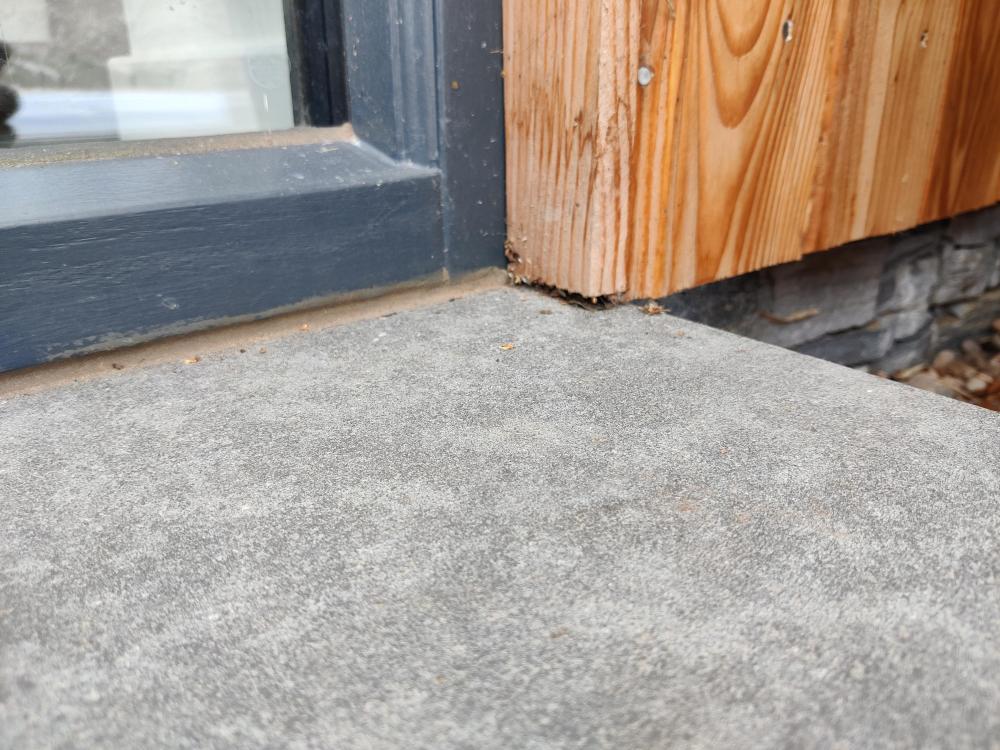
We have a roof overhang over that area, so that keep nearly all the water away from the door step area. But the big slab in front of the door slopes away from the house. It is also sat on concrete blocks and is basically a hollow area below, which very much self draining. The slab at the door, it just butts up to the window - have run a bead of silicone along the gap.
-
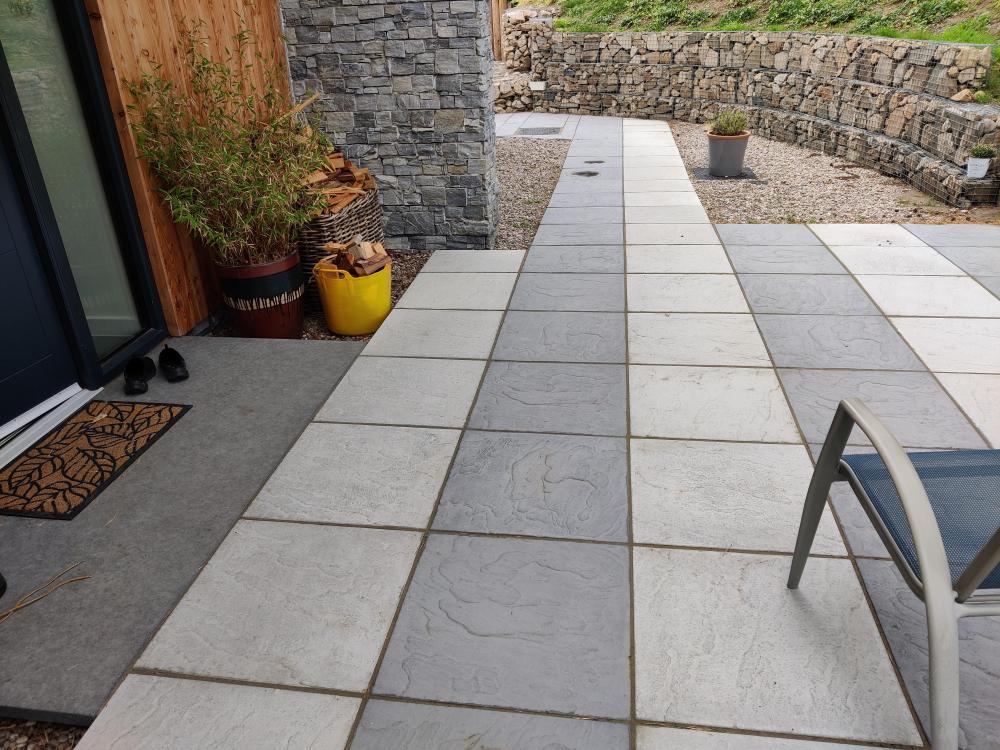
Ours is similar, basically slightly sloping away from door and then carries on downwards to our parking area. Slabs laid on wet sand cement mix.
-
Block and Block with 180mm cavity instead of Isotex ICF
JohnMo replied to Chanmenie's topic in Brick & Block
Why don't they stop it? Thermolite thermal conductivity is 0.14 and they are 215mm high while Marmox is 0.05W/mK, but 65mm high. So resulting U valve is lower for the Thermolite block - 0.65 compared to 0.77 for the downward direction. I think sideways they are similar, but any insulation in the cavity will stop sideways anyway. -
The point of MVHR is in an airtight house you need ventilation. When it's cold your windows are shut, you have ventilation your house doesn't turn green inside. When it's hot outside your house stays cooler for longer than it would otherwise. Windows open means hot air comes inside. You recover the heat otherwise lost through ventilation. So heating costs are lower. If you don't want MVHR build a leaky house to min building regs, pay for big heating bills for ever.
-
Block and Block with 180mm cavity instead of Isotex ICF
JohnMo replied to Chanmenie's topic in Brick & Block
Just reading this thread. Mine is similar to the image also. I filled my cavity with PIR. The area circled and blocks directly below, I used Thermolite blocks and doing the calculations (sideways and downwards) I found there was less of a cold bridge when I compared to Marmox. I also used Thermolite at the thresholds for the same reason. -
There is a lot I like about humidity controlled MEV system. One fan on extract only, but only when required in the area required. Humidity controlled inlets and extract points, fan speed increasing only when required. Way cheaper to install and run when compared to MVHR, but offset by slightly increased heating costs.
-
Loxone switch vs alternatives
JohnMo replied to BartW's topic in Networks, AV, Security & Automation
https://www.toolstation.com/mk-light-switch/p78751?store=LJ&utm_source=googleshopping&utm_medium=feed&utm_campaign=googleshoppingfeed&mkwid=_dm&pcrid=&pkw=&pmt=&gclid=Cj0KCQjwuZGnBhD1ARIsACxbAVhU-GnmoSFwriA4XASZilFYxPtsYoUPoYv4kRJlM47imctAtaFxzHcaAvecEALw_wcB&gclsrc=aw.ds Find these very good to use, really easy to configure and very functional. Everyone knows intuitively how to use them. -
We are the opposite, windows and doord shut all day, if the sun's out underfloor cooling on (powered by PV). Basically keep the heat out and don't let it in. Once the temps drop outside or the inside exceeds the outside due to the oversized glazing, then a couple windows at front are opened and rear door opened for a blow through. MVHR on all the time.
-
In simple turns your heat pump is sized to heat the house and also have time to sort the hot water out. So if your -2/3 day requires 4 kW, and your cylinder heating takes an hour, it's (4 x 24) / 23, so you need a heat pump that can give 4.2kW at -3. Saying the above, my heat demand is just over 3kW and I have a 6kW heat pump, but have designed my system so the heat pump doesn't short cycle, when heat demand is lowest.
-
Just undercut the door, Uber simple, no cost, next to zero noise transfer. Making something costly, complex for no good reason. Spend your money on good design so the noise transfer from the MVHR unit is minimised. Big ducts for low velocity, oversized MVHR unit for low running speed and decent plenum.