


JohnMo
-
Posts
13302 -
Joined
-
Last visited
-
Days Won
200
Everything posted by JohnMo
-

Private BC / Habitation forcing final sign off
JohnMo replied to ellieh89's topic in Building Regulations
Don't tell them what you or they don't want to hear. Are you living on site at the moment? -
The thermostat I linked has an adjustable hysterisis, 0.5, 0.2 and 0.1, it can also be configured to manage heating and cooling. I use as permissive to start and stop my heat pump.
-
These get my vote https://www.amazon.co.uk/COMPUTHERM-Q7RF-Wireless-Programmable-Thermostat/dp/B00SI1D6FY/ref=mp_s_a_1_1_pp?keywords=COMPUTHERM&qid=1699820036&sr=8-1
-
You don6need one specified a heat pump, if it can do a volt free or 230v switching it can do anything. More important if you are actually controlling the UFH with a thermostat is hysterisis. Thick screed need a very small hysterisis thin screed any old thermostat will do. Thick screed 0.1 gets my vote, anything worse than that expect big temperature swings
-
So a G98, 99 certificate, from DNO which you should have anyway!
- 20 replies
-
- 1
-

-
- feed in tariff
- octopus outgoing
- (and 1 more)
-
Are your internal and external temperatures connected up and reading correct? Outside temp look very similar for different days. Is it doing a defrost?
-
LG Therma V R32 Split - Frost build up
JohnMo replied to DustyBin's topic in Air Source Heat Pumps (ASHP)
I just looked at my technical manual (different make) it also say nothing much, it says there is a defrost and does stuff, but nothing you can adjust. Mine was defrosting last night, and the fins on the condenser looked completely blocked before it defrosts. A good even later of frost. What mine does say is it doesn't defrost in DHW heating mode, it waits until the end of the heating cycle. Could yours have been in DHW mode? -
So TRV removed from UVC outlet, temperature of stored water reduced to 45. Wife complained the shower was too hot this morning, with TRV I couldn't get it much above warm. So reset the mixer adjuster and all good. Currently letting the cylinder heat when it wants between 6am and 6pm. And will see how it goes. Aim is keep water at lowest temperature without complaints.
-
Min. Hot water supply temp. for shower mixer valve.
JohnMo replied to FarmerN's topic in General Plumbing
40 degs is very low, possibly too low without huge quantities and anything with a mixer will give luke warm water at best. -
It's a 6kW heat pump, with a flow and dT that was demanding 6kW. Reducing the flow has allowed the heat pump to modulate down further. Overnight it was down to -2 OAT and the heat pump ran for 7 hours straight, except to defrost.
-
Setting up MVHR
JohnMo replied to Arudge's topic in Mechanical Ventilation with Heat Recovery (MVHR)
I used a Testo hot wire in an duct to set up my MVHR, then got a man with a certified instrument to officially commission and give me a certificate for BC. Only one terminal need a very small adjustment. So nothing wrong with hot wire, as long as you take your time etc.. -
I used a couple of different mixers last year, including Ivar, feeding from a buffer charged via WC, but I had to have the mixer flow turned down to minimum and still had the flow cooler than I really wanted. One of the reasons, when I went heat pump, I removed the mixer and pump and added to my big pile of good but useless heating bits.
-
I was more worried about summer when the cylinder should be mostly PV heated and at higher temps. Plus the fact that secondary circulation would put high temps direct to taps. But tried the thermostat mode on the pump and it works well. So mixer is possibly an add-on not needed.
-
Wife was watching strictly, so just removed the mixer valve, and installed a pipe instead - the cylinder will be reheated tomorrow morning, so will check out the shower temp after that.
-
I did 50 just to see how the heat pump performed doing it really. But just read the instructions for the mixing valve (was in my stock of bits), it drops the temperature a minimum of 10 degs, not really much of an issue except the shower seems to do the same. So may remove it tomorrow, then run the cylinder at a lower temp and have a hitter shower.
-
If you have a look in your SAP report, for the infiltration valve for the heat loss calculations that us how they do. Think the 50Pa is equivalent of a near hurricane on all sides of the building at the same time. Which isn't that realistic, for a heat loss calculation.
-
He is playing with numbers, his house leaks like a seize. A passivhaus is also tested at 50Pa, they have to score 0.6 ACH or better from that test, he scored 6.4m3/m2 at the same pressure. Not quite the same scale, but close enough in this case. So using his example of dividing by 20 a passivhaus would leak at a rate 0.03 ACH.
-
Greenwood dMEV, silent is operation. We have one in a garden room, and had to remove the cover the other day to see if it was still running - couldn't hear it. Come with built in humidity sensor and super easy to setup
-
Electrical first fix in an ICF house
JohnMo replied to Meabh's topic in Insulated Concrete Formwork (ICF)
We have an ICF house, getting a mobile signal can be an issue due to the rebar in the walls, I assume. But have zero issues with WiFi, in the house. -
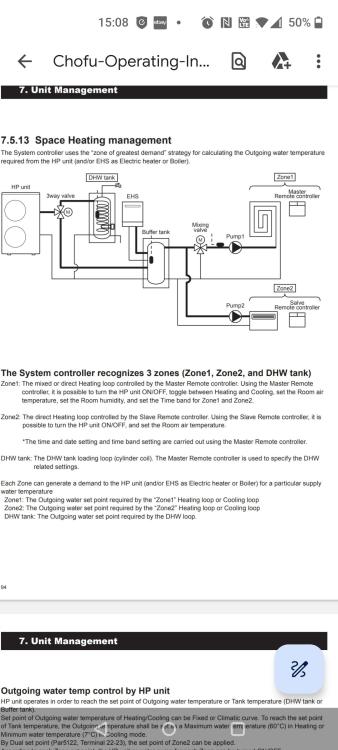
They do, but is only by the zone of highest demand that controls the temp output, the other zone is just a mixer valve. and
-
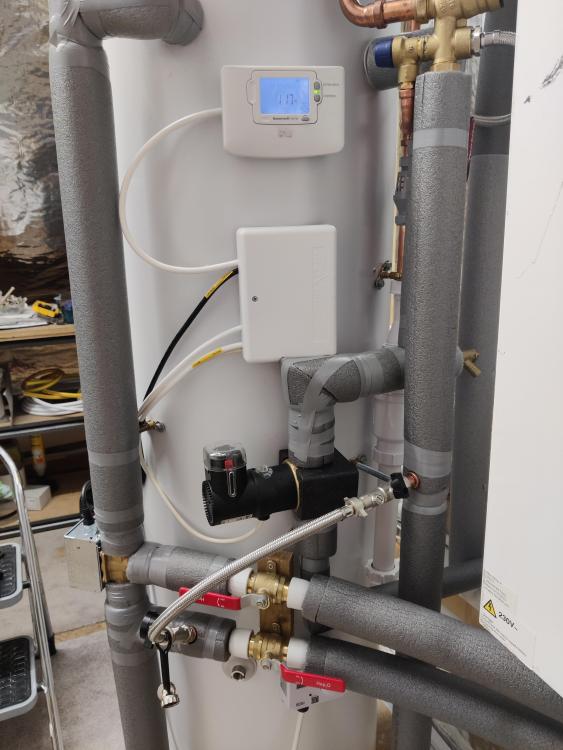
All sorted, cylinder installed and commissioned, and charged with hot water. Heated cylinder to 50 degs, ASHP was at about 56 deg. Need to get final set point of the mixing valve set, think it's a little low as the shower is running cooler than I would like. Will mess with that over the next couple of days. Have secondary circulation, with built in timer and thermostat. Currently set to run a couple of hours morning and evening, temp thermostat set to 30, the pump stops and starts to manage this temp within the time window. Combi boiler now isolated. Will look to get the gas disconnected in next week's, once I am comfortable there are no issues
-
Steel spec to suspend motorcycle
JohnMo replied to Capable Noob's topic in RSJs, Lintels & Steelwork
Way nicer than a Harley then. -
Just seen you have an Ivar mixer, you need to adjust the mixer to suit your flow rates. They are very adjustable, if you didn't get instructions with the manifold you can normally download them.
-
Steel spec to suspend motorcycle
JohnMo replied to Capable Noob's topic in RSJs, Lintels & Steelwork
At 180kg, is it a Harley? -
The air force moved up here for good reason. Very little or no fog, very dry (rain shadow caused by rain already falling in the Cairngorms) and longer summer days, although we have quite a bit shorter days during the winter, so suppose it balances out over the year. Think all the above make up, for being a lot further north.



