


JohnMo
-
Posts
13306 -
Joined
-
Last visited
-
Days Won
200
Everything posted by JohnMo
-

Total Heating Total Control (THTC) Help
JohnMo replied to ColinG's topic in Central Heating (Radiators)
I have just moved to E7 on a new build. Smart meter is installed, although due to where I live doesn't communicate, so it's a dumb smart meter. It has a day and night rate and I just record the readings manually. This what it looks like, a day and night rate. Not sure how you get around for your 24/7 heaters.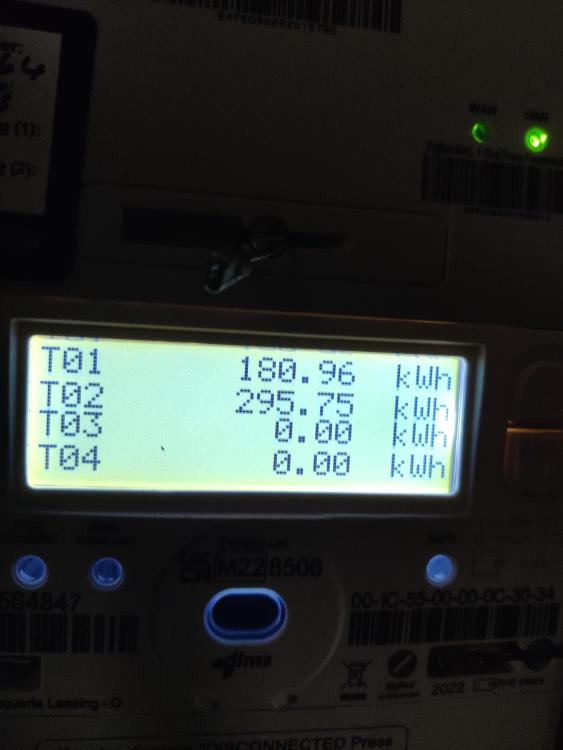
-
Concrete Cavity Fill Techniques For Large Houses and Volumes
JohnMo replied to jwoodhead978's topic in Brick & Block
Concrete pump, easy to do, may cost you, but easy and quick enough. Wonderful things, we hire one, 5 times during the build.
-
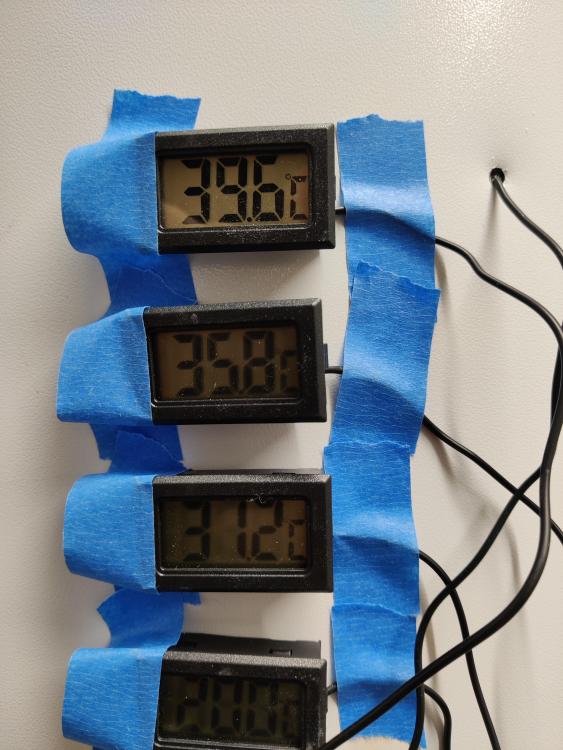
Slight update. Cancelled the cylinder charge scheduled for this afternoon, so last charge finished at 7am this morning. Set point was 48, it took 45 mins to charge the 210L slimline cylinder from a 6kW ASHP. Wife showered this morning and general house usage, I also showered, shower temp ok, but not as hot as it was yesterday. So have upped the temperature to 50. Added some additional temperature gauges on the cylinder this evening. Prior the shower the normal temperature probe was reading 21 degs, but it's close to the bottom of the cylinder. So pretty meaningless to the content temperature and how much hot water is remaining. 4 cheap temperature probes, a 6mm to drill through the outer casing and I had a very basic level gauge. Interestingly the gauges at 21 degs read within 0.1 of each other. Not bad for £24 for 8 off including delivery. Tappings are 250, 500, 750 and 1000mm from top of the cylinder. So down to 50% of the cylinder height. Will check the temperature reading in the morning to see how accurate they are. To me it looks like the top 500mm of the cylinder is still quite usable. Next job is to tidy the gauges up and look a little prettier.
-
Mitsubishi settings for DHW and Home Heating
JohnMo replied to roadrunnerAlgarve's topic in Air Source Heat Pumps (ASHP)
Think the ideal is something with the functionality of homely, but is just a temporary install. Wireless inside and outside temperature sensors and UV sensor on the southern side of the house. Almost the installer sets up a weather compensation curve, from design data. The homely type tool, is loaded with the same curve. It monitors over a week to a month time period and logs how the house responds and suggests delta to upper and ends of the curve. Installer removes the temporary equipment, and moves on. -
It's near enough +/-10mm is neither here nor there. Be there when they install; our hood was supposed to slot in-between cabinets and top and bottom, align with the top and bottom of cabinet. Turned my back for 10 mins it was set at 750mm, because they always are. They had to buy new parts to resolve so took an additional week. Just watch them like a hawk would be my advise.
-
How to insulate loft hatch with existing ladder
JohnMo replied to Novice Becky's topic in Heat Insulation
You could ju I'll seest replace it with an insulated and air sealed loft access with ladder. Screwfix and others sell them. Or could you space the ladder away from the hatch more, then glue PIR on to the hatch. The more the better. -
Just read the instructions, each one is slightly different, but an installer will set at 750mm unless asked to do differently.
-
Think if you read the manual it says auto adaption is for radiators, but if you have a very thin screed if should work ok. Once you hit a cold spell make sure the room temperature doesn't start to yo-yo up and down
-
Why is my flow fluctuating so much?
JohnMo replied to Ambaz79's topic in Air Source Heat Pumps (ASHP)
It shouldn't, there is normally a diffuser to slow the cold water coming in and limit mixing. So the thermocline slowly moved up the cylinder as hot water is consumed. Once your thermocline gets close the the secondary returns port, plenty of mixing can occur and leave you just lots of cool water. Our cylinder temperature pocket is really close to the bottom of the cylinder, cylinder at 0730 was 48, temp gauge now says 21 after wife had a shower. I am going to heat until tomorrow morning to see how my shower is tonight. -
Why is my flow fluctuating so much?
JohnMo replied to Ambaz79's topic in Air Source Heat Pumps (ASHP)
Secondary circulation really needs a thermostat and timer and pipes well insulated. So thermostat stops pump when returning water is comfortable temp, when the water cools, pump starts - repeat. Timer so pump only runs when useful. No use loosing cylinder temperature, when no one in house or everyone is asleep. -
Sounds like it's all been installed but not really commissioned. Why two heat pumps? Are you running through a buffer or low loss header or are the heat pumps connected directly to the UFH and radiators?
-
Measuring air flow
JohnMo replied to Coanda's topic in Mechanical Ventilation with Heat Recovery (MVHR)
One the correct units the other not -
Measuring air flow
JohnMo replied to Coanda's topic in Mechanical Ventilation with Heat Recovery (MVHR)
or m3/h Lots of calculations on here https://www.omnicalculator.com/math/area-of-a-circle -
Basically what ever they say as a throw away statement about pipe sizes, will only be true for a certain set of circumstances. You/designer still have design the piping system to manage total pressure drop, so you do not exceed the allowable system back pressure, and to ensure the circulation pump can meet the minimum flow rate requirement. Talking about exact pipe sizes, without a full design, is rubbish in, rubbish out and pretty meaningless.
-
Another thing to concider if you stay gas for hot water, is to install a heat pump cylinder anyway. The cylinder has a huge coil, boiler condensing for the whole heating period and lower flow temp settings, could save you 10 to 15% gas costs on its own.
-
Have tried to reduce cylinder set point, but resulted in max temperature at shower slightly lower than I want, so upped to 47/48. Currently still have two heating periods, the one in cheap rate takes 45 mins, the one in the day 35 mins. So next will try to have a single heating period instead of two. Even if I have to up the temperature slightly it will be cheaper than two heat sessions. Will report back in a few days.
-
Boiler or via a valve near the cylinder. Unvented cylinder is full of hot drinking grade water, so will not come that
-
Most R32 ASHP run to 60 without issue.
-
Or let them install a cylinder, which gets sold on later? Or let the heat pump try to heat the Sunamps, if it doesn't work well i.e. rubbish CoP, don't let it call for heat ever again. Tell installer what he wants to here, nothing more or less.
-
Why is my flow fluctuating so much?
JohnMo replied to Ambaz79's topic in Air Source Heat Pumps (ASHP)
Reason it feels cool, is the shower mixer, always mixes in cold water, it's looking for the hot water to be about 10 degs hotter than the shower water comes out the head. So if you have 40 deg water you are having a 30 deg shower - cool shower. 48 is good for us, 46 is a not so good shower experience. Not really the economical way to do things. Reducing flow decreases floor output, so you compensating by increasing flow temp, leads to a decrease in CoP. The heat pump cycles, when it's below its minimum modulation, it's normal. The amount of cycling is likely to be outside temperature related. If your heat pumps runs around 10 minutes don't worry. The DHW out pipe is always hot, by not being insulated you are constantly transferring heat to the room, away from the cylinder. -
The principal difference between the Chofu and Grant install. Chufu have a fully functional controller with built in thermostat and scheduler. Grant basically by-pass the design intent of this. Grant have modified the install to match a gas boiler, with two port valves, which have to be timed separately so DHW water cannot get into the heating system. There are several versions if the Chofu manual kicking about. This one has quite a few different schemes Chofu-Operating-Installation-Manual-R32.pdf
-
Self install is quite straightforward If UFH only ASHP to manifold, no mixer or pump. Set either a fix flow temp and control with a decent thermostat or set a WC curve. If you do it as one zone no buffer required, but system may benefit from a volumiser (long run times at low demand). You will need expansion vessel and relief, filling point, vent valves and a strainer. Biggest cost after heat pump is pipe, fittings, and insulation. If adding a DHW cylinder, three way diverter is added. I would look at a Grant heat pump, but install as Chofu intended. No other controls needed. Realistically you are looking at £3 to 3500, all the little bits add up. If you are adding a DHW cylinder an Ideal one are quite good price, good multiple coil comes with a 3 way valve. About £800 from City Plumbing.
-
Why is my flow fluctuating so much?
JohnMo replied to Ambaz79's topic in Air Source Heat Pumps (ASHP)
It daft that cylinders don't have a series of temperature probes up the cylinder (say 4 equally spaced), so you can see how much hot water you have. -
Why is my flow fluctuating so much?
JohnMo replied to Ambaz79's topic in Air Source Heat Pumps (ASHP)
You also need to look at the route the pipes take, especially the hot one from the top of cylinder, this pipe can takeaway heat quite quickly, especially if not really well insulated or goes up from the cylinder. Ideally this pipe drops around 150mm minimum from the top of the cylinder as soon as possible, before going horizontal. This stops any thermosyphon effect. -
It's in our summer house, which the wife uses for Reiki etc. so has to be quite. Had another make of dMEV fan in originally but it was too noisy.




