


JohnMo
-
Posts
13306 -
Joined
-
Last visited
-
Days Won
200
Everything posted by JohnMo
-
20% more cold air will overwhelm the warm air coming out and therefore not heat the incoming air as much. Once you get that sorted you will see a good increase in efficiency.
-

Pumps needed with ASHP and can a area be to small for UFH?
JohnMo replied to Bruce's topic in Underfloor Heating
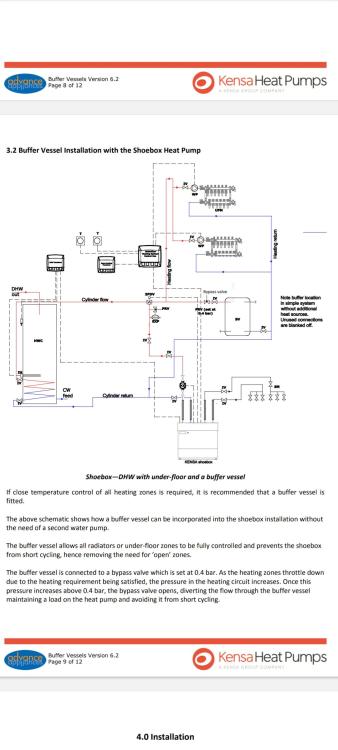
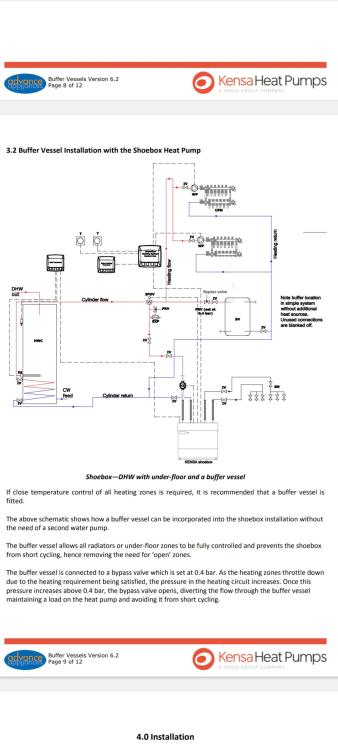
Without any zoning you are going to short cycle a 6kW heat pump with only 40L, so you need to add volume. Best way is a volumiser or a two port buffer across supply and extract. You will need a volume of circa 60L engaged volume. If you want heat out of you bathroom do the centres as close as you can, so a spiral pattern is best. Add an electric towel rad also. Running direct from heat pump can be done, just need to make sure the you are comfortable with getting some hot water in the floor when yiu have finished DHW heating. To run on the heat pump circulation pump, you need the buffer/volumiser as mentioned above not a 4 port. Some info on buffers attached Kensa Buffer.pdf -
I purchased the same gauges as yourself and had similar rubbish results. The heat exchanger is designed to see equal flow on supply and extract, if it doesn't you get a bad efficiency result. So I got out the flow meter and found the supply flow was set too high, I adjusted it and the room supply is now 4 to 5 degs warmer. Just looked at an hour later and extract and supply to rooms is within a degree.
-
Lessons learned from last ready - getting ready for cold snap
JohnMo replied to Conor's topic in Air Source Heat Pumps (ASHP)
Really depends on if you have standard rate electric or one of the time of use tariff. We have E7 so there are advantages (most the year) to run flat out for hours, then off. However today I have just let it run all day. -
Lessons learned from last ready - getting ready for cold snap
JohnMo replied to Conor's topic in Air Source Heat Pumps (ASHP)
If you size that way you normally include an immersion in the scheme, to make up any performance shortfall at low ambients. Then let the heat pump manage how it is operated. That's some electrical consumption for a day and a bit. Mine also has been doing plenty of defrosts, I batch charge the floor and it's been playing catch up today, as I let the floor temp drop a little too much. So it was running flat out from 0.30 am to around 1pm, defrosts last night 25 min to 45 min apart. It's now doing the normal run for 20 mins - 20 mins off. Haven't minded much as we have generated nearly 5kWh today from PV and the solar thermal is also adding. -
Couple of observations. Set back is very large for a heat pump, for it to cope your flow temps will be way higher than you really need. You normally set it back a couple of degrees only. For heat to spike that much you either have the temperature reader way to close to the heat source or it's direct electric heating. Reading close to source as above reply. The thing is, are you are trying to flow way to hot for the heat pump and it's just cycling on and off, as it can't dump the heat quick enough.
-
Lessons learned from last ready - getting ready for cold snap
JohnMo replied to Conor's topic in Air Source Heat Pumps (ASHP)
We have three days of -7 forecast, so have decided to let the heat pump run as long as it wants. Noticed the house temp getting a little cooler each day when I get up, been having down to -2 for the last week or so. -
Down to -7 for the next three days, so unlikely I will not be progressing much.
-
I am just running mine to heat between 6am and 7.30am (E7) to 50 degs, normally takes 45 mins, purely from the heat pump, no immersion. Keeps us in hot water all day. No need to do legionella at that temp either, so immersion only runs if we have excess solar, not likely to happen for awhile though.
-
If there is air in the loop, you need to push it out with a main water hose pipe, otherwise it just moves about and never really gets pushed out.
-
Building regs states you should insulate hot water recirculation. (Or pretty sure it does). Hope you do a good leak check on all these joints prior to plasterboarding.
-
Except the A2W I plan using (UFH already in and working, just not hot enough). Looks like I will take a CoP hit of around 0.4, but if the run time of the house heating comes down due to higher flow temps then maybe no hit in running costs (that would be a good upside if it happens)
-
My outlay for the mods will be quite small, main ones are antifreeze (10L) and an ESBE 3 way mixing valve and a new thermostat for the garden room; as I broke the previous one. Plus a few fittings I don't have. Although I will take a CoP hit, not sure the cost for A2A would ever stack up. Plus not a fan of blown hot air.
-
Lots of insulation already, floor and roof around 200mm, walls 140mm. Wall space is quite limited, so fan assist radiator not really an option. Idea is to heat both during cheap rate, but only top up the garden room as required during the day. There will also be a month at either end of the heating season where the house doesn't need heating, but the garden room does.
-
The good thing with this mixer is there is not always mixing as with a normal UFH mixer. So I could inject the full heat to the house floor for a shorter period. 30 to 32 I heat the house in 7 to 8 hrs for the whole day. So I may be able to heat house enough in a shorter period. I am hoping the controller runs as hot as possible, then when it starts to see house temps increase starts to back off flow temperature. My main issue is the kWh used in the garden room is averaging around 7kWh, by direct electric. At my current flow temps the UFH in the garden room supports the room to 10 degs inside. If I increase flow temp 5 deg, at full heat pump output the additional electricity load is around 200W at most temperatures. So instead of running a 2.5kW heater I drip feed the UFH but at suitable flow temp. I am hoping the CoP hit is made up by running the UFH in the house for less time as it's the biggest user. To make the heat pump output different flow temperatures, is a manual change of set point, so not practical on a day to day basis. I tried that a few months ago, trouble was even with the flow rates turned well down the house overheated and that was only at about 2.5 deg increased flow rate. There are only 2x 50m loops in the garden room and that cannot be run without a buffer, on its own. If I control the house to switch off without a buffer the heat pump just trips on low flow.
-
Currently we have a house UFH and summer house UFH operating as a single zone. But the summer house heating is pretty rubbish, so use an electric heater also. Now the temps are dropping the electric heater is starting to run through electric. to heat the summer house twice over the last couple of days and used around 14kWh. It is only going to get worse as temperature drop, becuase the the summer house is being used most days. So issues are, I need two very different flow temperatures, one for summer house and a much lower one for the house, the heating season for the summer house is much longer also. So need to make two zones. Since decommissioning the gas boiler, I have an Alpha Flowsmart 50L cylinder (previously used for combi boiler preheating), so will repurpose as a buffer, plumbed as a parallel, 2 port configuration across the supply and returns. Will follow the recommendation of Kensa heat pumps complete with PRV (by-pass valve) to engage the buffer only when needed. Also in my parts store is an ESBE CUA100 (cheap off eBay a while ago). This is an electronic mixer valve, that can be operated in either of two modes, fixed flow temperature or a modulating flow temperature based on house temperature. It incorporates a timer which works in both modes and allows a second temperature to be set. So in theory you can increase the temperature (either house temperature or flow temp) during E7 and lower at other times. So will install this and a pump on the house UFH. The summer house will be run on weather compensation, direct from the ASHP. CUA100_en_F_LR.pdf Just waiting for a new mixer valve to arrive. Controller is installed and everything seems to work, as it should. Have put the controller in the lounge using now defunct thermostat wiring and will use this room as a reference temperature. Will run on house temp mode first to see how it goes. If it not stable, its just a setting change to switch mode.
-
Question about boost
JohnMo replied to Coanda's topic in Mechanical Ventilation with Heat Recovery (MVHR)
Yep, it a balanced system. -
Mods I made to the electric heater worked well, until the thermostat failed. Had to heat the summer house twice over the last couple of days and used around 14kWh. It is only going to get worse as temperature drop, becuase the the summer house is being used most days. So issues are, I need two very different flow temperatures, one for summer house and a much lower one for the house, the heating season for the summer house is much longer also. So need to make two zones. Since decommissioning the gas boiler, I have an Alpha Flowsmart 50L cylinder, so will repurpose as a buffer, plumbed as a parallel, 2 port across the supply and returns. Will follow the recommendation of Kensa heat pumps complete with PRV (by-pass valve) to engage the buffer only when needed. Also in my parts store is an ESBE CUA100 (cheap off eBay a fair while ago). This is an electronic mixer valve, that can be operated in either of two modes, fixed flow temperature or a modulating flow temperature based on house temperature. It incorporates a timer which works in both modes and allows a second temperature to be set. So in theory you can increase the temperature (either house temperature or flow temp) during E7 and lower at other times. So will install this and a pump on the house UFH. The summer house will be run on weather compensation, direct from the ASHP. CUA100_en_F_LR.pdf Just waiting for a new mixer valve to arrive. Controller is installed and everything seems to work, as it should. Have put the controller in the lounge using now defunct thermostat wiring and will use this room as a reference temperature. Will run on house temp mode first to see how it goes. If it not stable, its just a setting change to switch mode.
-
I'm just off to do a stir-fry on my induction. I like, but wife keeps saying she likes gas more. But she doesn't cook every day. I always found gas way to slow to heat stuff up.
-
Look at a Grant (as in the company) heat pump. Their scheme is quite good. The quote and MCS is owned by Grant Corporate, the work is sub contracted to a local Grant installer. Grant themselves do the full design. Think everything is done via the local agent or installer. Grant Corporate do the final commission and sign off.
-
Certainly if you use passivhaus calculation method, you only work out to 2.5m high irrespective of actual heights. Maybe the same for building regs also
-
No, but neither is the gas boiler installation, both take the same amount of work. MCS is needed for grant.
-
Social media, well who believes what that says. Do your maths. Assuming you are a new build, so you need a heating system anyway. Any new install should be using heat pump ready sized radiators and cylinder. Difference in cost for a gas boiler and ASHP install is just the boiler or ASHP. You need a cylinder radiators or UFH for both. Again assuming you can install a 6kW heat pump, so ASHP will cost £2-3k, gas boiler £1-1.5k. so really about £1k difference, without any grants. Shopping around can save as well. Retrofit is a little different.
-
Mine is 10m away, zero issues. As long as noise isn't the issue on the boundary.
-
Are his calculations correct for volume? If so yes, but if 179 X 2.4 then nearer 0.5 ACH. Which is building regs. And with 2 or 3 in house is over ventilating in practice.


