
JohnMo
-
Posts
12470 -
Joined
-
Last visited
-
Days Won
179
Everything posted by JohnMo
-

Change Timing of Legionella Cycle
JohnMo replied to Grannysan's topic in Air Source Heat Pumps (ASHP)
So what you need to provide is ASHP make and model, then someone will know the answer. -
Get used to it, it called a planning system, you will get asked for worse. COVID made things worse as it gave them an excuse to communicate even less.
-
From the photos not hot dip galvanised Have read https://www.galvanizers.co.in/blog/difference-between-galvanized-vs-hot-dip-galvanized-metal/
-
MVHR Design with Loft Conversion
JohnMo replied to malk's topic in Mechanical Ventilation with Heat Recovery (MVHR)
I would Supply to lounge, extract kitchen, use dining as a pass through area, the rest something like explained on the attached, almost no duct required. 615103-a-leaflet_multi_air_supply-en-dig-lr_5057512563596.pdf -
I have winter data for MVHR, but wouldn't you need to overlay on my external temp, external humidity, internal temp and ventilation rates? On cold day I had internal humidity was as low as 36.5%, 14 days previously it was 45% and a couple of days later back to low 40s. House temp was pretty stable around 21 degs.
-
Almost the same, best way to compare is SCoP not CoP, SCoP comparison looks at efficiency over the year, not a small moment in time. Both examples below are the same output size ASHP. Vaillant (R290) at 35 deg flow 4.48 SCoP Maxa (R32) at 35 deg flow 4.48 SCoP 4.46 As said above system design is way more important, best heat pump in a poor system, becomes a poor performance heat pump.
-
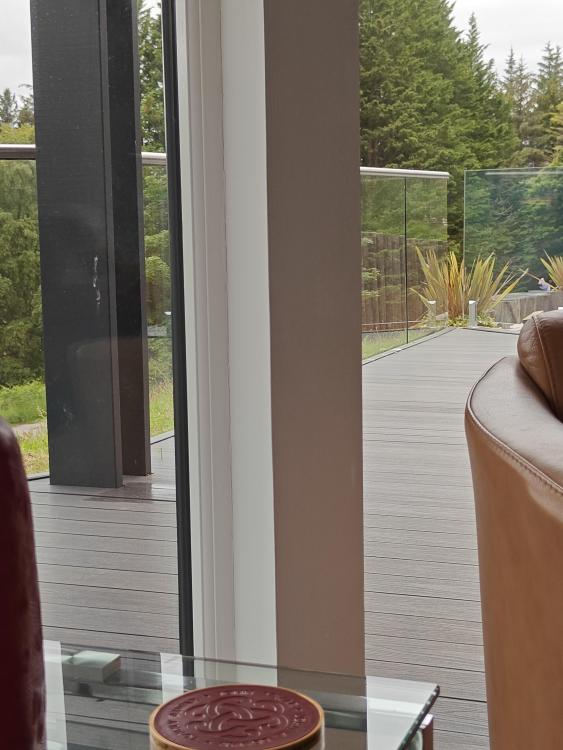
I tried to do this with our house, decided it wasn't worth the effort/risks so just got frames. The wooden frame takes away 30mm from the sight line, you don't notice it. Ours sit in front of a steel frame. Cold bridge Your area at the bottom of the window is a big cold bridge. You need to look at a continuous insulation line. So at the bottom I would add a layer of Compacfoam and bring in the meet the floor upstand (would make this at least 50mm thick). This will have enough strength to take the loads and remove the cold bridge. Position in the wall depth will depend on how your walls are insulated the window needs to straddle the insulation. The concrete/block section needs a good look at as from a thermal design perspective is rubbish and will leak heat like a seize. And likely lead to mould.
-
Change Timing of Legionella Cycle
JohnMo replied to Grannysan's topic in Air Source Heat Pumps (ASHP)
You need to step back slightly and ask the question do I need it at all. If you use a good proportion of the water each day and don't have infirmed elderly people in the house there is a good chance you don't. This is a good write up on the subject https://www.heatgeek.com/hot-water-temperature-scalding-and-legionella/ Other than that tell the installer to get his arse back to change the timings. Or talk you through it. Every heat pump will have a different way to change the timings. -
Good chance they are not actually galvanised, it could be just zinc electroplating (which us cheap rubbish and too thin). If it was galvanised you actually need an etching primer or an epoxy based Paint, to get the paint to stick on. But I would use Rust-Oleum® Stops Rust® Cold Galvanizing Compound Spray. Its 93% pure zinc coating applies a galvanized film with cathodic protection, which resists rusts, scratches and chips. It can go straight on zinc coating etc. Apply 3 to 4 heavy coats. Nothing else needed. Your stainless steel ones will rust if they used tools that were also used on carbon steel or have carbon steel grinding splatter on them or they used the wrong filler wire on the welds. Spray them in the cold galvanise spray also.
-
If they were galvanised (hot dip) after welding they should be good for about 50 years. That why they are galvanised.
-
That's still 10mm per metre. Plus the glass needs room to move. The examples for oak, the glass is secured by compression of EPDM and leaves everything some wiggle room, gives a water tight assembly and is easy to replace in 10 years time if the glazing unit looses it's argon and starts to fog up etc. Would expect your assembly fixed and bonded would lead to a crack glazing unit.
-
Take a look here https://sessile-oak.co.uk/oakFrames/glazing
-
Level door access disaster. Advice needed
JohnMo replied to Paene Finitur's topic in Doors & Door Frames
No it's 83.3mm per metre. So if you need 150mm that's just under 2m at 1:12, or longer for a less steep fall. -
Keep old boiler or upgrade for new UFH
JohnMo replied to Warrentdo's topic in Boilers & Hot Water Tanks
If you boiler is serviceable use it. It will turn down to about 12kW. Which is quite high, but if you are in a leaky (heat) house that maybe ok. All boilers benefit from a long run time and you really need to minimise zoning (remove as many thermostats as you can) to keep system open, otherwise you will get short cycling. Short cycling basically consumes loads of gas for very little heat output and shorten the boiler life. Assume you will mix UFH with radiators? If so use an Ivor mixer for the UFH or electronic (expensive). Most other mixers are rubbish. You may benefit from adding weather compensation to the existing boiler, then run the whole system on WC, use the existing trv's as limit stops (set a couple of degrees above target temp) and the UFH on continuous on a set low flow temperature.- 1 reply
-
- 1
-

-
Do a search on Google for frameless glass and oak frame, there are plenty of example of what to. Not sure what you are proposing would work due to the amount the wood moves.
-
I just knocked posts in to ground, ran three lengths of wire top, middle and bottom and infilled with orange dayglow mesh cable tied to the wires.
-
Concentrate on system design, refrigerant makes little or no difference to system performance. Big coil cylinder (3m2+), design for no buffer and single zone. Unit sized as close to heating demand as possible. If it can't do cooling out the box not interested, that would include lots of Daikin units, Vaillant etc If I was buying new again as small a Panasonic R32 unit as I could get away with. Why, combination of decent price, spec and user friendly instructions. I would avoid any heat pump, that makes me have an indoor unit, or ties me into the manufacturer cylinder, that includes all Bosch units, split units (of any kinds).
-
22 - 15 - 15 reducing tee for the hot, 15 - 22 reducer for the cold. You still need to be qualified to certify the installation, many plumbers don't like to certify self installation, unless organised before hand.
-
If you have the same (or similar) design temperature - or just about, you could do it all with no mixers or pumps and no buffer, drive it all as a single zone? This takes a little getting your head around. I do our main house UFH and a garden room with fan coil as a single zone. I have two thermostats either can call for heat, but both have to be off to stop heat. Basically the house acts as a buffer for the summer house. Took a little fine tuning, but it works. Trouble with mixers is they always mix, so if you want to flow 30 degs, you may need to flow 35 to 40 from heat pump, you also have mixing in the buffer, so you easily be flowing 42 to get 30 into the floor. Giving rubbish running efficiency and high running costs. Keep it as simple as possible.
-
Hot water cylinder as buffer tank
JohnMo replied to Little Clanger's topic in Central Heating (Radiators)
The basics are here https://www.open.edu/openlearn/nature-environment/energy-buildings/content-section-2.4.1 You need to understand how you external walls are constructed and insulated A cheat sheet is here https://www.heatgeek.com/how-to-size-my-heat-pump-or-boiler-heat-loss-cheat-sheet/ -
Hot water cylinder as buffer tank
JohnMo replied to Little Clanger's topic in Central Heating (Radiators)
Use the lower one on E7 and if an upper one, just set that thermostat to 35. But as @SteamyTea says if your radiators need to kick out 2kW that's 24 x 2kWh a day, not 6 x 2kWh. Unless you are heating an uninsulated shed 2kW sounds a lot. -
You do realise you need to be qualified/competent to plumb in an unvented cylinder? Are you using the cold water feed from the inlet group? If not you need pressure control valve near the stop cock and a check valve at the cylinder hot water outlet to prevent back feed to the cylinder.
-
Hot water cylinder as buffer tank
JohnMo replied to Little Clanger's topic in Central Heating (Radiators)
Simple calculator https://www.omnicalculator.com/physics/water-heating From 40 to 75 degC is about 10kWh. 35 to 75 is 12kWh From what you explained the cylinder would need to comply with G3 rules for unvented cylinders. You require a mixer on the outlet. Then flow low and slow all day. Do a proper calculation most the radiator suppliers calculators are rubbish. If you size the radiator for dT 15, flow temp would be about 35 degC on the coldest day, that would increase the storage capacity to 12kWh. Then set up a secondary thermostat to active the cylinder immersion to keep the cylinder at 35 degC. No external heater required. The secondary heating would only occur on the coldest day. -
Rega Vent MVHR Reviews
JohnMo replied to bob the builder 2's topic in Mechanical Ventilation with Heat Recovery (MVHR)
I bought two units both Titon (HRV10 and a 1.6) from eBay. The whole system installed was just over £2k. -
Posts for raised decking: timber or plastic?
JohnMo replied to Lift span's topic in Landscaping, Decking & Patios
You really need a proper design, depending on actual drop and wind load and infill type, will change things dramatically. Because you are trying to do a job a structural engineer needs to complete.