


JohnMo
-
Posts
13307 -
Joined
-
Last visited
-
Days Won
200
Everything posted by JohnMo
-
What does your installation manual say on the subject?
-
But not if you have hot water circulation. As there are issues with very hot water making its way past the TMV. Couple of simple ways to mitigate 1. Just set your tank temp to 48 to 50 degs, then no need to have a TMV at all. 2. If you have a mixer tap on the bath this issue should be taken care of by the mixer.
-

Internal Walls - Marmox Thermoblocks & Concrete Blocks
JohnMo replied to Mulberry View's topic in Brick & Block
That was the way I calculated it all out also. I used engineered brick on top of thermolite, good for fixing too. Our screed is 100mm concrete, so the thermolite block starts above the screed to insulation interface. So the no thermal bridges. All our internal walls are wood stud walls. We left an air gap either side of the acoustic insulation before the plasterboard. -
Not jumping in to your question. But make sure heritage has actually seen and approved stuff. Even with planning in place, doesn't mean they have approved anything. They are normally engaged separately. Been there, been bitten.
-
Fan Coil Units for use with a (cooling) ASHP
JohnMo replied to ProDave's topic in Air Source Heat Pumps (ASHP)
But the point really is you don't wait until the house is up to 30 degs before, you say let's switch on the cooling, like heating it's better to keep things at a even temperature. The house then sits at say 23-25, not in the 30s. Example, 2 August for us, had an external humidity of 74% in the afternoon, we get all our heat from solar gain, left unchecked the garden room (fan coil) will easily exceed 30 degs. Cooling was left to run on weather compensation. Max temp reached in room was 23 and max humidity was 52%. So dew point was 12.6 degs. If I left the temp to rise to 30 and humidity remained at 52% the dew point jumps up to 19.1 degs so you have condensation issues. -
Help needed with Mitsubishi FTC2BR controller
JohnMo replied to Tim S's topic in Air Source Heat Pumps (ASHP)
Do you really need it. Switch over from DHW to UFH a couple of litres of hot water pumped into the 35T of concrete. Zero effects. Plus your mixer will always add a minimum of 5 degs to your flow temperature as they always mix flow and return irrespective of mixer settings. Looked at the installer manual, have selected the scheme to match your install, noted there were loads of options available? -
Help needed with Mitsubishi FTC2BR controller
JohnMo replied to Tim S's topic in Air Source Heat Pumps (ASHP)
You really should look to simplify your system. Questions Do you have a buffer? If so is it temperature controlled by the heat pump. If you don't have a buffer all your zones are going to cause you a bunch of issues. Notably short cycling if you only get down to a couple of small circuits. Do you have a mixer and pump on the UFH manifold? -
If you can charge a few times a day, you just need to look at the likely usage between changing. Then pull together a spreadsheet to compare running cost to capital cost and do what makes sense for you. Most dominant period is winter. Most simple is AC coupled battery. If you add solar later it all still works.
-
We also have about 50+ tonnes of slab, but its only 100mm thick. Once you start to monitor what happening you actually see solar gain, slab average temp starts to rise (seen in a rise of the return and flow temp) in the tenths of degree. I have reverted to straight WC away from batch charging because its more efficient in terms of kWh through the meter, and if the daily temperatures follows the normal pattern of colder at night and warmer in the day, suits our E7 tariff quite well. Basically the bulk of the heating gets done as the outside temps drop, charging the floor, as the day temps rise the target flow temp also lowers so heat pump naturally stays off. But the important bit is, floor temp isn't allowed to cool, resulting in the heat running at elevated flow temps for long period to recharge the floor. Yesterday we had 3 degs overnight and the day went up to 10 degs during the day. Even running in the time of 3 degs was still getting a cop of 4.8, so 2.7p per kWh, the bits of running in the day and evening all came from the battery, but was getting a CoP of around 5.3 so 2.4p (maybe zero as battery was being charged by solar during the day). Note the 2x greyed sections are DHW heating.
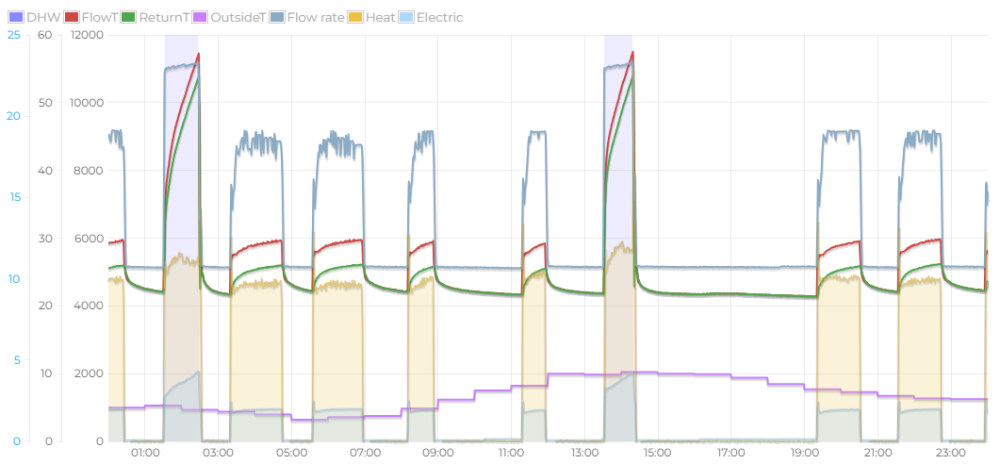
-
Trouble is the big players like octopus want you have a system with a design flow temp of 50 degs. This maximises their profits, makes an easier install. Justification is a good selection of tariffs which are available (but for how long) so cheaper to run than gas. That starts to get difficult, even a 6kW ASHP will have a power required of 3kW at sub zero and high flow temp. Without accounting for in rush current on motor start and the various outlets for immersion heaters driven from the ASHP. Hybrid incentives are the only real way to get mass roll out. No internal changes to heating system required (you could though, to drop design flow temp). System runs 90% of the time on heat pump, if house has a combi no cylinder required. Just make weather comp manditory, boiler manufacturer have to provide an interface to allow this if boiler needs it. In nearly all cases a 4kW ASHP would be ok.
-
Kitchen plasterboard and tile backer?
JohnMo replied to Super_Paulie's topic in Kitchen Units & Worktops
Plasterboard the lot, no idea what tile backer brings to the party except taking some of your money. Tile direct to the plasterboard. -
Also try Atag boilers, they are super quiet, they also start up at min modulation and slowly ramp up. Most boilers work the other way around. 16kW sounds big for your heat losses, you need to get one with good modulation and sized to suit heat loss. You seem to have zoned the house a lot, you need to be careful you aren't cycling the boiler too much for good gas consumption. The lower the flow temperature the less the boiler can modulate down. Most plumbers know S and Y plan and are then out of their depth. Look for a plumber that understands heat pumps and then the install should be quite straightforward. The other option for boilers, is you find one at a good price, get the plumber to install per your instructions and take a risk on warranty. Pretty much what I did. Or you can do most the courses yourself online via Viessmann if you want. Then you carry the warranty instead of the plumber.
-
Pre-Filter for Log Burner Smells
JohnMo replied to benben5555's topic in Mechanical Ventilation with Heat Recovery (MVHR)
Really depends on your system design and where you sit with regard pressure drops. More pressure drops require higher fan speed and more potential noise. You can always go big and use reducer to you duct - bigger the filter the lower the pressure drop. -
Seeking advice re Multifuel stove – feeling duped?!
JohnMo replied to Loobyloo's topic in Stoves, Fires & Fireplaces
I take it you are using the primary and secondary controls. The user manual states "If you are burning only wood, the primary air control can be fully closed. If you are burning solid fuel you will require some primary air. Your stove is burning with maximum efficiency when a bright fire is achieved using minimum air inlet and a Stove Thermometer. We advise that stove thermometer is purchased in order to for you to monitor the operation of the stove. For best results the thermometer should register within the “Best Burn” range. -
Pre-Filter for Log Burner Smells
JohnMo replied to benben5555's topic in Mechanical Ventilation with Heat Recovery (MVHR)
Here is an alternative https://www.aliexpress.com/item/1005003455622982.html?src=google&src=google&albch=shopping&acnt=494-037-6276&isdl=y&slnk=&plac=&mtctp=&albbt=Google_7_shopping&aff_platform=google&aff_short_key=UneMJZVf&gclsrc=aw.ds&&albagn=888888&&ds_e_adid=&ds_e_matchtype=&ds_e_device=m&ds_e_network=x&ds_e_product_group_id=&ds_e_product_id=en1005003455622982&ds_e_product_merchant_id=527456140&ds_e_product_country=GB&ds_e_product_language=en&ds_e_product_channel=online&ds_e_product_store_id=&ds_url_v=2&albcp=17859500389&albag=&isSmbAutoCall=false&needSmbHouyi=false&gad_source=1&gclid=CjwKCAjw6c63BhAiEiwAF0EH1MrTImL6T5sg-4vdV9V4pJsXZrbU5HeTBo5qkiis0U3iu0Em4qvraxoC6isQAvD_BwE -
Pre-Filter for Log Burner Smells
JohnMo replied to benben5555's topic in Mechanical Ventilation with Heat Recovery (MVHR)
We have G3/4 filters in our MVHR and few houses around us use log burners quite a bit. No smells in house, but if you go outside in the evening you do smell the smoke. I bought a carbon filter, but have never installed it. -
I was just using this initially https://hyundaipowerequipment.co.uk/p1-p10000le-7-9kw-9-8kva-recoil-electric-start-site-petrol-generator-powered-by-hyundai?absrc=Google&abid=&abcampid=20457680345&abgroupid=&gclid=Cj0KCQjwxsm3BhDrARIsAMtVz6OdU063Hh0q_OXZ9cG9n3YoyecXIdDMUai4B6yBIx4tceC0UWEQsz8aAmiLEALw_wcB&abkwdid=&tw_source=google&tw_adid=&tw_campaign=20457680345&gad_source=1 Ran whole house, including LED lights, induction hob and ASHP and borehole pump. Just add a mains change over switch.
-
BUS voucher and gas line
JohnMo replied to allthatpebbledash's topic in Air Source Heat Pumps (ASHP)
Seems excessive cost. Yes Daikin do one, just tees ito existing system, but all heat pump can be hybridised if you want. Went through an exercise with my existing boiler and new ASHP. I connected via a plate exchanger all worked fine. If I actually use it different matter. As I was saying you used £7.5k of tax payers money, a hybrid could be way cheaper. Get all the benefits of lower running costs and emissions when it's mild from ASHP and cheaper costs from gas when cold. Then make the Bus grant £3k, instead of £7500. -
BUS voucher and gas line
JohnMo replied to allthatpebbledash's topic in Air Source Heat Pumps (ASHP)
Don't believe @JamesPa has a heat pump - maybe not for the want of trying. I believe the best bang for tax payers money, would be a simple hybrid boiler. Leave the whole heating system as is, plug in a 4kW small heat pump. It does everything down to 3 degs. If it's a combi boiler leave it to do DHW. Plus a fabric first approach. -
BUS voucher and gas line
JohnMo replied to allthatpebbledash's topic in Air Source Heat Pumps (ASHP)
NOx class 5 boiler - Less than 70 milligrams of nitrogen oxides (NOx) per kilowatt hour (mg/kWh), whike class 6 would be less than 56. National grid in 2023 was supposed to be 750 mg/kWh. So a boiler on this is better. But CO2 generated by burning natural gas is 0.185 kg / kWh while English national grid is around 0.2 to 0.3 kg / kWh generally. But a well installed heat pump should be in the range of 300 to 400% efficient. So emissions drop to about 0.05 kg. So heat pump is loads better. Same is true for oil etc. Scottish national grid has way lower CO2 emissions so a no brainer from emissions perspective. -
Possibly full of nasty chemicals to stop them quickly rotting away once installed. Hence being hazardous waste.
-
BUS voucher and gas line
JohnMo replied to allthatpebbledash's topic in Air Source Heat Pumps (ASHP)
Go on to the government website and read the rules. Not sure it says gas has to be disconnected, but it explicitly says all heat and hot water has to come from the heat pump. Nothing in any rules I have heard about are banning gas hobs. -
Welfare hot water, no mains yet
JohnMo replied to Post and beam's topic in General Self Build & DIY Discussion
That was what I thought also. He will be asked to provide hot water bottles when it gets chilly next. -
Fool proof - As at @ProDave says, zero input required for a couple of days. Zero electric needed either.
-
Tell him to call, GRC Aquatech, they are in Aberdeenshire, but come out your direction also I believe.


