


JohnMo
-
Posts
13307 -
Joined
-
Last visited
-
Days Won
200
Everything posted by JohnMo
-

Monitioring hardware/software recommendations
JohnMo replied to Dam0's topic in Air Source Heat Pumps (ASHP)
Basics are You need to be able to read instantaneous electric consumption in Watts, you need to be able to read flow rate and flow and return temps at the same time. That will give you instantaneous CoP, with a few calculations. You need outside temp also. It's better to able to log and see a period of time, as there are plenty of variables that for ever change. Instantaneous CoP is useful, daily CoP is also useful, as is the CoP while running. Your controller may give this info or most of it. It is normally to include everything in the system electrically in the inputs, so controller, pump, valves etc. Exact numbers aren't that important, repeatable numbers are. You will be comparing your system to it's self with slight variations to settings. Good CoP comes from Lowest flow temp, but also from lowest cycle start temperature so the controller can the widest dT for as long as it can. Great CoP doesn't necessarily mean low running costs it a fine balance. Heat pumps cycle especially at low loads, managing these cycles is useful to running costs -
Remember PIR is more flammable than wood. If they don't want wood not due PIR will be any good either.
-
Monitioring hardware/software recommendations
JohnMo replied to Dam0's topic in Air Source Heat Pumps (ASHP)
I have just installed this https://shop.openenergymonitor.com/level-3-heat-pump-monitoring-bundle-emonhp/ Came already configured so all straightforward. Makes comparison test runs very easy to measure and understand. But not cheap. -
If that is the case, I cannot see. You need a check valve in the hot water outlet (top of cylinder) to prevent reverse flow, as cold water pressure could be higher than hot water cylinder pressure.
-
Can you do this? So long as it's opentherm you should be able to. https://www.ephcontrols.co.uk/section/pdhw/ Or as shown on this video. Cheap and should work.
-
A few issues unrelated to the question The pipe exiting the tundish is supposed to have a continuous fall, to comply with G3. Yours goes horizontal which does not comply. If it's 22mm you are only allowed it to be a max of 9m less 0.8m for each elbow. There are a minimum of 3x elbows visible so max length allowed is 6.6m. not sure where the pipe goes off the edge of the photo. But maybe too long? Insulation has way to many gaps. This needs to be sorted, plus better corner joints. All joints should be tight. Plus if outside the heated envelope it looks like thicker insulation would help. As @John Carroll says cold water feed is not correct. The combined valve has a check valve within it, the balanced cold water feed is taken upstream of the check valve. In it's current location you are likely getting a reverse flow through the cylinder when both hot and colder water are asked for. 3 things to sort Connect cold to balanced port on combination valve. Sort tundish discharge pipe. Full instructions are in your cylinder manual. Sort insulation.
-
Drain at threshold and Hardcore to buildup levels. Not really sure what you are asking. But to increase insulation thickness the whole floor would increase in height including the block work under the wall. A 100mm block on its side under the 140mm, would lift the whole house 100mm. Increase insulation depth and make it a thick screed? Plenty of different ways to do it, just think it through.
-
If your boiler only does a single flow temp no advantage over S plan. Most boilers will have options or optional kit that will allow weather compensation. If you add this you can then adapt to PDHW. This basically switch WC off when doing DHW. You would need to share info on your boiler make model or have a read through the manual
-
It a Maxa i32V5, which is same unit Viessmann bought in and rebadged as a 100-A.
-
Not sure I understand that point. I know exactly how my system responds to change and I can get plenty with south west facing windows, that made me learn quickly. Have a look on open energy monitor there are plenty of systems set exactly as mine is, they work, mine works, your works for you. I am happy with that, obviously you're not. Fundamental difference in view, so I will leave the conversation now, to stop going round in circles.
-
As I said my heat pump compressor runs for 20 mins and is then off a few hours at 11 degs. So I doubt the sun coming out and the heat pump being on would, A. likely occur within the same time period, and B in that 20 minute period I am only adding 1.3kWh to the slab. My wife just had the hairdryer on and put close to that into the air. As I said we are only here to give opinions, ours are different and that's good. Your system works for you, mine works for me.
-
This is what my manual says 8.1 EVAPORATOR WATER FLOW The nominal water flow rate refers to a 5°C temperature difference between the evaporator inlet and outlet. The maximum permitted flow rate features a 3°C temperature difference while the minimum one has an 8°C temperature difference at the nominal conditions as shown in the technical sheet. My circulation pump speed is varied by the controller, so I have no real control over dT. Generally heat pump will modulate but are just as likely to modulate a bit and switch off especially at low flow temperature. Some are better than others, your modulation is also dictated by your flow temp, low flow temp generally equals less modulation, from what I have seen. Mine currently only modulates down to 64% of nominal capacity at 12 degs From an energy used perspective, a heat pump pulling 800W 20 mins in the hour is better than one 400W 60 mins an hour.
-
Add another 60mm to the floor insulation. Make it 200mm.
-
Retrofit UFH above suspended concrete beam floor
JohnMo replied to meadowlodger's topic in Underfloor Heating
UFH in bedrooms is not the best solution, slow to heat up, slow to cool down. Retrofit UFH like you mentioned has to run hot also. Would do something else. I had a similar UFH system in a well insulated garden room, it was rubbish, never heated well at all. ended up with a fan coil instead. -
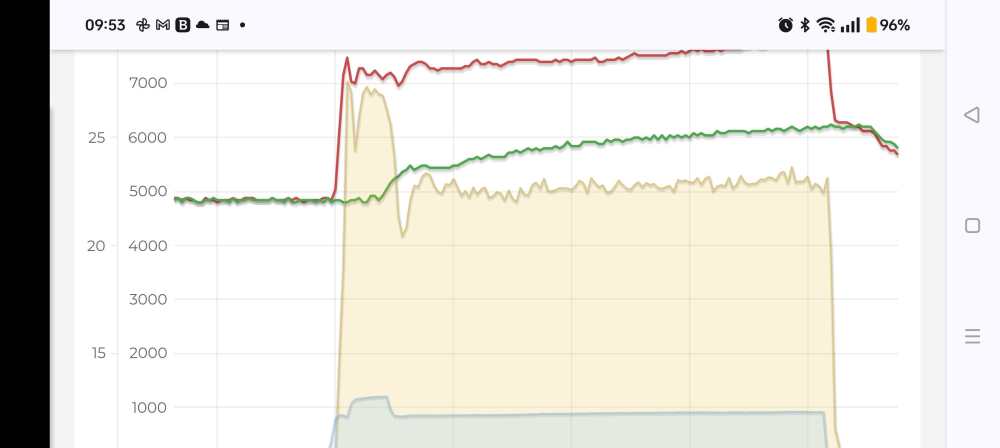
Generally when the compressor starts it tries to get the target dT fixed with as little heat input possible. Once target dT is there it manages dT by either modulating output down (if it can) or to add additional heat to flow temp as return gets hotter. Once at target flow temp it allows dT to reduce. Once the heat pump controller is no longer happy the compressor is switched off. Mine running - 25 mins running. Yellow/tan shaded area is power output big load initially and then quickly goes to the main modulation it can. Red flow temp slowly increases and dT between green (return) closes
-
Correct, flow temp will 28. Flow temp doesn't equal floor surface temp, there is a temperature gradient away from the pipes. But at 11 degrees the compressor runs for about 20 to 30 mins and is off for about 3+ hrs. While the compressor is running heat radiates from the floor pipes in to concrete, so floor surface temp gets a small increase in temperature, it's not 28 degs. If my heat pump would turn down to less than a kW at 11 degs, it would be set to the lowest flow temp I could - it would not run to 28 degs. I have tried to run shorter cycles at a lower temperature, but energy transfer wasn't great. So the fact is as I sit here, the heat pump compressor ran 3 hrs ago, water is being circulated at 22 degs, summer house is being heated by 22 Deg water. It is unlikely the heat pump will do anything other than DHW for the rest of the day. If I get solar gain in the lounge the floor output will go negative and that heat will be redistributed. No not so, if you are getting a lot of solar gain, the compressor goes off, but the floor is a huge buffer, it always at or above minimum temperature required to keep room temperature stable. Last year I was using the floor as a storage heat, heating for 7 hrs (longer when below -3) , extracting heat for 17 hrs. House had a 0.5 Deg fluctuations generally.
-
Bit of a generalisation on gas boilers, my Atag boiler and most low temp boilers do not work at a dT of 20, when I was flowing 30 degs the dT was closer to 5. dT is variable dependant on heating system and flow rate. During a heating cycle our ASHP will start at about 7 dT, and slowly close this down to about 3.5. reason is simple the return temp rises over time, and target flow temperature is fixed.
-
Yes correct. Average return temp also very close to the floor temp when the ASHP compressor is off. As soon as heat input is turned off, the whole floor tries to get to an equal temperature, so return temp is a very good gauge. And as floor to room dT is proportionally to output Watts, all you are doing with weather compensation is changing the dT to get the Watts you need to keep room temp constant. The closer the floor temp is to room temperature, the better it self modulates its output to match circumstances such as solar gain, doors being opened etc.
-
The above isn't quite correct, when the rooms are in steady state conditions, they will be getting 60:40 split of energy and always getting a 60:40 split of water flow. But as room temp gets closer to floor temp or radiator temp the dT between the two reduces, so the heat output also decreases from the emitter. So, Room A is in an over heat condition (or just a little warmer than target), Room A emitter dT reduces, therefore heat output reduces. In an overheat condition the emitter output goes to zero. Example floor surface temp 22, room 22 UFH output is 0W. So as a result of Room A being warmer, the system equilibrium is no longer a 60:40 energy split - it has become 0:100 (or anything in between), so although water flow is still being distributed in a 60:40 split, no energy is being emitted into Room A, so all heat can go to Room B. The heating system does not contribute to making overheating worse.
-
For me that's a similar setup as I originally had with a gas boiler. But way off what I now have with the heat pump. If it wasn't needed it got deleted. Anything that adds to flow temp required, adds to the running costs. An UFH manifold with mixer, will always mix around 5 degs of return water in to the hot in flow water. A buffer unless huge has a degree of mixing especially when different circuits of the heating system opens and closes. Bouncing off thermostats results in higher running costs - why because have to run too hot a flow and that hits CoP hard. Two floors of UFH is already a huge buffer and thermal store. You really don't need another. You also don't want to be running lots of thermostats. If you have them operate as limit stops, not controllers. So if you want 21 degrees in room set the thermostat to 22/23 and fine tune weather compensation curve to suit. Balance room loops to get individual room at the correct temperature. A simple weather compensation curve, is all you need. Run 24/7.
-
Heat pump manuals for any make aren't easy, must read mine a hundred times. I will still read bits again.
-
Multi zone or single zone if all your doors are open, your rooms will generally be at the same temp. Close the doors there is some individual room temp control. But the output of UFH or radiators can fine tuned by changing the dT across either floor loops or across a radiator to fine tune individual rooms i.e balancing. You really need a zone to do that. To give you background I had a zone in every room a big 160L buffer, I slowly simplified and almost halved gas consumption. Applied the simple is best approach to the heat pump, last year it was cheaper than gas by a good margin.
-
Not really, the heat pump is never off, the compressor only will go off. So if you need a floor surface temp of 22 to keep room temperature stable, once the return temp gets 22 the compressor restarts tops up the floor. With the flow on all the time, the floor temp never drops below a useful temperature. All set via the WC curve.
-
Tell that to Scotland, was 2.5 last night. Highest average temp over the last 4 days was 9 degs. A 6 Deg OAT is getting 4.9 CoP and a 2.5 OAT getting 4.7 CoP. You pay - you choose. Forums like this give people options, to allow an informed choice. No right answer just informed posts. Buffers that are big, I see zero issue with, very little mixing occurs, you can fill the buffer to your heating temp via WC, very little cycling very little over temperature required from the heat pump - but not many people have room for a DHW let alone another 200L or bigger buffer. I just use my floor as a buffer. Small buffers on the other hand, that most installer fit, are the devils work. Plenty of mixing elevated return flow temperature knocking down the CoP considerably. Not really, I have spent lots of time learning about low energy, low flow temp heating systems. And used these lessons through trial and error on my own system. Mostly because I have enjoyed it. Most people are paying a very high price for a heat pump install, they should be getting this level learning as part of the price - not many seem too. Did an experiment the other day, ran the heat pump at a fixed flow temp, set a thermostat at target house temp. House temp super stable, just like well set up WC. Like for like outside temp CoP dropped from 6 to 5.
-
I would do 28mm from the 3/4 fittings, to a 28mm diverter. Drive the whole lot from the Grant pump without mixer or pump on the manifold. You have loads of water volume. No actuators needed. How are you controlling the Grant unit, per Grant or Chofu. Given an option I would go Chofu, every thing should be possible directly from the controller that Grant put in a cupboard.



