
JohnMo
-
Posts
12469 -
Joined
-
Last visited
-
Days Won
179
Everything posted by JohnMo
-

Sourcing tall windows.... 5m x 1.0m without splitting into two?
JohnMo replied to fatgus's topic in Windows & Glazing
We are at about 5m split into 2x2.5m tall. Even then there was special lifting gear involved. Couple issues with the design Bigger means thicker, which in turn means heavy. Our triple glazed 2.5m tall are already 3 x 5.8mm thick panes and at design wind loads have a nearly 16mm deflection. Once over 2m tall you really don't notice the join as its above your eye line. Doing it again I would just stop the glazing at the 2.5m level and have well insulated above that. -
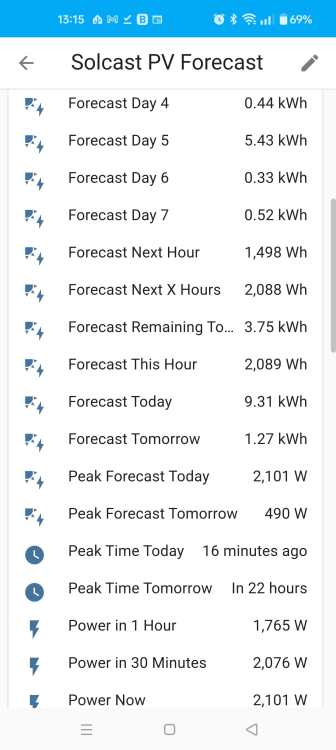
Home assistant will track sun angles if you want, it also has integration with solar forecasting such as Solcast. So you get all this sort of information So you don't need to know really what is actually going down the wires, with CT clamps etc. Mine is currently putting 5kW into the floor and 3kW into DHW, that stops at predetermine battery SoC or 2.5 hrs before sun set which ever comes first. All software driven via home assistant. The big solid state relay does what home assistant says for the immersion, while a small Shelly relay sets the heat pump at a higher flow temp, so it will run on demand.
-
ASHP UFH manifold flow meter setting help
JohnMo replied to MechanicalBuilder's topic in Underfloor Heating
Start with a higher flow rate overall, heat pumps like high flow rates. So not really an issue. My long loops are at about 2.5 l/min. On Daikin units you can adjust the dT, this in turn adjusts many other parameters, such as flow rate. May be worth playing with that also. Think you go in to the heating type to adjust. Another thing to use is one where it runs WC but also uses the built-in thermostat to stop overheating. But what's stopping it going below 30, should be able to select down to 25? -
ASHP UFH manifold flow meter setting help
JohnMo replied to MechanicalBuilder's topic in Underfloor Heating
Don't get too hung up dT. Use the settings you have now and fine tune. Start with a reference room say the lounge, don't touch these flow rates if you are happy with room temp. Then balance the flow rates to get the other rooms at your preferred temp. Increase flow rate, to increase room temp, decrease to get lower room temp. Leave you reference room flow the same all the time. Leave a good 24 hrs between adjustments. -
Electric panel heater. Gas heater no ventilation sounds like carbon monoxide poisoning, if your not careful. Or just work harder.
-
You balance via emitter area principally and fine tune with flow adjustment, which is part of commissioning. You can add Salus self adjusting actuators which peg dT across a loop so it's constant if you want. You can have a thermostat in every room. Many options. Make as simple or complicated as you like. You do what you need and feel you want to do.
-
Ooooops Spray foam gets a thumbs down from UK lenders
JohnMo replied to MikeSharp01's topic in Heat Insulation
We have it. Am I bothered - no Why, because it's installed in an appropriate manner, is not sprayed on to hold a failed roof together and not applied to non-breathable membranes. -
ASHP UFH manifold flow meter setting help
JohnMo replied to MechanicalBuilder's topic in Underfloor Heating
More info needed Is manifold connected directly to heat pump? Do you have a buffer? Do you have mixer and pump on manifold? Do you have room thermostats? -
Ditch the idea you are over thinking it. Ditch the buffer, ditch the thermostat(s). You have taken zero account of floor inertia. Which can be huge. You can simply buffer excess energy in the floor, way more capacity than a water container buffer. Simple - your heat pump already manages the return temp. But it needs to be directly connected. No mixers or additional pumps needed. You set a WC curve to match your heat loss. The compressor within you heat pump is started and stopped based on target flow temp, a delta T and therefore by default the return temperature is managed. The compressor starts based on return temp, stops based on flow temp control hysterisis. A simple self regulating system is ASHP, WC, UFH manifold. You really don't need anything else. Your room gets solar gain, the floor stops giving out heat, continuous circulation moves the energy elsewhere in the house.
-
Are you switching off the UFH and switching on the radiators? If so that could be the issue. Do you have a buffer and secondary pump? Or are you running straight off the ASHP. If your UFH is fine, you switch it off, you could be trying to squeeze a lot of flow through a small radiator circuit. Especially if the plumber has balanced the whole system to work as one big circuit. Think we will need much more details about your system and how it is all operated etc. more details the better
-
What happens if you just turn off that radiator? Do you get noise elsewhere?
-
Stick big 500W plus solar panels on the roof?
-
What large bore Plastic Primary Pipe for ASHP?
JohnMo replied to ian192744's topic in Other Heating Systems
Really depends on heat pump size, but more importantly how many kW you need to flow through that particular section of pipe. At dT 5 15mm will carry 2.75kW, 22mm will carry 6kW. 28mm is happy with 10kW. -
MVHR Options
JohnMo replied to Johnnyire's topic in Mechanical Ventilation with Heat Recovery (MVHR)
Or set up a reminder/alert on the phone to repeat every 6 months - zero cost option - yet another manufacturer interface deleted from your life -
MVHR Options
JohnMo replied to Johnnyire's topic in Mechanical Ventilation with Heat Recovery (MVHR)
Maybe your boost is set too high? -
MVHR Options
JohnMo replied to Johnnyire's topic in Mechanical Ventilation with Heat Recovery (MVHR)
I bought my units, I have two, from eBay. The two units are Titon HRV, great no issues in 3 years. There is zero fancy stuff with then, one unit tells me to clean filters and when it's on boost. I am firmly in the keep it simple camp, it's just ventilation. You don't need internet connectivity or fancy interfaces, you set it up and leave it alone to get on with it. One has a built in humidity sensor, the other I installed an aftermarket one. For the first year they boosted occasionally, but now house is dry, they very rarely need to. Mine were self installed, self commissioned, but checked by a professional with certified equipment for building control. -
Just swop it out for one with a manual isolation screw. Instead of an always open tube. Something like one of these https://www.monsterplumb.co.uk/auto-bottle-air-vent-1-2-top-vent
-
Mainly because all wooden framed windows are good thermally, the aluminium adds weather resistance. Many aluminium windows historically (lots still are) had absolutely rubbish thermal properties. Newer one's can be good. But they certainly are not pure aluminium. The aluminium forms weather resistant coating over plastic instead of wood. So pretty much the same just sold differently.
-
Interesting it doesn't state UG or UW. SO pretty meaningless as far as performance.
-
Driveway access fire brigade Reduced width long length
JohnMo replied to Oz07's topic in Building Regulations
They have to have a turning space at the house end, so no reversing back down the lane. They need a defined weight loading design fir the road so they don't get stuck. -
Homely is running the heat pump changing the demand flow temp etc. to get lowest running costs. I would be careful trying to hard, Homely may just throw a wobbly or just overwrite your settings anyway. If it's mild outside any heat pump will only run a short while because the radiators or UFH cannot shift the heat quickly enough. The only way to make it run a long time, is to use an elevated flow temp. If want Homely to run your heat pump then let it do so, or remove it and set it up yourself, not sure there is a middle ground. Homely is set to manipulate any or all heat pump settings to get the best energy usage/cost.
-
Move your energy to Octopus now, they will disconnect for zero cost. Alteration will still involve a meter and standing charge. Disconnect will not.
-
So there is no second home taxes to pay, or increased council tax etc. Not sure why there would be unless she already has a house registered in her name. As first time buyer not even sure there is stamp duty to pay. What the property firmer use was, is nothing to do with what you purchase for. For this purchase it will be your daughter's primary home.
-
Thought you were were putting in your daughter's name? Anything else will cost lots, second homes are expensive in Scotland.
-
dMVHR suppliers list (not complete)
JohnMo replied to HughF's topic in Mechanical Ventilation with Heat Recovery (MVHR)
Are you pretty much airtight or still a leaky Victorian house?