


JohnMo
-
Posts
13299 -
Joined
-
Last visited
-
Days Won
200
Everything posted by JohnMo
-

First timers attempting an ICF and Oak Frame house in Devon
JohnMo replied to MCoops's topic in Introduce Yourself
Well that won't make then airtight. Obviously the person doesn't understand airtightness. -
First timers attempting an ICF and Oak Frame house in Devon
JohnMo replied to MCoops's topic in Introduce Yourself
Durisol build - zero issues, 2 of us did the walls neither of us builders nor had either of us done it before. Just after WW2, others 30+ year after. If you are wet plaster inside that side is sorted. Render on outside that side is sorted. We lime/cement parged inside, very thin coat. Stone slips, and wooden cladding outside. -
It may show on your planning or building warrant, but it's not set in stone. The sewage system is only approved when when you have been through the full approval process with SEPA and have a duly approved certificate for that exact make and model. So up to that point are free to change things, after certificate issue you are not, without reapproval of the full system and new certificate.
-
First timers attempting an ICF and Oak Frame house in Devon
JohnMo replied to MCoops's topic in Introduce Yourself
Obviously Velox and Isotex are not very good copies of Durisol. So should not be compared as the same. -
We are the same 2 off us, but find the house way more comfortable with a steady trickle of heat. You can keep the house cooler and feel way more comfortable, but also use the gas way more efficiently. So actual gas usage is the same or comes down. Combi v cylinder, we have had both, we actually use less energy heating a modern cylinder than the combi did. The water out of the tap comes much quicker also from opening the tap. The combi would just fire up to full load of if you open a tap for a second or two. That doesn't happen with a cylinder.
-
Observation I thought you were getting BUS grant for ASHP, the grant should cover the installation of the heating system also, so should that bit be covered by the heating installation? Seems mad they are doing everything including supply radiator valves but not the radiators? All sounds expensive to me, I would be looking for a second or third quote.
-
First timers attempting an ICF and Oak Frame house in Devon
JohnMo replied to MCoops's topic in Introduce Yourself
Not correct. Woodcrete is an open structure and water will free flow under gravity out the bottom. It doesn't readily absorb water. Not sure where you are getting the information but it nothing like anything I experienced doing our build. Are you really talking about woodcrete ICF blocks or something different? Or wood fibre insulation? -
The quote is what?
-
First do a room heat loss. That will tell you. You make no mention of heat source or flow temp, these all have an impact on suitability. BTU, thought people stopped using them 40 years ago unless your from the USA.
-
Boiler short cycling with low flow temperatures
JohnMo replied to seanblee's topic in Central Heating (Radiators)
That's to be expected. One zone and 10kW output stands no chance of running well. Putting bigger rads in, is unlikely to help if only that zone is allowed to call for heat. Would really try to get it all on or all off, nothing in between. Dumb TRVs that don't fully close, maybe helpful in a small number, not everywhere. You may need to balance the system so room comes up in temperature at a fairly equal rate and use a single thermostat to bring all on and all off together. Keep it simple is generally the only way. -
Boiler short cycling with low flow temperatures
JohnMo replied to seanblee's topic in Central Heating (Radiators)
HA has it's merits, until your internet stops, or you have a power cut and the server doesn't automatically restart - been there. I have just moved everything away from HA for heating, so nothing is reliant on internet based services. Think your boiler does Opentherm, so I would look at an Opentherm Tado to manage the boiler for you. Then dump HA from the heating system. -
Boiler short cycling with low flow temperatures
JohnMo replied to seanblee's topic in Central Heating (Radiators)
Boiler and equally so heat pumps, just produce heat, if the heat cannot be dispersed to the house, return temp stays too high and you get what you are seeing. Splitting the system with zones will make life hard for the boiler. Are you running with lots of thermostats, TRVs etc. micro bore may not be the issue, actual flow rate may be. Remember the microbore is only carrying the flow to a radiator which will have a decent volume. -
That's what I like about Atag boilers there is none of this range rating to do, you can limit max power output, but you don't really need to, and no faffing with boiler flow rates. Everything in fully integrated - pump flow automatically modulates to suit flow and return temp, and output is automatically modulating. They also start differently from other boilers, start up is at minimum output and they slowly ramp up (depending on how you set the gradient setting) settling at min output and suitable dT to support demand. Pretty much the same as my heat pump.
-
MVHR Commissioning documentation
JohnMo replied to PaulD's topic in Mechanical Ventilation with Heat Recovery (MVHR)
You need a simple form that says Building Regs flow rate and actual flow rates in normal and boost, as a total and room by room basis, plus stating whether it's a extract or supply. Plus you need the flow meter you used, calibration certificate. -
BUS Grant requirements (conflicting info)
JohnMo replied to Rudski's topic in Air Source Heat Pumps (ASHP)
And a video https://youtu.be/FohU-RNTA4E?si=4dBQdfkq4eXEVDXD -
BUS Grant requirements (conflicting info)
JohnMo replied to Rudski's topic in Air Source Heat Pumps (ASHP)
Think it can be located in various locations depending on exact model and indoor unit purchased. 16L is about 0.6kWh which is equal to the energy used for defrost in the write up. Smaller units maybe don't heat up so high? -
Maybe a photo of the hole not the ladder would be good. But I would do a proper job - patch the two walls with blocks and cement, after cutting away to make hole to neat shape. Prior to doing the final wall reinstate insulation in the cavity.
-
Architects, ballooning fees and estimates
JohnMo replied to Drellingore's topic in Costing & Estimating
They use a look up table, for indicative build costs. -
I would look at something like an Atag i15S, with PDHW kit. 18 year warranty.
-
Heat loss rate W is the heat loss. You need a boiler that can provide that to heat the house, worst case. Allow some time for DHW heating you are still only needing less than 7kW. But realistically you will be in the 11 to 20kW range of boilers. It's just important that you get one with a good modulation, if it can go down to about 3kW you will have a good stable operation all year, running a simple WC curve. So you just need the following Boiler (that does PDHW and weather compensation) Get a heat pump cylinder with 3m² heating coil Diverter valve. Ideally size radiators for the same temperature as the UFH (you can then run the whole system from the system boiler circulation pump all at the same temperature. (no UFH mixer or pump needed) A controller from the boiler manufacturer. Run all as a single zone, with trvs on the bedroom radiators only. Your system is then heat pump ready also. But will make the most out of the gas boiler.
-
So you just need a dinky gas boiler. Find a new plumber. They are just sticking a finger in air and having guess. The difference in a good install and poor one is using twice the gas.
-
Look at as built or as designed space heat required section. Depending on how accurate your sap is, depends how good the figure is. 4th line down - heat loss rate W. Look for the most onerous month. So that is your ball park heat loss rate.
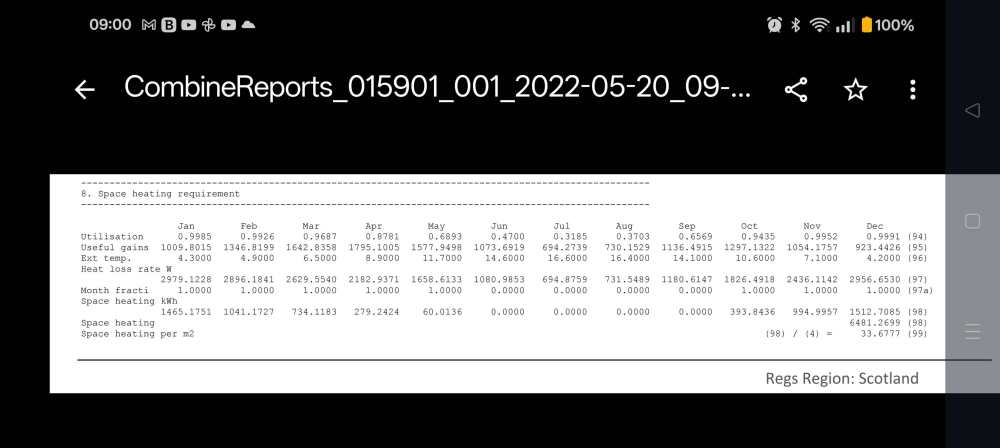
-
What really matters is modulation range, if it can go down to 2kW it's suitable for just about any house. If it only returns down to 15kW it maybe too big for most properties. Do a heat loss calculation as linked above. Or read your sap report (full version) and it will have max demand hidden there also. I'm currently running a 32kW boiler in a 3.5kW (at -10) heat demand house. But it turns down to 6kW and is running into a thick screed UFH. It doesn't cycle, runs at 37 degs for hours on end, when asked to do so. I am running simulated weather compensation (boiler thinks it's running WC) but delivers a fixed flow temp that modulates power. If your doing a new boiler, set it up correctly - priority demand hot water (PDHW), and weather compensation. I would do a system boiler not a heat only and get one that manages pump flow rate also. Go Intergas, Atag, Viessmann or a new series of Vaillant which modulate better.
-
New broadband connection deemed non-uso
JohnMo replied to Thorfun's topic in Networks, AV, Security & Automation
Not exactly rubbish - by any stretch. Can't get anything like that here. You may need a little perspective or dip your hand in your pockets. -
Not even sure I would leave them in the house, just take them with you. MCS battery install, doesn't allow you export and get paid for it. Panels yes - battery no.



