


JohnMo
-
Posts
13297 -
Joined
-
Last visited
-
Days Won
200
Everything posted by JohnMo
-
I have normally just used normal house insurance on renovations, you just declare major work and define what you are doing. No special insurance ever.
-
Easy wait until you can afford it, then do whatever you need to. Live with what you were happy to buy. Do nothing, don't waste money or time on things that could be skipped in a few months. Spend your time living in the house and work out what really works for you.
-
 3 port is better than 4 port. But a 3 port would need a pretty big buffer to stop mixing. The 2 port ideally will be at least 50L, ideally more if you have the space. Different running profiles for 3 and 2 port buffer. The 2 port has a thermostat this calls the ASHP to start and stop. So mixing of flow and return and the distortion this causes is minimal. Low demand heating the ASHP more or less runs to keep buffer at temperature, thermostat switching on and off. High heating loads the 2 port is likely to be by-passed fully. A 3 port is normally just a vessel with ports the heat pump doesn't know it there. If the heating demand is low some flow from ASHP will migrate to the the lower ports and cause distortion to the way the ASHP runs. Distortion in simple terms is an elevated return temperature caused by flow and return mixing. This gives an elevated return temperature and causes output temperature to increase affecting CoP. But all the above said, try to a do the heating scheme as open as possible, no zones, no buffer. Run the UFH and ceiling loops fully open, this will allow the heat pump to flow what it wants and manage dT and flow rates.
 -
So do two/three rows of normal size panels with GSE or similar mounts in landscape instead of portrait? As suggested above. Big panels aren't always the correct answer.
-
Had the 110mm stuff already in my left over build pile. But refused to pay a small fortune for pipes that had worse insulation than I wanted. So 28mm Hep2O roll, several lengths of closed cell insulation and aluminium tape left over from build. And an hour or less of my time. No special coupling needed either just normal Hep2O ones. All in less than a 1/3 the price for materials and no delivery charges either.
-
Plaster in wall lights...skim up to or over
JohnMo replied to Huckleberrys's topic in Plastering & Rendering
What happens when they fail. Do you dig them out of the plaster replace and then get the plasterer back. "This product contains integrated LED's" so not a replacement item. -
You need to ensure the inverter is ok, big panel can mean big amps. Generally hybrid inverters are ok. But check.
-
Easy - go back to structural engineer and ask.
-
Timber frame with stone cladding / render - Window details
JohnMo replied to HanleeHouse's topic in Windows & Glazing
Forgot to mention, is the external detail robust enough to take the weight of 30mm blocks? Has it been checked structurally? -
Green treated timber for internal service battens?
JohnMo replied to Grimaldi's topic in General Joinery
Bog standard treated 50x45 battens for me, used the same inside and out. Cheap as chips. Was a couple of months between battens going in and plasterboard, so plenty of time for any toxins to weather off. If they haven't moved by then, it's unlikely they will. -
Timber frame with stone cladding / render - Window details
JohnMo replied to HanleeHouse's topic in Windows & Glazing
Think you are making things a little difficult as drawn. Your frame needs to straddle the insulation not necessary to fully bedded into it. So if you bring the window frame to outside flush with cement board, you don't need to form an outside return. Which could look a bit bitty. This is mine, cut the stone with a diamond cutter. Inside return is now deeper and easier to form, as you have material available to attach things too without risk of splitting.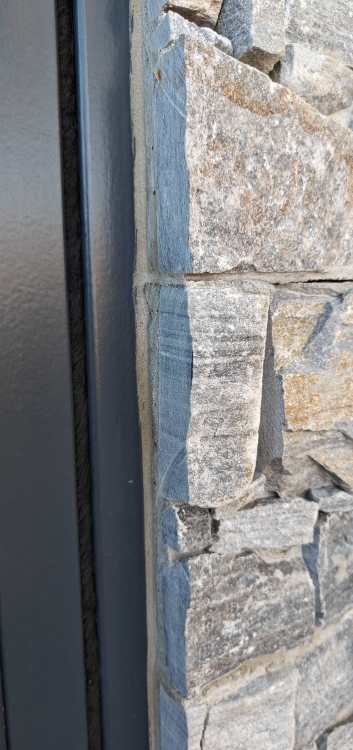
-
Not really seeing any benefits. Works well at the terminals, zero noise, zero cost for more parts, measure, adjust done. Instead of measure, go to manifold pull off hose, pull out widget to change, re-assemble, check, repeat.
-
Our heat pump is about that distance, I trenched about 600mm. Insulated pipes in 25mm black insulation, then aluminium foil tape wrapped and then inserted into 110mm Flexi underground twin skin pipe. Sealed the ends at ground level with stainless steel mesh and spray foam (stop mice etc). Zero issues.
-
Between a Roof and a hard place....
JohnMo replied to Mulberry View's topic in General Self Build & DIY Discussion
We did similar, although on compacfoam upstairs. We did an EPDM standing seam, the upstand is completely covered and seal welded. Again we open doors and windows, but also run UFH in cool mode. -
Between a Roof and a hard place....
JohnMo replied to Mulberry View's topic in General Self Build & DIY Discussion
We actually did ours before walls or roof. So you are in a better starting point and way less likely to get wet, even with your current issues. Just do a cement based screed that is tolerant of being wet. -
When I lived in Singapore the apartment had small local storage cylinders with heating element. So one in kitchen and one in the wall for showers and sink. For showers gave the same experience as an UVC shower. Near instant heat. Having a big cylinder isn't the only solution, storing small amounts of hot water and only heating what you use is a better solution, better than instant heater.
-
Statistics and numbers are a wonderful thing. I've always said insulation is king but this does put a different spin on things. Not sure this approach would apply with a suspended floor, as it's outside air cold underneath. But as with all statistics you have to be careful. Also note it is extremely likely the floor was then screeded, not the same as a foam former covered with OSB, heat transfer from pipes was good to the floor the way it's been done. CoP and energy use are related, but very different. Running low flow temperature with a heat pump yields a good CoP, but doesn't mean the energy yield is all used. Insulation means more energy input can be utilised in the house and less escapes. Think in the video he said the heat loss was about 3kW at -3, assume 25% of that is floor losses, so about 5p per hour (CoP of 4) but only when it's -3, less than half that at 7 degs. So justifying ripping floor up to insulate would be low. Good result for CoP, but maybe not so good for energy utilisation. But a cost effective solution overall. Just a matter of number balancing.
-
self-build PhD Thesis Survey - Self-build Industry in UK
JohnMo replied to CemCet's topic in General Self Build & DIY Discussion
That sounds like hard work, hadn't planned that today. Wife has left over french onion soup for her and I've got left over Mac n cheese to eat. -
That's what I like about the titon units, super easy to adjust, normal rate adjustment by individual flow and return potentiometers, same for boost. Setback just falls midway between current normal setting and min acceptable flow. Had a look at Titon frost strategy for cold weather without input heater. As it senses heat exchanger frosting is likely to occur, it starts to slow the supply fan down, once temp is outside frost zone it starts to slowly increase fan speed. So over a prolonged cold period supply fan will cycle speed up and down slightly. Only part of the story You need a low pressure drop over the system, to get fan speed as low as possible. But the MVHR also needs to be generally quiet also. But you also need the supply or extract terminal to be open as far as possible to reduced localised noise generation. But also have system balanced. That is part of commissioning, you can model noise as much as like, but poor commissioning will lead to a noisy system.
-
Combi - they aren't flushing the toilet, running taps elsewhere, got the dishwasher on? That would be my start point.
-
There is a thread from about year ago, someone did something similar and one part of the floor was great the other rubbish. The different heat profiles although small, had an impact on the system worked. At very least you need to ensure each floor type has its own UFH loops, so the loops do not have to work in both areas. Then you can balance the flows to get the system to work correctly. Do not try to mix radiators and UFH in the same area, you will have two systems with very different inertia fighting controls. Your money, your house, opinions given as requested. KISS (Keep it simple stupid) is the best policy for heating systems, zones and mixed systems are normally worse, not better performing.
-
Not if anything on this video will help
-
That is tiny amount of space inside - loads of work and possibly money, that will get skipped in a years time because it's so small.
-
How are you going to maintain the French drain? How are going to render? Why do people build so close the boundaries. Just move to the correct house. PIR insulation is the worst insulation for a cavity wall. Easy to make a bad job of it, difficult to get a good job.
-
This is a different take to the UFH argument. But you will need to run 24/7 to keep floor buffered with heat. Which is how you should run UFH really.



