


PeterW
-
Posts
18480 -
Joined
-
Days Won
207
Everything posted by PeterW
-
It’s VAT exempt as a new connection to a new property.
-
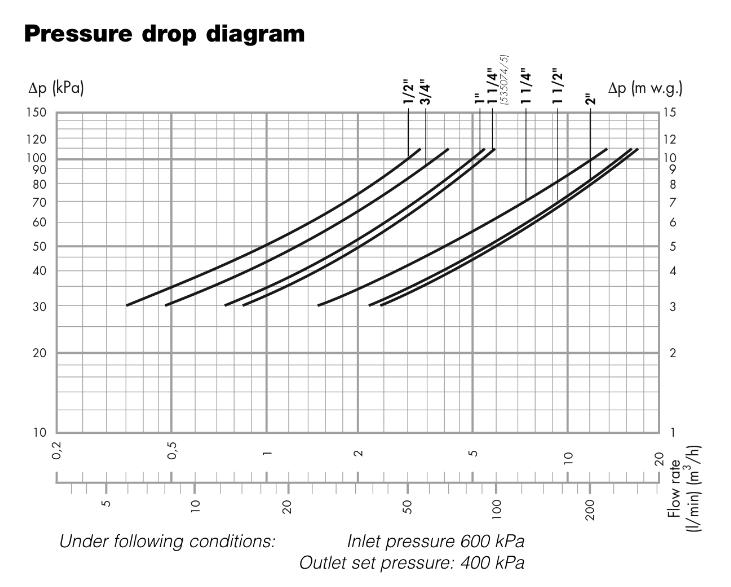
Not necessarily - they are factory set for an average use at 3bar or 300kpa at 10lpm which is fine usually. Standard fluid dynamics says that if you increase the flow you decrease the pressure so you need to decrease the pressure restriction. Graph below shows that for 14lpm you would need to decrease the restrictor by approx 0.45bar or 45kpa
-
Looking at the graph the pressure drop at 15 litres /min is about 0.5 bar at most. They can be adjusted upwards so you can set it to 3.5 bar if you are losing pressure downstream.
-
They are a Caleffi unit and you can change the flow regulator. I would check you’re getting 2 bar dynamic water pressure prior to the PRV first as it could be a 6 bar static until you get a flow.
-
You can use any provider - BT are not the only ones who can order a new line.
-

Is CIL payable on a self-build conversion?
PeterW replied to Andy Le Vien's topic in Barn Conversions
Croydon aren’t doing the calculation correctly ... you may need the VOA on this after all as it should be calculated on any new space created minus any existing use B1 etc -
Just whack it on its side and use that - quick and simple but remember all your door linings will need to be custom made.
-
Substitute an RSJ with an oak beam.
PeterW replied to epsilonGreedy's topic in General Construction Issues
None of that’s needed anyway ...!! How long is the wall we are talking ..?? Assuming it’s 10m, it needs a single buttress somewhere between 4 and 6m in its length. That buttress needs to be no more than a block on side or a stub return wall of 450mm from memory. ( @StructuralEngineer Can probably confirm) The steel is doing nothing ....... it’s not “tying” anything unless it’s bolted through to padstones both ends and even then your maximum load is the mortar strength. Lateral restraint of walls is usually done using the bent straps attached to the joists. -
Other than swapping the insulation and concrete depths I would say not far off although don’t forget you will needs to get rid of the spoil and also lay one or two courses of blocks internal and external walls to put the slab down.
-
Is CIL payable on a self-build conversion?
PeterW replied to Andy Le Vien's topic in Barn Conversions
From Michelmores Would a permitted change of use from offices to residential trigger a CIL liability? From 30 May 2013 premises in use class B1(a) office use can change to C3 residential use (subject to prior approval covering flooding, highways/ transport issues and contamination) without requiring planning permission, under permitted development rights. Permitted developments are liable for CIL in the same way as development permitted by planning permission. Usually however, a simple change of use will not trigger CIL, as no new buildings are being created. However existing floorspace may only be used to offset the CIL liability where it has been in continuous lawful use for at least six months in the 12 months. So if the office building has not been in a lawful use for at least 6 months in the last 12 months and the use changes to residential, CIL could be triggered So basically they can’t charge CIL for that as you can offset, and any new extension under the PP would be less than 100m2 I expect anyway so you would not pay... -
Substitute an RSJ with an oak beam.
PeterW replied to epsilonGreedy's topic in General Construction Issues
Yes and no...... You would need to use a structural beam certified by an engineer. It would still need the same structural support as an RSJ if it supports anything above. Your alternative is to design out the RSJ now and make the joists run parallel to the beam and convert any block work walls upstairs to stud work. -
Air volume, air brick
PeterW replied to Russell griffiths's topic in General Self Build & DIY Discussion
@Russell griffiths you may find this useful https://www.bre.co.uk/filelibrary/radon/56998_jRadonSht2PP.pdf 1500mm2 per metre of wall according to this -
Charge is less than an hour from dead - mine take about 25-35 mins at most. You can buy a quick charger separately if you really need to anyway.
-
Is CIL payable on a self-build conversion?
PeterW replied to Andy Le Vien's topic in Barn Conversions
Ok - so you’ve currently got a certificate of lawful use on the existing property. I’d suggest the following (and I’m not a lawyer or planning expert..!) which would to be to convert what is there first on a new planning application. It’s entirely legal and a change of use is exempt from CIL anyway. Then when that is done and signed off, use the old PP to build the extension or even do it under permitted development if needed. May cost you two lots of BRegs charges but it’s got to be less than the CIL liability ..? -
Bin unless you’ve got the ability to balance it. Bigger blades have more rotational inertia and any off balance shows up as vibration. The more vibration the more wear on bearings.
-
Plot bought with a double garage on it for conversion but that cost more to strip and retain than it would have done to demolish and rebuild...! No architects fees as the plot had PP so just BRegs and Warranty costs. Room in roof certainly saves money as it reduces wall build and utilises all the “lost” space. Probably about £10k of free labour in there but otherwise all paid.
-
I had 3 broadband accounts on one line at one point - asked them how it was possible and got no answer ! Business team are UK based so a bit easier to deal with - I got them to agree that as it was their issue and I was helping them that anything over a 5 minute phone call was me charging them £120/hr +VAT.... soon got their attention !
-
Currently on target to deliver a 168sqm 3 bed/2 bath with room in roof at around £122k so £720/m2 and that isn't including a VAT reclaim as its classed as a conversion. Pays to shop around and pick trades carefully.
-
Another "what's the correct name" plumbing question
PeterW replied to ProDave's topic in General Plumbing
I thought you meant the expansion vessel size @Nickfromwales..! So that’s interesting then though about the coil as the spec I’ve got says half that..! But it may be the standard coil not the HP coil ..? Even so, it makes squit difference as 8 litres is more than enough ... -
Another "what's the correct name" plumbing question
PeterW replied to ProDave's topic in General Plumbing
Its the failure scenario - you're right however you need to design for it hence the 8 litre one anyway (which is pretty small !) -
Retaining wall structure and strength
PeterW replied to David Chapman's topic in Landscaping, Decking & Patios
So in a purely mechanical / geophysical view, the ground will not slide anywhere as it will be bearing straight down with the exception of the last metre that will be exerting "some" force at 45 degrees to the structure. Gabions can comfortably hold back 1m but would need to be stepped to acheive this although a 1m cube is not the most attractive of things unless you grow something out of it..? I doubt I would go with the concrete boards as these I expect would crack pretty quickly as they aren't designed to be structural - I would just suggest a pair of 500x500 gabions stacked to give you a step and then work from that. -
Another "what's the correct name" plumbing question
PeterW replied to ProDave's topic in General Plumbing
Eh..??? 21 litres is what’s needed for the UVC not the coil and pipework..... @ProDave working from the coil spec I have, it’s 11.7 litres in the HP coil, 30m of 22mm and adding in the loops it’s circa 70 litres. At 90c that’s a 4.2 litre expansion vessel required so next standard one up is 8 litres which will be fine. -
Ignoring the Welsh wonder, I linked the Plasson 25/22 as you can reuse it on your house supply as a permanent stop tap..... ?
-
Bin the tap Get a Plasson 25/22 stop tap Make up a 22 > 22/15 Reducer > 15 section of pipe New 15mm tap with DCV
-
Is CIL payable on a self-build conversion?
PeterW replied to Andy Le Vien's topic in Barn Conversions
They do get involved - it’s a 116B appeal which refers to the amount of exemption given - in your case it is zero..! “the collecting authority’s calculation of the amount of the exemption for self-build housing (regulation 116B appeal)“ https://assets.publishing.service.gov.uk/government/uploads/system/uploads/attachment_data/file/421848/Guidance_Leaflet_for_Appeal_Form__clean_.pdf I would write to Croydon asking them where the definition of a new build is in the CIL regulations. Out of interest what are you converting ..??

