PeterW
-
Posts
18480 -
Joined
-
Days Won
207
Everything posted by PeterW
-

Ufh manifold, blending valve with ASHP.
PeterW replied to Russell griffiths's topic in Underfloor Heating
So what is setting the temperature of the buffer..? And how any manifolds do you have..??? In this design, one manifold could deliver cold water to the buffer faster than the other so you will get mismatched flows and no way of setting the actual flow of the system Incorrect - Minimum setting on the IVAR and ESBE valves is 22-24c Incorrect - a manifold pump will pull from the buffer via the flow valve, as per any design (including a couple I have recently installed and commissioned that work fine...) Incorrect - you set the mixer to the flow temperature required. The required heat to get the slab/room to the correct temperature is the same, irrespective of the flow temperature (this is the standard laws of thermodynamics) so there is no additional running cost. OK so this is the crux of the issue. He doesn't recommend them, so ask him to WARRANTY that the ASHP can never exceed 35c including in a fault condition. Also, does the buffer have a backup immersion..??? -
Ufh manifold, blending valve with ASHP.
PeterW replied to Russell griffiths's topic in Underfloor Heating
Ask them to guarantee the output of the ASHP, and warranty against any floor damage in the event that the ASHP overheats the floor. And then fit a blending valve.... -
micro inverters..??
-
It depends ...!! If it’s a flow and return system - so the two pipes are not connected to the same pipe - then caps are OK. If the supply pipes are from the same pipe, then again you can cap off. However if the flow goes through the inlet then out the rad at the other side you would need to join the pipes ..! I would keep the pipes anyway and put in a towel rail, you will struggle to heat a bathroom in an older house with underfloor heating alone.
-
What type of joists?
PeterW replied to osmononame's topic in Mechanical Ventilation with Heat Recovery (MVHR)
Oddly, if it is spanning over a load bearing wall it may improve the structural strength as you will transfer the tension in the chord past the wall into the next room. I would still be checking the pricing though as the variation sounds too big. Some builders like JJI joists as they can be adjusted on site - a luxury you don’t get with a posi joist. -
24.6p/W https://www.itstechnologies.shop/collections/ja-solar/products/16-x-ja-solar-280w-poly-trade-prices-online-shop ITS have quite a few different ones. Check with Wagner Renewables as they may well match the price if you buy the in roof system from them too.
-
Those Canadian Solar panels are much bigger than a normal panel - usually used in industrial installations. They still come in about 25p/W for the panels but need less framing hence the saving on fixings. You could try GB Sol and ask if they would consider their RIS system being reconfigured for the size of panels you have, but it won’t be cheap as it’s custom made to fit. The whole lot is riveted together and you would also need to get the EDPM sealing strips from them. Can you not cancel your order ..? Distance selling and 14 days cancellation ..??
-
What type of joists?
PeterW replied to osmononame's topic in Mechanical Ventilation with Heat Recovery (MVHR)
What is the span and the size of joists ..?? And roughly how much in total area do you need ..? I- beams aren’t that much cheaper than Posi joists, are you sure the posi quote doesn’t include the noggins/clips and boards too ..?? -
Awkward Shower Shape
PeterW replied to canalsiderenovation's topic in Bathrooms, Ensuites & Wetrooms
Where is the drain through the floor ..?? Or under the floor ..?? That will dictate where the waste goes - can’t see it on the pictures. For me, I would go 1400/1500 x 800/900 and not worry about the door anyway - an 800 door would still leave a swing of 600 before the end of any glass frames (and a nice space behind the door for the towel rails) -
Ufh manifold, blending valve with ASHP.
PeterW replied to Russell griffiths's topic in Underfloor Heating
Ask them the minimum temperature the valve will go to - I think it’s 42c from memory which isn’t low enough for ASHP and a decent insulation level. -
Awkward Shower Shape
PeterW replied to canalsiderenovation's topic in Bathrooms, Ensuites & Wetrooms
Square the corner off, put the toilet on the squared off wall (could use a back to wall frame) and then put the shower where the WC should be and move the basin left ... -
Moving loads of plumbing and plumbing in plastic...
PeterW replied to Carrerahill's topic in General Plumbing
Because you’re doing it on hundreds and are doing it professionally...? I’ve seen a lot of these installed where the collet is not done up - the horse shoe is to show it has been done up correctly - it is why it should be fitted. -
Moving loads of plumbing and plumbing in plastic...
PeterW replied to Carrerahill's topic in General Plumbing
Difference there is a three stage process to fit a JG fitting - insert the pipe, check and then rotate the collet, finally adding the clip to stop the pipe removal clip being depressed. Hep2O is a single process, and you cannot accidentally catch the release mechanism. -
No reason why not ... charge your build £20 a week (plus VAT) rental, then sell it at the end of the build. Offset your depreciation against the company profits .. No different to a building company buying a server !
-
Daft numbers being quoted unless you live in central London ...
-
£6k for a concrete slab is a joke anywhere but Mayfair. There is £600 of concrete in that slab. I would get round the BRegs and planning issue by building a pair of 20sqm buildings separated by a 3m pergola / covered area between the two buildings. You could use the same roof but leave both ends open and it’s not classed as internal area. Gives you flexibility to use them for different things too.
-
Ufh manifold, blending valve with ASHP.
PeterW replied to Russell griffiths's topic in Underfloor Heating
Shall we try by talking slowly ........?? DHW doesn’t need a TMV on the input to the coil but does need it from the output from the storage whether its UVC or SunAmp or TS. UFH should always have a TMV as you want to blend the floor temp to a maximum temperature to prevent overheating - trusting the ASHP to do that, and also only having the ASHP pump to circulate water in the system is a really bad idea. -
Ufh manifold, blending valve with ASHP.
PeterW replied to Russell griffiths's topic in Underfloor Heating
Fiiiiiiggghhttt..!!! Blending valve every time, otherwise even when it’s off you are circulating fluid through the ASHP. -
No the Willis heaters are there for a backup if the ASHP breaks Sizing an ASHP is fairly simple, the difference is getting used to running it on off peak power such as E7 or E10. You use the floor as a big storage heater, pump lots of heat in and then it radiates through the day. E10 allows you to give it a boost later in the day.
-
Ok but be careful and don’t move it until the first circle on batten is rock hard.
-
Moving loads of plumbing and plumbing in plastic...
PeterW replied to Carrerahill's topic in General Plumbing
Ok so ... I won’t use Speedfit as the quality is not as good as Hep2O. If it rattles, it’s the wrong insert. I wouldn’t hesitate to use plastic in a ceiling - as you say it’s a single run and no joins to leak. -
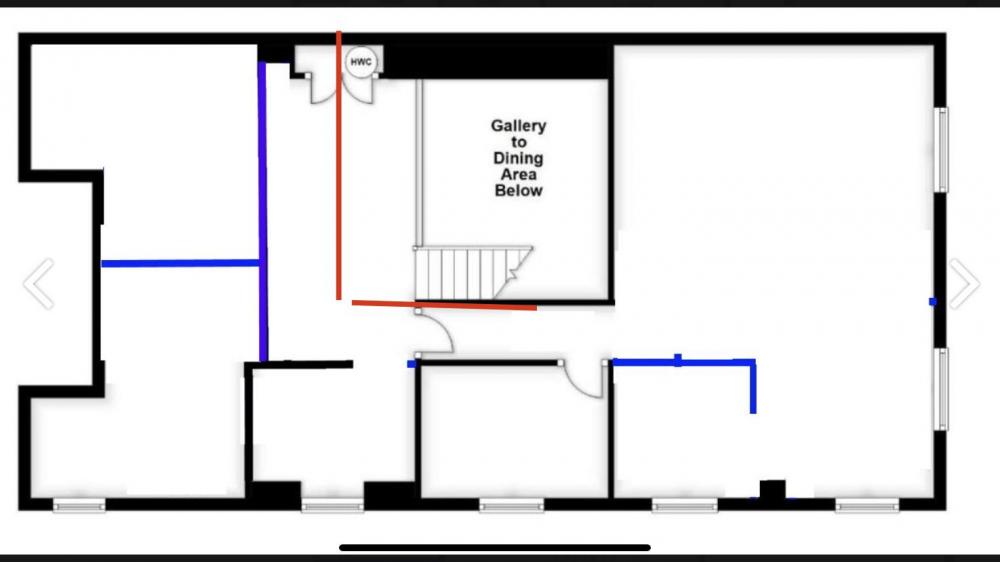
Could you not do this ..? Would obviously need a door somewhere ..!
-
Only if you made the stairwell fully protected for fire, which would need all of the doors to be fire doors, and potentially you may have to include secondary protection such as sprinklers. You may find if you made the upstairs gallery narrower and provide a protected fire corridor to another room, they may let you do that. Would need an understanding BCO.
-
So round there the price for a week is about £380 ex for a 7 metre TH, goes up to £480 ex for a 12 metre TH for a week. You’ll also need to insure that - think JCB insurance is £120/wk for non road use. You should have some training ideally - not sure what an insurer would say if you had an accident and they are very easy to tip if you don’t have good knowledge of how to make them manouvre on a sloping site. I would say that in a week, I reckon you will use it for 3-4 hours most unless you are doing a timber frame on your own and you’ll find it quicker, cheaper and easier to find a friendly farmer - I pay £40/hr and lose all the hassle and the worry ..!
-
Not difficult to do with a table saw - the inside angle one is a little more tricky but shouldn’t take much. Are you doing the cladding yourself ..?