PeterW
-
Posts
18480 -
Joined
-
Days Won
207
Everything posted by PeterW
-
Anything downstream from manhole away from the neighbour (flow direction) is adopted, the upstream side isn’t
-
It’s a powder hardened GRP - are they also using mesh..? Other option is Desmopol or similar - it is a rubber based product so more flexible but potentially less durable. How will you get to maintain this out of interest ..??
-
And a huge cost saving - price up XFLo, Rubber and 6mm ply vs battens, pug and 11mm OSB
-
not at all .. parquet OSB Pug/pipes/batten 22mm Caberdeck Joists / insulation Clearer..??
-

Viessmann Vitodens 200-w - initial impressions
PeterW replied to larry's topic in Boilers & Hot Water Tanks
Given that is the core component in a combo boiler and it’s less than 6 months old, it kind of puts it firmly on the “do not specify” list. -
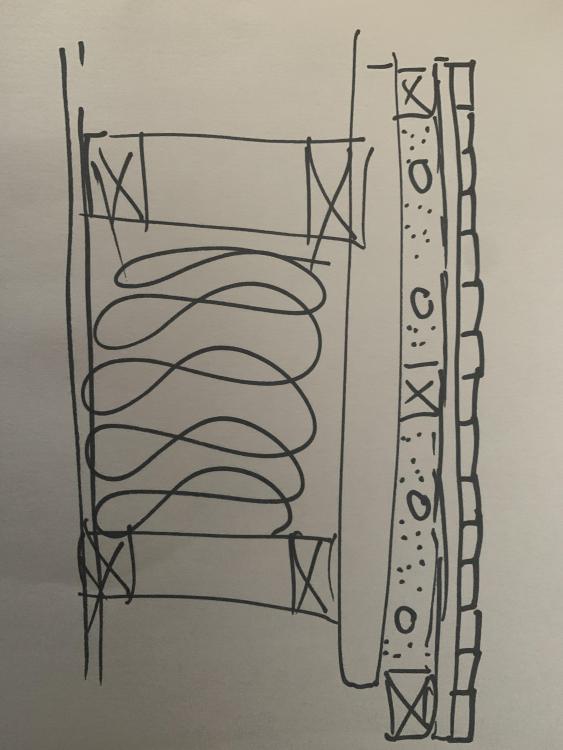
What is the XFLo adding here if this is first floor..?? I would - assuming joists can support - use 18mm battens at 400 centres with the pipes in between, and fill with a pug mix of 6:1 sand cement. Cap this with 11mm OSB, then your parquet. That build up of 29mm is less than your Cellecta and it’s rubber flooring and the pug mix adds a decent amount of dampening mass. @ProDave has something similar so can comment on the sound issues.
-
Correct - anything pre-meter will use the PV generation.
-
Casting window cills on-site.
PeterW replied to epsilonGreedy's topic in Bricklaying, Blockwork & Mortar
one is concrete and one is recon stone - different products. -
No issues but you won’t be able to thread pipe under the mesh. You will have to lay the bottom mesh and the chairs, lay the pipes then lay the top mesh and cable tie the pipe up to the top.
-
Is that sharing the trench or the pipe ..? Are they above or below you on the connection ..? so if it’s one house connected, you want to go for a minimum 2 bar and 25l/min to get decent showers running in parallel. pressure loss on 50mm would be around 0.18 bar, on 32mm it will be 1.1 bar over 600mm at 25l/min. Ideally you want 3 bar at the house so you need to understand the main pressure and the minimum they will guarantee at the property. Where are southern suggesting the meter will go as that is always the restriction
-
Don’t buy the fakita angle grinder ... just died on me after 2 weeks and not given it that much abuse !
-
New member problems with kitchen extension
PeterW replied to Bobby Dazzler's topic in Introduce Yourself
Most surveyors I know won’t even use a set of steps to get into an attic, never mind scaffolding ..! How old are the houses as it’s very rare to do anything like inspections unless there is a visible issue or they are selling. If the houses are similar age, get Mrs Bobby Dazzler to ask why the neighbour wants the wall inspected... and see if it’s bluff.. -
Excessive cracks and shrinkage in plasterboard ceiling
PeterW replied to GaryM's topic in General Construction Issues
That isn’t correct PIR is 0.022-0.025w/mK, glass wool is 0.035-0.045w/mK If you remember that uValues are calculated using the inverse (i.e. 1/uValue) then glass wool is half as efficient as PIR. So I expect that the builder has stuffed the insulation up under the OSB which will have removed any ventilation and you have condensation issues. The moisture from the drying plaster will have also gone upward and condensed on the OSB - do you know what membrane was used ..? -
New member problems with kitchen extension
PeterW replied to Bobby Dazzler's topic in Introduce Yourself
OK they have a right to inspect but not to erect scaffolding .... and even if they did they still need your permission .! For example, they cannot erect scaffolding that would block your usage of your property without your express permission. And this all hinges around what is “reasonable” and a surveyor would not reasonably require scaffold to inspect a wall - if they did then it would be commonplace and I’ve never seen it used in over 30 years !! -
List of mortgage companies will be limited with that, and if this is for sale in the near future (is that your plan..?) then I would get a recognised warranty Differences are here - and it’s pretty clear why mortgage companies don’t like these. https://cic.org.uk/admin/resources/cml-certificates.pdf
-
Stiffening subfloor with floating noggins
PeterW replied to MortarThePoint's topic in General Flooring
So ... I agree ..! I don’t think that’s correct as you’re using a single planar deflection. You’re assuming the board can flex but also it will act as a beam and it is a multiple span / support element as a board is fixed across a minimum of 3 joists. When you look at it like that, you start to realise the complexity of the floor system is actually a modular cassette of beam and floor acting as a single element. Also worth understanding that the floor beam / joist has more of an impact to the structure than the “skin” itself. This is also a 2 person job as the stress members would need to be added in parallel to the joists so they cannot be added to the boards ahead of installation so you’re talking about 5min/m x 2 people x £20/hr which is £330 in labour plus £100 materials so £430. Take into consideration that moving from 600 to 400 centres would add around 8 additional joists, then the £430 would be better spent on that element which has a significant increase on overall stiffness. There are also additional issues such as the inability to use spreader plates etc so this is possibly a useful remedial activity for a floor that has issues and requires additional stiffening, but as a new build the use of the correct products in the first place would be preferable. -
Do you need a warranty ..?? If so, private will be cheaper when linked with a warranty inspection company. I don’t use LABC as around me they used to be atrocious for not turning up but I have now seen they have amalgamated 4 authorities BCs so that may now improve.
-
New member problems with kitchen extension
PeterW replied to Bobby Dazzler's topic in Introduce Yourself
so you may find they have very deep foundations on your side if it’s stepped. What are you building ..? Double or single height ..?? -
What type of shower can I use in my new install?
PeterW replied to TryC's topic in Bathrooms, Ensuites & Wetrooms
You have a combi, so have a mains pressure hot water supply albeit lower than an unvented cylinder due to the flow restriction within the boiler. Power are usually pumped (but not exclusively) and can’t be connected to a mains supply directly, Mixers can be either high or low pressure, and digital are just posh mixers (some of which have pumps ) -
New member problems with kitchen extension
PeterW replied to Bobby Dazzler's topic in Introduce Yourself
That’s not correct. There is no real minimum, and a lot of houses are built 900mm or closer. Also, right of access to inspect is just that, it does not give right of access to erect scaffold without permission. There will be an additional clause that states about access for repair which would potentially require scaffolding but it would not be deemed usual by a surveyor to erect scaffold to inspect. The crux will be, how many times have they enacted the access, and who owns it ..?? They cannot stop you building on your own land, and as long as “reasonable” provision is made for access to inspect then you have no concerns. If they cannot show that they have used this - by erecting scaffold for the purpose - in the past 10 years then it would be highly unlikely that they could enforce anything. PWA is different, and you need to serve a PWA notice if you are digging below the foundations of the house next door. This is the clause : What does the Act say if I want to excavate near neighbouring buildings? If you plan to: excavate, or excavate for and construct foundations for a new building or structure, within 3 metres of any part of a neighbouring owner's building or structure, where any part of that work will go deeper than the neighbour's foundations ; or excavate, or excavate for and construct foundations for a new building or structure, within 6 metres of any part of a neighbouring owner's building or structure, where any part of that work will meet a line drawn downwards at 45° in the direction of the excavation from the bottom of the neighbour's foundations So first and foremost, you need to decide how deep you are going ..!! If you are not going any lower than the existing property, and what would be deemed the same depth as your neighbour, then you do not need PWA approval. This is a really good guide - section 6 is what you need to review. https://assets.publishing.service.gov.uk/government/uploads/system/uploads/attachment_data/file/523010/Party_Wall_etc__Act_1996_-_Explanatory_Booklet.pdf -
Concord Vertical - 2.3kW Any colour you want ... https://www.stelrad.com/radiators/vertical-radiators/concord-vertical-coloured-2000mm-x-740mm/
-
Do you mean vertical flat or a column rad ...?
-
'Best' ceiling hood for open plan kitchen-diner
PeterW replied to irish_admiral's topic in Kitchen & Household Appliances
yep - that is 203l/s which is quite substantial on full power ..! It’s nearly 7 times the building regs minimum hence my query. -
Casting window cills on-site.
PeterW replied to epsilonGreedy's topic in Bricklaying, Blockwork & Mortar
Or one of the online calculators ... https://www.calculatorsoup.com/calculators/geometry-solids/pyramid.php -
Posi-joists on suspended ground floor with large air gap
PeterW replied to DanielShepherd's topic in Heat Insulation
If it was me - and there was space - I would ignore the super quilt as it’s crap, and basically get under the floor. 200mm of sheep’s wool between the joists then hold it up with the PIR attached to the bottom of the lower chords with battens and keep working across. Will be warm but you may need to buy another sheet of PIR to complete it. Tape the joints if you like with foil tape but it will work without. Where is the UFH in that pic..?