Ian
-
Posts
751 -
Joined
-
Last visited
-
Days Won
3
Everything posted by Ian
-
@Oz07 +1 @hmpmarketing in England it's called a Class 6 exemption for small detached buildings. As @Oz07 said, the building needs to have an internal floor area not exceeding 30 sq.m and there are some other limits listed here: http://www.legislation.gov.uk/uksi/2010/2214/schedule/2/part/6/made Unfortunately, it sounds from your description that the building is a little larger than this.
-
@haddock @jack You can get condensation in Summer in situations like this. On hot summer days if you get a sudden rain shower it can cool metal roofs and rooflights enough to cause condensation.
-
Insect mesh help please - stainless steel or plastic or ?
Ian replied to Weebles's topic in Roofing, Tiling & Slating
I replaced all our plastic mesh with stainless steel but I was more concerned with keeping the mice out rather than insects. I managed to source cheap rolls of SS offcut from this company: https://www.themeshcompany.com/ -
There's also a breather membrane between the battens that support the cladding and the main structure of the building
-
@Thedreamer You could buy one of these lead flashings and get the roofers to fit it now. You'll need to check with the stove supplier to find out the diameter of the eventual stove pipe that they will be fitting so that you can correctly size the diameter of the lead flashing. The stove pipe will pass through it and they will install a weather skirt at the junction. The lead flashings are available in a variety of sizes. If you want a stove pipe without any bends it will also be important to very precise with the location of the lead flashing. https://www.roofingsuperstore.co.uk/product/6-lead-roofing-slate-450mm-x-450mm-x-45-degree.html?gclid=CjwKCAjwwJrbBRAoEiwAGA1B_T59_q_aZ-zcEN0Q3W33OElZ6cpUSJqX5FjKsh3wwMYmFJIHcBsv3RoCpjcQAvD_BwE For a 5" stove pipe you'll need a 6" flashing
-
Online guide to compatibility of various solar films with various types of glass inc toughened and laminated https://www.windowfilm.co.uk/content/files/1045/The Window Film Company - 2016 Film Compatibility Chart.pdf
-
@willbish It looks like cast stone. You could try Haddonstone: https://www.haddonstone.com/en-gb/type/custom-made-stone
-
I see you are in Marple. I work as an architect locally to that area and have used Robinsons Preservation Ltd several times with success inc dry rot issues. Try contacting Neil Faulkner who is the MD. They are based in Salford.
- 4 replies
-
- 1
-

-
- high water table
- ventillation
- (and 6 more)
-
The tale of the sale of our old house
Ian replied to Jeremy Harris's topic in General Self Build & DIY Discussion
Brilliant result! Well done! -
You could try filling it with grease instead of water
-
Not sure what you mean by liquid screed. Usually when people talk about liquid screed they mean a calcium sulphate (anhydrite) screed which is pumped into place and is self levelling. This type of screed can't be used outside where it is exposed to the weather as it has gypsum in it which swells in contact with water
-
https://www.diy.com/departments/roof-pro-black-super-shed-felt-l-10m-w-1000mm/1932699_BQ.prd https://www.wickes.co.uk/Iko-Black-Ultra-Durable-Super-Shed-Felt-8-x-1m/p/117668 https://www.travisperkins.co.uk/Iko-Trade-Top-Sheet-Green-1-x-10m/p/652113
-
@Hecateh what type of screed are you planning to use and what is the design thickness?
-
10 to 15mm doesn't sound like a lot but it can play havoc with certain things which follow later if you are not careful and think it through. EG - what effect will it have on your Part M accessible front door threshold detail. Is there any reason why they can't quote for the 2 cubic metres you actually need?
-
I'd over-felt it with a better grade of felt. (There's a big difference in quality & price between the cheapest grade of felt and a polyester reinforced top-sheet felt)
-
what about installing gutter brushes? https://www.guttersupplies.co.uk/products/gutter-protection/gutterbrush-4m-length-black/?keyword=&matchtype=&device=c&campaign=GS_|_Gutter_|_Other_Ranges_|_Gutter_Protection_|_Black&gclid=Cj0KCQjwv-DaBRCcARIsAI9sba8P5Nj2eQwfnHowYe3m3zP-XZvUCxpukvGzAIrCEGvSMHN5Od8O6wAaAkXsEALw_wcB
-
it's highly likely that its a clear treatment
-
the recommendation in the relevant British Standard is that all structural timber should be treated even when it's internal and theoretically safe from rot. The reason for the recommendation is due to the risk factor if something goes wrong. The last thing you need is dry rot starting in your floor timbers due to....say, a slow leak from a pipe or radiator.
-
It was Total 70 in a charcoal grey colour supply & install price was £4,800 for 18.5 sq.m including a front door so £259 per sq.m Edit: for anyone interested in Rehau for 3G windows here's their spec for the glass that you need to achieve 0.8 'U' value using their standard Total 70 frame system. (I used something similar from Pilkington for my own windows) 0.8_5 chamber.pdf
-
+1 Our Rehau 3G windows cost about £500 more than 2G. (We had 18.5 sq.m of windows and french doors) The frame is the standard 70mm Rehau profile which can accept 44mm glazing units so 3G is typically 4-16-4-16-4 which is not far off the optimum spacing. Inner and middle panes Low E. All 3 panes toughened and low iron. Argon fill. Super Spacers.
-
same with me - 3 different addresses on the invoices but no problems with the Vat reclaim which went straight through without a hitch
-
The tale of the sale of our old house
Ian replied to Jeremy Harris's topic in General Self Build & DIY Discussion
brilliant result - well done! -
Designing for blown beads at the cavity bottom.
Ian replied to epsilonGreedy's topic in Heat Insulation
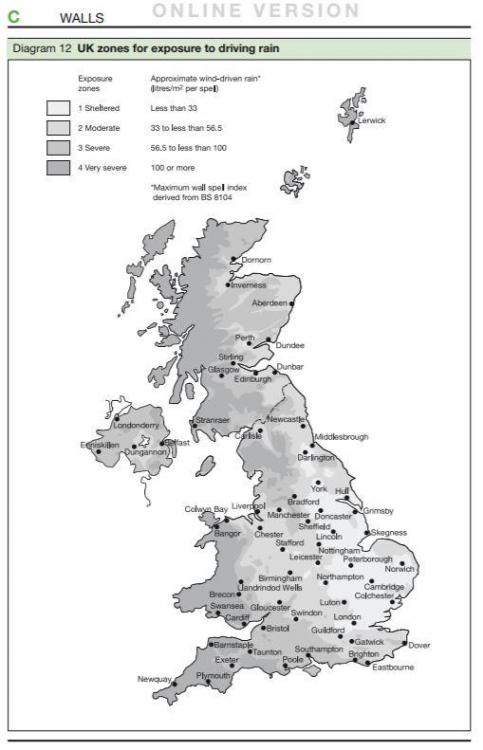
@epsilonGreedy During renovation and rebuilding works where the inner leaf of the cavity wall has been taken down I've seen water running down the inner 'cavity' side face of the outer brick wall. On several occasions the outer walls were so badly built that you could read a newspaper through them. The weakness was unfilled or partially filled vertical perpend joints in the brick. BTW - here's the English Building Regs Approved Doc diagrams regarding this issue of full fill of cavities.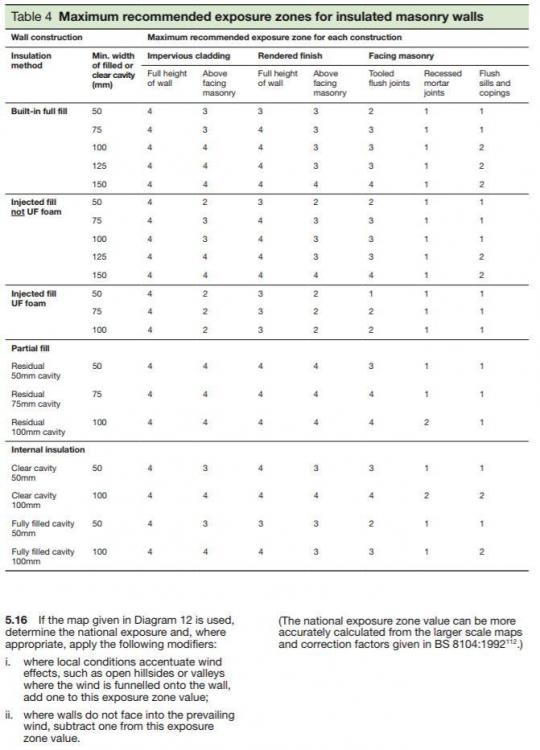
-
@MikeGrahamT21 Is your floor timber construction or concrete and does it have cross-ventilation of the under floor void zone?
-
Cladding: vertical or horizontal - does it matter?
Ian replied to ToughButterCup's topic in General Construction Issues
@recoveringacademic This Scottish Gov document is good on timber cladding: http://www.gov.scot/Publications/2002/03/15098/8731 It's important to get the spec of your timber cladding right before buying it to avoid disappointment eg amount of knots, finish etc. Also, it's a natural material and will move so make sure you allow for shrinkage when designing the way the joints between individual lengths of timber board work. EG if you have a long length of wall it might be worth considering cutting all the planks to the same max length so that all the joints line up at regular intervals and you can install a cover strip or flashing over the common joint line. Longer planks of timber will shrink more than short ones and that's one reason why I think the Scottish system of vertically boarded cladding can work really well on single storey buildings as you end up with shortish (circa 2.5m) lengths of timber so shrinkage is well controlled compared to the alternative of running it horizontally in longer lengths. It allows the use of cheaper freshly sawn timber which will shrink a lot more than timber that has had time to dry before going onto the building.