

dnb
-
Posts
581 -
Joined
-
Last visited
-
Days Won
10
Everything posted by dnb
-
I am drawing up the duct routes this week ready for some 1st fix progress and I have two options for MVHR. Reading the threads here it looks like there is a requirement to separate the intake and exhaust of the MVHR by 2 to 3m and keep them on the same (ideally sheltered) wall. Both of my options achieve this, but does it make a difference if the separation is vertical or horizontal? Option 1 has vertical separation with the intake low down on the wall (apprx. 3m above ground) with the exhaust just under the eaves at around 6m above ground with up to 2m horizontal separation. Option 2 has both intake and exhaust at 6m above ground. Horizontal separation can be up to 10m but the easiest option gives approx 5m. Option 1 presents some inconveniences to other bits of infrastructure so unless there's a compelling reason for vertical separation I would prefer option 2. I would very much like to know what anyone else has done.
-
Is a kitchen extractor a requirement for BR?
dnb replied to Happy Valley's topic in Kitchen & Household Appliances
Good luck. They don't appear to be written as nicely as the Scottish regs. How did you go about filtering the air extracted from the kitchen if the mvhr is doing the work? My architect was concerned about this to the point of advising me not to put the kitchen air into the mvhr. -
With you there! I made friends with the people at work that do the air cooling designs for some of our equipment a while ago. ?
-
They are a good call. Not seen that particular brand before. Thanks also for the design recomendation. I don't believe there's a need to revisit my design at the moment since the overall requirements are still close enough to the initial design.
-
When did the United Kingdom start going wrong?
dnb replied to epsilonGreedy's topic in General Self Build & DIY Discussion
On careful consideration it was probably when TSR2 did not go onto production. -
Thanks. I was looking at various Airflow products and a recomendation that they do what they say is good. Very happy with the concept of having something too "big" and running it with capacity to spare. Not quite. I rolled my own out of an air conditioning spreadsheet and some easy (OK, not exactly easy, but far from difficult) equations. The house is to be fully air conditioned so it made sense to reuse the pressure drop calculations and duct flow speed equations. All things being equal, I suspect we end up at similar operating points. Did this come from the Passive House guide? The guidance in ADF is obviously absent here. My understanding from the specs I have seen was that a 700m^3/hr unit would extract AND supply that (after all, this is the air flow that results from doing both the extract and supply jobs). Is this not the case for all of them or do I have to divide the spec figures by 2 to select a unit? Probably not a bad plan either way because we are all saying that the units should not generally be run near rated capacity.
-
I am currently checking all the calculations I did 18 months ago for the heating and MVHR and updating where things are different to the original design. I happened to read through part F to verify the architect's initial figures and I am a little confused as to what the document is getting at. It seems I am required to ventilate at a rate of 0.3l/s per sqm of floor area as a minimum. This works out at 96l/s for my house and feels a little on the high side. But whatever happens I need to be able to demonstrate compliance with document F. Now we come to the boost requirement. It seems I now need to supply 53 l/s (4 bath, 1 kitchen, 1 utility) as a minimum - so less than normal. I consider this more than a little nonsensical so have made up my own requirement of a 15% increase over the minimum. I guess this bit of silliness is a function of the house not being average sized. What other interpretations have people made for these rules? (No doubt I will turn the whole thing down when I have a completion certificate.) Now on to the MVHR unit. I would like a few recomendations as to which units perform well and aren't silly expensive and are actually available to buy. I would prefer to have one unit that will need to be able to provide somewhere in the region of 125l/s as opposed to trying to run smaller units in parallel. It would be an advantage if the unit were to have horizontal duct connections. I've not found one of these that is big enough yet.
-
When did the United Kingdom start going wrong?
dnb replied to epsilonGreedy's topic in General Self Build & DIY Discussion
We still make radars on the Isle of Wight. But I agree about the concorde factory site in Farnborough. -
Who uses 1.5m underlay apart from SelfBuilders?
dnb replied to epsilonGreedy's topic in Roofing, Tiling & Slating
Mine was all 1.5m. I know I did the roof myself, but the membrane was supplied and fitted as part of the SIPs kit. -
Yes. Guilty as charged.
-
Woops there goes another one..... ! Nearly
dnb replied to ToughButterCup's topic in Tools & Equipment
Pieces of 10! Pieces of 10! Said the octal parrot -
Woops there goes another one..... ! Nearly
dnb replied to ToughButterCup's topic in Tools & Equipment
I would argue (from practical experience) that losing a part of one finger has similar results. Well done for avoiding external bloodshed. And where are pocster's additional reactions when you need them... -
I am curious about this product too. I have a timber clad house where I was considering using similar products. No idea if it works, but it might be fun to test it. I have a couple of SIPS packer pieces that I could cover with timber cladding offcuts, treat one of them and try burning both of them. In the name of science of course. I am in no way a pyromaniac.
-
Back of envelope suggests that the junction performance will leak around twice as much heat with concrete blocks vs aircrete assuming a 25mm EPS upstand. Depending on the perimieter vs area, this might be significant for your performance goals. It was for mine.
-
Jul 2021: FT work + DIY build = slow slow slow
dnb commented on LSB's blog entry in Little Stud Barn
I know the pain of balancing paid work and building all too well. It's never easy. You'll find there is progress but it will be everyone else that see it first. Good luck! -
Fit them yourself. You then have the choice of fixings and what products you use to seal them to the walls. I've fitted all of my aluminium frame windows (some documentation in my blog) but as PeterW suggests, I have not fitted my own bi-fold doors yet since I am waiting for some professional assistance (and I need help lifting door size laminated glazing units because I'm an unfit desk flyer!).
-
It's looking good so far. You could borrow mine should you stray this side of the solent for a summer break and need to display some forward progress. It's the same basic design, and yes there are better designs... I would avoid box section for the top clamp since you'll need to bend pieces more than 90 degrees - triangles are the way forward.
-
Rainwater harvesting tank
dnb replied to Happy Valley's topic in General Self Build & DIY Discussion
You aren't as far as I can see. And I think you are on the optimistic side at £160, but my maths is based on having a guess at sewerage and surface water costs since I don't have mains drainage. I am building "for but not with" on the rainwater recycling. The house will support it with a header tank for rain water in the attic and space for pumps etc to fill it from an underground tank, but there will be no underground tank until they get to a sensible price. I am unwilling to pay more than I spent on a treatment plant on something much simpler when it doesn't have a realistic payback time. -
Possible savings when all plumbing kept in the same quadrant?
dnb replied to NickK's topic in New House & Self Build Design
It would have halved the number of stacks on my build and removed a whole section of foul drain. Cost of parts saved is small, but design time and implementation design runs to many days of effort to get everything as I want it. But I made the call that I would live in the house far longer than I would spend building it. (This may have been a bad call, given the way things are going...) -
The office has good air conditioning. I can build in the evening.
-
A few steps forwards and a couple back
dnb commented on dnb's blog entry in Building in a woodland on the Isle of Wight
Yes. But it was a bit Heath-Robinson involving gaffer tape and a workshop vacuum. -
A few steps forwards and a couple back
dnb posted a blog entry in Building in a woodland on the Isle of Wight
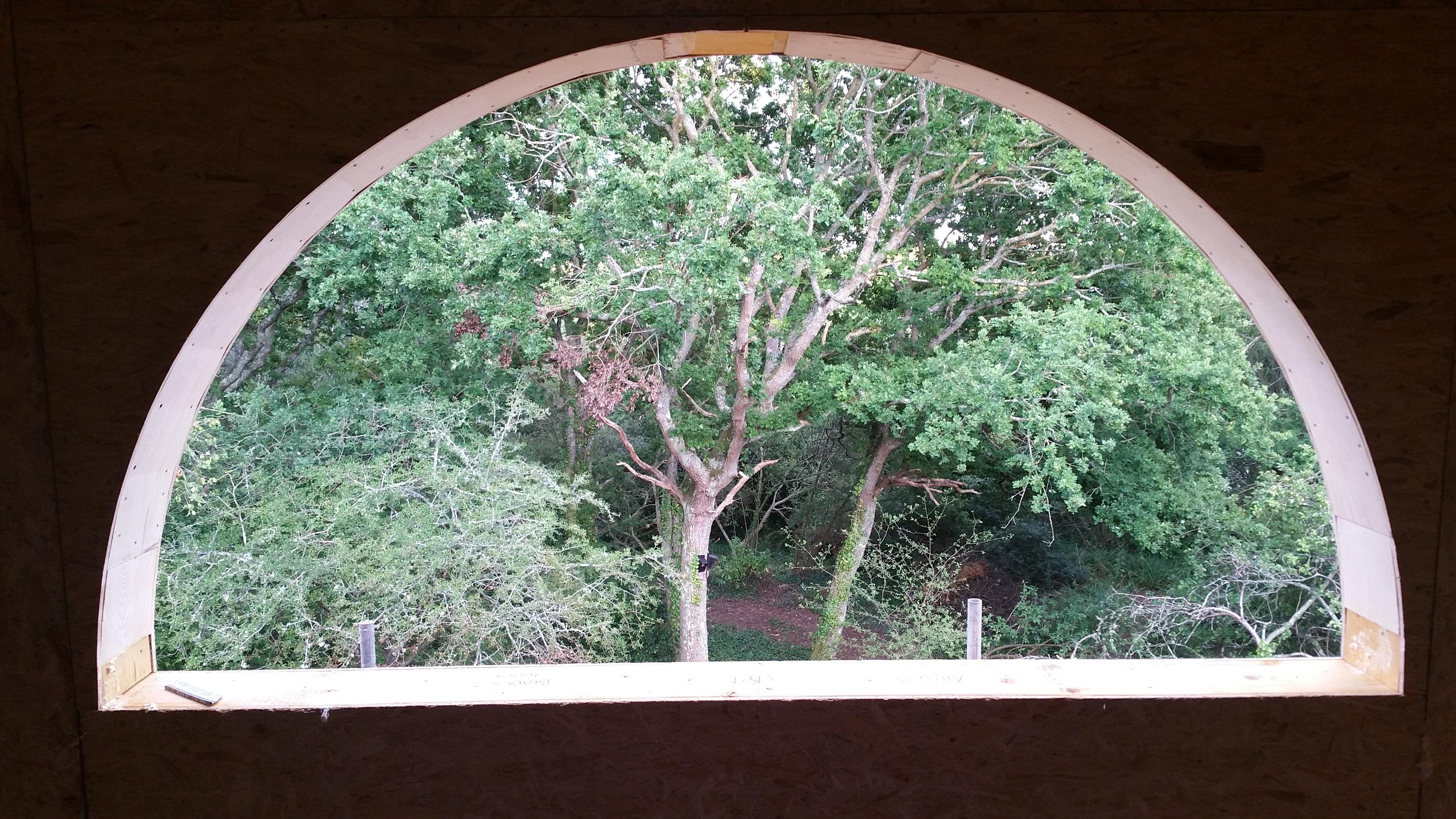
It's about time I put fingers on keyboard for a purpose other than Matlab or Perl. So here is a brief summary of the lack of progress in the woodland. I couldn't pass up a few weeks of sea pay, so progress in May was nil but it was lucrative, helping to offset some of the cost increases. And it gave the scaffolders a bit of time to strike the remaining scaffolding (rather a long wait for this). We're still waiting for the arch windows (another long wait) but all the other windows are fitted. The house is just about water tight so it's time to look at 1st fix and services. There's still a lot to do, and still plenty of supply problems to navigate. Before we did too much work, it was time to tidy up inside. Nic wanted to see what the family room felt like with some representative "furniture" to plot decor and fixtures. The first big job was to dig the pit for the sewage treatment plant. This all went very well with the digger earning its keep. No, I didn't make my daugher dig any of it tempting though it was. I planned to fit shuttering ply the next day because there was going to be a week wait for the concrete. Now for a backward step. It rained more than a little that evening, so I ended up the proud owner of a large garden pond with considerably increased area. Not exactly top of my list of desires. I got a good start on the trenches for the foul drains. Plenty more to do but at least they haven't turned into canals yet despite the rain. So I decided to ignore the problems outside for a while since the floor insulation had arrived and was in the way. Not content with the pool outside, I thought I could make one inside. But then I thought better of it (got caught by the boss for plotting silliness) and fitted insulation instead. It turns out that cutting 150mm insulation to get a good clean straight edge is particularly tricky. So I made a table saw. It's a little bit lethal, so much so that a work colleage called it the "death saw". I think it's a little harsh. It's only a sabre saw with a 12" blade bolted upside down under a home made table... Perhaps the sort of thing @Onoff would make? ? It does a very good job. Finally this month I looked at getting the ducting laid for the water main into the house. Very pleased with getting through 300mm of concrete and keeping the trench straight. The only snag is that I "found" the water main I intended to use as the house supply. It was exactly where the plan said, but only 200mm deep. Oh well, I like playing with the digger. -
I'm not all that old (despite what my daughter might say). The last time I saw round pin sockets in a domestic setting was in an upmarket part of London when I was labouring for a builder to make ends meet in 1999/2000. They were specifically for lighting of course.
-
Agreed that the 150mm is hard to cut. I ended up making an extremely large (and possibly lethal) table saw to get the cuts straight and vertical.
-
I have not had problems with cheap nails in my IM360, but it needs to use Paslode gas because nobody makes alternative gas. The IM360 gas has a bit of propane in with the butane to enable it to work at lower temperatures - I can vouch for this working because I was able to drink all of my coffee at a civilised temperature this winter. I have used Quikload stainless nails, Fischer nails and Firmhold nails all without problem apart from the very occasional double fire. (I also have a significant pile of IM350 pattern gas I can't use.) I am led to believe the 350+ and 360 are near identical when it comes to the nail magazine, so I would not expect too many problems.


