
dnb
-
Posts
581 -
Joined
-
Last visited
-
Days Won
10
Everything posted by dnb
-
Membrane (applied early) and Eaves detail SIPS
dnb replied to SuperJohnG's topic in Roofing, Tiling & Slating
I initially thought that. Then I left a tray out in the sun accidentally and it turned into an interesting shape! -
Membrane (applied early) and Eaves detail SIPS
dnb replied to SuperJohnG's topic in Roofing, Tiling & Slating
Looks about right to me. I have done exactly one SIPS roof, to a very similar way to your drawings. Would agree that fillets to support the eaves protectors are a good plan. I made mine from the offcuts from the splines. -
True... Most of the stats I end up doing end up non-Gaussian in some way or from the tails of Weibull distributions. Radar signal processing can be full of horrors seemingly specially designed to defeat standard statistical methods if you keep looking at it in ever more detail because you want to see that really small thing hiding in the clutter.
-
Thanks for this - fake components are a damned nuiscence both at home and at work.
-
I didn't mention precision. (But some here have mistaken precision for accuracy.) Or "very good" accuracy come to that! I negelcted any form of specification, so you *should* have accused me of giving a terrible specification... Sensible accuracy is far easier to work with. They obviously don't need to be accurate to 0.0001 degrees, but +/- 20 degrees depending on absolute temperature and a hugely non-linear response (e.g NTC thermistor) is next door to useless when you want 10+ sensors all to do the same thing. Obviously I could construct a calibration scheme for these, but in my experience from work it is often best to spend a bit more effort on selecting well behaved components before thinking you can fix everything in software. Let's say I want to end up with accuracy to 0.5 degrees from -5 to 40 deg C. My thoughts are that the DS18B20 sensors are a good option, have a linear output with temperature and are probably close to meeting the spec without calibration. It is a simple scale and offset to calibrate anyway, so not hard. (No messing with Steinhart-Hart coefficients or anything daft.) Hopefully the scaling is well matched to 1 from the manufacturing process so leaving just an offset. Mostly true, yes. But there are a few temperatures I do want to use as absolutes albeit I don't think I need 0.5 degrees accuracy for these. They are for stage 2 of the plan. Medians work better than means (as a rule). They handily ignore with outliers and the median absolute deviation does a good job of emulating standard deviation with a mutiplying factor.
-
I really need to do some experiments with the house to measure the insulation performance. I want to position temperature probes in the main rooms and outside and log the temperature over several days to measure things so that the risks from the house not performing as planned in the heating/cooling design can be retired. (This sounds too much like I am at work!) Ideally I would like to use cheap sensors connected to a cheap central data logger. But I would like them to be well matched since I'll be looking at small temperature differences, and this usually precludes cheap. I could of course calibrate them myself, but if I can avoid it by spending a little more it is worthwhile for me. We have a couple of nice many channelled thermocouple loggers at work that would be ideal but they cost a bit more than I would like to pay for this. My initial thoughts are that cheap one wire sensors are available on ebay that could be used on an ATMega microcontroller with a few lines of WinAVR (insert your own choice of microcontroller here) with the data logger part constructed from an old laptop with a serial port writing down what the microcontroller tells it. The advantage is that I have many of these parts sat in a box of spares somewhere so it is simply the cost of time and sensors. The one wire sensors are an unknown quantity - I'm not sure what technology they work on but suspect it is along the lines of an LM335 as opposed to an NTC thermistor. This means that calibration shouldn't be too much of a headache (at least it is linear!). Has anyone done anything like this with cheap parts, or am I best spending a bit (lot?) more money on something like the 8 channel thermocouple things? I might have other uses for such a thing in the future, but nothing I can think of immediately.
-
Stud wall construction for sound insulation (and cost)
dnb replied to dnb's topic in Sound Insulation
Not separating dwellings. I need to implement a protected corridor through part of the house as part of a fire escape. I am told that it needs more protection than one sheet of PB. I also want to keep the kid and grandad snoring noises at bay! I will take that as confirmation that steel should work better than timber. -
We all know that getting hold of materials are a problem for small scale builders right now, so I am forced (very much against my will) to do jobs in a somewhat crackpot order depending on what arrives on the site. I am now looking at the stud walls because my very friendly wood supplier has told me they have restocked and can deliver quickly again. The price is not terrible, but there might be a better way that stops at least a portion of my overspend. I am considering using steel U sections for the stud walls, with a batten of 4x2 at the top and bottom. My thoughts are that this will be considerably cheaper and will result in better performance for conduction of sound - the connections between the two surfaces are small, and it looks like a lot less work than unconnected staggered timber. Most of the studwork will be double plasterboarded on at least one side (fire safety requirements) so there may be a game to play with the thickness of the steelwork. If I use the 94mm it is the same size as the 4x2 CLS used in the racking walls and the house comes out with room sizes as planned. So all good. But if I use 72mm I can double plasterboard both sides of the wall for the 12.5 mm less wall thickness (the wall is still just over 100mm thick) and maybe improve sound isolation performance. The additional cost of plasterboard is easily paid for by the savings on steel over timber, but if the reduced air gap in the wall next to the sound insulation reduces performance more than the extra board increases it then it's a waste of time and money. I'm not sure how to model this so would appreciate suggestions from anyone with "experimental evidence". I can't see anything obvious in the approved docs that stop me doing this and there is nothing going inside the stud walls that won't fit into a 70mm gap. Have I missed anything?
-
It's getting to the time of installing ducting for ventilation. I am planning on MVHR and cooling so I need to look at insulated ducting to avoid condensation. Does anyone have experience of EPS rigid insulated ducting such as is sold by Verplas, Titon or Kair? It sounds a good idea on the face of it, but I'm a little concerned about making a rod for my own back when it comes to fire spread prevention. I also note that Kair seem to be discontinuing a large number of products, so again it might be something to be concerned about. My thinking is that metal ducting is more work to insulate, heavy and expensive to ship to my location so avoiding it may well be benefitial to the bottom line, but if it gives a substantially better solution then that's the way it needs to be.
-
15mm T&G wood cladding - Fixing
dnb replied to NewToAllOfThis's topic in General Construction Issues
Get a "no mar" head for the 1st fix gun. They work well if you are painting the cladding. Photos to follow if you want. -
You mean he did York Minster first?
-
Hurry up and wait! (And do some gardening)
dnb commented on dnb's blog entry in Building in a woodland on the Isle of Wight
Fangorn was in reference to my daughter idly wondering if we would find Ents in the woodland if we got to the middle. -
Hurry up and wait! (And do some gardening)
dnb commented on dnb's blog entry in Building in a woodland on the Isle of Wight
I think it's just over the boundary. No dragons as far as I know, but the neighbour does keep some quite vicious looking geese. The whole garden was overgrown, so it's going to be either like finding an "extra" 100 metres, or getting lost in Fangorn Forest. We knew the land was there in theory of course, but in the 3 years we've owned the site we had never ventured into the middle. -
Hurry up and wait! (And do some gardening)
dnb posted a blog entry in Building in a woodland on the Isle of Wight
There has been much discussion on the short supply of materials etc on the forum, so I'm not repeating it here. Suffice to say, the progress on the house itself is best described as "hurry up and wait". The upstairs windows are all installed, the downstairs are due to go in when the scaffolding finally goes away (any day now?), and the cladding is completed as far as is possible while waiting for the MVHR and air conditioning equipment. The sewage treatment plant arrives very shortly (thankfully no shortage here) so we have taken the opportunity to find out what is in the garden in order to install the plant and dig an attenuation pond for drainage. We would also like to be able to get to the end of the garden to see what is there! The view from the road of the house illuminated by floodlights during a late evening of activity while working on the cladding. Our snowdrops seem to scale themselves to fit their surroundings. We get a good crop every year, possibly because we leave them alone. Maybe I should be wary of breeding Triffids? They aren't supposed to be on the Isle of Wight! Last year's clearance efforts are still more or less clear. The primroses have taken over somewhat, but that's far better than nettles and brambles. The stunted pear tree is finally coming good two seasons after removing the Eucalyptus that was overshadowing it. We'll get around to trimming the dead wood at the appropriate time since we missed the opportunity this year. We're hoping for more than two pears this year. The entrance to the wilderness. We are aiming to clear at least a path to the bottom of the garden established before the growing season fills the place with the usual collection of nettles, brambles, blackthorn and willow. Based on the current growth, we don't have that much time left! We have a pathway extending at least 50 metres into the garden. This took us three days with a chainsaw, a strimmer multi-tool and a lot of wheelbarrowing. The sheer amount of dead wood is really not helping the trees - they are spreading past each other and fighting for every scrap of light until the branches get so heavy they break. We are aiming to remove only the dead wood this year so the trees can grow more sensibly and we can see exactly what we have left to work with. There is still a long way to go! Now to find something to do with the 30 barrowloads of wood. Maybe some charcoal making? Unfortunately this didn't work as well as we would have liked when the bottom of the barrel perforated in the heat, and we made a lot of ash. Oh well... time for a new plan. Finally, we are getting near the bottom of the garden. Well, at least within 30 metres. I didn't know we had all these oak trees. They are a bit too close together unfortunately so I doubt they will all stay long term. We did however find two mature oaks that are nicely spaced in another part of the garden. We can't quite get to them yet because of a thicket of blackthorn in the way. That's next week's problem unless house parts start turning up. -
PIR insulation in very short supply - alternative plan?
dnb replied to dnb's topic in Floor Structures
Best plan yet! Unfortunately yes, otherwise I would take the Range Rover and trailer over. Let me know if you do get over. Haven't added it all up yet, but if it is then 100 + 50 still makes 150 well enough. -
PIR insulation in very short supply - alternative plan?
dnb replied to dnb's topic in Floor Structures
Seriously thought about this, but I don't think it works. I need 37 sheets of 150mm thick and 10 sheets of 25mm. That's 1.2m * 2.4m * 0.15m * 38 + 1.2m * 2.4m * 0.025m * 10 = 17m^3 approx. So this would apparently just fit in a large luton van. But the long dimension of any van I can find here is less than 4.8m and both the width and height are less than 2.4, so you can't ever fill it with whole sheets. I therefore need to go for something bigger, like a 7.5 tonner which gets a bit expensive on the ferry. I therefore think the best answer is to go for 75 sheets of 75mm (or whatever combination I can get that adds up to 150mm) so I can use one of the two suppliers I found that seem sensible on delivery and are not too bad on price. -
PIR insulation in very short supply - alternative plan?
dnb replied to dnb's topic in Floor Structures
You and I might think that. But tests have shown that the IOW ferry is often a sticking point. It's a small market here, and this is one of the costs of living in, when all said and done, a really pleasant place. Unfortunately not. I didn't plan for both brexit and pandemic when I agreed the foundation design. Had I known how the world would go I would have dug down another 100mm and put in another row of plinth blocks. Then I could have at least 200mm EPS. When I costed it in of 2018 it was better to have PIR. How things change... (But of course if I had done that I would probably want 200mm of PIR, chasing those ever diminishing returns!!) -
PIR insulation in very short supply - alternative plan?
dnb replied to dnb's topic in Floor Structures
Thanks for the pointer. I know there are supply problems in pretty much everything. The biggest logistical problem for me is usually getting things across the Solent on a ferry without it costing the earth. One delivery example was free to Southampton, but £250 to site - a sizable additional cost in relation to the materials themselves. Needless to say, all angles need to be considered - houses aren't more expensive over here and I do need to worry about the budget. And thanks all for confirming that there's no hidden gotcha with staggered double layer. It gives a few more workable options. I like the idea of staggered joints and I can make a castleated joint with the upstands at the edge too. One of my local suppliers (specialist in roofing materials) has recently given up on PIR insulation because of the supply issues, but they inform me that their structural timber supply is much better now. Looks like the next job might have to be the stud walls on the 1st floor. -
I planned to put 150mm of PIR insulation between the screed and beam and block floor. The snag is that nobody seems to have a sufficient quantity in stock or won't deliver it to my postcode. So my revised plan is 2 layers of thinner PIR to reach the same 150mm thickness. Are there any pitfalls with this other than it costing a little more (but at least I can get it on to site)? I don't believe there are any alternative materials that give sufficient levels of insulation.
-
A current clamp and multimeter with a data logging port connected to a laptop would do this to reasonable accuracy.
-
It is the same in my industry. People change things so they can be seen to be doing something. It is easier than trying to solve the real problems in many cases.
-
Take photos when you have all the pipes in. Then there is a point of reference before anyone gets a drill out.
-
Prompted by @Ralph's thread about amplified TV aerials, and beginning the first fix wiring on my build I am questioning the requirement for antennae and signal distribution in the house. For a bit of context: We will be 6km from a transmitter that supplies national and local DAB, DVB and FM, so even a bent coat hanger in the clear will get a usable signal. Internal aerials might work, but they are only so good when there's lots of graphite and foil insulating the house and a garden full of mature oak trees between them and the transmitter - FM is not so bad, but DAB and DVB do degrade a fair bit in rain. So if I put up antennae, the signal needs distribution to several areas of the house and needs to cover all the bases. It's easy and cheap enough, but needs planning and doing in this stage of the work and if we can get away without then it's a time and cost saver. My plan would be three separate antennae into a 3 input / N output distibution amplifier with a 1GHz cutoff filter built in since it looks to be cheaper and better than messing with a combined (compromised) amplified single antenna into a single input distribution unit, at least in terms of RF performance. The asthetics of multiple antennae are of course less good. But at least all of the antennae can be small - high gain and narrow beamwidths aren't really required here. We will have tolerable broadband and there is a good chance of it getting better in the next couple of years, but I can't see fibre to the house happening for a long time because of ANOB, private road and isolated community type reasons. (The house is approximately 400m from the nearest fibre cabinet.) I can see running 2 VPNs for us each working from home using all the available bandwidth leaving nothing for a radio stream. Not that I work from home much - I can't exactly bring my work toys home, and I wouldn't enjoy the electric bill for them! We aren't watching that much TV these days - too busy working on the house - and much of what we do watch is from on demand services. But this will hopefully change when we are less busy and we all like to listen to the radio while working at home. 10 years from now, the decision would probably be easy. There might be a date set for switching off broadcast TV and FM radio. But currently it's looking fairly open ended. We don't intend to sell the house for at least 20 years, but plans do change. So on balance, I believe receiving broadcast signals is still a requirement for the house, although this will drop away as time goes on, but would like to canvas opinions.
-
If you have a bad signal then an amplifier won't help. It will amplify the noise just as much as the signal and you end up no better off.. In these situations a high gain yagi aimed correctly is the better option. But they look nasty in a lit of situations. It sounds like you are not in this situation though so a simple dipole antenna might work well enough.
-
Hmmm, someone is in trouble with planning!
dnb posted a topic in General Self Build & DIY Discussion
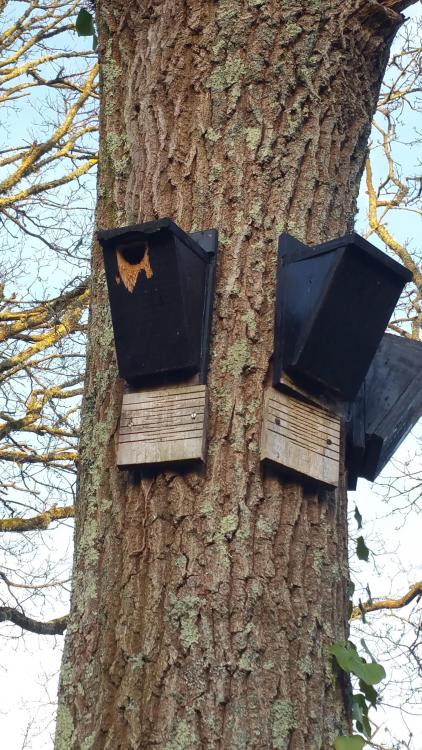
I had a planning condition to install bat boxes on my property. So I discussed their requirements and agreed to put three suitable boxes on a south facing tree. I sent numerous invitations to the bats, but they didn't move in for a while. But one evening last autumn I saw a bat inspect one of the boxes. So far, so good. Now I find that some very noisy neighbours have moved in next to the bat, and he's complaining about nuiscence hammering all day. Someone shoud really write to the greater spotted woodpeckers in question about the noise and damage... They aren't getting the security deposit back, that's for certain. Better make some more bat boxes before the council complain about contition number 6 no longer being met.