
dnb
-
Posts
581 -
Joined
-
Last visited
-
Days Won
10
Everything posted by dnb
-
Took the kick boards off - how am I going to seal this up?
dnb replied to Sparrowhawk's topic in Heat Insulation
A long bit of thin hose used as an extension on the foam gun would work. But have it attached to a long stick so you can manoeuvre it or hold it still as needed. -
Happy to do this. But it will take 3 to 6 months and in the meantime I don't have usable facilities that I need now. All I want is get a feel for where the line between a legitimate repair and a breach of planning sits given it will be a bit like Triggers Broom and a like for like replacement is not really an option due to banned materials.
-
The garage was built legally 60ish years ago so I can see no reason why I cannot have a certificate saying that. It is unclear to me how this helps with my problem of repairing the garage so extensively that it looks like a different one. So I must be missing something.
-
That one is easy at least. While I am not going to admit to money being anything other than tight, time is the pressing thing. I need a solution so that other bits of life carry on without interruption. Effort is OK because I have a chippy on site with not quite enough to do while other work is in progress and it is better if he doesn't disappear! We aren't overlooked on that side but there are enough cockwombles to make me think twice. (One is enough...) But a set of big gates deals with this nicely! It seems to be Council policy for bungalow redevelopment in outlying areas with sparse infrastructure. And if I appeal I may end up with a blanket TPO which would be a lot worse! Granted it isn't ideal but for now I have permission to build all I want. A static caravan isn't really an option for the things I want to store.
-
Sorry for the very late replies. Sometimes work drags me away from house building for extended periods. I think so! It certainly answers the solar PV aspect of the question. You can certainly ask! From other posts you made here we appear to have similar interests in using data for efficient housing. I am looking at using several parameters from weather forecast data (the MET office API appears to give the most likely state of their monte-carlo weather model at 3 hour intervals for the next week) to decide on an energy optimisation strategy for the next few days. Amount of sunshine is just one (probably derived or inferred) parameter of many. E.g. a rule set such as "It's going to be overcast all week, so keep the hot water tank topped up with cheap-rate electricity until Tuesday when it should be sunny." This is the data collection stage so I can prove algorithms against it and with other data I am collecting measure how well the house performs against its heat loss model. I also have a set of candidate algorithms to model energy demands. I believe I can express the system as something related to a Kalman filter (at it's simplest this is an iterative form of least squares regression) that will answer the question of what action the house should take to stay comfortable for us using the least energy (on average) for the next N hour time period given a particular set of inputs and a current state, where N will be a significant fraction of a day. It is definitely NOT about immediate responses since the best "nowcast" for the weather is to look outside! True. This is why I am hopeful the Kalamn filter type approach will work since it smooths the daily data and can account for random errors. (But far less good at bias errors!)
-
I am looking for a little wisdom for what to do with an old and rickety single garage I have on my site. I am currently using it for storage of things unrelated to my house build. My site is quite big (50m frontage and right out in the sticks) and you can't really see the garage from the road or from Google Earth because it's tucked in one corner surrounded by overgrown trees, assorted wilderness and my neighbour's caravan collection (but it is more than 5m from any boundary if that makes a difference) so doesn't look connected with the property at this time. I am not required to demolish it to implement my planning permission but I do lose permitted development rights to build new structures other than the significant workshop elswehere on site already described in the permission. The last couple of winters have not been kind to the 1960s concrete section structure and it's now developed an alarming list. A tree is also threatening to fall on it. I therefore need to either get the tree and structure removed or rebuild/repair it all. And it is probably the most urgent job on the list, even though it is far from the most important. My limited understanding of planning rules are that I can repair this structure but can't demolish it wholesale and build something else. I don't believe I need building control involvement because it's well under the floor area they care about. So where is the line drawn for repairs vs new build? I don't really want to lose the storage space for the duration of the build or ideally when we are completed since dry storage is always useful. I am considering some combination of the following: 1. Have the asbestos roof removed from site and deal with the dodgy tree. (Definitely happening as soon as possible - will make things safer all round and can't really upset anyone) 2. Install steel or plastic panels on the (10ish degree) pitched gable roof and attempt to brace the concrete structure. This would seem to be a very time limited option by the state of the exposed rebar and existing rusty roof trusses! And it may end up that the structure is beyond redemption so could easily be a significant waste of time trying. But if it gets me another 1 to 2 years of storage space so I can worry about the problem in say 2025 then it's an acceptable and fairly low cost short term option that shouldn't upset anyone. 3. In the event of (2) not working out well, replace all of the garage with an equivilent size timber frame structure with a flat roof. Roof height would be the same as current eves height - high ceilings aren't really needed. Clad the new structure with some kind of renderboard/cement board so it can look like the old concrete structure or leftover timber cladding from the house. (I would prefer timber because it's essentially "free" but not if it invites trouble). 4. As (3) but retain the pitched roof. I don't really want the additional cost of this but if it is necessary then so be it. 5. Other options I've considered include an iso container on the old slab. But this definitely removes the permission of a fixed structure on the site in that location. As an aside, I do recall someone here replacing a workshop one wall at a time because they couldn't get permission to build a new one, and this strategy working. Do I need to consider this level of silliness? 😉 Thanks for any insights into the world of planning! My ideal solution is to find a legitimate and sustainable way forward that doesn't involve a lot of waiting around for an overworked local government office because it looks like that sort of time is not on my side.
-
Has anyone played with the Met office data API? I am looking and can't see anything that can be used as a predictor for hours of sunshine other than perhaps visibility (but not sure what the units are!) Was hoping for a cloud cover number but I can't see it in the 3 hour spot forecasts.
-
Not this year unless writing the code for the lighting controls counts. Better than 2021 where we slated the roof on Xmas day because it had the best weather. We ate Xmas dinner on boxing day when it rained.
-
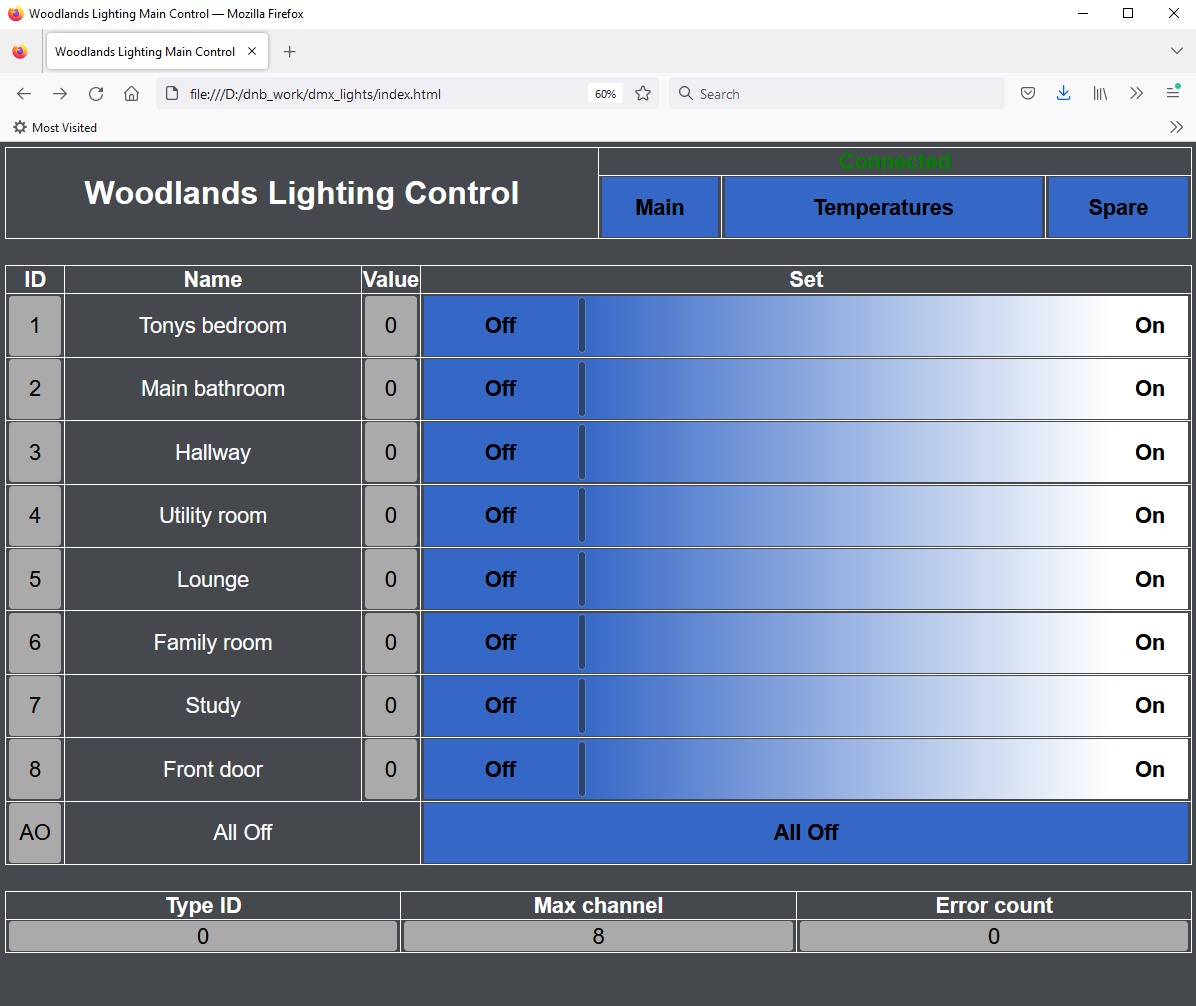
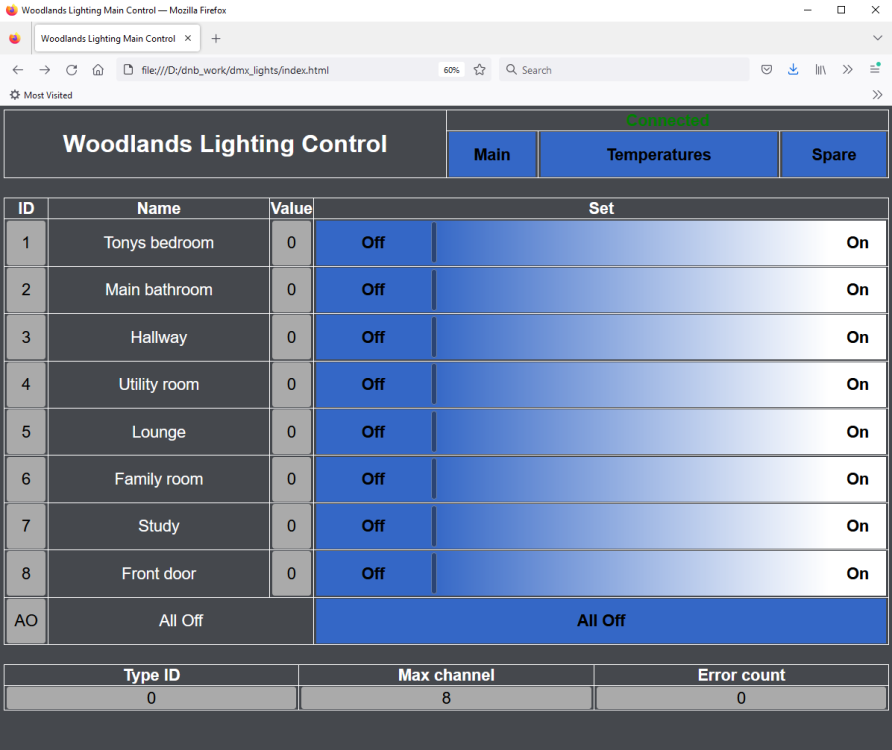
It seems I got a bit carried away when I wanted to test the (expensive but very good) 220v 16 channel DMX dimmer. I thought it would be a good idea to have a light in each room controlled from a spare laptop in the study for the winter so I don't have to mess about with extension leads in the dark. But I might have taken things a bit far when I realised the free DMX controller software had a basic web server interface and came with the source code. So after a couple of evenings (sometimes becoming mornings 🤪 ) of tinkering and learning basic Javascript I have a web server that enumerates the lights in the house based on the DMX software configuration and provides a dynamic web page to any device logged in to the airgapped house control network. The "boss" seems to like it so I think I might have found my 20 year supportable technology for light switches. TCP/IP, HTML and Javascript don't appear to be going away any time soon. And above all, it has been a cheap way to get the lights functional for the remainder of the build even if we control the DMX with a more commercial off the shelf solution. Here's an early picture of the interface - nothing fancy for now since it's only aimed at letting us work in the house - there is plenty of potential in both the lighting software and the web interface for cleverness. The gradient filled bit is a dimmer slider for each light that the server has in its configuration. All off is for going home at night! What I need to figure out now is if I want to take this a bit further what are the best (and cheapest) devices I can use to make the physical light switches from. Old smart phones or tablets are a surprisingly good candidate although there are some battery issues. A Pi or a Pi Pico and a small touch screen are also looking sensible although I am yet to find a reliable source of touchscreens. Anything that can render a fairly simple web page will do. The switches will need to sit on wired Ethernet so POE will easily power anything. I'm not a lover of WiFi for infrastructure. Suggestions for hardware are appreciated - I'm well out of the loop on what's currently available.
-
- 3
-

-
Thanks for a lot of good information. I think I have a good plan now. Now you mention cantilevers, an idea for the other staircase (that might not be possible with the space I have, but it would look good if it did work) comes to mind. Will try to do a sketch. It's much less urgent than the main stairs though. No piles of books this time. I promise
-
This is exactly what I am looking at. And from Stairbox too (at the moment - the only thing to change it would be my local stair builder chap suddenly becoming a bit less expensive and infinitely less busy) I'm essentially aiming for the mirror of what @ProDave and @joe90has done. I assume that the photo makes them look steeper than they actually are. If you don't mind me asking what rise and going did you end up with? I've got a bit of wiggle room with mine so I can use the space to make the stairs wider or making the goings longer. Both measurements are comfortably better than minimum standard already. Sounds difficult. Guess what SWMBO wants... At least she's gone off the carpetted open riser staircase. Thanks all
-
A silly staircase question given that most people seem to not want to supply half landings. What are the requirements to consider for a half landing (I'm thinking mostly of loading)? Part K only really talks about sizing and positioning which are quite easy to meet.
-
There's absolutely nothing wrong with buying a digger because you want a digger. I've done a lot of work with mine and there's a lot still to do, but when all is said and done I wanted a digger of my own.
-
I'm "auditioning" one of these http://www.whitewing.co.uk/acdim.html at the moment in my build. If it works out, I'll need two more (I have managed to require 46 channels somehow 🤪 But better than 49 I suppose...) This solves providing dimmable power to the light fittings but not the switch elements themselves, however DMX is at least a well known open standard, and Loxone can control it if that's what I choose in the end. Will probably do something based on open software and COTS hardware because I have no faith that single source hardware will remain compatible with existing parts when repairs are needed in 10+ years. (e.g. It needs to be cheap enough I can do a "lifetime buy" and have 2 or 3 of the key parts) I do have a lot of downlights in my plan (I don't have quite the same opinion as @Jack but he does raise some very good points) they are all dimmable and there are an excess of 2A lighting sockets at key points for task lighting in most rooms (all DMX controlled and placed to allow the scenarios Jack discusses to be fully developed as we live there) and of course built in task lighting for the kitchen - we know much of what we want here already.
-
Floor loading understanding check please (long(ish) & maths content)
dnb replied to dnb's topic in Boffin's Corner
There are 4 full height book cases full at home, 1 partially filled case and many boxes squirrelled in places that are now sounding in some cases like a bad place to have a lot of mass. Would guess at somewhere around 2.5 tonnes of books. I'm not a horder, honestly! That's true. The new house floors are wildly stiffer than the current house. The comparison between 6" timber with dodgy 1980s plumbing notches to 300mm I beam joists is telling. So to check my (similarly alchohol fuelled) undersanding, what you are saying is that I should consider the bonded floorboards + noggins etc as a more efficient load spreader than my calculation would suggest. So a certain amount of "averaging" will happen provided that I steer clear of very pointy books. And since your Dad hasn't yet ended up with escaped books and my 1980s house hasn't yet fallen down it's all probably OK. 😉 -
Floor loading understanding check please (long(ish) & maths content)
dnb replied to dnb's topic in Boffin's Corner
This is exactly what I am trying to do - gain some understanding of the mechanics so I am sufficiently armed to ask the right questions. Foremost in my mind. The elastic limit on a Steico joist is closer than one may think. Or so I am told. At least the answer to that is easy. Steico joists in hangers on to 217mm SIPS panels. Yes, the design figures are not unusually high or low. Thank you all. Nobody has said the maths is wrong yet, so that's a good start. So it looks like I plan to spread the books out on half height shelves. This works well for the room since it has a vaulted ceiling and short walls. -
I have become a little concerned that I don't fully understand how floor loading calculations work. I've got a whole lot of calculations from the SE and everyone is happy with them, but I would like to make sure I don't do anything silly when heavy things start to arrive in the house (I like books for one thing... And wasn't planning to have a ground floor library this time). So as with engineers everywhere I set out to create a model of the problem to see if that helped. It hasn't much, but if I can explain it here and get some feedback there's a good chance of either knowing not worrying more or averting a disaster by reconsidering the library before I have to ask my very busy SE any more questions. For info, the floors are all implemented with mostly Steico I beam joists with the odd LVL or steelwork for key structural parts (stairs, supporting roof structures etc..) The LVLs and steels aren't involved in the area I am thinking about. The floor design loadings seem typical 1.5kN/m^2 live loads, 0.5kN/m^2 dead loads and 0.25kN/m^2 for partitions. So my understanding is that since the floor is 100m^2 it would support 15 tonnes and only deflect by the designed amount if evenly loaded throughout. (It would probably support more but the deflection would exceed the requirement and this isn't good, so let's not let this happen.) OK so far, I don't have *that* many books. The thing is that book cases, are usually tall thin things, so then we come to point loads, and the structural calculations as written down are far less clear as to what I can do and what I need to worry about. Taking an absurd example, putting the 15 tonnes of books on 50m^2 of the floor all on one side probably wouldn't be good, but 0.5m^2 piles of the same weight of books over the whole floor might well be OK. The following should be an example that can apply "just too much" loading (unrelated to books) from a limited distributed load sat in one part of the floor to check I am understanding how this works. Let's assume a 650kg distributed mass. To be within the 1.5kN/m^2 live loading simple mathis indicates it would need to be squashed to occupy 4.25m^2. Let's assume my heavy thing is 2.1m long, so would therefore need to be 2m wide. But I've learned over the years that simple often doesn't tell the whole story - joists only go one way for a start. So I tried to simplify it all to a beam loading calculation in 1 dimension because this seems to be what mech engineers try to do... (I do physics based work, so I like point sources and vacuums - who am I to criticise? 😉 ). I set up a 4m long beam to represent the 22mm floorboards and then put supports at 600mm intervals to represent the joists viewed end-on. I added a 2.1 metre long distributed load across the middle 4 "joists" of 3kN/m. The reaction forces at the supports should represent the forces applied to the joists (albeit with a sign change). The 4 numbers come out as 1kN, 1.97kN, 1.88kN and 1.6kN. Can I translate this back to a 3d reality by assuming that if my 2.1 metre distributed load were 1.6 metres wide (1.6m * 0.6m = 1m^2) then I could approximate the loading across the "heavy thing" as a maximum of 1.97kN/m^2 approximately in the centre? So in this case it exceeds the live loading in 3 of 4 cases. Given the area occupied by the "heavy thing" in this case works out to only 3.36m^2 we expect a problem since the simple case above also would have indicated a problem. Now if said "heavy thing" were squashed to be 3.2m wide then the approximation of maximum loading would be halved to 0.985kN/m^2, and this is well within the live load for all 4 points so all is fine. But of course the squashed heavy thing is now taking up 6.72m^2 of space. So the simple case again predicts that things are OK, although it would under-estimate the area required for achieving this loading as 6.47m^2 (because it has essentially averaged the load out) indicating that the original 4.25m^2 may also be an under-estimate and the heavy thing really needs to be squashed to at least 2.2m wide rather than 2m so consume at least 4.6m^2 for all 4 of my sample points to be at or below the live loading requirement. I think the take-home here is that working near the limits is best avoided... Now to start weighing the books... Paper is 1200kg/m^3!
-
Getting rid of your static caravan? Any tips?
dnb replied to DragsterDriver's topic in General Self Build & DIY Discussion
Hire a digger. Peel the caravan with the digger. Video your efforts - it works for Top Gear. Weigh in the scrap aluminium. Burn the useless timber. This is my plan for the site caravan. Except that I have a digger already. -
The issue I am finding with doing work myself is that it's slow. I have to work in a "proper job" 5 days a week and it can be all consuming at times. So often I don't really like the idea of leaving work to get a few hours on site before bed time. But I'm committed to finishing some jobs before my chippy is back from some other jobs, so I just have to do it in order to keep to some form of timescale. The amount of time to devote to the build is something to carefully consider. Mine has become like a second full time job. (I'm reading Buildhub in the wee small hours while I should be pricing up and placing the orders for next week's required materials...) Definite no to the bricklaying course. I would spend it on tools myself (I'd be lost without my Paslode, chop saw and impact driver on my build). I would like to believe I'm a fairly practical sort even though I fly a desk most of the time. Then again, would you take advice from someone who's first thought on getting the site was "Good, I can buy a digger now!"? 😉
-
Is the best practice in these parts to use a recirculating kitchen extractor of some kind (grease trap & carbon filters - any other requirements?) when you have a reasonably air tight house (when the correct doors are fitted - long story...) and MVHR? The extractor will be made to trigger a boost setting on the MVHR as appropriate to clear the results of the "bacon test". We both like cooking and I refuse to give up fried bacon sandwiches (adding lettuce and tomatoes makes them healthy, doesn't it?) or home made battered fish until there are pressing health concerns so I am keen things get done well without perforating the house unnecessarily. It will be an induction hob. Combustion based things are kept in the garage where they belong. Thanks for any recent insight. Obviously on a new build it's somewhat dictated by what building control want. So far they've not insisted on a dedicated kitchen extract but we've not really talked about it specifically.
-
All done now including the afternoon nap. Will do a blog entry soon.
-
I've seen a 400m^3/hr unit from Orcon that looks about right for my purposes but it's not a make I have heard of until yesterday. Does anyone have experience of them? Keen to get it ordered ASAP if it is any good because there's a bit of a wait for many MVHR products. Thanks
-
2 days in. I am worn out and my arms ache. Was a short day today due to the way the ground floor is divided up (28 m^2 so only 4 tonnes of barrowing). Last day tomorrow and I can go for a long lie down. Just under 6 tonnes to go!
-
Looks like I have managed to find an option 2 based solution. My preferred sand and cement based screed layer has a delayed job so if I add some labour to the team we can get everything done in a couple of days. With any luck it will all be done (and I will need a chiropractor) by this time next week.
-
It isn't. But this is a tradesman's September. So could mean October or November... 😉 the disinterest is marked in some cases. And this is why I don't want to do it myself! I have tried plastering and I am dreadful at it so won't do it again. I did screed half a small kitchen last year and that went OK. But it was hidden by units in an old house so I had a huge tolerance to aim for. Room sizes are approx. 7.5 x 4, 7.5 x 5 and 9.5 x 5 (all metres). A cement based screed is readily available. But labour to lay it well is not. Getting even one section done would allow other build progress. Will keep working on option 2.