andyscotland
-
Posts
633 -
Joined
-
Last visited
-
Days Won
1
Everything posted by andyscotland
-
Very true and you're right that fixed price has less built-in contingency than firm price. All the same I suspect things like exchange rate contingency have a lower impact (on domestic jobs) than the kinds of internal risks @ProDave mentions which are fairly common/predictable and mostly would be expected to be covered even on a fixed price - likely therefore to attract a decent premium in the quote.
-
The flip side of course is that on fixed price the incentive is for the contractor to quote on worst-case estimates for materials and labour. There is then a strong incentive for them to try and drive that down, but the savings come to them so make no real difference to you (except perhaps they may be happier/more attentive if they're making more profit than expected). Equally on fixed price if the contractor isn't making as much profit as they expected you can find any changes you request cost a lot more than they should. Indeed, some contractors actively quote low and hope to claw it back through later additions (especially big firms, that's one reason public sector contracts of every type end up costing way over the original budget). If you're doing a competitive tender with sealed bids that can help to get a realistic fixed price at the outset, the contractors won't want to seem unreasonably cheap or unreasonably expensive. But if you're just approaching one firm and they know that, you may have similar pricing risk whether fixed price or cost plus, just one is baked in at the start and one creeps in as you go. I have heard of hybrid models where e.g. there's a fixed maximum price but if it comes in cheaper the client and contractor split the difference which creates at least some incentive to get the costs down. My MiL's builder actually works on a fixed maximum price but the client gets the whole of any savings. Personally I think that's a slightly bonkers business model, as he gets all the risk but no reward, but he values being able to take away references that the job came in a bit under budget. At the end of the day it really depends on how much you trust the contractor to price fairly and do a good job. I would probably always lean to cost plus, as at least then it's transparent, and you may be able to agree that you'll do some materials sourcing to get the prices down. I'd also ideally want the contractor to allow for their labour/profit separately e.g. including a standalone project management fee or whatever. If they're relying on making their money from a percentage markup on the materials that can be difficult - ideally you want them to make the same amount for their time even if you can get the wood cheaper.
-
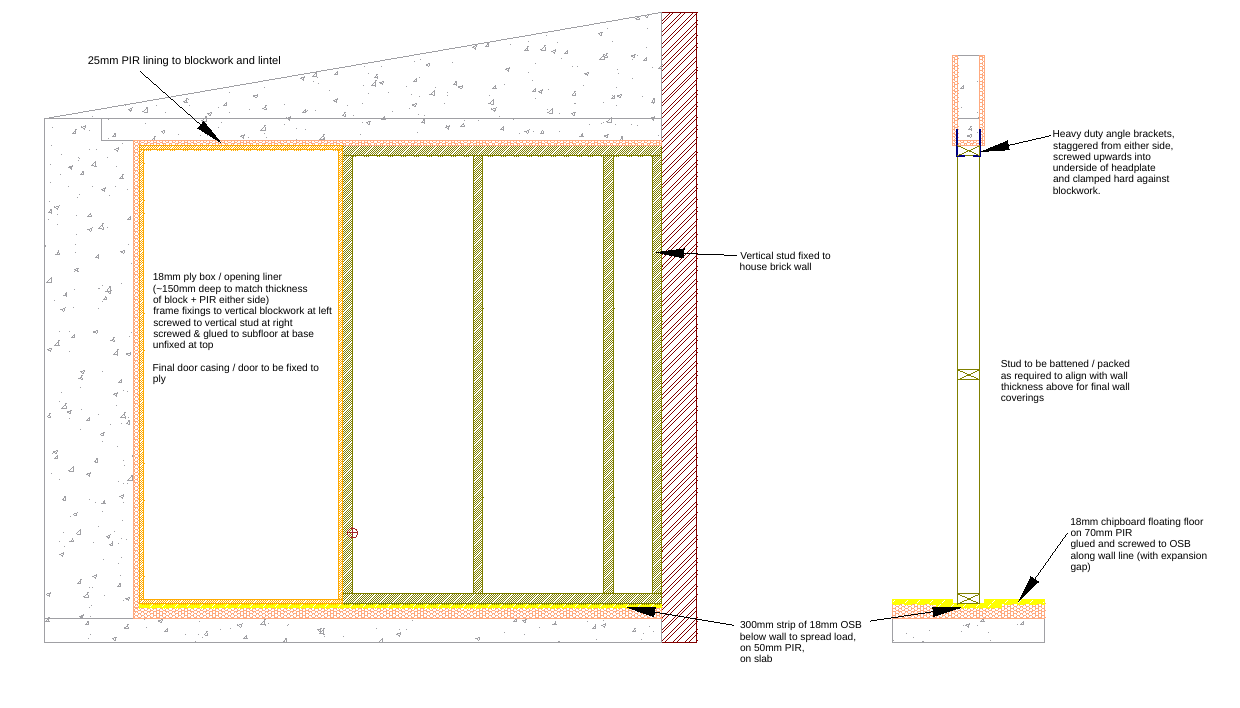
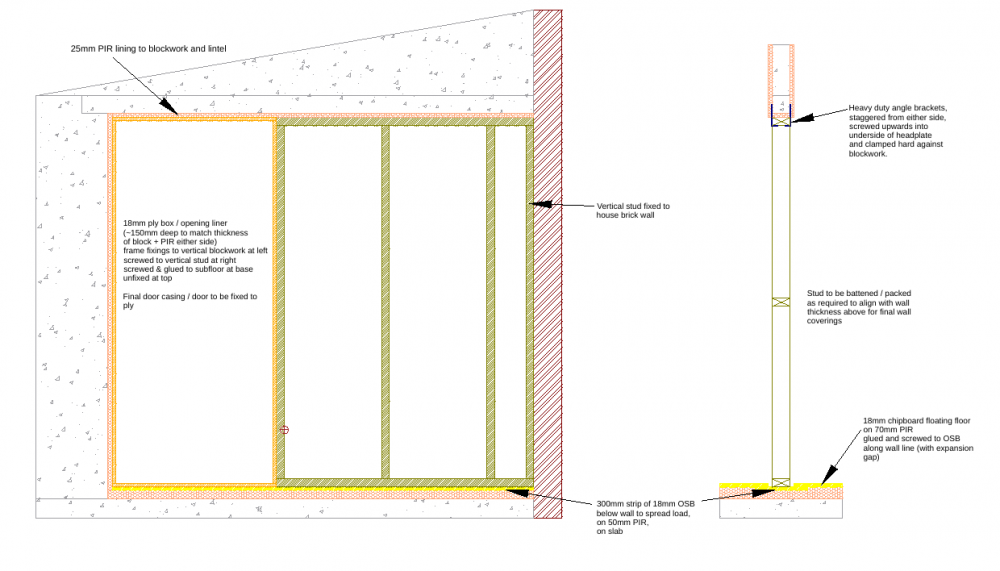
Thanks Mike. There's 25mm PIR between the plasterboard and lintel/blockwork so it'll be easy enough to rebate that to accommodate the brackets. Possibly one or two I guess. Not sure how easy it would be to chemical anchor upside down though. The existing holes are very offset to one edge (one has actually chipped the edge) as they were for battens against an old set of patio doors so not ideally located for a secure fixing.
-
I'm having a little wobble about the fine positioning of the internal stud walls of my garage conversion. There's a very fine tolerance on the width of the corridor past the en-suite vs the space within the bathroom. The nearer I can get the room door to the edge of the old garage, the better this tolerance gets (due to the angles involved, it's a tricky layout). NB this is now an internal door - there's a new extension on the front of the garage. The original plan was to fill the whole opening with a stud wall, fixed to the blockwork at one side and the house brick at the other. I don't really want to fix up into the lintel (it's already been drilled in a couple of places for a historic - rubbish - conversion and I think best to leave well alone now). I now think I could save about 27mm - significant in the bigger picture - by only building the stud across part of the opening, framing the door opening with an 18mm ply box. That does however mean the studs will only be fixed at one side, so not very sturdy. I think I could solve that by screwing some heavy angle brackets either side of the head plate, staggered along the length, so that they clamp hard against either side of the lintel above. I'm hoping that would be enough to keep the wall rigid at the top. The sides of the ply box would then be fixed to the last stud and to the old garage wall, so that should provide a stable/solid enough base for the final door casing and door... What do you think?
-
At a total guess: * Forests that are left to their own devices are growing faster than expected due to higher availability of CO2 * Simultaneously humans are cutting and clearing forests much more rapidly than in the past Entirely possible for both of these to be true. Also possible for the percentage increase in growth rate to be significant looking only at growth, but to be a tiny figure relative to the rate of human deforestation.
-
I think it would be hard to outright replace/add to the window itself and get a good seal/overlap round the flashings/fibreglass. Although, one of the benefits of fibreglass is that you can cut sections out / add new sections and bond it all together reliably without too much hassle. But you could definitely look at putting something above the whole window assembly to stop rain landing on it. There are several ranges of flat roof window that use a plastic dome for that purpose - basically an umbrella over the window itself. It looks like sterlingbuild sell the polycarbonate domes as a standalone unit e.g. https://www.sterlingbuild.co.uk/product/rectangular-dome-only-single-skin-50x80cm and they're quite cheap. You would only need single skin as it's not doing anything thermal, just keeping the rain off the actual window. If they have a size big enough to overlap the entire current window you could just do that. You might have to be clever with how you fix it on at the sides (perhaps carefully drill/screw through the side of the window flashing with some washers for spacing, or maybe go slightly bigger and fix down into the top of the fibreglass kerb with spacers as required). If you leave a gap you'll still be able to open the window/trickle vents for ventilation and possibly even enough for cleaning if the dome is big enough. Or, I guess you could engineer some sort of flat glass canopy above the window but that might look more odd and be harder to achieve/fix securely - I suspect a horizontal pane of glass in mid air will get fairly battered by the wind.
-
It does sound like a strange thing to say - the concept itself and the way they've worded it (never seen a solicitor say "endless to-ing and fro-ing"!) My hunch is the solicitor is more used to buying buildings than plots/land? While the PP aspect won't be affected it might be worth thinking about/asking if there's anyone in the firm who can check whether there are other aspects of the transaction that someone with more land experience would be looking out for. Not sure what that would be really - slightly different contract clauses, more detailed searches for underground services/rights of way or that sort of thing? I'd just be a bit nervous that buying land is different to buying a building and if they're not familiar with that they might miss something lawyery that could bite later. But maybe you have all that covered yourself.
-
I'd be careful unless your loft is very well ventilated and the blockage/standing water well below the cap lid. Those products can produce a lot of bubbling and fumes, possibly moreso if mixed with the concoction of things you've already got in the pipe. Definitely stand well back either way. My normal go-to for blocked/slow drains is caustic soda powder (also at homebase) works very well with cold water per the packet instructions or for more stubborn blockages a kettle of boiling water poured down after it produces a much more violent reaction and has never failed yet. But either way it's another "open the window and stand well back" job.
-
Changing door to terrace to locked access hatch?
andyscotland replied to jack's topic in Building Regulations
IMO it's a slightly different context. Tool-operated electrical enclosures are predominantly about kids/inquisitive or accidental opening. Where the regs for fall protection/access cover that but also are as much about controlling/planning for intentional (but perhaps ill-advised) work at height. A door you can unlock doesn't do anything on that front. -
Changing door to terrace to locked access hatch?
andyscotland replied to jack's topic in Building Regulations
@Mr Punter is bang on re protection for children etc and that's definitely worth thinking about and having a robust/foolproof solution for. Possibly something that can only ever be either open and unlocked or closed and locked, so it can't ever be accidentally left unsealed. In terms of tree contractors/you clearing leaves I might take a slightly different view. If you/an other actually need to be on the roof, or it's the easiest place to work from, then that's where you'll be - door or not. There will always then be a risk of working too near the edge or being distracted on the phone. I don't see that justifies increasing the risk (eg by fitting permanent barrier/fixed window and using ladders to get up just so you can say "well nobody was meant to be up there guv". So personally I would assess the frequency and nature of work on the roof and what's reasonable precautions for temporary or permanent edge/fall protection. But then entirely separately if there's an easy/ secure way to provide safe access on and off the roof I'd do that. -
Changing door to terrace to locked access hatch?
andyscotland replied to jack's topic in Building Regulations
Don't know how it would translate to a domestic environment, but in commercial I think if routine maintenance access was required there'd still need to be a designed-in solution for edge/fall protection whether guarding, restraint system, or whatever. Obviously in commercial you can also make a stronger case for protection by locked door/gate as you can have proper management and control measures over permit-to-work/access to the key/monitoring frequency of access etc. So might e.g get away with restraint system over permanent guardrail. In domestic you're essentially asking BC to take it on trust that neither you (nor a future occupier) will unlock the door without thinking through fall protection. I'm not sure having to use tools makes that much more of a guarantee - though would at least prevent kids/visitors etc getting out there I guess. I think I remember reading something that said a roof etc could only really be considered inaccessible and left unprotected if you needed a ladder for access, at which point the assumption is that a) it will be very infrequent and b) the ladder user will plan the whole operation sensibly. Unless you get on very well with BC I would be tempted to put a "permanent" juliet balcony barrier across the gap, keep stum about maintenance access, then revisit after completion. I wouldn't personally want to take the risk of telling BC I'd be up there all the time clearing leaves. -
(smart?) things that should be in every room
andyscotland replied to puntloos's topic in New House & Self Build Design
I would definitely put cat 5 (or higher) alongside every coax, at the very least. I would also duct all those points to make it easy to pull in alternative cables in future. The end of over-the-air TV broadcast is still a wee way off but could conceivably come sooner than expected. There's a lot of pressure on radio frequency spectrum for the rollout of high-speed mobile internet, and if streaming/catchup TV also continues to grow rapidly that's bound eventually to mean they can't justify keeping the spectrum currently used for traditional broadcasting. Aerials and coax will probably hang in there a good while longer, but I certainly wouldn't bet on them outlasting your house. -
Switchable power to every room?
andyscotland replied to puntloos's topic in Networks, AV, Security & Automation
All that said, having just got poked in the eye by a pine needle for the umpteenth time I would recommend a smart socket for your Christmas tree lights! -
Switchable power to every room?
andyscotland replied to puntloos's topic in Networks, AV, Security & Automation
Like @ProDave I can't really see the real-world usefulness of this. In terms of remote switching, a room-by-room basis could well be too blunt. Also worth bearing in mind there are increasing numbers of devices that have some sort of shutdown procedure and don't take kindly to a hard power off. So you may still have to go into the rooms to shut down before you can use your fancy remote isolator anyway. The only thing I can think of would be for powering off the house when you go away but in that case again you might want to have some of those random room/desk lamp/TV&radio controllers to make it look occupied so a global kill switch not that handy. And does it happen often enough to justify the cost/future maintenance potential etc? Likewise per-room data logging might not really tell you much (unless e.g. to show a lodger or older child how much they're using, or support an expenses/tax claim for homeworking). There's also easier ways to do that e.g. with current transformers. Per-outlet switching and monitoring like a fully functional building management system might be useful but at much higher cost. But possibly one of those where saving a little ones halfway house is actually a waste of money. If it was me I'd organise the electrics based on traditional concerns (load distribution, what fails if the circuit trips, can you still see your way to the fuseboard, what's logical and easy to understand in terms of isolating for maintenance). And then add a couple of smart sockets/inline meters/whatever for appliances and outlets you're particularly interested in. -
Relatives working on site.
andyscotland replied to ToughButterCup's topic in General Self Build & DIY Discussion
To a point, yes. But I find no matter how much googling/planning you do in advance there are always unexpected things come up. E.g. the fibreglass bubbles I got that weren't quite like anything covered in the many how-to and troubleshooting vids I'd looked at. Or junctions between materials/corner details that don't quite line up in 3D the way they did in the CAD sections. Or a material that's been cut/installed wrong and you need to figure out if there's a way to use it anyway or if you need to waste it and start again. Most of those things could perhaps be solved by doing even more detailed planning and upfront "what if" research but in my experience there's really no substitute for experience for covering all the possible bases. Unknown unknowns and all that. -
Relatives working on site.
andyscotland replied to ToughButterCup's topic in General Self Build & DIY Discussion
Definitely. Nothing worse than someone helpfully saying "what can I do now?" while you're trying to think/do something tricky. In the end that's why I sent him away and did the fibreglass on my own, took a lot longer but was massively less stressful. At least with my labourer I know that telling him to take yet another break is just wasting my £. Feels much worse with a friend/family member to be wasting their time. -
Relatives working on site.
andyscotland replied to ToughButterCup's topic in General Self Build & DIY Discussion
Can definitely agree with this. I find I'm snapping at (and later apologising to) my labourer much more than I ever did to anyone on an event site even at moments of outstanding stupidity with doors about to open and the audience outside. Can only imagine that being much worse with a family member. I think the main issue was on an event site I was well inside my competencies and even when problem solving I had the experience to come up with a solution fast and manage the team to fix it calmly without stress. Whereas on the build I am learning all the time, there's a lot more thinking on my feet, a lot more worrying if I'm making the right call, and a lot more wishing the labourer would disappear for a bit so I could sit down with a cup of tea and YouTube/buildhub to figure things out. -
Relatives working on site.
andyscotland replied to ToughButterCup's topic in General Self Build & DIY Discussion
Tbh even that is sometimes a minefield. Quite often had issues with being pushed/pulled/tipped/overbalanced by someone who can't grasp basic handling techniques and doesn't listen to instructions. Actually the worst is the kind passersby - almost always male - that are determined to dive in uninvited and grab/lift a bit of my MiLs wheelchair to "help" us down steps/up kerbs. 99% of the time aren't open to being told what to do or politely refused by either MiL or the pusher. Have had several close shaves where a well-meaning person has nearly landed us all upside down on the pavement on top of her. Now got quite good at assertively refusing as they approach which probably comes across as rude, but seems to be the only way to keep her safe. Yours sound pretty safe and straightforward compared to some I've used over the years. The two-13A-plugs-to-one-commando-socket adaptors commonly used to power lighting kit in temporary venues always raised eyebrows - but never singed any. Or there was the Murrayfield gig where the crew ran the 300A distribution cables back through the stadium to the generators in the car park with the plugs at the wrong end, prompting the touring spark to knock up a set of 300A plug-to-plug adapters as there wasn't time to re-run the cables... Think too many of us grew up watching"don't try this at home" shows ? -
My engineer specified: This is for an extension sitting on a raft slab/foundation with thickened edges, the walls sit on a concrete kerb cast in situ on top of the slab. The L straps just go dowm and bolt into the slab. Two sides of the extension are joined to existing masonry building. Not sure if this would be adequate for a freestanding structure on traditional foundations. But I would think ultimately if you can get a secure fixing down into a mass of concrete below/beside the wall it's unlikely to go anywhere.
-
Fairly sure that there is a minimum requirement for sound insulation between floors (under building regs) so this is probably a detail you need to agree with your builder/BCO
-
Building regs and building survey recourse
andyscotland replied to H F's topic in Building Regulations
That might help - you could potentially pursue them for deception. However if it could be argued they didn't understand what they were saying it might be hard to prove they did it deliberately. That was the situation we found ourselves in. Ours originally put on the form that they hadn't done any alterations so didn't have any building control paperwork, and later claimed they hadn't realised a garage conversion counted as an alteration because their builder had told them it didn't need building control approval. The vendor's solicitor said it was the surveyor's job to check the info the vendor provided so it should be them responsible (I was tempted to agree, if we could trust vendors to provide all the right info we wouldn't bother paying surveyors at all!). Meanwhile the surveyors said that they couldn't be held responsible for checking things the vendor hadn't declared. And that was when my solicitor explained that essentially gave both of them a watertight defence, because really they were both responsible but that's not actionable in law. -
Building regs and building survey recourse
andyscotland replied to H F's topic in Building Regulations
We had similar issues with our survey when we bought. After working through it with both our own solicitor and the firm appointed by our home insurance legal cover it turns out to be very difficult indeed to pursue any recourse for this. As well as the caveats others have mentioned, even if it is something they should have spotted you will not get anything if it's just a mistake. You would have to prove it was negligent - a mistake no reasonable person could have made if they were taking reasonable care. To do this you'd have to pay another surveyor for expert evidence that it was a negligent mistake. There's a fairly high bar for this - surveyors have a vested interest in making sure most mistakes are not negligent, in case any of their own come back to bite them. And of course if the defending surveyor can find an independent expert of their own willing to say "yeah, I can totally see how they missed that in the circumstances, I'm sure I've made similar mistakes" you will be bogged down in court trying to prove your expert is more believable than theirs. The cost of the case will therefore often far outweigh the potential damages, which makes it unlikely an insurer will cover it. More importantly, you have to pay your expert upfront to get their opinion on whether you can win. And an insurer won't pay for advice until they know the case is winnable. My legal insurer's solicitor told me that chicken-and-egg problem meant that although on paper the policy covers negligence claims, in practice they hardly ever take them. They're only interested if the mistake is jaw-droppingly-obviously-negligent (the house doesn't actually exist, or more usually the surgeon left the scissors inside the patient). If you have legal cover it's worth an ask, and if you have a tame solicitor of your own you could always try writing a letter to the surveyor demanding some compensation. Apparently below a certain level the surveyor's insurer will often take over the case and just settle straight away to avoid the cost of looking into it at their end. But if they refuse (as ours did) you don't have a lot of options. I'd be careful here. My understanding is the legal responsibility is with the person who commissioned/did the work. They have to make a declaration at the end that it's all compliant. Building Control may do some inspections to check that, and may refuse to accept the declaration if they find anything problematic. But I don't think that shifts the responsibility to them if they don't find anything. You could try and go after them if their mistake was negligent - but I suspect building control would argue a) they didn't owe you a duty of care, as you had no interest in the property at the time and b) your loss really stemmed from the fact somebody did non-compliant work rather than from Building Control not spotting it. Either of those arguments, if successful, would win them the case. Unfortunately they don't even have to prove the person that did the work was wholly responsible for your loss, they just have to prove they contributed. Liability for negligence can't be apportioned between people, so if there are two parties involved each of them only has to prove the other was partly responsible and that gets them both off the hook. However, building control do have the power to force you - as current owner of the property - to put right recent work that they discover is not compliant. I guess they probably wouldn't if it was minor (and/or not a safety thing), and they would potentially be a bit flexible if they knew you were trying to address a situation you inherited. But there is probably a risk that if you highlight that your house doesn't comply with regulations, and has an invalid completion certificate, you may open a can of worms that you'd prefer to leave closed. Again this might be an area where it's worth taking specialist advice if the mistakes are severe, but I'd definitely keep that conversation well away from the council till you know where you stand. You might possibly be able to go after the person that submitted the completion declaration if that was outright fraudulent, but again there might be issues in proving that you suffered a loss as a direct result of that. If I'd known when we bought our place what I've learned since, I'd have ignored the survey completely and spent a day here with my tools before we concluded contracts... For all the reassurance things like surveys and building control are meant to provide, it seems it's really still very much a case of caveat emptor if things go wrong. -
Thinking about it, if when it's all done and you have the heating on inside this still proves to be a regular/permanent problem there might be some heath-robinson-esque things you could try. Possible ideas might include trying to source some of the electrically heated film they use on car windscreens, or maybe some sort of fan/channel affair delivering a curtain of gently heated or dehumidified air over the glass. I think there are also some anti-condensation sprays (I've seen them marketed for cars) if the window doesn't already have a coating on the glass. You basically need to increase the glazing temp, dry the air immediately beside it, or encourage the condensation to form into droplets and run off. Or some combination. You could have it triggered off a humidity/temp sensor once you identify the conditions where it happens. No idea if any of them would work and you'd definitely be at the mad boffin end of the spectrum, but if you find it a genuine issue it could make for an interesting project down in the shed if that sort of thing floats your boat. But I think most people just accept it as evidence that the window is doing a good job of keeping their expensive heat inside the building.
-
Most would have just tried one (or both) and just seen what came up. And then tried something else if what they found didn't seem useful/relevant. It's not like there's a cost to a Google search. Bit unreasonable imo to badger people to spend their free time telling you exactly what search term to use. Your existing windows are potentially on heated rooms and/or single glazed? So the outer pane of the glass will be warmer. Doesn't need to be much warmer to make a difference. Nobody can tell you if the inside finishing work will definitely solve it. It might be once you have the heating on it warms the glass just enough. Or it might not. Or it might only work on some days. Depends on the exact combination of air temperature, humidity, air movement etc in the micro-climate right next to the window. What we can say is this is an expected behaviour of glazing in certain conditions, that becomes more common the more insulated (e.g. triple Vs double Vs single) the glazing. It's not a defect. Unless you want to heat up, or dry out, Wales, there isn't anything you can do to change it. You will just have to wait and see what it's like once the heating is on.
-
Detailing insulation / VCL below internal stud walls
andyscotland replied to andyscotland's topic in Heat Insulation
@PeterW thanks - sounds like a good solution. I guess I'd need to reduce the PIR by 20mm down to the next standard thickness, so would then need to pack a few mm between the OSB and the chipboard to keep the levels? That should be doable. I asked Ecotherm technical and they've come back and quoted 28kN/m2 for a permanent loading figure at 1-2% yield, so does sound like increasing the bearing area as you've suggested is a good plan.