


andyscotland
-
Posts
638 -
Joined
-
Last visited
-
Days Won
1
Everything posted by andyscotland
-
Building regs and building survey recourse
andyscotland replied to H F's topic in Building Regulations
That might help - you could potentially pursue them for deception. However if it could be argued they didn't understand what they were saying it might be hard to prove they did it deliberately. That was the situation we found ourselves in. Ours originally put on the form that they hadn't done any alterations so didn't have any building control paperwork, and later claimed they hadn't realised a garage conversion counted as an alteration because their builder had told them it didn't need building control approval. The vendor's solicitor said it was the surveyor's job to check the info the vendor provided so it should be them responsible (I was tempted to agree, if we could trust vendors to provide all the right info we wouldn't bother paying surveyors at all!). Meanwhile the surveyors said that they couldn't be held responsible for checking things the vendor hadn't declared. And that was when my solicitor explained that essentially gave both of them a watertight defence, because really they were both responsible but that's not actionable in law. -
Building regs and building survey recourse
andyscotland replied to H F's topic in Building Regulations
We had similar issues with our survey when we bought. After working through it with both our own solicitor and the firm appointed by our home insurance legal cover it turns out to be very difficult indeed to pursue any recourse for this. As well as the caveats others have mentioned, even if it is something they should have spotted you will not get anything if it's just a mistake. You would have to prove it was negligent - a mistake no reasonable person could have made if they were taking reasonable care. To do this you'd have to pay another surveyor for expert evidence that it was a negligent mistake. There's a fairly high bar for this - surveyors have a vested interest in making sure most mistakes are not negligent, in case any of their own come back to bite them. And of course if the defending surveyor can find an independent expert of their own willing to say "yeah, I can totally see how they missed that in the circumstances, I'm sure I've made similar mistakes" you will be bogged down in court trying to prove your expert is more believable than theirs. The cost of the case will therefore often far outweigh the potential damages, which makes it unlikely an insurer will cover it. More importantly, you have to pay your expert upfront to get their opinion on whether you can win. And an insurer won't pay for advice until they know the case is winnable. My legal insurer's solicitor told me that chicken-and-egg problem meant that although on paper the policy covers negligence claims, in practice they hardly ever take them. They're only interested if the mistake is jaw-droppingly-obviously-negligent (the house doesn't actually exist, or more usually the surgeon left the scissors inside the patient). If you have legal cover it's worth an ask, and if you have a tame solicitor of your own you could always try writing a letter to the surveyor demanding some compensation. Apparently below a certain level the surveyor's insurer will often take over the case and just settle straight away to avoid the cost of looking into it at their end. But if they refuse (as ours did) you don't have a lot of options. I'd be careful here. My understanding is the legal responsibility is with the person who commissioned/did the work. They have to make a declaration at the end that it's all compliant. Building Control may do some inspections to check that, and may refuse to accept the declaration if they find anything problematic. But I don't think that shifts the responsibility to them if they don't find anything. You could try and go after them if their mistake was negligent - but I suspect building control would argue a) they didn't owe you a duty of care, as you had no interest in the property at the time and b) your loss really stemmed from the fact somebody did non-compliant work rather than from Building Control not spotting it. Either of those arguments, if successful, would win them the case. Unfortunately they don't even have to prove the person that did the work was wholly responsible for your loss, they just have to prove they contributed. Liability for negligence can't be apportioned between people, so if there are two parties involved each of them only has to prove the other was partly responsible and that gets them both off the hook. However, building control do have the power to force you - as current owner of the property - to put right recent work that they discover is not compliant. I guess they probably wouldn't if it was minor (and/or not a safety thing), and they would potentially be a bit flexible if they knew you were trying to address a situation you inherited. But there is probably a risk that if you highlight that your house doesn't comply with regulations, and has an invalid completion certificate, you may open a can of worms that you'd prefer to leave closed. Again this might be an area where it's worth taking specialist advice if the mistakes are severe, but I'd definitely keep that conversation well away from the council till you know where you stand. You might possibly be able to go after the person that submitted the completion declaration if that was outright fraudulent, but again there might be issues in proving that you suffered a loss as a direct result of that. If I'd known when we bought our place what I've learned since, I'd have ignored the survey completely and spent a day here with my tools before we concluded contracts... For all the reassurance things like surveys and building control are meant to provide, it seems it's really still very much a case of caveat emptor if things go wrong. -
Thinking about it, if when it's all done and you have the heating on inside this still proves to be a regular/permanent problem there might be some heath-robinson-esque things you could try. Possible ideas might include trying to source some of the electrically heated film they use on car windscreens, or maybe some sort of fan/channel affair delivering a curtain of gently heated or dehumidified air over the glass. I think there are also some anti-condensation sprays (I've seen them marketed for cars) if the window doesn't already have a coating on the glass. You basically need to increase the glazing temp, dry the air immediately beside it, or encourage the condensation to form into droplets and run off. Or some combination. You could have it triggered off a humidity/temp sensor once you identify the conditions where it happens. No idea if any of them would work and you'd definitely be at the mad boffin end of the spectrum, but if you find it a genuine issue it could make for an interesting project down in the shed if that sort of thing floats your boat. But I think most people just accept it as evidence that the window is doing a good job of keeping their expensive heat inside the building.
-
Most would have just tried one (or both) and just seen what came up. And then tried something else if what they found didn't seem useful/relevant. It's not like there's a cost to a Google search. Bit unreasonable imo to badger people to spend their free time telling you exactly what search term to use. Your existing windows are potentially on heated rooms and/or single glazed? So the outer pane of the glass will be warmer. Doesn't need to be much warmer to make a difference. Nobody can tell you if the inside finishing work will definitely solve it. It might be once you have the heating on it warms the glass just enough. Or it might not. Or it might only work on some days. Depends on the exact combination of air temperature, humidity, air movement etc in the micro-climate right next to the window. What we can say is this is an expected behaviour of glazing in certain conditions, that becomes more common the more insulated (e.g. triple Vs double Vs single) the glazing. It's not a defect. Unless you want to heat up, or dry out, Wales, there isn't anything you can do to change it. You will just have to wait and see what it's like once the heating is on.
-
Detailing insulation / VCL below internal stud walls
andyscotland replied to andyscotland's topic in Heat Insulation
@PeterW thanks - sounds like a good solution. I guess I'd need to reduce the PIR by 20mm down to the next standard thickness, so would then need to pack a few mm between the OSB and the chipboard to keep the levels? That should be doable. I asked Ecotherm technical and they've come back and quoted 28kN/m2 for a permanent loading figure at 1-2% yield, so does sound like increasing the bearing area as you've suggested is a good plan. -
Detailing insulation / VCL below internal stud walls
andyscotland replied to andyscotland's topic in Heat Insulation
Should EPS300 be easy to source for a couple of sheets? I made a couple of calls this morning to my usual merchants but they didn't carry it. A quick google is only turning it up online in quite big quantities. Thanks. Looked at the eco-versal datasheet as that's what I have : they say a continuous static load of 30kN/m2 (possibly due to compressive creep?). I am assuming that's a working limit, rather than a failure load that needs an additional safety margin applied. The narrowest studs I have are 38 x 63 CLS. If I have it right, that works out to a load limit of 1.89kN/metre of wall. Which would be 192kg/m. By my reckoning, the walls weigh about 100kg/m as below (plus a little bit for fixings, filler, paint, etc I guess): item qty width depth height volume density mass m m m m3 kg/m3 kg soleplate 1 1.000 0.063 0.038 0.0024 370 0.89 base member 1 1.000 0.063 0.038 0.0024 370 0.89 noggin 1 1.000 0.063 0.038 0.0024 370 0.89 top member 1 1.000 0.063 0.038 0.0024 370 0.89 head 1 1.000 0.063 0.038 0.0024 370 0.89 stud @ 600 ctr 1.67 0.038 0.063 2.500 0.0060 370 2.21 insulation 1 1.000 0.063 2.500 0.1575 10 1.58 fermacell 1 1.000 0.013 2.500 0.0313 1200 37.50 ply 1 1.000 0.018 2.500 0.0450 680 30.60 ply battens vert 2 0.020 0.020 2.500 0.0080 370 2.96 ply battens horz 4 1.000 0.020 0.020 0.0004 370 0.15 wall panel 1 1.000 0.010 2.500 0.0250 800 20.00 total mass per metre of wall (kg/m) 99.43 Does that seem plausible? If so then it would be well within the bearing capacity of the PIR, I think? One slight complication is that a couple of the walls have doorways, so the weight will be a bit different and the bearing area will be smaller, but if the above calc is correct there's a fair bit of headroom and the calc doesn't allow for any weight being taken where the end studs fix into the adjacent masonry walls. 3 or 4mm could be enough to make a difference at the bottoms of the walls though (especially in terms of the tile/skirting/whatever junction in the bathroom)? And maybe a risk of forces on the wall (e.g. from opening/closing doors) pushing the chipboard towards the perimeter expansion gaps - though I guess there'd be quite a lot of friction to overcome. Just feel a little nervous about having a "floating wall". I know NHBC standards rule out building a wall off a floating floor - I don't have to comply with them, but presumably that rule is due to defects they've encountered in the past... -
Detailing insulation / VCL below internal stud walls
andyscotland replied to andyscotland's topic in Heat Insulation
Good question, not certain - I'll try to work it out. Not enormous I think (they're only about 2.4m tall), though the heaviest will have 18mm ply and shower panels on one side, potentially fermacell on the other. So a bit heavier than a standard plasterboard stud. I'd not got them sitting on the chipboard as that's just floating, I'd read somewhere some concerns about whether the wall would move as the flooring expands/contracts. though perhaps could fix the soleplate down through the chipboard and insulation to eliminate that. -
I've realised there's a detail on my garage conversion that I'd not quite thought through. There are a couple of internal (non-loadbearing) stud walls to divide off rooms within the space. At the moment I have the soleplates for these sitting directly on the concrete slab (bridging the floor insulation). But I hadn't quite thought about how the VCL would detail round these (and hadn't drawn it on the building control plans). I've drawn what I think would be easiest on my section below - the VCL passing below the soleplate so it's continuous across the whole area. However this will allow vapour to get down to the cold slab/soleplate junction and I'm wondering if that's a condensation risk. Alternatives I can think of are: Make the PIR and VCL continuous across the whole slab, build the wall on top of the insulation. But not sure if that would be OK structurally in terms of loading on the PIR? Keep the soleplate directly on the slab, but take the VCL over the top, sealing it around all the vertical studs. So the bottom timbers are cold but dry (though moisture could still penetrate through / around the vertical stud junctions?) Take the VCL between the soleplate and the bottom member of the wall - so the VCL is continuous, and the coldest timber is dry - the bottom member should be less likely to hit dew point? Sit the wall on something insulating with more compressive strength (compacfoam or marmox thermoblock) to reduce the thermal bridge and keep the timber warm - but looks relatively pricey / and/or hard to source in small quantities. Or am I worrying too much? Only one of the walls runs to the outside wall of the property, the others are all in the centre of the slab or adjacent to the house - I know most slab heat loss is around the exposed perimeter so potentially where my walls are sitting won't get too cold? What do you all think? Cheers
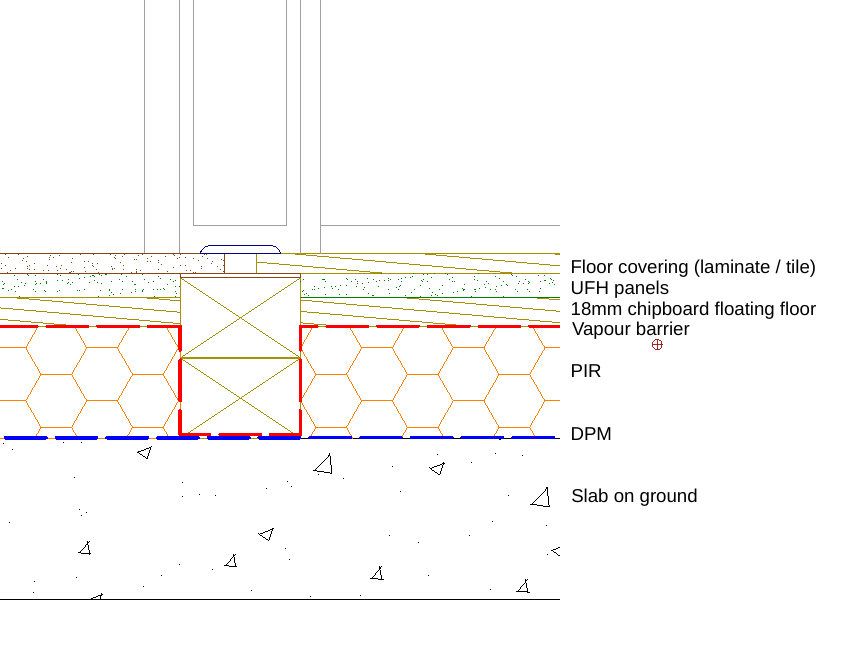
-
@ProDave I like your idea. My ground floor is PIR insulation on top of slab (garage conversion) and I'd been going to put 18mm chipboard floating floor then the pre-routed overlay boards for the UFH but this is working out a bit pricey. Wondering if your solution might work for me too - it's just floating laminate floor going down on top so needs to be quite a solid base.
-
Boiler size for underfloor heating vs radiators
andyscotland replied to andyscotland's topic in Underfloor Heating
Exactly my thinking -
Boiler size for underfloor heating vs radiators
andyscotland replied to andyscotland's topic in Underfloor Heating
Thanks all - yes absolutely I think the plan is to plumb it back to a separate zone for control/timing reasons. The only sticking point really is whether it's going to make a difference to whether a boiler upgrade is required. As the architect has given the steer that there's quite a cost difference for UFH + a boiler vs just an extra radiator off the existing boiler, but my thinking is the boiler sizing for the house is essentially a separate question. So my advice to MiL is essentially going to be to crack on on the basis she'll have the UFH she wants. Then when the heating engineer eventually gets involved, if they're confident she needs a new boiler to manage the extension she can get one, if they think it'll potentially be OK she can give it a go without and get the boiler upgraded later if it turns out to be a bit under-powered. -
Boiler size for underfloor heating vs radiators
andyscotland replied to andyscotland's topic in Underfloor Heating
I think that's just a question of a valve that lets enough hot water from the main/radiator loop to top up the water in the UFH loop and keep it at the lower target temp. I do know that means the boiler will potentially have to do more running "little and often" than it would with just radiators alone. -
Boiler size for underfloor heating vs radiators
andyscotland replied to andyscotland's topic in Underfloor Heating
Thanks @ProDave that was my hunch, or just that he wasn't totally up to speed with it. Good to have a second opinion! -
Another question on my mother in law's build. She wants underfloor heating in the extension (30m2). The architect has raised a concern that the existing boiler might not be big enough for UFH, and so she may have to have radiators or upgrade the boiler I am confused by this. I can't understand why the heat delivery method would affect the power demand in any significant way. As far as I can see either the boiler is big enough to cope with the extra heating load of the extension, or it isn't? I know there is a higher loss to the ground, but the slab is going to be very well insulated (overall floor u-value of 0.13) and running this through @Jeremy Harris floor heat loss spreadsheet I get a loss of about 4.5% which seems fairly negligible. Surely the heat demand is governed by the size and thermal performance of the space - it will require the same input whether it's from UFH or radiators? Indeed if anything the boiler power rating could be lower for UFH since it is essentially on more continuously rather than in peaks and troughs like a conventional system? When I asked the architect he just said it was to do with UFH operating at a lower temperature, but I still don't follow why that would be (I know it can have an impact on the boiler in terms of cycle time / running time etc). Am I missing something?
-
@MaryM you're doing all the right things. You may (if you want them) end up paying for the kitchen units but as you say it needs to be considered as part of overall settlement including money you've already paid him for work not done/work done with defects etc. As you have already raised a dispute with him, and started the ball rolling on adjudication, he can't realistically pursue you for payment through the courts/any third party until the dispute is resolved. And it's very unlikely down the line anyone would uphold any interest/late charges etc against you for not paying until that was all settled particularly as you have already paid his earlier invoices. So whatever he thinks, for all intents and purposes the matter is held in abeyance at this point. So he can (and potentially will) send you increasingly firm messages etc asking for payment. But they have no teeth - so I would just respond to each chaser with a clear but firm "As I have told you, I'm not paying anything further till the dispute is resolved" and otherwise ignore them.
-
It's fairly standard for supply contracts to have a clause like that, but it doesn't mean the contract for sale can't be enforced. It's primarily there in case you go bankrupt, so the supplier can get the materials back rather than having to join the queue of unsecured creditors. In general terms, unless you have a right to cancel/return goods then as soon as you order them you can be forced to pay for them. If you don't pay then the goods might be taken in part-payment of the debt but they would not necessarily be valued at the full sale price and you might still owe for any balance to account for the supplier's lost profit/overheads. In your specific case, however, then assuming the builder bought them on your behalf I'd argue they are part and parcel of the work he has failed to deliver. And as such are no different to e.g. timber he's already fitted to the building/any other materials. Your contract (which may be verbal) is for supply and fit, and can't be retrospectively be split off to supply only. If he's not fitted them he has not delivered his side of the contract, so shouldn't be paid at all. Until/unless you both go through adjudication and come up with a settlement/route forward for the project as a whole. So I would be taking the line that you are not paying for them until they're fitted, and if he wants to return/sell them he can take them away.
-
deck in attic over mineral wool
andyscotland replied to moldy's topic in General Construction Issues
There's various options but as far as I know loft legs are the easiest/most thermally efficient solution -
Scaffolding tent for temporary roofing
andyscotland replied to andyscotland's topic in General Self Build & DIY Discussion
I've been fully gloved up : went through a billion latex gloves in the early stages, then switched to some trusty marigolds which are lasting much better! I have managed to laminate my trousers to my knees a couple of times but not noticed any ill effects once unstuck ? -
Scaffolding tent for temporary roofing
andyscotland replied to andyscotland's topic in General Self Build & DIY Discussion
Blue (slightly greenish) then turns brown-green once catalysed. -
Scaffolding tent for temporary roofing
andyscotland replied to andyscotland's topic in General Self Build & DIY Discussion
I'm not sure what an environmental resin is but it doesn't feel slippery. It's Cromar ProGRP - they say it's "pure resin, not blended". -
Scaffolding tent for temporary roofing
andyscotland replied to andyscotland's topic in General Self Build & DIY Discussion
Wee update : tent is still up and weatherproof, have had 3 electric patio heaters on low continuously and a dehumidifier up there. It's not totally sealed at the corners/edges but I've closed up the worst of the drafts. The temperature is consistently a good few degrees above outside air, the dehumidifier has cleared up the condensation/dew that was initially forming on the inside and then dripping back onto the boards. Now getting solid 5-6% readings from my electronic moisture meter. Did a couple of small sections of the GRP in lunch breaks last week, sanding and acetoning at the joins between each day's work and it's going down fine. Also much more efficient being able to leave all the tools and materials up there overnight rather than having to bring everything down and back up. It dropped to 2° in there overnight while it was -5 outside, but otherwise has always been 5° or higher. Good demo of the power of solar gain too : yesterday lunchtime it was 2° outside but so sunny that with the heaters off the boards and air were at 22°! Bit of luck I'll finish the laminate this weekend, then going to sand and acetone the whole thing, put a thin coat of resin and then topcoat as I've read that can get a better bond if there's been a delay in getting the topcoat down. So far seems like the bonkers plan is working! -
So the architect has just put forward a standard Scottish Minor Works contract (and the outdated 2011 edition at that). He'd previously said he didn't think an off-the-shelf contract would work and hasn't explained why he thinks that's changed. Reading the contract it doesn't seem to me like it properly reflects the relationship at all, and definitely insurance is murky, the contractor has to have cover for defects/liability by his employees and subbies (of which there are none) but it says nothing about liability/cover for anything done by people he's found and is managing but who are working directly for the client. Anyone know of a standard contract that would cover this setup better?
-
Thanks everyone, much appreciated.
-
@nod thanks - I think it's not helping my nerves that he has now a couple of times insisted to MiL that he will be main contractor and that there's no difference to using a firm where all the invoices go through them. Feels a little underhand because - as you say - I'm very aware he won't actually be main contractor in the traditional sense, he'll just be project managing.
-
As well as my own project we're giving my mother in law a bit of help co-ordinating her own extension/internal alterations. It's a fairly simple timber frame extension, plus quite a bit of reorganising the inside of the house (widening doorways, swapping rooms about, new wetroom/kitchen/utility). Her architect has recommended a builder who trades primarily as a joiner but will be acting as main contractor. However as he wants to keep below VAT registration he will do all the organising and project management but my MiL will be invoiced by and pay suppliers and trades/subcontractors direct. The only payment to/through his firm will be for his own labour. He has done this before on a similar size of project and the reference we spoke to said it worked well. He has said (when asked) that he will provide the full main contractor service, e.g. taking responsibility for any issues with subbies workmanship or for example if it turns out he's underestimated what they'll charge. My immediate reaction is to be quite nervous about this setup. It feels to me like it's quite messy - if MiL is paying everyone direct then realistically any contractual relationship is also direct with each provider, rather than through the "main contractor"? The main contractor would obviously be liable for his project management services, but I'm not sure how he could realistically be liable for the actual work the subbies do. So it will potentially all be OK if it all goes OK, but could become problematic if there are any issues. I guess I'm partly worried about contractual issues for the build itself, and partly about insurance. Obviously the nightmare would be if something major went wrong (structural damage to the existing house while widening doorways / electrician accidentally sets the place on fire) and all the respective insurers managed to argue it was someone else's liability leaving MiL hanging or in court. Notably the "main contractor"s insurance certificate lists his occupation as carpenter/joiner and has a lower contract works sum than his estimate for the project. He will on paper be responsible for all the safety management and MiL is definitely a domestic client so I think from that angle that's unlikely to come back to her if there was an accident. Smaller things like disputes with subbies / cost issues / mistakes could also have the potential to be awkward but I guess probably solvable one way or another. We've asked for a copy of his proposed contract (since none of the standard main contractor ones will work) but he's not provided one : apparently the architect is going to draw one up. Am I right to be nervous? Are there practical things we can do to reduce risk?

