


andyscotland
-
Posts
638 -
Joined
-
Last visited
-
Days Won
1
Everything posted by andyscotland
-
Where is the kWh price heading in 2022?
andyscotland replied to epsilonGreedy's topic in General Self Build & DIY Discussion
Their analogy makes it sound like whisky is driving the price up because it pushes the average up. My understanding based on various articles from Octopus and others is that it is actually even worse: all the generators are paid the price of the most expensive generator required at any given moment. So in the analogy it's like if every time you needed any whisky to top off the bucket you also paid the whisky price to the water & fizzy drink suppliers. And in fact it's even worse because for the "fully renewables" tarrifs the supplier has to pay the gas-based wholesale price for the consumption and then separately on top for the renewables certificates to guarantee that an equivalent amount of renewables has been fed into the mix. Octopus and others have been pushing for the market to be reformed e.g. to pay everyone the average price at any given moment, or to have a separate pool/different rate for renewables. It seems to me that would be vastly more effective than subsidising individuals or windfall taxing generators, quite why the government aren't talking about that as a solution is beyond me... -
Where is the kWh price heading in 2022?
andyscotland replied to epsilonGreedy's topic in General Self Build & DIY Discussion
To be fair that generally means the manufacturer has included public domain open source code that the author has allowed to be used without payment so long as they get a credit. It's the closed source code manufacturers add that you need to be worried about! -
Cladding/batten/breather membrane is a pretty standard detail for a wall construction. I've never seen a wall specified with an extra layer of felt. Not looked at dormer construction in detail but can't think why it would be different. From your first picture it looks like they started with a line of breather parallel to the roof. I can't see in the photos but from the angle/cut of the pieces I assume they are L-shaped and come out from the wall a bit at the bottom & overlap either your tiles or the roof membrane below the lead. If so, that should catch any driving rain/condensation that gets behind the cladding and take it out down the roof. Potentially your neighbour is familiar with older construction methods & not aware of what the breather membrane is & does.
-
Where is the kWh price heading in 2022?
andyscotland replied to epsilonGreedy's topic in General Self Build & DIY Discussion
100% this. The biggest issue is surely the way the wholesale electricity market pays the gas-based price to the renewables generators even tho, as you say, their costs have not changed. Quite why the government can't just intervene and say "force majeure folks, we need to renegotiate the contracts" I don't know. It must be possible to find a price per kWh for wind power that still gives the turbine owner a healthy profit on their investment (beyond anything they could have anticipated) but is still lower than they are being paid at the moment? It seems to me that's entirely in the government's hands, would make a real difference to the cost of people's bills, and without costing the taxpayer anything. Perhaps I'm missing something. -
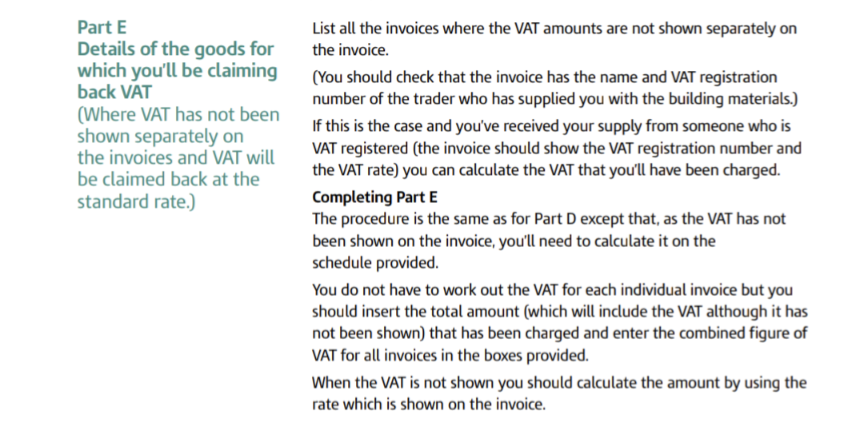
The notes on section E of the reclaim form say this: Note the comment "You should check that the invoice has the name and VAT registration number of the trader who has supplied you with the building materials.)" In other words section E is for things like the retail scheme where you have bought from a VAT-registered trader who has provided a simplified retail receipt which shows their details inc VAT number but not an actual breakdown/amount of VAT charged. If you are buying from a non-VAT-registered trader then even if they paid VAT on the stuff they bought, and even if that is included in the price they charge you, it is not "VAT" when you pay it and it cannot be reclaimed by you. That's a basic principle of VAT accounting and as far as I know there is no special exemption for that on the self-build scheme although I am not an expert.
-
Octopus Smart Meter Display suddenly showing export rate
andyscotland replied to NSS's topic in Photovoltaics (PV)
Seems like their systems need to apply a bit of "does that seem plausible" validation to incoming readings! -
@gaz_moose Electric Unit rate 27.84p per kWh Standing charge 49.38p per day Gas Unit rate 7.33p per kWh Standing charge 27.22p per day This is for Edinburgh
-
Sleeved and non-sleeved plugs
andyscotland replied to Adsibob's topic in Regulations, Training & Qualifications
That is surprising. Not 100% certain but as far as I know: * BS1363 only applies to 13A square pin plugs and as you say the current version requires them to be sleeved. * BS546 is the (older) standard for round pin plugs. There was a later update to allow for sleeved plugs & shuttered sockets but for whatever reason this was optional - unlike the equivalent update to BS1363 which was mandatory. * BS7671 allows for use of BS546 sockets on lighting circuits, it specifies in a domestic setting the sockets must be shuttered. However of course this standard only covers the fixed installation, so plugs on lamps etc are out of scope. * The "Plugs and Sockets regulations" only applies to domestic use, and it allows either BS1363 or BS546 plugs so long as they comply with the relevant BS. Interestingly the second part of that legislation only allows manufacturers to supply (domestic) appliances fitted with 1363 plugs, which is why if you want a lamp with a round pin you have to fit it yourself. My hunch is therefore they can sell them because they comply with BS546, and there are some circumstances where a BS546 plug can legally be used. They are presumably some fraction of a penny cheaper to make. There are of course general provisions in various electrical safety legislation that require taking reasonable precautions and IMO if someone was injured it'd be hard to argue good reasons for fitting a new plug with unsleeved pins. It has been good practice to use sleeved BS546 plugs for new equipment even in industrial settings for a long time. Round pins (mostly 15A) are very common in theatre and in the early 00s we'd use sleeved for most new kit & repairs but still sign off unsleeved when inspecting existing kit. IMHO in a domestic setting unsleeved plugs are unsafe, regardless of the legalities. I would return them and get sleeved versions. 6 amps is more than enough to kill a person. In fact you could probably kill a human chain of several people. Risk of death for an adult begins around 50mA. Of course in a modern install you will be protected by the 30mA RCD in the consumer unit - the fuse (circuit breaker) is there to protect the wiring from overheating and fire. But I would not rely on the RCD alone, particularly as @Adsibobsays the pins are more likely to be touched by a child, if at all. -
Just to say @ProDave kindly gave me a code for Octopus today. The website does look like they're not taking/are discouraging new customers. However if you click the "I know I want to save money, I want to switch anyway" you get through to the option to phone up. I phoned this afternoon, got through pretty quick and spoke to an extremely helpful & friendly agent. Call took about 15 mins all in including holding & a bit of chat. He was able to set me up over the phone - prices on the variable tariff basically the same as Shell (standing charge about 0.2p cheaper) as I'd expected. He also added the referral code to my account, worth £50 each for me and @ProDave so worth having! Less than an hour after dialling the number I've had the email to provide Octopus with closing meter readings so although the official switch isn't till next week I've used my last Shell-supplied units which feels brilliant 🤣
-
Would this be possible - Temp power to barn
andyscotland replied to Space Race's topic in Consumer Units, RCDs, MCBOs
In principle, yes it would be possible. The actual cost/practicality will depend on quite a few variables e.g. to do with cable sizing, earthing arrangements and where/how the supply is taken off the distribution at the house. There are also some regulations/considerations specific to caravans which differ from those for buildings and there's a few different options for tackling that. It may be possible to reuse elements of the existing supply to the barn, depending on what that was originally designed & installed for. Really the only way to get an accurate opinion would be to get a suitably experienced electrician on site to take a look. -
Well indeed. But given this is quite a future-looking project, & a major investment, I'd have thought it was a good opportunity to start positioning themselves as a major solar energy exporter as well. Sooner or later the oil will run out and/or be less valuable.
-
I'm also confused why it is entirely mirrors rather than PV. I guess mirrors looks more fancy in the renderings, but surely it would be worth having at least some of the wall surface generating power?
-
Octopus Smart Meter Display suddenly showing export rate
andyscotland replied to NSS's topic in Photovoltaics (PV)
That is indeed poor data then! -
Octopus Smart Meter Display suddenly showing export rate
andyscotland replied to NSS's topic in Photovoltaics (PV)
Odd that they show it reducing your monthly payment (implying your direct debit will go down when prices go up). It would surely make more sense for them to show your DD staying as-is and then take the £400 on top, would give a much more realistic picture and make the debt balance look a bit less scary. -
payment term for bathroom refurbishment
andyscotland replied to Janet stone's topic in General Plumbing
From a quick skim my immediate question is how are you defining the "halfway point of the scope of works" for the second payment? And have you already discussed these stages/instalments with the fitter / have they given any indication of their normal practice? -
Indeed, I have experienced all of those. Hence my usual temptation is to take the most pedantic read of the regs I can and crack on. Although if they reply in writing saying something is ok then I think it would be challenging for an inspector to reject that at completion unless the advice was very obviously wrong/dangerous. Which is probably why when I have asked they have often been non-committal/said it's up to me to comply and they'll only give a view if I apply for an amendment to warrant... 😒 I'd probably go that way tbf.
-
@Hastings it does occur that in the activity space drawings @TonyT mentioned, the loo is shown in a corner of the room (wall behind & on one side) & the shower is in the middle of a room with only one wall at the back of it. So arguably if they could be sited with no wall at all, they could have a wall that's not robust... May be worth asking BC for a view...
-
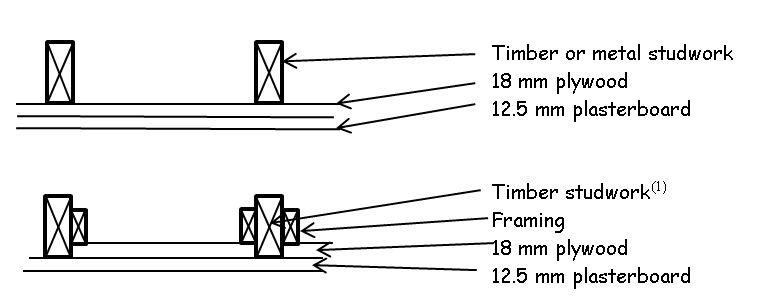
They show both : plan drawings of the available activity space and then the elevations @Hastings posted in the OP showing the area that should be "robust" with a section showing either ply over studs or ply between on battens. https://www.gov.scot/publications/building-standards-2017-domestic/3-environment/312-sanitary-facilities/
-
First read I'd thought you were asking if it was needed on both sides of the wall e.g. the side facing bathroom and the side facing corridor/outside/whatever. I see now you meant one or both sides of the shower/WC. I'm not an expert but strict read of the wording & drawings fairly clearly suggests both walls e.g. "walls adjacent to any sanitary facility" not "one wall adjacent to each sanitary facility". I know that it's quite common to need rails both/a specific side of a WC or shower depending on nature of a person's disabilities. So I would assume all round. Assume this is timber frame and/or plasterboard on battens? Obviously if direct masonry that's fine as-is. If the plasterboard is hollow behind then my read (and again, not an expert) is you would need these to be robust. You probably have 3 options: * Ask building control for an opinion (and be willing to do whatever they say). * Take a loose read that the wording means one robust side, do the walls that are easy, leave the others, hope that's correct and/or not noticed. * Strip and do it now. Depends I guess on how much more work it'd be to strip it later (will you have to damage tiles etc) if building control pull you up on it...
-
As I understand the issue is there is no "correct position" in Scotland, the regs are concerned with future proofing to allow installation of "grab rails and other aids" anywhere within the marked zones at any time in the future. Hence why they show zones not specific provisions of numbers/locations of rails etc. My mother in law was, however, recently asked for photos showing the wall met the robust construction requirements. So it does depend on the inspector/local authority. @Hastings reading your post again it sounds like the issue is the bathroom side is already plasterboarded but the other side may still be open? If so you could possibly retrofit ply between studs using the bottom option here (from fig 3.33 in the technical handbook). Mount the ply to battens then slide into the gap & screw/nail to the studs. May be less work than stripping and reboarding? Also, may be a daft question but a strict read of 3.12.3 would be that the robust wall is only required if the bathroom is officially required to be "accessible sanitary accommodation". If you have other accessible bath/shower rooms you may have a bit of wiggle room here?
-
I'm pretty sure it's only required on the bathroom side - my warrant drawings were accepted on that basis anyway. Makes sense as the purpose is to provide secure fixing for fittings and ply on the opposite side of the wall would make no difference to that.
-
Wow!
-
I’m confused about ubiquiti
andyscotland replied to Adsibob's topic in Networks, AV, Security & Automation
Yes, broadly, although it is probably less prevalent than on Android etc due to the Apple app store review process. However it's not infallible. Third-party apps is one major route of compromise but another big one is older devices that have not been patched with more recent security updates. Apple's very hard cutoff for supported device/software versions can be an issue there as there will be people (e.g. older relatives) with old devices that appear to be working fine, say "this is up to date" when you check for updates, but in fact have not been patched for years. It's quite common that exploits rely on vulnerabilities that have been widely deployed but only semi-recently discovered. To be honest though in a normal home network I would probably worry more about security of "internet of things" devices (some of which are woefully bad out of the box) more than a visitor's phone of any brand. -
I’m confused about ubiquiti
andyscotland replied to Adsibob's topic in Networks, AV, Security & Automation
It's not just about trusting the person, also trusting the device. If they bring a device that - unknown to them - has malware, having that on a separate network gives you a lot more protection. Although of course it falls apart a little if you need to give them access to smart home stuff that's on the main network as although that can be solved the easiest and therefore most likely thing is you just give them the main network password. -
The Scottish equivalent of Stamp Duty & second home tax is the Land and Buildings Transaction Tax and the Additional Dwelling Supplement. https://www.gov.scot/policies/taxes/land-and-buildings-transaction-tax/ LBTT applies to all land and property but only to transactions e.g. change of ownership. The Additional Dwelling Supplement applies only if you are buying a "dwelling" - it does not apply if you are buying an empty plot, even if it has planning permission https://revenue.scot/taxes/land-buildings-transaction-tax/lbtt-legislation-guidance/additional-dwelling-supplement-ads-technical/ads-legislation-key-terms#LBTT10015 - NB it might apply if the plot has a building to be demolished/refurbished, and costs more than £40k. If you already own the plot, building a house on it that you will also own is not a "land transaction" so there is no LBTT or ADS. The only tax that will trigger when you build the house is council tax. As others have said there may also be CGT when you eventually sell either your existing or new property, depending which has been your main home. You will be able to offset most of the cost of building the house as well as the original plot purchase, so you're only paying tax on your "profit". It would be worth keeping good records of your build costs so you have evidence for CGT deductions later. Assuming the rules don't change, you will not pay any LBTT if/when you sell either : it is paid by the buyer. Disclaimer: I'm not a lawyer or an accountant!

