


Nick Laslett
-
Posts
687 -
Joined
-
Last visited
-
Days Won
1
Everything posted by Nick Laslett
-
I like the OSO tank for it’s standing heat loss. But the Telford’s seem much better due to more sizes, larger heat exchange, immersion placement and twin immersion. What is the purpose of having the immersion halfway up the tank in the OSO, vs at the bottom with the Telford? @ProDave made the point that having the immersion at the bottom gave more water for the Solar divert to heat. That sounds like a good thing?
-
Sizing ASHP and hot water cylinder
Nick Laslett replied to eandg's topic in Air Source Heat Pumps (ASHP)
Hey @PeterW, I’m re-reading a few posts due to the WWHR, which was new to me. You are such a great asset to the forum, because your posts are so clear. Just wanted to say thanks. -
Thanks @Dan F, never heard of WWHRS, but looks like a very simple solution for a common problem. I was surprised that it had not really been mentioned much on the forum. But I did a search and there are very few posts on this nifty solution. For a new build I can’t see what the catch is?
-
ICF window details - Be VERY careful
Nick Laslett replied to magnethead's topic in Insulated Concrete Formwork (ICF)
@magnethead Thank you for making this post. It will prove very helpful when I come to fit my windows. -
MVHR Experience
Nick Laslett replied to Ryan Bazeley's topic in Mechanical Ventilation with Heat Recovery (MVHR)
Hello Conor, how did you handle the penetrations through the ICF? Did you use an oversized sleeve, or the actual duct? Steel or PVC? Any thoughts would be much appreciated. -
Flat roof considerations: Safety, Rain and Shine
Nick Laslett replied to puntloos's topic in Flat Roofs
Should I be worried about putting in a roof light on a flat roof, or is the issue only to do with installation and there should not really be any problems? -
Hello Gents, Need some help, what size pipe do you think I need? ASHP manual spec Water supply/return Ø R 1 1⁄4” Use Rp 1 1⁄4" nut for both water inlet and water outlet connection There are two insulated pipes in the Uponor catalogue Uponor Ecoflex Thermo Twin External diameter 32mm, internal diameter 25mm or External diameter 40mm, internal diameter 32mm https://www.underfloorstore.co.uk/product/uponor-ecoflex-thermo-twin-pre-insulated-pipe I need about 8m of pipe
-
Totally agree with the manifold approach. Are you planning on 10mm runs for hot water to downstairs toilet? If you have an insulated raft foundation, are you putting any water pipes in the insulation below the raft? Have you considered a Hot Water Return loop if you have very long runs? These are the questions that are occupying me at present
-
How low a U value is good enough?
Nick Laslett replied to cbk's topic in Insulated Concrete Formwork (ICF)
I thought your approach of adding extra EPS was actually really clever and an elegant way to increase the U-value. I spent some time thinking about it for my project. -
How low a U value is good enough?
Nick Laslett replied to cbk's topic in Insulated Concrete Formwork (ICF)
I went with the 300mm Standard Block (0.20W/m2K) and with the ThermoRoof and the Thermofloor. I am not particularly motivated by wall U-values, especially once you factor in windows and doors. Airtightness is probably more important. From memory the U-value wall test is pretty dumb and bears very little correlation to real life use, e.g. the junctions between elements are what really matter. You need an holistic approach, make sure the walls, floor, roof, windows and doors are adequately insulated and in proportion. If you really want to understand the thermal properties of your design, then I believe the Passive House Planning Package (PHPP) xls does a better job of the modelling. You can find some example spreadsheet outputs online to see the details of this modelling. The Stroma SAP tool also allows you to play about with the thermal modelling, this is free to down load. -
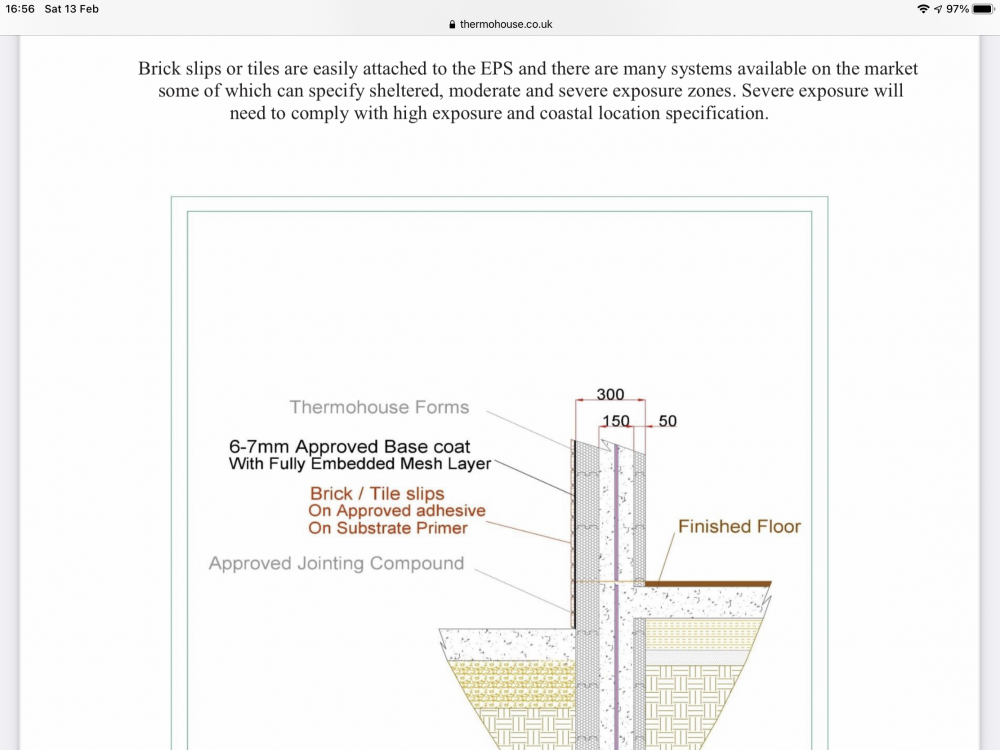
I’ve done no research on brick slips, but next page of technical manual doesn’t list any restrictions. Most ICF apartment blocks seem to be brick slips, more economical than standard bricks?
-
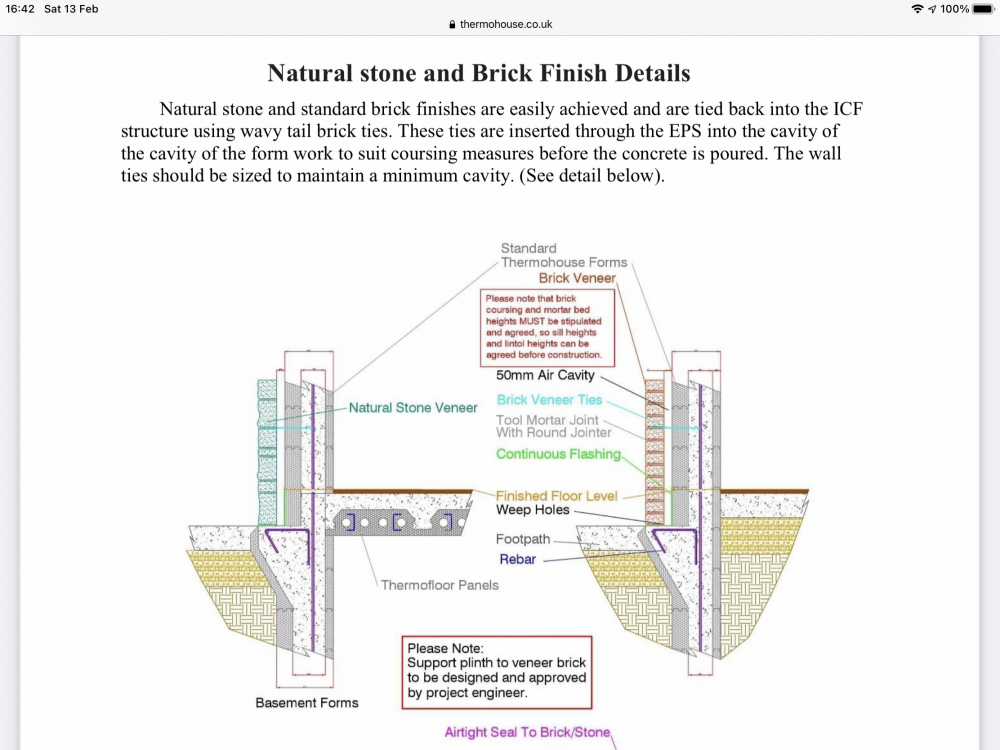
What is the issue with standard bricks and ICF? I’m only familiar with the system I’m using, there are no cladding restrictions from what I can see. Thermohouse manual 2018 page 68 https://thermohouse.co.uk/wp-content/uploads/2018/07/Technical-Manual-2018.pdf I looked at the LABC Certificate and there is nothing there about cladding restrictions. LABC EWW178 Thermohouse https://thermohouse.co.uk/technical-spec/ Drawing detail for Standard brick and Stone cladding
-
Heating, Hot water, ASHP, and Sunamp Design Needed
Nick Laslett replied to Triassic's topic in Other Heating Systems
Yes you are right, I should have been clearer. I was trying to make a comparison between electric +PV Sunamp vs Eco7 all electric UVC. My original interest in Sunamp was the idea that I could heat tomorrow’s DHW with today’s PV and have it store the heat for the following morning. It seems like a real pain to get the Sunamp to work this way as you can’t force it to take a charge. The other suggestion was to power it overnight. This seems a bit pointless as you can get a UVC with A rated heat loss for a lot less money and still easily use the PV divert. The VIP insulated UVC have nearly the same heat loss as the Sunamp, they both have 3kw heating elements, my simplistic understanding is that they use the same amount of electricity to heat to the same capacity (maybe I am mistaken here), the Sunamp is just more compact, which could be a deal breaker for some installations. I don’t know how the ASHP heated Sunamp compares to the equivalent UVC setup. My naive goal was to get my DHW heated by PV when it was feasible. Solar pipe heating is probably a much simpler answer, but that is a definitive no from SWMBO. -
How low a U value is good enough?
Nick Laslett replied to cbk's topic in Insulated Concrete Formwork (ICF)
I’m using the Thermohouse ICF system, their block U values are: 300mm Standard Block 0.20W/m2K 400mm Passive Gold Block 0.12W/m2K 450mm Passive Platinum Block 0.10W/m2K They use a rebated block for the reveals, which makes window air tightness much simpler. They also have an EPS based flooring system and roofing system. They use the BASF Neopor EPS which has some advantages over regular EPS. -
How low a U value is good enough?
Nick Laslett replied to cbk's topic in Insulated Concrete Formwork (ICF)
I feel that you have to consider all the aspects of the build together, foundation, walls, roof, windows and doors. No point in having an unbalanced approach, with low U value walls, but not enough floor insulation, remember heat will always go to the coldest surface first. The level of air tightness, and how you are going to achieve it, is also very important. High levels of air tightness mean you need to think about MVHR. Low U-value doors and windows with just a standard install will not give good air tightness. Different build approaches create different issues with penetrations, cold bridges, etc. The number and size of the windows will greatly effect the U value of the whole wall. What is your ultimate goal? You could engineer a house that needs very little heating, but costs or aesthetics might be an issue. Looking at any of the straw bale house case studies is a real eye opener for your preconceptions. A highly insulated house doesn’t have to be expensive. With ICF, the concrete is the air tightness layer, so the junction between the top of the walls and the roof is the critical area where you could create cold bridges and lose heat. A big potential drawback to ICF is that any future remodelling can be very difficult, because the concrete walls are full of steel rebar in addition to being 100 - 150mm thick. On reading a lot of the threads here during the early stages of my journey, the thing that surprised me the most was that cooling, needs to be higher up on your list of things to worry about. Also try to factor in the plant room in the floor plan design. -
Heating, Hot water, ASHP, and Sunamp Design Needed
Nick Laslett replied to Triassic's topic in Other Heating Systems
Have you seen the prices they want for these things. I’m still on the fence, but a UniQ12 is 3x the price of an equivalent UVC. My worry is still about running out of hot water and not having a fall back as simple as switching on an immersion. During lockdown, the timing of DHW across the household, really went out the window. I ended up having the UVC on call for heat whenever the tank temp dropped below 48c, from 7am to 4pm. In a household of 5, the showers were spread very randomly across the day and the idea of all DHW water needs being satisfied by 8.30am just didn’t cut it. The Sunamp seems simple, but how does it accommodate for the above scenario. If the answer is to overspec the Sunamp, the costs are even greater. When I first researched this I thought I understood the Sunamp, but now it seems to be described like a classic economy 7, electric hot water system, with a better insulated tank. If you have to turn it on in the day, where are the cost savings? -
UFH pipes protection/testing/fluid in slab.
Nick Laslett replied to SuperJohnG's topic in Underfloor Heating
My thoughts is to use air to pressurise the pipes, @Nickfromwales talks about this approach. Filling with water can be a hassle if you haven't got supply to the site, then there is an issue of an unexpected freezing spell. I was going to attach the pipe ends to a plywood board using a couple of clip tracks. Then cut pipes and install manifold during first fix. There is a post here showing an upstand with steel legs connected to the plywood. -
Pete, great questions. I would like to be brave enough to fit a Panasonic ASHP. I believe that @jack has a Panasonic ASHP with cooling mode engaged. I think you need a service menu code to enable it.
-
Walking around my Village today and all the wood burning, made me think I’ll definitely have to pre-filter my MVHR.
-
Has anyone used THERMOHOUSE roof system??
Nick Laslett replied to NickK's topic in Roofing, Tiling & Slating
That is a shame. I sent them 1 email asking them to recommend an architect familiar with their system and went from there. -
Thank you Peter. Is the 1.5m pipe the intake?
-
This seems like a bit of a contradiction, if the minimum recommended distance between Intake and Exhaust is 3m, how do you keep the distance to 1.5m. Unless fitted in the roof, one pipe will need two 90 degree turns to exit building and be far enough away from other pipe.
-
Has anyone used THERMOHOUSE roof system??
Nick Laslett replied to NickK's topic in Roofing, Tiling & Slating
It was used on one of the Grand Design house’s on the Graven Hill development. https://thermohouse.co.uk/blog/thermoroof-grand-designs/ https://thermohouse.co.uk/project/graven-hill/ The short YouTube clip is blocked in UK. You can use a VPN get round this. The whole episode is on Catch-up We will be using the complete Thermohouse system for our build next year. We have 6 dorma windows, two on the house, three on the cartlodge. Here is one of their build’s with good pictures of the dorma. https://thermohouse.co.uk/project/raleigh-close-hendon/ The Technical Manual is available to download on the website and covers the roof system in a lot of detail. https://thermohouse.co.uk/download/thr-018-dormer-window/# -
What about Aerogel, very thin, might be too expensive? https://www.thermablok.co.uk/our-products/thermablok-aerogel-magnesium-floor-board/ https://www.phstore.co.uk/spacetherm
-
Where will the heat go? Isn’t that the point of an insulated raft? Why are my structural engineer drawings so explicit about where the UFH pipes should go? I believe @IanR has an AFT raft, and his UFH is clipped to the EPS, his concrete might only be 100mm.


