


Dan F
-
Posts
1431 -
Joined
-
Last visited
-
Days Won
2
Everything posted by Dan F
-
The problem with customers getting hold of this (and also the Roma Kompendium) is that they then start asking for all the sorts of different options and add-ons that are available and drive their window supplier mad! ?.
-
@Thorfun I'm ordering Roma blinds (with Gaulhoffer windows) and have had similar unhelpful emails from Lisa when i have asked simple questions. Are you looking for blinds only or blinds with windows? If you want blinds only than either see if you can go via a supplier in Ireland (I know someone that did this) or alternatively look at Warema who i think do a have one U.K. supplier i think. If you want windows too then talk to @craig.
-
Demolition, site clearance, reduce dig and installation of pre-insulated pipes for ASHP and potential future garden room. The pre-insulated pipe we used in the end was "REHAU RAUTHERMEX 25mm+25mm/111mm DUO PIPE". The ground was luckily fantastic, apart from one area with some roots and a couple of soft spots left over from the demolition. So we managed to avoid the extra 800mm reduced dig that had been specified based on 2 trial holes in the old front garden. At over 200m2, that would have been a lot of muck-away and hardcore..
-
The bungalow we bought back in autumn 2018 with plans to demolish and rebuild. Only now, finally, is our build kicking off..
-
Strip is to stop noise/vibration transmission from flooring to walls and vice-versa which can be an issue however many layers of plasterboard and rockwool you use as sound from foot-fall and other sources can be transmitted through structure. What i've been told though is if you use a resilient layer under first floor flooring and resilient bars on ceiling below then this is isn't so much of an issue. @Moonshine also made the point about it not being important on ground floor concrete->wood junctions.
-
I think I'm going to skip the isolating strips and use resilient bars more widely along with correct use of perimeter acoustic sealants etc. My thinking is that this will reduce transmission to structure to the point that reducing transmission through the structure via these strips is less critical and wouldn't have much more additional impact.
-
If you cooling demand is low, you have MVHR and you can insulate ducts you could consider one of these: https://veab.com/kategori/duct-heaters-cooler-water. MVHR isn't a great way to cool though so only good for low cooling demand.
-
Ground bearing or Raft? (Insulated foundation - Kore)
Dan F replied to SuperJohnG's topic in Foundations
If the base is type3 + fine gravel, yes If it's type2 + sand (like ours) then you could potentially argue that DPM here is a good idea. -
It was the Vaillant sales guy that told me this, rather than a supplier/partner. You can get him on twitter @ https://twitter.com/cj_Vaillant
-
2 x Powerall2 @ £480/kWh. If you get just one it's a bit more (given gateway is one-time expense) @ £560/kWh.
-
Batteries only? That sounds like an awful lot! I have a quote for <£500/kWh AC-coupled incl labour.
-
Ground bearing or Raft? (Insulated foundation - Kore)
Dan F replied to SuperJohnG's topic in Foundations
If this is the case, and EPS thermal performance is reduced when it absorbs moisture, isn't there an argument for always using a layer of DPC below the EPS? -
@davidc In the U.K they come with cooling disabled. Cooling can be enabled by adding a "coding resistor"
-
MBC foundation question. Do I need that much Type 1?
Dan F replied to rufusmacdoofus's topic in Foundations
In our case our foundation design showed 800mm sub-base below the 150mm MBC layer, but once we started digging the ground was perfect so we only went down 450mm and not 1250mm as had been suggested by MBC. Building inspector was more than happy and we saved on 180m3 muck-away and hardcore! BTW, MBC standard detail for foundations now seems to be type 2 + sharp sand rather than type 3 + fine gravel. I beleive this change is due to a change in the SE doing their foundation designs. -
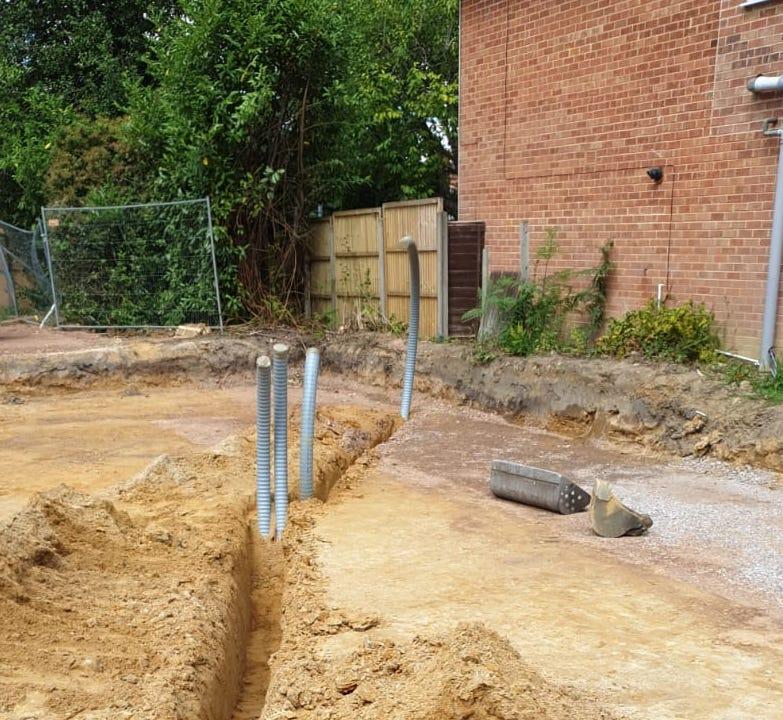
These are our pre-insulated pipes put in below the sub-base. 3 x REHAU RAUTHERMEX 25mm+25mm/111mm DUO PIPE
-
The partnership as far as I understand is that they've tested Sunamp with the ASHP and produced model-specific controllers. This means that when you order a Sunamp you have to order the right controller depending on which ASHP you plan to use. I may have said this elsewhere, but the fact it is different hardware, and that changing your heat-source means you may need to get a different controller, it's unforfgivable in 2020 in my opinion.
-
BTW. The "Vaillant high(er) temperature ASHP'"'s that were the subject of this thread have now been available for a few weeks. If anyone gets one, please report back! - Monobloc - MCS approved - Max 75C - 3.5/7/10/12 kW versions. - SCOP of up to 5 @35C, 3.6 @55C
-
@Nick Laslett What I plan to do is divert PV to ASHP indirectly via battery so as to get round the instability of PV required to run a ASHP. This allows you to take advantage of ASHP COP rather than just using immersion heater. (This might seem over-engineered for a summers day when there is plenty of PV generation, it's in spring/autumn with shorter days where it's more valuable) In practice this would mean firing the ASHP up for n minutes if: - UVC temp < x - PV generation over last m minutes > y - Battery Charge > z It's not true PV diversion, but would have roughly the same effect and by using the battery as a buffer gets around the instability of PV, and by turning ASHP on for a mininum time of n it stops the ASHP cycling as much. This is just theoretical for now but don't see why It shouldn't work..
-
The costs all depend on who you use and what you agree. We're using a main contractor but only for "fit out" post timber-frame, so while there is a percentage for overheads and profit it's lower than you might expect across our whole build. How much a main contractor does/doesn't involve you depends on both what you have agreed and how they work, not all main contractors are the same and not all work on a fixed price closed-book basis where they make most of the decisions. I was very against working with a main contractor, until we found someone that agreed to just do fit-out, has reasonable costs and didn't insist on charging a % on groundworks or frame. Also we get on very well with him and we're comfortable that he'll ensure quality, consult on the important items and allow us to be as involved as needed, but not bother us if he needs to order bags of cement. Are we spending a bit more using a main contractor post-frame rather than PMing ourselves? Yes, we almost certainaly are. But, having someone that's run this type of project multiple times before will mean the process goes more smoothly and is completed a bit quicker. If you consider this means i) less risk/stress on us ii) that we'll save a potentially significant amount on rent and iii) I'm less likely to loose my job because I'm too distracted on the build then for us, in balance, it's worth spending this bit extra. I beleive that the right way to run a build depends on everyones own personal situation: budget, skills, interest, work/family situation and if they are in a caravan or paying rent every month etc.
-
1) Someone (a PM or QS) who can help you setup a project timeline, cost plan and help you find a main contractor at a reasonable price and set up a contract with them. 2) A good main contractor. (Who won't necesairly cost any more than a PM hiring individual contractors, but unlike a PM will i) own the site ii) take on main contractor CDM responsibility iii) have a price/time commitment) If possible pay PM/QS by task/hours, and avoid them taking a % as a contract administrator. If you have a good main contractor you can trust and have agreed prices/formulas and a contract in place, I can't really see why you need all the meetings/valuations and other items you listed. If you have a mortgage that needs a valuation, they'll send someone out to do this.
-
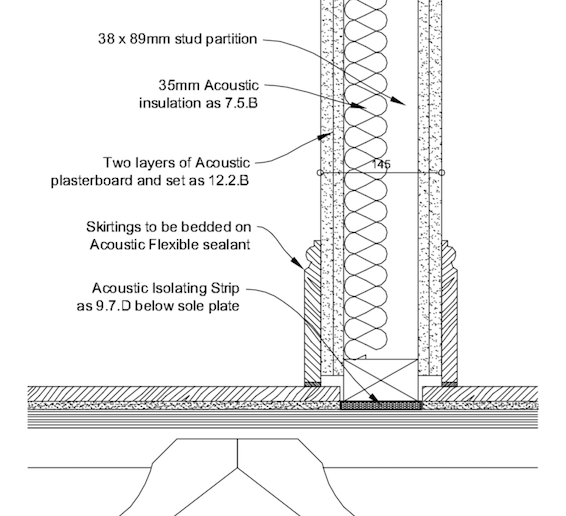
Currently we don't have resilient bars planned for anywhere apart from TV room. The detail for TV room is the same as pasted with the addition of a resi-bar on one side (TV side). It might make sense for us to use resi-bar detail slightly more widely though, e.g around bedroom/studies. In laymans terms, does this mean that the type of sound/vibration carried by the slab isn't going to be transmitted easily by wood and vica-versa? Also I assume that if you wanted to prevent sound (e.g. from a subwoofer) travelling through the slab, the best approach would be an acoustic mat in that specific room, right? We'd use "Regupol® 3D Isolation Washers" where mechanical fastenings are needed. So potentially still value in using tape at top of downstairs stubs and bottom of upstaris studs? In you view, does the use of resi-bars reduce the need for isolation strips or are they two seperate complimentary strategies?
-
That's part of what I'm trying to work out. This is our standard wall details (upstairs is 22mm caberdeck on metal-web joists, downstairs is concrete slab). The TV room is the same plus a resi-bar on one side. You can see that a strip is proposed below stud, but not above. Yet the supplier says that to do the job probably you need to use it at the top of studwork and where it abuts external walls too.
-
Timber studs because these come with the MBC package. They can put the isolating strips in, no issue, I just need to decide where. Thing is I don't want to i) regret not putting them in when I could have (can't retrofit) or ii) put them everywhere if not needed due to cost implications and risk it doesn't go down too well with designer/installers if I put them everywhere just in case.
-
It's a whole weeks read now, since you restarted it ? Do share...
-
Want to keep sound in TV room and teenagers bedrooms, but also have good noise isolation throughout the the between rooms in general. Our current plan for TV room is resi-bars (on just one side), 2 layers of soundbloc each side and mineral wool plus the correct edge detailing. Most other internal walls between rooms in the house are the same, but just without the resi-bars. We aren't using resi-bars everywhere (not currently) but I too was also wondering why/when you'd need both resilient bars and isolating strips. That said, the supplier recommneds using the isolating strip even if you do have resilient bars and a lot of details online also show both. Using the isolation strips in TV room just in case isn't a big deal and not going to cost a huge amount, what I'm trying to work out is it I should use them elsewhere in the house, where resi-bars aren't planned. And also if I should be using below studs, or above and below as supplier suggests (they would though... as they sell more)


