
Conor
-
Posts
4165 -
Joined
-
Last visited
-
Days Won
12
Everything posted by Conor
-
fitting PV is more about reducing demand on the network and reducing the carbon footprint of your lifestyle.... e.g. timing your heat pump, car charging, washing machine etc to make use of PV electric to reduce usage from the carbon intense network. it depends if that is important to you or not. As above, payback is usually in the 10-15 year bracket. I'm going for a 6pkW system split over three roofs with a 4kw inverter. It's coming in a shade under £5k. Excludes wiring and commissioning.
-

Site Fencing Requirements England
Conor replied to NewToAllOfThis's topic in Project & Site Management
You have to make sure your site is not easily accessible... I think in reality that requires a 2m wall/fence/thorn hedge! As above, security fence panels are only about £20 each new, and are easy to buy/sell second hand. If you don't take sufficient security measures, you insurance may be invalidated. -
Advice re compacted gratefully received!
Conor replied to Chickenbrain's topic in Introduce Yourself
Commented on your other post but didn't realise it was that kind of compactor. Sell it and hire a proper vibrating plate compactor. Much better job and easier to use. It will only take a couple hours so you should only need to hire one for a day or weekend... So I doubt it will cost you more than £40 or £50. -
What's above it? Another floor or attic space? The laths in our house were is surprisingly good condition, even tho the plaster had been destroyed by damp and leaks. Previous owners had simply fitted timber panelling below the failing plaster. Removing the plaster from the laths is an easy but hurrendously messy and unpleasant job.
-
How do you all do it? I envisage ducts "hanging" from brackets nailed or screwed into the above floor slab. Suspended ceiling then goes in after all services done. Is this correct? I suspect this would result in a lot of fixings... We have two precast floors to fix to. (Hence thread about nail guns) Any other methods? Worth fixing batons first?
-
Looks like hiring a Hilti for a weekend and getting it all done in one go sounds like the best option.
-
Our build has precast floor slabs, plenty of steel and internal block walls. I can see a lot of fixing to concrete for vent ducts, plumbing pipes etc. What kind of nail gun would be suitable for this? Talking no more than 40mm nails. Electric? Gas? I really detest the thought of drilling and screwing in to over head precast slabs!
-
Welcome. Sounds like a good project. Agree, slab sounds overkill. Ours is 200mm main slab and 300mm at ring beam with single layer of mesh... And that's for a basement supporting another concrete built 1.5 stories above!!! I'd definitely question it as you could make significant cost savings. Is there much steel in it? What SIP roof are you using? I struggled to find anybody here to take it on so looks like a standard cut roof for us.
-
Advice re compacted gratefully received!
Conor replied to Chickenbrain's topic in Introduce Yourself
Nope - no need to worry. The guidance is you shouldn't mechanically compact over a service unless you have 400mm of cover... in reality this never happens. Just compact in 100mm layers and don't let the compacter sit stationary on or near any services or structures... keep it moving at all times. If you are going over any newly laid ducts, first back fill with dust and manually compact to 100mm before letting the compactor anywhere near it. -
Self Demolishing A House
Conor replied to Internet Know How's topic in New House & Self Build Design
Highly unlikely you'll get insurance, so if anything happens to you, a visitor, contractor (unless a demolition specialist) or member of public, you'll be personally liable. E.g. if a wall falls on to the grab wagon you've hired, you'll have to pay for repairs out of your pocket. If debris falls on the road and damages a car, your fault. I looked in to all this before demolishing our house. Couldn't get any of the self build insurers to cover demolition works - by me or anybody else (unless they had their own demolition insurance in place to an equal or great value than the self build policy) I went ahead anyway, but did it all myself and was satisfied there was no real risk to public or neighboring buildings. As it was a single story brick built house with hipped roof, was relatively easy and was never far off the ground or under any large walls. Didn't need to hire any equipment apart from a telehandler to help with the slate removal. Only other things you've missed off your list are planning permission (most areas you need to have planning in place for a replacement dwelling) and an asbestos survey. -
Anybody have this glass? Trying to get an idea of the tint and how it looks from inside the house. From any photos it seems to have a blue tint? Thanks
-
Holywood, co down. Approx 3m footpath connection to meter box. Free.
-
Thanks guys. So floor area has increased to 280m² since initial PHPP modelling, and we've added solar control glass. That would mean heating load would be closer to 3kw, or more. Currently eying a 6kw Mitsubishi ecodan, seem this would fit the bill? Next one up is 8.5kw
-
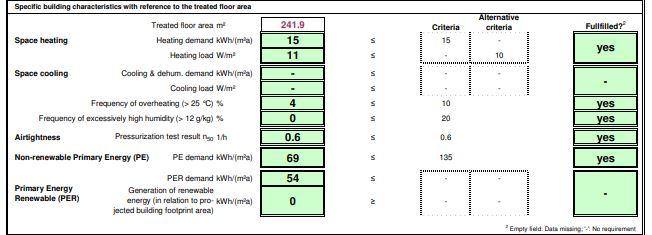
Need to order ASHP soon enough... just checking size requirements. I've always assumed a 5kW ASHP would be sufficient. 200l DHW tank. two adults and one child. UFH mostly on ground floor only plus two rooms in basement - so three loops/zones only. I have a preliminary SAP - summary attached. What here would allow me to pick ASHP size from? Also PHPP (PHPP slightly out of date as floor are increased) Thanks Conor

-
Timber Brise Soleils
Conor replied to Conor's topic in Energy Efficient & Sustainable Design Concepts
Hadn't considered that. I need to go to Ridgeway soon anyway so will check them out. -
We're doing 5% of total contract value. 2.5% will be paid upon handover of documents, certificates etc and when architect signs it off. Remaining 2.5% will be paid after a three month defects period. We're not doing anymore than that as it's just a contract for a watertight shell.
-
For comparison, I was planning a 5kw ASHP for our 300m² build (majority of heating on ground floor only), bit upsizing to 7kw as there isn't a huge price difference and unit won't be running as "hard" as a 5kw.
-
MVHR Decisions...what to do?
Conor replied to Thorfun's topic in Mechanical Ventilation with Heat Recovery (MVHR)
You will need two units. The building control requirement of 0.3 ACH is the absolute minimum you want to work at and those units will be running at high speed to meet that. You really want to run at 0.5 ach and have the fan speed curve in the middle of the range, so there's the capacity for decent boost rate. so you'll need a much higher capacity unit. I'm just under 300m² gross floor area and borderline if I can get away with just one unit- looking at the zehnder Q600 and komfobent 700. -
110 will be easier to install (more rigid, easier to set levels) and with brewing waste it's inevitable that you'll get a build up of sugary waste that will quickly block a 32 or 40mm pipe. (Proud builder and previous owner of a brewshed)
-
This isn't quite the help I had in mind, but it might work out..
Conor commented on dnb's blog entry in Building in a woodland on the Isle of Wight
Every site needs it's motivational mascots. -
Very nice. Good to see solar gain has been thought of on the design. Don't worry, building a new house is easier than renovating an old one. Everything is easier and cheaper.... There's just more of it!
-
That's a scary piece of kit!
-
Certainly a unique situation! We had mild steel storage units in the floor of an apartment building I lived in years ago. Directly on the ground. Everything was always wet. Once moisture got in, it never left. If you are confident you won't have surface water flowing in (only takes a small amount), when what you propose is fine. If laying a timber shed or structure, I'd first install a ground plate with pressure treated timber. Unlikely to rot in the time you describe. To save time, you could get a shed that matches your dimension, and just modify the roof so it's flat, rather than pitched?
-
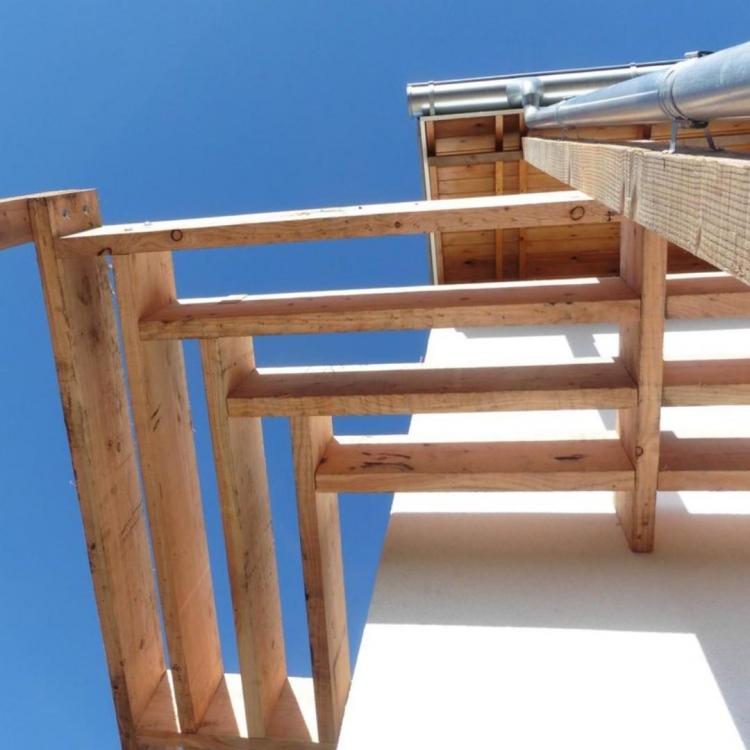
We will need a couple brise soleils at the southern aspect. I've got quotes for the 5.5m, 1.8m projection one coming in at £4-£5k for aluminium, a bit more than I was expecting. Anybody made a shading solution from timber? I quite like this one, made from Larch. Seems very simple construction and well within my skills. When weathered, would go quite well with our window frames and stone detailing. It would sit above deck with the same projection, and I'd run corner posts all the way up from the deck ballustrade to support the canopy. Looking for advice on design ideas and specifically if maintenance is an issue with larch etc.
-
Hi, we're new to self build, Glenarm, Northern Ireland
Conor replied to Kerry Rhodes's topic in Introduce Yourself
Nice one. Will be very impressed if you get FPP for that in Glenarm! Who's your architect?