

Radian
-
Posts
2586 -
Joined
-
Last visited
-
Days Won
15
Everything posted by Radian
-

sander - loads of dust in room, hardly any in dust bag. Is this normal?
Radian replied to Question's topic in Decorating
I keep seeing the Mirka on TV - repair shop and a couple of different makeover shows. Their (suspected) product placement works as I've noticed it and want it. Good job I can't afford it. -
Thanks for posting that up. A 10ms reduction in response time is only 30 Joules @ 3kW so I'm surprised that helps given the typical UK bucket size of 3600J but I have no idea what the French meters are about.
-
The cold flat roof vent is scribbled out - why?
-
I'd Instrument the heck out of it first. Drive a scaf. pole as deep as you can with a temperature probe attached and log it over a year to see what it does naturally.
-
Hybrid inverter for small in roof 2kw array - help please!
Radian replied to Timmyk's topic in Photovoltaics (PV)
Is it ever going to be a real problem I wonder? What kind of situation would lead to a large number of residents on an estate self-installing PV and not notifying the DNO? The only cases of disruptive behaviour that I can think of relate to low cost, unskilled activities like E-scooters, Drones, Laser Pointers and, many years ago, AM CB radios. -
Possibly. CurrentCost sends a radio packet every 10 seconds which is not possible over WiFi, on batteries. But WiFi can be brought up, say every 10 minutes, and the last 10 minutes of data could be transmitted including a temperature reading. The ESP can also sleep between pulses so minimising power consumption. Alternatively ESP32 has more in the way of power saving including Bluetooth LE. At the end of the day they're equally easy to work with. Anything you can think of doing has very likely been done and put on Github for inclusion in your code.
-
OK, so there's a thousand different ways of going about this. But I recommend just one: Node Red. Node Red can easily be installed in seconds and has a fully graphical interface that presents itself in any web browser. You can create dashboards and have it all show up on the sort of display you've found there, as a full screen. But as it runs on a webserver on the Pi you can also access it from any other PC, tablet or smartphone on your LAN. You can do anything with GPIOs and timestamps etc. like you've done in Python. The other thing I'd highly recommend is to install a MQTT broker This gives you simple messaging between things and is fully integrated with Node Red, Python etc. Say, for example, you had other energy meters connected to Pi zeros. You could publish MQTT messages containing the power info and collect and display them all in Node Red. You could even communicate between the Python script your written and Node Red for display. Thus you have one central server Pi running Node red and the MQTT broker (and have it also taking some measurements) and have as many satellite devices as you like. MQTT is a great way to communicate with ESP8266 modules as well, so you could slim down your measuring devices for temperature, power etc. with a £3 device!
-
Hybrid inverter for small in roof 2kw array - help please!
Radian replied to Timmyk's topic in Photovoltaics (PV)
OFGEM even recognise the potential opportunities offered by Distributed Energy Resources (our solar and battery installations) to help them with "Black Starts" on the grid. Some seriously "joined up thinking" is required here. -
The crimps and plastic shells themselves are inexpensive but the crimping tool you need is expensive. Not worth it if you're only doing this kind of thing on rare occasions. The patch leads are one way around it and You can also get male to female versions to make daisy chains in order to get a bit more length.
-
We should have installed air conditioning… now what?
Radian replied to Adsibob's topic in Other Heating Systems
Good to see an actual photo of those. I might be going down that route myself. My room in roof "fancy workshop" has six velux windows - three face SE and three NW. At the moment, if I don't open them all every day it goes well over 30C and stuff begins to melt.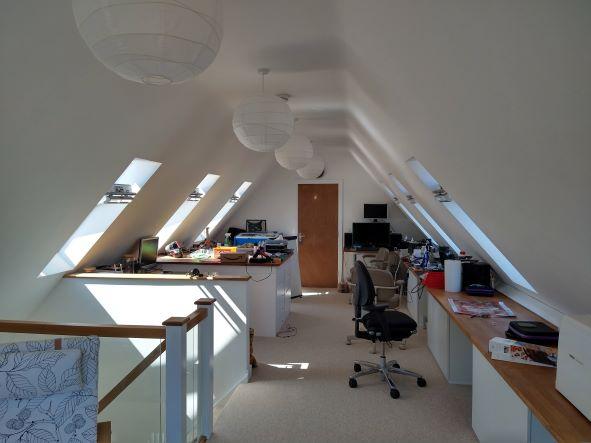
-
Probably a genuine card then. The current market is peppered with fake SD but USB sticks generally fare better. Thinking about how someone with no soldering skills could assemble this, some female to female 0.1" patch leads could be used to connect the photodetector to the 0.1" header on the Rpi so long as it was purchased with the ready assembled header pins. And to avoid the need for the USB to TTL serial adapter, with WiFi on the Pi, you can SSH into the command line by adding a couple of files to the SD card after writing the Operating System to it: Step by step Instructions here
-
Hybrid inverter for small in roof 2kw array - help please!
Radian replied to Timmyk's topic in Photovoltaics (PV)
Can make a very loud bang. -
No but the Rpi is writing to SD card if you're not using a RAM disk/network storage device/USB stick or HD. Most SD cards aren't really up to the repetitive write task but then again, they're dirt cheap.
-
Great write-up. So there's no 'rate limit' on the number of records - the more power you draw the more records are created. Might that not get a bit heavy if you logged a big load? like 100 writes to boil a kettle?
-
That's a fantastic wall! Proper chunky top, not just a mound of mortar and some tortilla chips shoved in - like we see all over Dorset.
-
Hybrid inverter for small in roof 2kw array - help please!
Radian replied to Timmyk's topic in Photovoltaics (PV)
It's a funny old world. We're trusted not to plough both our C-Max's into each other at 60MPH thus releasing 1.1 megajoules of kinetic energy - yet even dumping a full 32A breaker into earth, in the unlikely event that it takes 1 second to blow, would involve just 1/143th of that. Mind you, now I've worked that out, I wouldn't want to be within 20m of either happening! -
Reducing Energy Bills - How goes it?
Radian replied to Ferdinand's topic in General Self Build & DIY Discussion
Doh! So does mine after all. But because I've had the diverter running since I started looking closely it either stays off completely while the Joule bucket is filling or blinks at 4000 flashes/kWh when empty (and we're drawing power from the grid). The one case I was overlooking is the odd occasion that I'm trying to track down - when a little power is leaked back into the grid. Then it lights solid for a brief moment, no wonder I missed it! I've only noticed it now while trying that smartphone app. -
Reducing Energy Bills - How goes it?
Radian replied to Ferdinand's topic in General Self Build & DIY Discussion
Do you have to enable comments for a blog? Couldn't see how to add one. -
Hybrid inverter for small in roof 2kw array - help please!
Radian replied to Timmyk's topic in Photovoltaics (PV)
Well, it is published as a "Guide" after all 😃 I went nuts trying to tie down the legal requirements for self-installers but a parallel search for cases where people were being prosecuted for not abiding by the "difficult to determine" regulations came up empty handed too - so draw your own conclusions. Part P is obviously a "must" for any new circuit though. -
Reducing Energy Bills - How goes it?
Radian replied to Ferdinand's topic in General Self Build & DIY Discussion
That could be useful to me. My homebrew PV diverter is "losing" 0.1kWh to the grid every couple of days or so. Really small error but annoying as I'm sure I've got it calibrated correctly. My calibration reference, however, is another power meter (a Chinese one). I was about to go down steamy's route and make a pulse counter but this could save me the bother - especially as I only need it temporarily. But one issue is that when exporting, I think the LED on the meter stops flashing altogether. Will have a closer look. -
Reducing Energy Bills - How goes it?
Radian replied to Ferdinand's topic in General Self Build & DIY Discussion
You've really got the hang of LED pulse counting 😀 But where do you find all these LEDs? Wouldn't it be great if there was a standard for manufacturers to modulate the "power on" LED for appliances to signal their power consumption. Something like a 100us dip to signal the passing of 1Wh would be very handy and trivial for any controller that already knows it's power draw. -
Reducing Energy Bills - How goes it?
Radian replied to Ferdinand's topic in General Self Build & DIY Discussion
Maybe? And please don't talk to me about nuclear waste. The absolute daftest person I personally know has a top job in the decommissioning sector and every night I heave a sigh of relief that we made it through yet another day without a serious cock-up in that department. -
Hybrid inverter for small in roof 2kw array - help please!
Radian replied to Timmyk's topic in Photovoltaics (PV)
I'm not so sure anyone can just fill in a form though. In the G98 guidance notes we have this paragraph on page 33: And the legal mandate on the same page: -
Reducing Energy Bills - How goes it?
Radian replied to Ferdinand's topic in General Self Build & DIY Discussion
That'll be politics. It doesn't help that there are numerous pressure groups like the "Renewable Energy Foundation" who say they do not see renewables as a large part of net zero strategy. We've got lobbyists up and down the country trying to stop investment into our most cost-effective energy sources like the Suffolk residents who are objecting to the wind farms off England’s east coast being developed by ScottishPower. The solutions to the carbon and energy crisis are all ready to go but the politicians aren't committed enough. Perhaps it will take a severe winter in which a significant number of people will start taking direct action - either by protesting or dying through cold and hunger to turn around that commitment. -
PIR won't work behind glass. Glass blocks the IR. And being an indoor (burglar alarm) sensor - it has no light sensor. There's several reasons it's so cheap. Both outdoor sensors have light sensors and adjustable timers.
