
Radian
-
Posts
2586 -
Joined
-
Last visited
-
Days Won
15
Everything posted by Radian
-
I can't link you to anything but I do recall the vent pipe being required to rise continually. I had an argument with a plumber about this once. However, the reasoning must be about the ability of the system to relieve pressure in the event of overheating and boiling the water. Would a London loop develop enough back pressure to rupture a cylinder? Give us a break! Obviously the safest pipework would be the simplest with an uninhibited rise to the top but for goodness sake! Of course if there was a 'local minimum' and no flow then sediment might accumulate and bung up the loop. That might just be enough reason for the regulations to prohibit it but I for one wouldn't let it stop me, especially with 22mm pipework.
-

Hybrid inverter for small in roof 2kw array - help please!
Radian replied to Timmyk's topic in Photovoltaics (PV)
We all have a contract when we get power connected to our houses. It's all set out in the National terms of connection Page 53 states that we shall not export a Watt without prior agreement. Now how much notice is taken and what enforcement is applied is anyon's guess. But terms are terms. I should mention that @Dillsue kindly pointed me in the direction of the contract a while ago. -
https://www.amazon.co.uk/Steinel-Infrared-Movement-Detector-Swiveling/dp/B002J93FU2/ref=pd_lpo_1?pd_rd_i=B002J93FU2&psc=1 Another Steinel with a little bit less range but better price. Actually that's a very keen price. Toolstation want over £60 for it!
-
But that's an indoor one. Wouldn't last past the first rainstorm!
-
There are so called "long range PIR detectors" such as: https://www.electricaldirect.co.uk/product/steinel-sensiq-s-long-range-20m-300°-pir-sensor-black-109229 I'm sure you could get a better price than that.
-
Hybrid inverter for small in roof 2kw array - help please!
Radian replied to Timmyk's topic in Photovoltaics (PV)
DNO also needs to know that the inverter (that may push current back into the grid) is type approved and below the generation limit. -
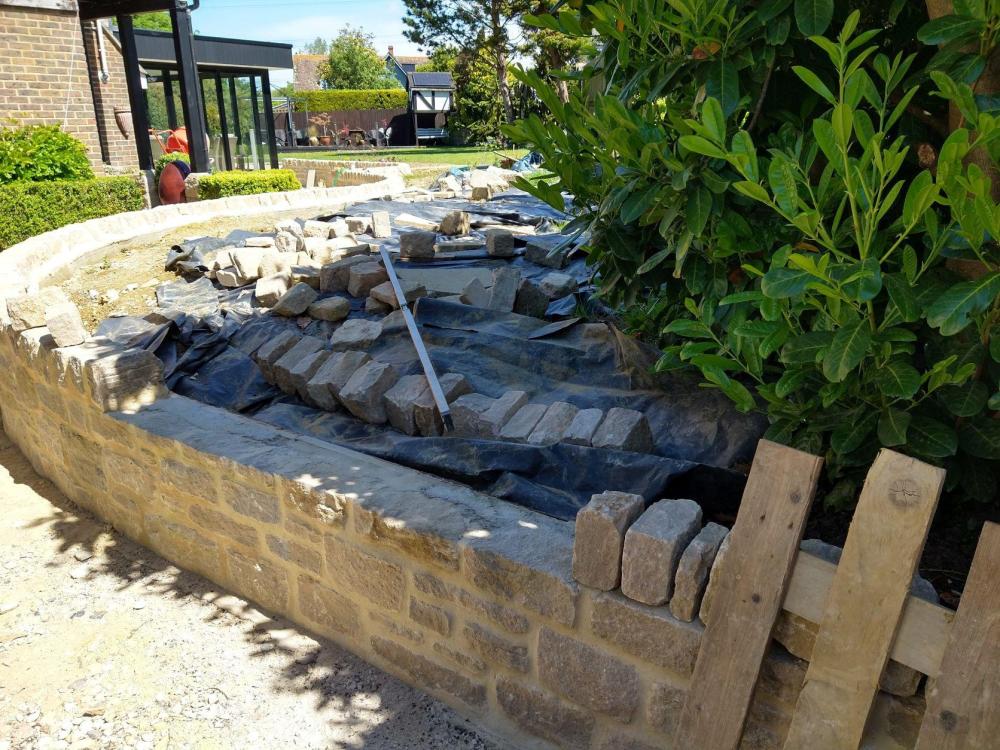
Yes. The aim of a footing is to put the load onto stable ground so the depth from ground level to the bottom of the trench is key. It needn't be full of concrete. The depth of concrete is determined by the vertical load which in your case is minimal. It's up to you if you fill it to ground level with concrete or just put in a couple of hundred mm and build up with blocks. It's a pig to lay blocks below ground level so concrete might be the simpler option. My retaining wall is 600mm high and I went down 500mm and laid in 200mm concrete and came out with blocks laid flat. I had spare blocks on site and access was poor so went for this particular balance. Most important for long-term stability will be drainage. A perforated pipe on the foundation and back fill wth gravel one the side facing the ground you're retaining will help keep the wall in good condition. I used a vertical drain sheet on the back of the wall to drain the surface down to the foundation level which, being plastic, also stops water leeching through and messing up the pretty stonework.
-
Will I be eligible for ASHP Grant?
Radian replied to richo106's topic in Air Source Heat Pumps (ASHP)
First time driving a C-Max I couldn't believe how well it cornered. -
Will I be eligible for ASHP Grant?
Radian replied to richo106's topic in Air Source Heat Pumps (ASHP)
Are there any additional restrictions on Propane? -
How did you arrive at the dimensions for the footing? I'm guessing this must be a substantial wall. 2m tall?
-
2750kg/m3 granite = 235kg - the same weight as 1m3 of snow, or about the weight of a mature pig.
-
Why doesn't the Shelley EM meet that brief - with the smartphone app? I'm not 100% certain but the instructions make a big deal about wiring the CT WRT polarity so that would suggest it's sensitive to power flow direction. Failing that, you could re-visit your home made diverter and get to the bottom of why the washing machine was upsetting things. I found the process of sampling I & V and multiplying the samples together 'just worked' for me. I improved accuracy by phase shifting the current by five samples out of 170 per cycle but even before that it was accurate to better than 5%.
-
Oven baked tomatoes. You can get a scalded mouth eating those half an hour after they're served 🙄
-
Keep trying. Maybe the beer will come in handy at some point.
-
I think it would depend greatly on how the rest of the roof is constructed. For instance, if there are parapets how are they built? How breathable is the makeup of the side elevations? When the sun heats a roof it makes the air in voids expand and then contract again at night. This will tend to repeatedly pump outside air out and in - and this will have a relatively higher moisture content. If it can diffuse through a semi-permeable material like OSB covered with a breathable membrane it will fare better than if fully wrapped in an impermeable skin. This may not describe your exact situation but I think it may still be worth watching:
-
Is there a reliable and fool proof occupancy sensor for WCs out there
Radian replied to MikeSharp01's topic in Lighting
Oh boy, Keysight MXA - 10 Hz to 50 GHz - will have a gander at that video for sure. -
Not sure. Looks a bit like the display on this app to me:

-
It depends on the way it's all put together. Hopefully there's a DC path between the PV module array and batteries without going via the inverter's AC output in which case the full power of the array would be available for battery charging - minus any load on the AC output of course.
-
I think it's worth mentioning the First Law of Thermodynamics: "Energy can be changed from one form to another, but it cannot be created or destroyed." The Solar PV modules can't change photon flux into any more energy than the inverter can push out - so it's not like there's 4kW worth of power lurking unused in the array. This is why Voltage is sometimes referred to as Potential.
-
Looks like you might have to travel to Faslane to redeem that. According to that map, Ivan is taking trouble to avoid deleting our nuke fleet 🤔
-
Yes, after pondering this a while, I came up with the same unpleasant thought. I've probably been blanking it out because it's just too awful to contemplate. But like getting used to getting old - and all the unavoidable changes that brings, I think I'm beginning to get used to letting go all the certainties we once enjoyed about the cost of energy. A canny investor may well make a balanced judgment about the future and deploy their financial resources accordingly. Time for a second mortgage perhaps. Oh wait, I know Ohms law... 😉
-
No apology necessary. I have run my own numbers on a small (3.2kWp) PV installation and even with turn-key MCS certified installation it does make financial sense for me. But how I wish the economics of battery storage would pan out. I'm sizing my PV based on what I know I can consume. I've modelled that quite extensively but I still bet I've got it wrong!
-
I was genuinely trying to see if there's something I was missing that might be relevant to my own financial situation - which is one where payback is of paramount importance. I'm not criticising anyone or anything. I do however know that I have a considerable capacity to overlook the bleedin' obvious at times!
-
Is there a reliable and fool proof occupancy sensor for WCs out there
Radian replied to MikeSharp01's topic in Lighting
I've never really tried using either as an occupancy sensor. The CO2 sensor is in a room that we tend to receive visitors in and gives me a silent reminder to open a window if levels go above 800ppm. Here's an old thread about CO2 sensors used with MVHR: -
Could do both, belt & braces. I hope @Ian79 can report back with what the builders say about this. I'm not totally convinced that BC should have picked up on it. I don't think their schedule of inspection involves looking just before the insulation is laid down on the prepared deck.