
Radian
-
Posts
2586 -
Joined
-
Last visited
-
Days Won
15
Everything posted by Radian
-
Believe me I don't want to go raining on anyone's parade but I sincerely wish I understood the economics of battery storage in today's market. 10kWh of leccy for £12K? £3's worth. OK, so absolute best case brim it with solar and displace the grid when the sun ain't shining, every day of the year and 10 years later @30p/kWh. you break even. Possibly a more attractive 6 1/2 years @50p/kWh. If it goes even higher than that there will be many other things to worry about. But, I mean, best case... P.S.@pocster 'raining on anyone's parade' is not meant to be any kind of euphemism in this context 😂
-
There will be a vapor pressure from the room pushing moisture through the OSB. Once it reaches the dew line it will condense and drip back down onto the OSB. Might take 20 years to show as a problem (hence why builders sometimes 'forget' to do it properly). If the PB ceiling has yet to be fitted you could mitigate by fixing a vapor barrier (plastic sheet) under the joists before the PB goes up. Keep downlighters etc. well sealed.
-

Is there a reliable and fool proof occupancy sensor for WCs out there
Radian replied to MikeSharp01's topic in Lighting
CO2 Is also a good option I've not seen mentioned. Especially in a smallish room. They used to be very expensive but an IR one like this is similar in price to the microwave sensor. RS232 output and plenty of Rpi and Arduino libraries - although I use one with an ESP8266 running Tasmota to get MQTT from it...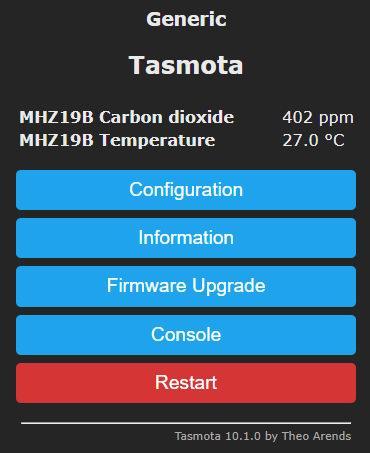
-
Anyone recognise these lightweight concrete blocks?
Radian replied to Radian's topic in Brick & Block
Ta, but that's what I found and they only show the following block thickness (mm) 50 100 140 200 It can't have been any of those. -
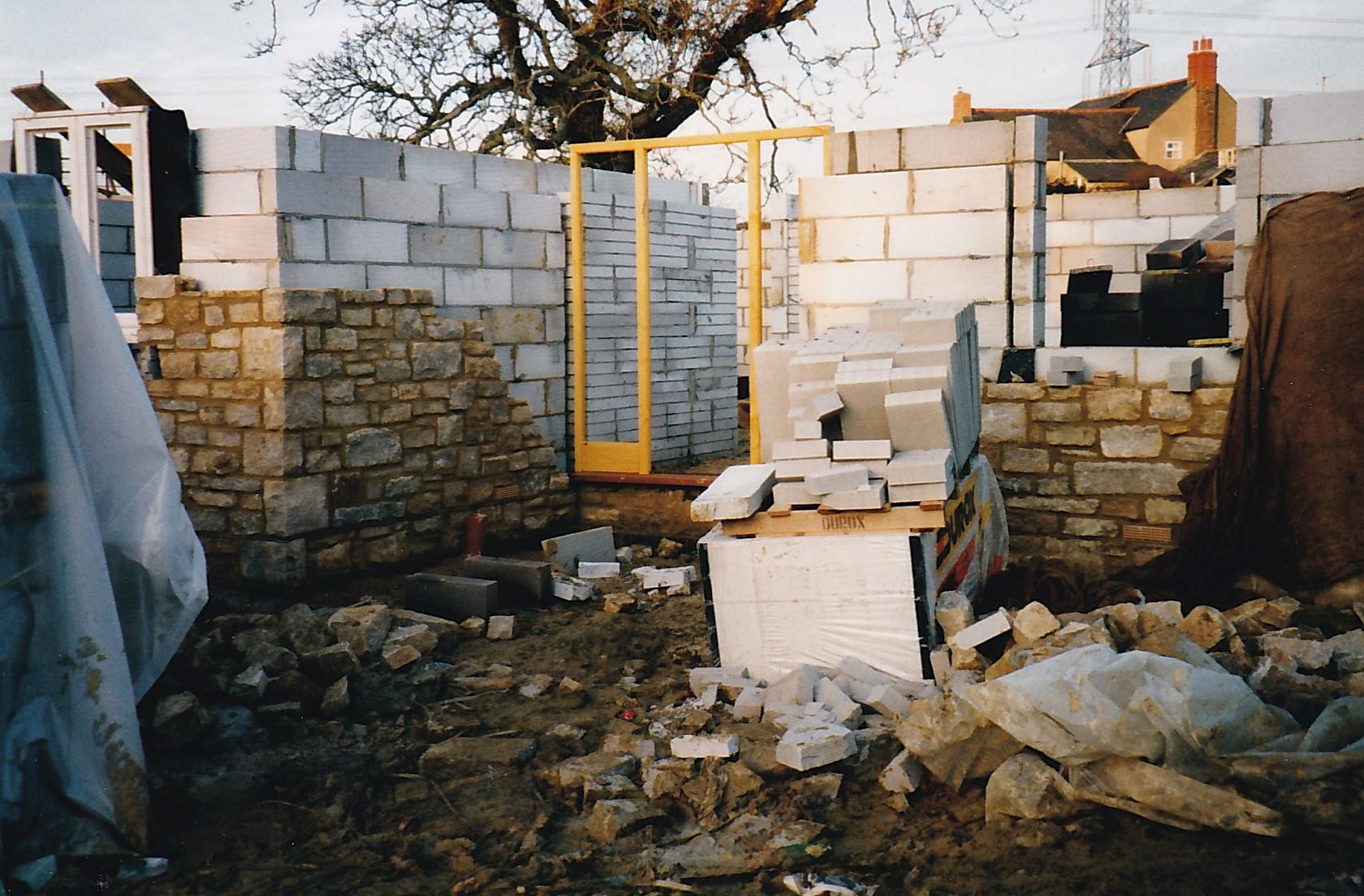
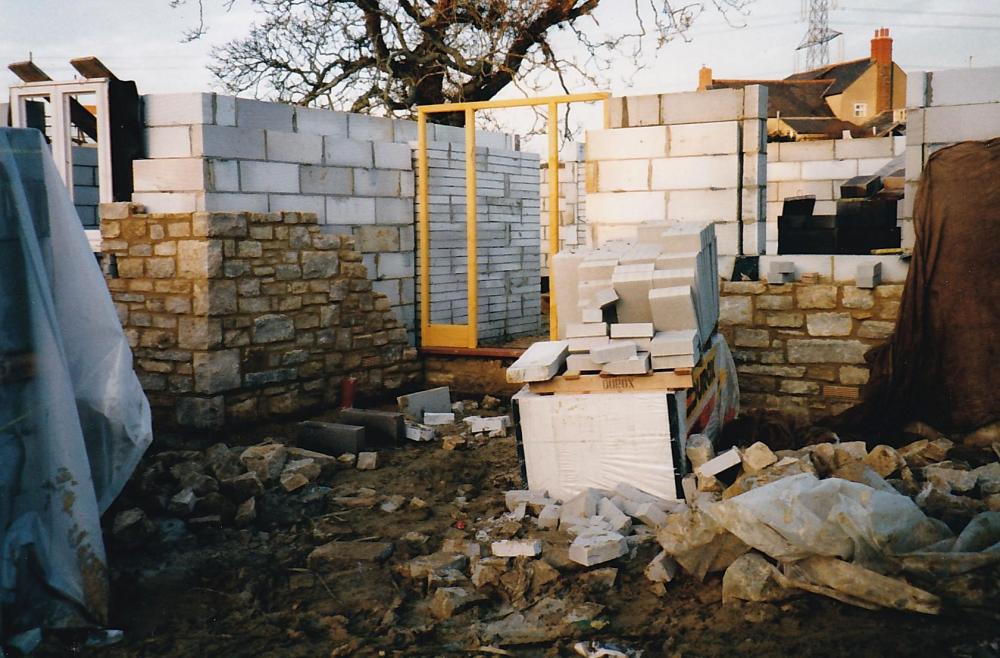
My house being built back in 1997: What a mess. Anyhow, the palette has Durox printed on it. But the blocks look long and skinny to me, not a size Durox currently make. The ones laid flat, inside the front door, are presumaly around 70mm thick to get three courses per upright block. They laid them flat wherever the stone cladding wasn't, to make up the width. The innermost leaf is, I'm pretty sure, 100mm thick. Then a 50mm empty cavity, then 70mm outer leaf clad with ~150mm cropped walling sandstone. Durox don't seem to do this size anymore but I was hoping to find some data on it.
-
I do have the monthly gas consumption for the last couple of years and if I take the months where heating was off as the baseline for DHW and subtract that from each month, then I suppose I could apply the U-Value ratio between insulated and uninsulated build-ups? All seems a bit too easy. E.g. Last year: J 3060 + F 2191 + M 1672 + A 1311 + M 1041 + O 1049 + N 1559 + D 2326 = 14209 kWh * 0.262/0.675 = 5515 kWh Which is a saving of 8684 kWh, or £695 at 8p/kWh Oh, that can't be right can it?
-
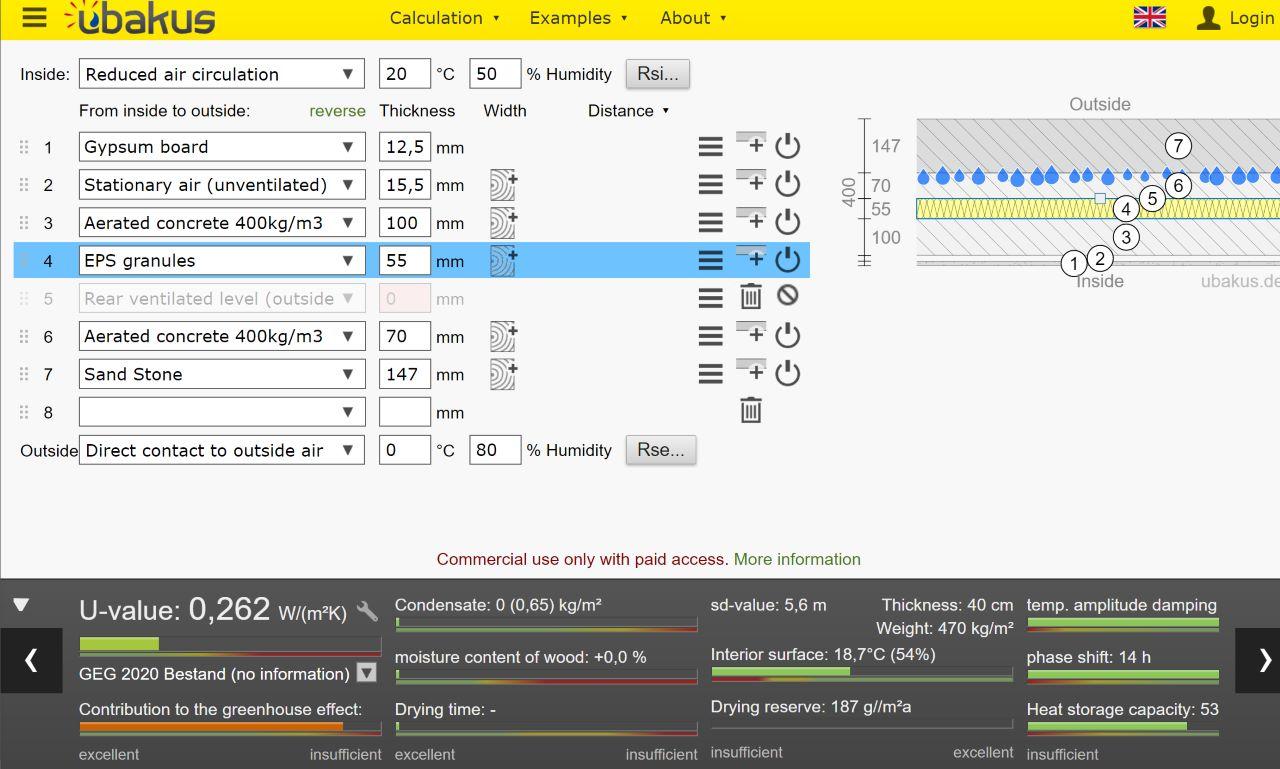
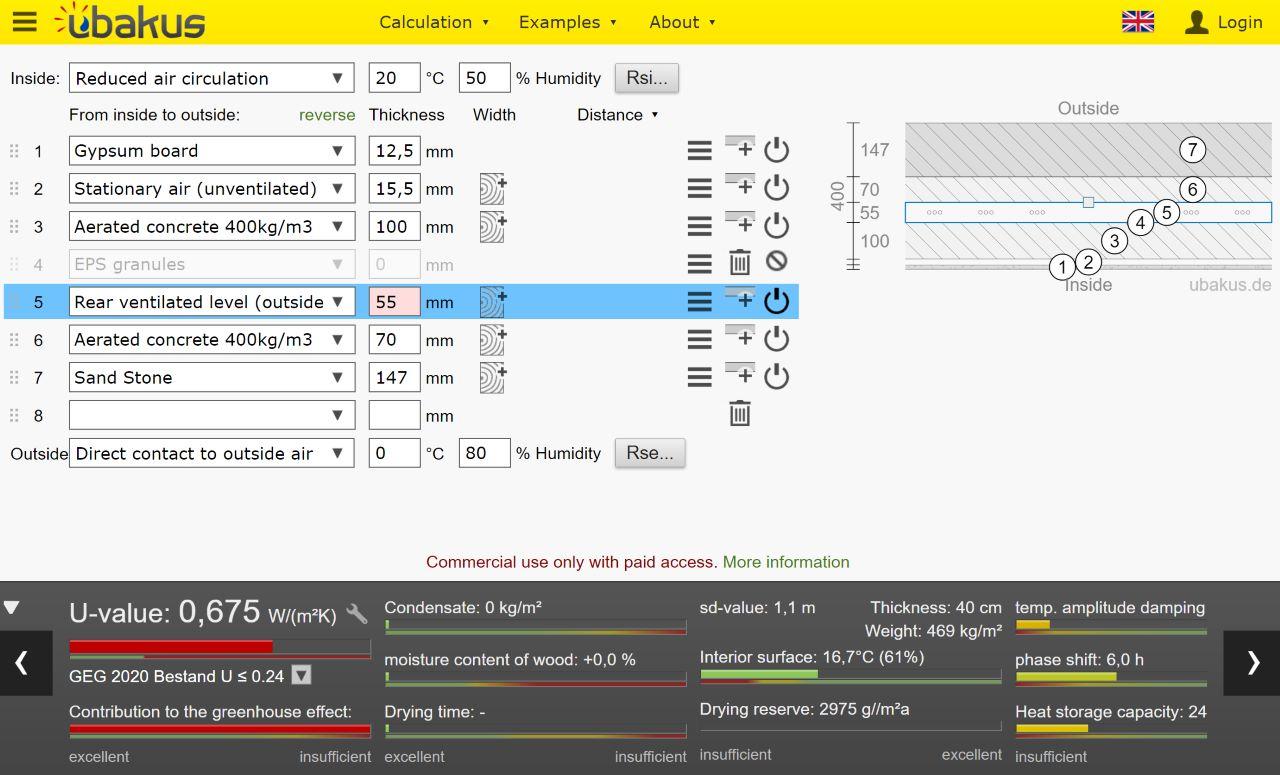
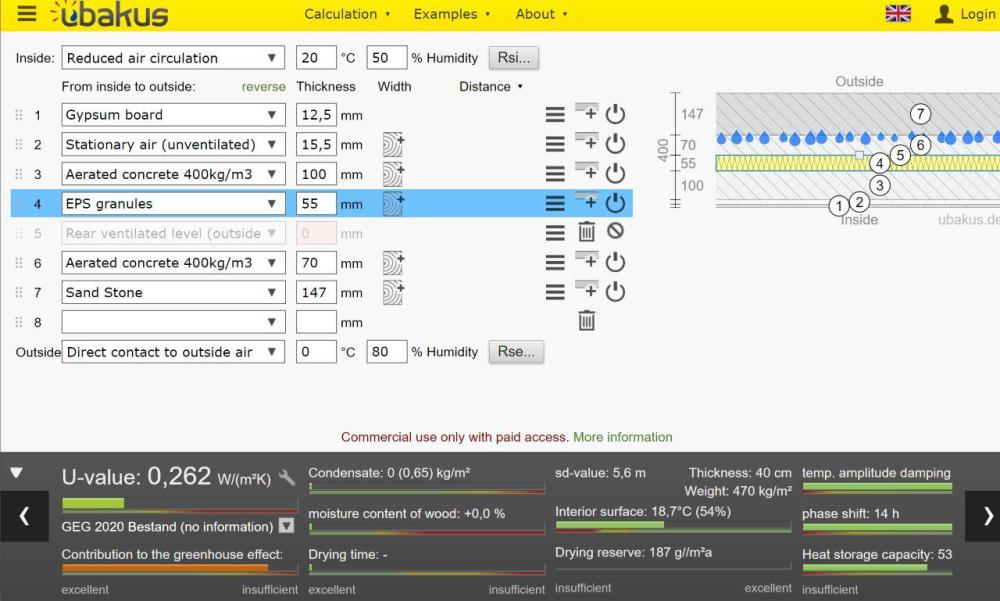
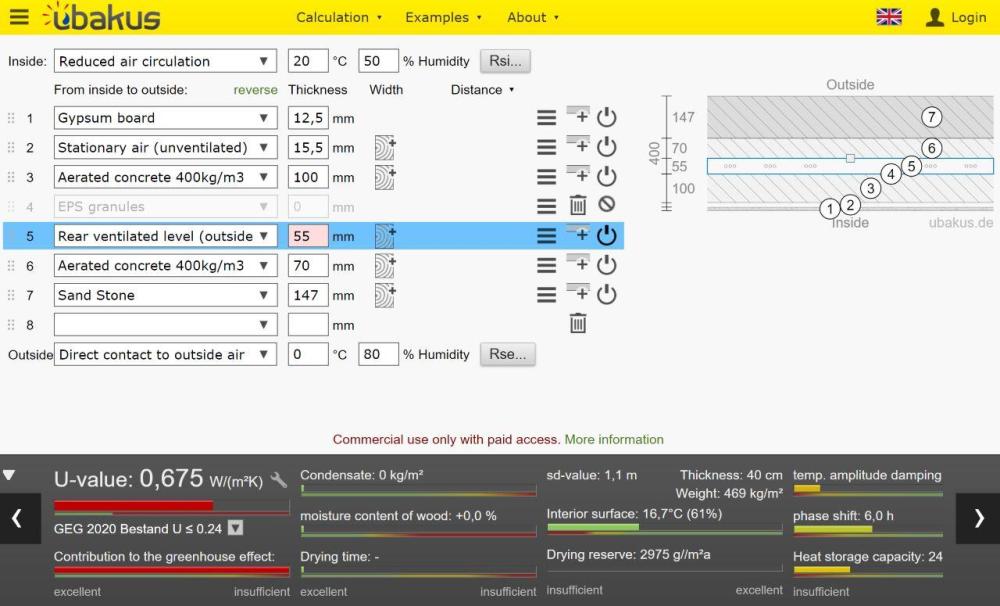
So, we've been "measured up" for Evobead (AKA Climabead) EPS in the cavities. Given the build date of our house (1997) the surveyor wouldn't believe me that our cavities were empty until he got out his SDS drill and borescope. I've run the build-up through Ubakus and it seems filling the 55mm cavity would take us from 0.675 W/(m2K) down to 0.262 W/(m2K) 😱 Not brilliant but a whole lot better. 0.413 W/(m2K) saving over 160m2 and 20C difference amounts to 1.3kW less heat input needed during the coldest sort of days we get here. Working out an annual saving is a bit more difficult. I guess around half of this for 6 months might be a ballpark ~ 2800 kWh or £170 ish. I bet the cost makes this more than a 10 year payback.
-
Is there a reliable and fool proof occupancy sensor for WCs out there
Radian replied to MikeSharp01's topic in Lighting
That's a nice find! Could do with a couple of those round my Mums house. -
Feel like silly questions but may not be.
Radian replied to MikeSharp01's topic in Networks, AV, Security & Automation
That's kind of true unfortunately. This is another one of those examples of roll-your-own-and-save-big-time: if it's just hacking stuff together that you have lying around, then payback can be instant - like my under kitchen-cabinet light dimmer which is now saving me a few hundred kWh per year. -
How does your garden grow?
Radian replied to recoveringbuilder's topic in Landscaping, Decking & Patios
A tiny bit more surface area for sure! But 1.6V would be fine if it's got a source resistance low enough... If you have a resistor handy, somewhere between 470 and 1K Ohms, then measure the voltage you can develop across it. As you know from Ohms law, knowing the voltage across a resistor tells you the current flowing through it: I=V/R Then knowing how much voltage was dropped from the open-circuit voltage (1.65V in your case minus whatever you read across your test resistor) and dividing that by the resistor current, will tell you the source impedance: R=V/I Hopefully under 500 Ohms. -
How does your garden grow?
Radian replied to recoveringbuilder's topic in Landscaping, Decking & Patios
Had a go at making it but not really getting anywhere. I guessed at a 500 Ohm source impedance for the zinc/copper ground spikes but the ones I made came in at five times as much. With such a high impedance the capacitor doesn't charge up enough to turn on the transistor bases (>0.6V). The collector resistors bleed off too much current. It works fine with an AA battery though - but defeats the object of using the bimetallic battery principle. If I had some very low threshold mosfet transistors that could possibly work but my lowest Vgs devices are all over 1V. -
I've often felt like pointing that out but backed off to avoid an argument 🙄.
-
How does your garden grow?
Radian replied to recoveringbuilder's topic in Landscaping, Decking & Patios
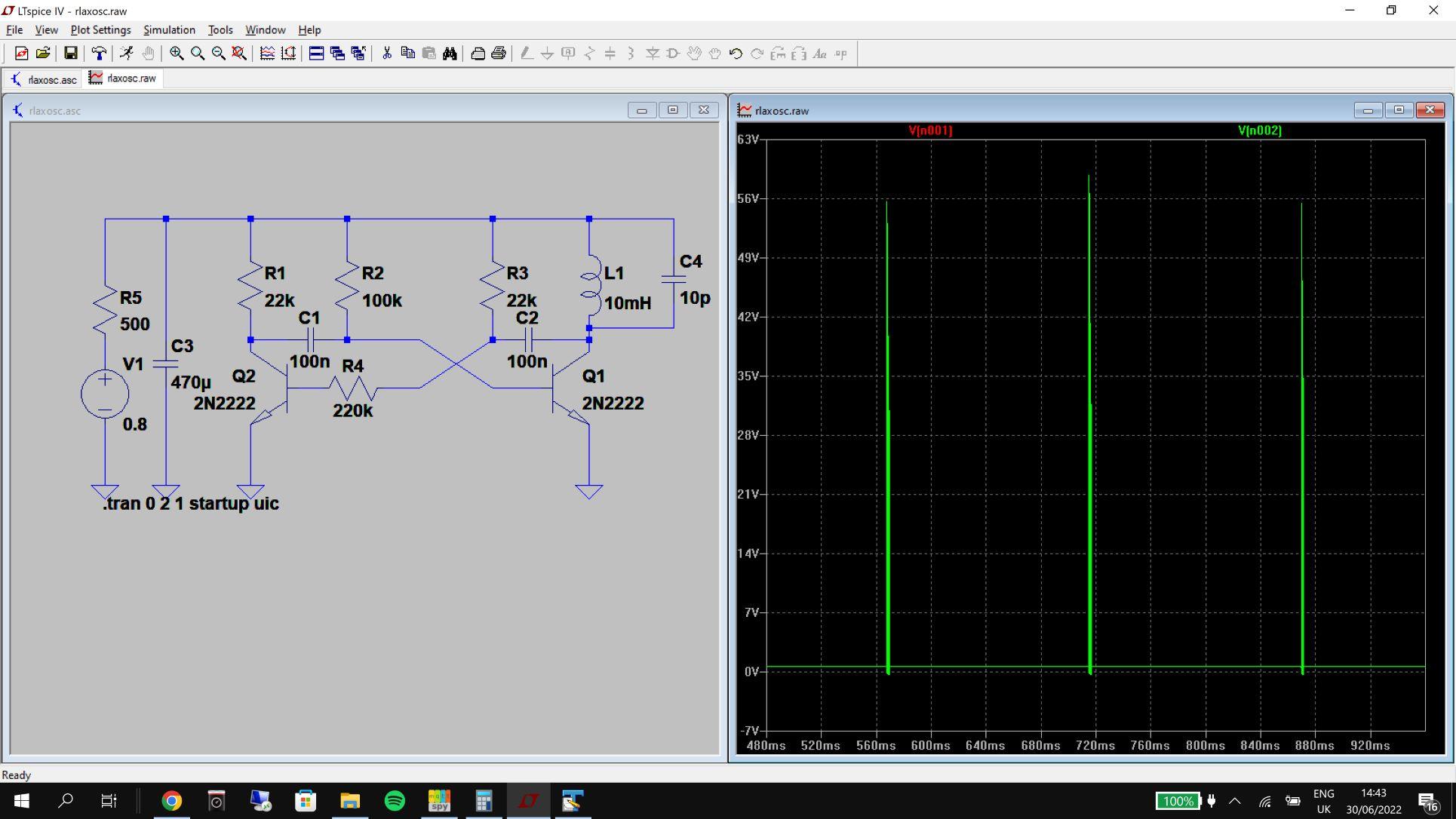
He speaks very highly of you too. But yes, that was my first thought. Something like: Sim shows 50V spikes at around 10 times a second for 200uA input current @0.8V Not sure that circuit would behave exactly the same for real. Quite a lot of component value juggling to get bursts of HV like that. It would more naturally have a tendency to settle out at a constant square wave at lower voltage i.e. around 10V. But that would probably feel similarly unpleasant to a slug.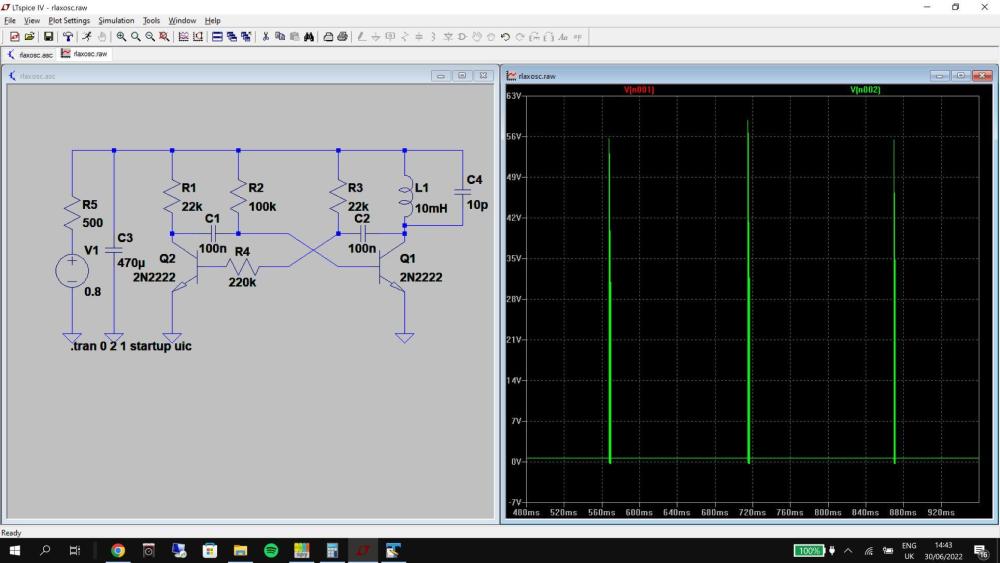
-
How does your garden grow?
Radian replied to recoveringbuilder's topic in Landscaping, Decking & Patios
Did you copy the same photo by mistake, both multimeter shots look the same (0.826V) I was wondering about getting a bit more voltage to begin with, although I think I can get a simple two-transistor oscilator running off of 0.8V. -
How does your garden grow?
Radian replied to recoveringbuilder's topic in Landscaping, Decking & Patios
You can get self adhesive copper foil used for stained glass work. Thinking about the meagre 0.8V, If you used that to charge a capacitor, then repetitively dumped that charge into an inductor, the back emf could be much higher (boost circuit) and give the wildlife something much more serious to deal with. -
Reducing Energy Bills - How goes it?
Radian replied to Ferdinand's topic in General Self Build & DIY Discussion
I had to stop the car for an american mink crossing the track to our house yesterday. Seen it before on our driveway cctv but thought it might have been a stoat or weasel. Up close it was definitely a mink. -
Reducing Energy Bills - How goes it?
Radian replied to Ferdinand's topic in General Self Build & DIY Discussion
The good news: compared to last year, after taking numerous energy saving measures I've dropped our daily electricity consumption by around 5kWh. The bad: This time last year we were using around 20kWh every day 😟 -
Reducing Energy Bills - How goes it?
Radian replied to Ferdinand's topic in General Self Build & DIY Discussion
Boiling a kettle (for 2 minutes) uses 0.1 unit. Unless your TV is plasma it probably also uses around 0.1 unit every hour. -
It's almost certainly regulating down to 5V or less which could be why you got away with running it from a 5V power pack. Might not be ideal though, with no headroom at all. If you do go with the adjustable regulator (good find @Temp) adjust it to 9V. The router probably wouldn't draw any less power at a lower voltage and might just be less reliable. That's a nice looking synchronous switch-mode regulator Temp found. Somewhat overkill in the amount of current it can deliver but no bad thing. The excellent conversion efficiency it gives you is worth it. With it, I'd recommend using a 24V LiFePO4 battery such as this one which I'm using because it's a better match to 250W panels.
-
😂🤣😀 Did the type of .jpeg @pocster deleted rhyme with Corn? Or is my PC playing up?

-
Link us to the model of router...
-
Yes, that's why I opted for a 24V battery. Much better fit for a 250W panel as the battery max out at 28V. Also all the LED lighting is switch-mode so the current is halved in the 100m+ cabling. I don't know if @pstunt can power the router directly from 12V or if it demands 9V maximum. Usually the switch-mode input would permit that range. Anyway I thought 24V would be pushing it so said to go for 12V. If an additional regulator was needed (12V->9V) then that could be spec'd for 24V->9V and therefore make use of the 24V battery. So much choice!
-
I use a 10A 12/24V charge controller (£60) with a single 250W panel (around £100) and a 24V 10Ah LiFePO4 battery (£115) for my garden lights - but you would be better off with a 12v 22Ah Lithium Iron Phosphate LiFePO4 Battery These batteries are much more reliable. I guarantee you will only get 2 years max. out of a car or leisure battery whereas these could give you 10 years or more.
-
The actual energy that goes into the air is modest, a couple of watts at most. It's the losses in switching the transistors that create the radio signal that make up bulk of the power consumption. The faster that transistors are switched, the more heat they generate. 2.4gHz is more power efficient than 5gHz and cell phones use from 0.8gHz to 2.6gHz so give quite a varied battery life depending on type of use and proximity to the cell tower.
-
If you did get a cheap 2nd hand solar panel, say 200W, and use a scrapyard 12V car battery with an ebay solar charger you've got something that could be worth keeping to power this and any future router (as a UPS). I'd say this was worth doing if you had somewhere (e.g shed roof) to put it.