
Radian
-
Posts
2586 -
Joined
-
Last visited
-
Days Won
15
Everything posted by Radian
-
So PW sees the 3.6kW solar as the sum of PW solar (0.98kW) and battery discharge (2.67kW) while SE is 'generating'. But I'm confused as to what it does with that info?
-
And don't they just! As the decades roll by I notice this is almost inevitable on any wiring I've ever gone back to with a screwdriver. I know this happens very quickly if you come across a stranded wire that's been tinned because the lead is so soft, but solid copper wire? I guess its the same principle but just takes longer as it's less ductile. I really don't know what the mechanism is other than perhaps repeated thermal expansion and contraction? Whatever, a spring force clamp is not going to suffer the same fate so long as it remains springy.
-
You'll be waiting a loooooooong time if you want a 222 style in 8-way. 2,3 & 5 are the only options they make. But you knew that already 🙊
-
What's that? Seem to recall the term from somewhen in the distant past. Spose I could google it.
-
Nulling is actually a big dose of -ve feedback ~ the most stable variety.
-
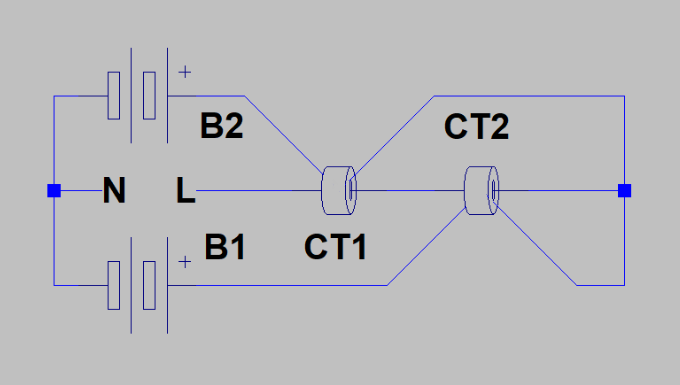
That is how I understand it. Yes, the SE CT will show imported grid current so it's SE's duty to raise it's output voltage enough to zero the grid current while still meeting the EV's demand. I believe that PW is expecting to be paired with PV but I don't know if it uses 1 ro 2 CT's to determine when PV is providing the power. Interestingly, if the SE live is threaded in with the PW grid CT (as I showed in my schematic) SE generation will 'look' like grid power so PW ought to step in to minimise it. How this settles out is difficult to predict but it could be that they both end up sharing the duty.
-
No. During peak hours both battery system's aim should be to provide power in preference to importing it. To do this they look at magnitude and direction of power through their respective CTs and modulate their output to keep it to zero. Power thus flows from both battery systems into the kettle load, possibly a little lopsidedly but not massively so. Roughly 1kW therefore flows into the kettle from each and nothing to the grid. You're suggestion that both will deliver 2kW 'come what may' might be based on your thinking that each system can't see the other's contribution. Indeed they can't. All they can see is the same house load drawing on the grid so both raise their outputs to compensate. This is where differences in control loops might become apparent but as they both see the same power flow to or from the grid, they will not blindly raise their outputs and start exporting (or importing). AC battery systems already seem to manage this scenario. I agree we have no reason to guess the exact share that would result but it's a secondary objective to evenly share the local energy store. The primary objective is to stop the two systems stealing each others charge and careful CT threading can achieve this.
-
Whoa! The way you say it "too much power sounds" very bad but is, in fact, what's required here. It's not like the lights will be brighter! What it really means is that both batteries can slurp free/cheap leccy together when available (good) and both can supply it in preference when not (also good).
-
Pocster and I both think it is. And it is the key constraint we require. Sure, it's pretty gruesome. The CTs tell the two systems the quantity and direction of power flow between house and grid. If one system sees the other drawing power from the grid but can't distinguish it from Pocster putting on the kettle, it will jump in and supply it. That constraint can be met by nulling the drain from the opposing system. You appear to have looked at it from the perspective of only one system and put the other system on the other side of the CT to hide it. Fine, but once again, this is a symmetrical problem and can only be resolved by having each system nulled from the other. We're spinning our wheels dreadfully here. Assuming that you're not just trolling, what is it about mutually nulling the systems to each other that you won't go along with?
-
...But this is the issue we're trying to overcome in this thread. There appears to be insufficient control provided by SE and PW to do such synchronising hence the reverse routing trick through the CTs to mask the systems from each other.
-
Hard to say without knowing for sure the location of the CTs but if the SE CT is just sat next to the PW CT on the incomer (topologically speaking) then neither should baulk at the other taking 3kW+ as it might just be you needing to electric shower in the middle of the night. Like you sometimes need to 🙈 However, the fun & games might start, as I think you've seen, when one or other reaches capacity and switches to 'provider' mode. In principle it should know you're in the off-peak window and avoid any discharge so might have instead a 'standby' mode before switching to 'provider' mode at the end of the window. Don't know.
-
Do you know what kind of ground your houses are on? Hopefully not former coalmines! What's the monthly rainfall been like in your location? Are there trees nearby? Where we are there was zero rain in July and about 1/4 the usual for the previous months. Clay soils will shrink back and trees make things even worse as they draw up water from greater depths.
-
I think I get what you're saying. PW must know when there's free PV to slurp on, and when there isn't, in order for it to be compatible with the off-peak energy scheme it's associated with. Pretty fundamental to the whole idea behind it all. But of course it will never see (or expect to see) PV in the off-peak window. Therefore when it does charge in the off-peak window, the resulting load must be hidden from SE and here we go around the explanation merry-go-round once again. I'm pretty certain You or your installer is going to have to do some nifty CT lacing to fix it. It may be that they did something along these lines but either got the current direction the wrong way around, or only did it for one battery system (or all the other combinatorial fails that are possible).
-
"Why does/doesn't the PW..." seems to be a very common refrain, featuring greatly in Tesla's own FAQ. The glib answer is because it's got some of Musk's AI baked into it - so nobody, not even Musk himself, knows why it does what it does at times. A great deal will actually depend on what external sensing it has. Is there more than one CT for example? Certainly one for the main incomer but is there another looking at the output from the SE?
-
Except for it's insistence on charging the PW in the sublet during off-peak tariff time if PW is in need of charge and SE isn't. This is what annoys poor old Pocster so much becuase he doesn't want them exchanging their power reserves - ever!
-
That's right. I suspect Pocster's install is wired in exactly the way RobLe shows it in (c) although which is batt is PW and which is SE is unclear. But it doesn't matter. It's the job of each battery to supply the power demand in preference to the grid except for when it is set to absorb power at off-peak times. Neither battery system can distinguish the house load from the other battery system if that battery system is being charged - therefore, if not actively charging itself, it will attempt to provide power for the other batteries charge. Again, it's a highly symmetrical problem so is unlikely to yield satisfactorily to an asymmetric solution.
-
I know you're being tongue in cheek but if only all this kit was DC then diodes could indeed solve the problem. Unfortunately you can't selectively block the direction of Alternating Current to create a 'one-way road' in the same simple fashion.
-
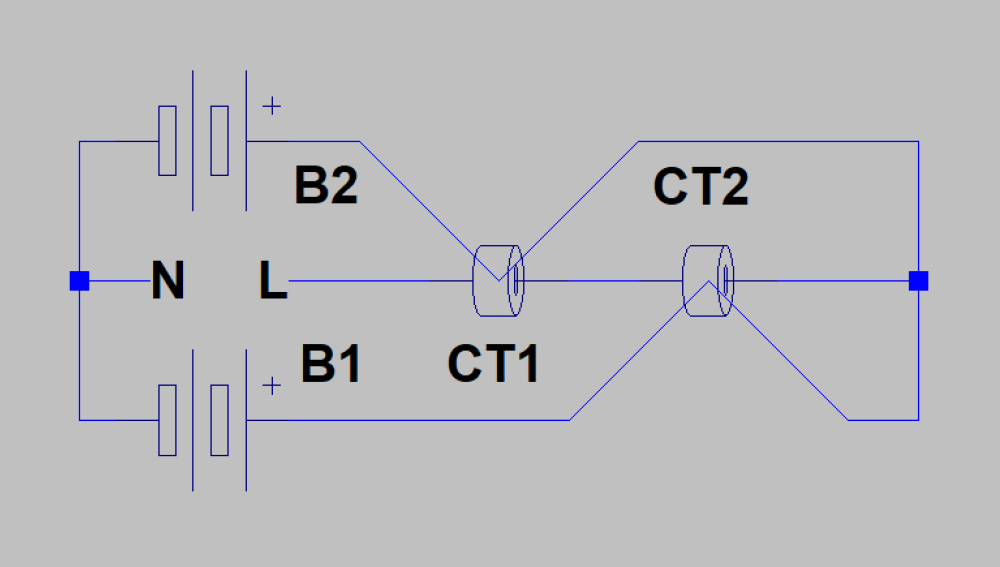
Hi RobLe, in trying to understand your suggested scheme I couldn't work out what you meant by 'after'. But I suspect the issue is that, as being near-identical generators and consumers of power, no asymmetric arrangement of clamps is going to produce symetrical results. Pocster needs both storage systems to bank-up charge in the narrow off-peak window. I don't follow. B1 is not nulling CT1, it would defeat the operation of the composite device. CT1 belongs to B1 and must see everything going in or out of it! What happens in the arrangement I'm proposing is that B1's operation is invisible to B2 and vice-versa.
-
Er, Are my picture attachments not showing up? How about this one...

-
Me neither because I'm incredibly jealous of all that luverly kit 🤣 Glancing at my schematic again, I realise that I'm taking it for granted that people understand that the house loads come off at the far right of the 'L' cable although not shown. This diagram only shows the relative locations and wiring for the two battery systems. Also, I think the SE system is a hybrid inverter but it should only have the one connection point to the AC so can be considered as a 'self charging battery' for our purposes here.
-
That cancellation is exactly what I think is needed to fix the problem. If the PW can't see the power flowing into the SE then it won't push up its output voltage to try and supply it. And the same is true for the SE. Edited to repost the schematic to make the cables passing through the CTs clearer:
-
No, it's an unnecessary drain on the other battery. We want both to charge from the grid, not each other. Here's a schematic of what I think might work: Obviously the symbol for the batteries is a bit wrong for AC but it gives the idea. CT1 is owned by B1 and C2 by B2. Whatever current flows to or from Live by either battery is hidden from the other. Am I being silly or is it as simple as this?
-
It seems OK, it's entirely symmetrical - the power delivered by the battery systems will be hidden to each other so they should always just 'see' their own imports/exports and everything else bar the other battery system. I think.
-
If you could cancel the load imposed by each battery system when charging from the other's CT (by routing their live wires in the opposite direction to the main incomer) then they will both only respond to the other house loads. But when current goes the other way, when generating, my head explodes. I mean, I haven't figured out what would happen yet!
-
As there's no communication between them both will just 'fill up' until they decide they've had enough. The Telsa seems to be the one with most unpredictable behaviour in this respect. However, once 'full' they will return to supplying the house loads - of which one load may be a battery still charging. Hence a window must be defined in which no generation takes place. But this means some import for the house's base load must be tolerated.