

.jpg.c21f3ac78c9b7efd90cbdcb312744dc5.jpg)
jack
-
Posts
7460 -
Joined
-
Last visited
-
Days Won
41
Everything posted by jack
-
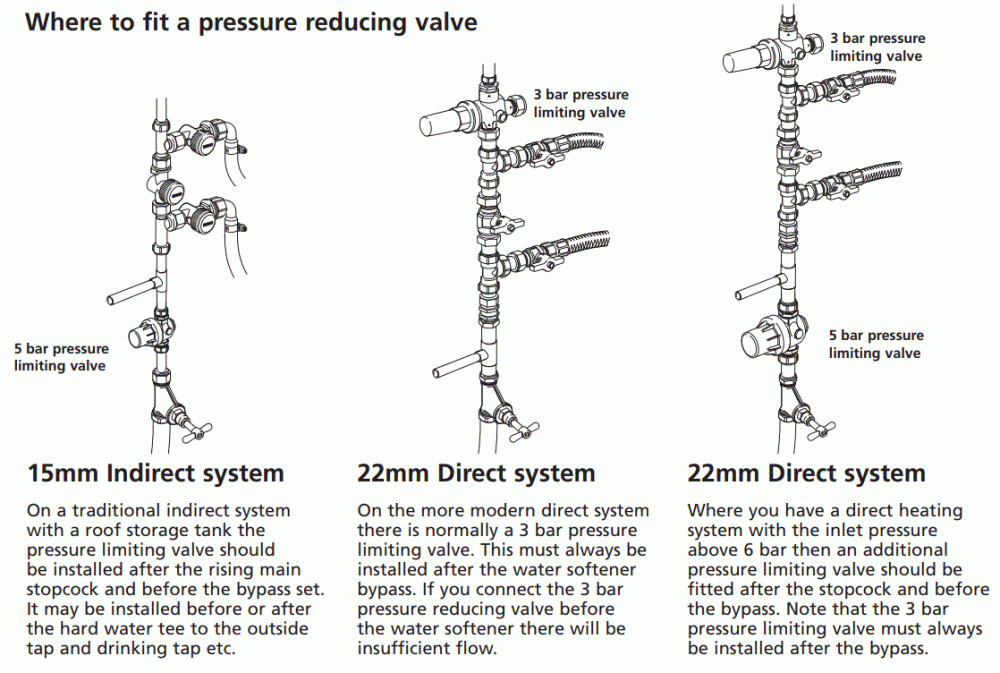
Be careful to note your unit's installation details. I didn't check ours until long after the plumber had left, and his team didn't follow the instructions. If you have high incoming water pressure, then the trick is to put a first PRV before the softener to bring the pressure below the softener's maximum operating pressure, and then a further one after it to bring the pressure down to what the house is designed to operate at. For example, we have nearly 6 bar incoming. We should have a ~5 bar (6 bar being the max the softener runs at) PRV on the incoming main, and then a 3 bar PRV after the softener. Even if your pressure isn't that high, you should still put the main PRV after the softener, not before. Here's the picture from the manual: Unfortunately, we have only a 2(!) bar PRV on the incoming before the softener, which does leave us with sub-optimal water pressure if there's a shower on, the washing machine is refilling, and the water softener decides to regenerate at the same time. When I asked why they installed such a low bar PRV, I was told that they wanted to make sure the water pressure didn't look too powerful if the building control guy turned the taps on!
-
.jpg.c21f3ac78c9b7efd90cbdcb312744dc5.thumb.jpg.7adcad4c0e384f5ecd7d56b0618df6e5.jpg)
New build floorplans - opinions welcome
jack replied to Indy's topic in New House & Self Build Design
I really like this take. -
New build floorplans - opinions welcome
jack replied to Indy's topic in New House & Self Build Design
Thanks so much for that link. JFC those are some unpleasant houses. -
We have 28mm Hep2O connecting our ASHP to our plant room over a ~9 metre distance. All done without a single join, which in our case would have been a massive pain given a lot of it is in a channel cut through our underfloor EPS. Hep2O barrier pipe includes an oxygen barrier and is specifically designed for this sort of application, so I can't what the objection would be to its use - from https://blog.wavin.co.uk/all-you-need-to-know-about-hep2o-push-fit-plastic-plumbing-pipe/:

-
Death of MHRV unit
jack replied to DaveAndAnnaUK's topic in Mechanical Ventilation with Heat Recovery (MVHR)
I suspect you're right. The only time I've ever seen mould in ours was when we had some issues with condensation buildup. It was in a patch on the heat exchanger, and it was a nightmare to clean even though it was just along an edge. That said, I understand that many of these units share a heat exchanger, so with luck it might be cheaply replaced if needed. -
VAT evidence to HMRC
jack replied to Moonshine's topic in Self Build VAT, Community Infrastructure Levy (CIL), S106 & Tax
Claim for the total if delivery is on the same invoice. We converted to GBP using the historic daily exchange rates on xe.com. Might have perhaps been able to show the actual amount paid in GBP by digging through credit card statements, but that seemed like far too much faff for the amount it would return. -
MBC offered to engineer our joists to take a 50mm poured screed and I'm sure it wasn't that much more cost-wise. The real cost would have been getting the screed done.
-
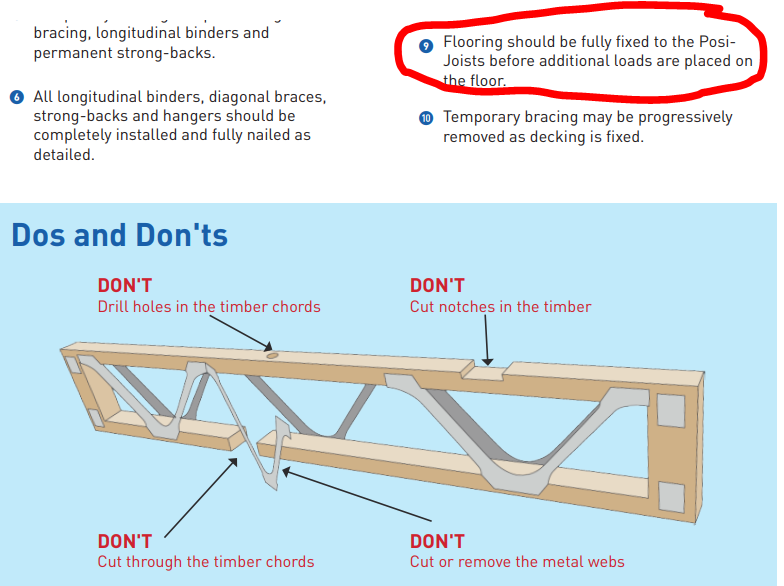
According to the posi joist technical handbook, holes and notches are forbidden, but fixing flooring and strongbacks etc is allowed:
-
I recently looked into drilling a small hole in an existing posi joist and all the evidence suggests no form of drilling or notching is allowed. Have you checked this?
-
Death of MHRV unit
jack replied to DaveAndAnnaUK's topic in Mechanical Ventilation with Heat Recovery (MVHR)
Never heard of this before, but the wikipedia entry for Portland has this:
-
I described what happened in this thread: If you don't fancy reading it all, I'd say the main takeaways are to make sure you use proper fixings (eg, not plasterboard screws if you're using a tile backer board), and lots of them, and don't butt boards up hard against each other.
-
If you demolish to the foundations leaving no more than the facade standing, and this is a planning requirement, it can be treated as a new build for VAT reclaim purposes: see section 3.2.1 here I seem to recall that this is treated very strictly, so you need to be careful about how you go about it. Personally, unless you have no other choice, I'd nuke the lot and start again.
-
Death of MHRV unit
jack replied to DaveAndAnnaUK's topic in Mechanical Ventilation with Heat Recovery (MVHR)
You can upload it to YouTube and post the link here. Use a throwaway account if you want to increase your privacy somewhat. -
Death of MHRV unit
jack replied to DaveAndAnnaUK's topic in Mechanical Ventilation with Heat Recovery (MVHR)
Welcome to the forum. That's very unhappy-looking MVHR system you have there! How long did you leave the MVHR system turned off, and how have you been ventilating the house during this period? How was it left with the supplier? Did they advise what you should be doing while waiting for parts? It also seems odd that no effort was made by them to identify exactly what had gone wrong. I genuinely have no idea whether the unit is salvageable. It's possible that you can clean it out and disinfect it sufficiently that it can be used again, but getting at the insides of the distribution pipework in the rest of the house may be an issue. Do you have a semi-rigid system? If so, is it circular in cross section? It's possible that with a lot of time and energy you could clean and disinfect the insides of such ductwork (I vaguely recall someone once talking about duct cleaning a few years ago), but it may not be a job you can do yourself. -
New build floorplans - opinions welcome
jack replied to Indy's topic in New House & Self Build Design
We have exactly the same. We have never set foot on the balcony off our master bedroom, and the one off my older boy's is similarly unused. They do look nice though, and the overhangs provide some shade in summer. Shame that they collect leaves and need cleaning periodically. Couldn't agree more. -
Soundproofing 1930s semi after neighbour's extension
jack replied to JMPS's topic in Sound Insulation
If you can hear low volume conversations, that suggests a pretty direct route for sound - think airborne rather than structure-borne, to begin with at least. -
Cheeky blighter making it out of easily removable materials so he can get rid of it after sign-off.
-
WTAF? I wonder whether it's viewing the trap as a potential nest, and dragging in some materials to close off the entrance a bit?
-
I've lived with it in a highly insulated and airtight house for about 6 years, and there's no way I'd ever voluntarily live in a house without it in the future. It costs a bit to buy and run, and you need to replace filters periodically, but I think it's a small price to pay for consistently fresh air all year around.
-
Having had to remove and replace all of the cracked marble tiles from two showers because the tiler failed to follow some pretty basic principles, I'd go for self-builder overkill every time!
-
Check Quooker's current advice. Certainly when I bought mine 6 years ago, they specifically said that you shouldn't supply their product with softened water due to the possibility of the lower pH of the water damaging the tank. I seem to recall that they'd softened (pardon the pun) the advice a bit last time I looked, and now suggest this is only potentially a problem if your incoming water is very hard (and hence your softened water is of particularly low pH). We live in a moderately hard water area and we've got unsoftened water going to our Quooker. It hasn't cause any problems - you might want to get hold of a descaling kit and empty out the scale once every year or two. It doesn't stick to the element, but instead just falls as flakes onto the floor of the tank.
-
ASHP and Hard Water - do we need to soften/condition
jack replied to DeanAlan's topic in Other Heating Systems
Take a look at Dualflo. I believe they're made by Harvey and may even be rebadged Harvey softeners. They're meant for trade purchasers, so if you have a friendly plumber who'd be willing to buy on your behalf, you could save some cash. -
Some HA bits to give away for freeee (KNX/Dali/modbus)
jack replied to joth's topic in Networks, AV, Security & Automation
I couldn't agree more. I replaced a load of crappy dimmers with a Theben 8 channel KNX dimmer unit. Great hardware quality, and it's been rock solid for well over a year. Even so, I found the whole ecosystem so unintuitive to set up that there's no way I'll stick with it in the future when this unit needs replacing. As you say, I'd be starting from scratch again, trying to figure out what arcane set of hoops they want me to jump through to set it up. Six years later I still enjoy opening up the Loxone config software to tweak or add things. It's wonderfully intuitive. I'm hardly scratching the surface with what I've done (dimmers, blinds, basic ASHP control, alarm) - I plan to do more stuff when (let's face it, if!) I have the time. -
I gave no consideration to date order at all. Mine were very roughly grouped by supplier, but even that was pretty haphazard.
-
Worth a search of BuildHub for "node red" (in quotes). It's been discussed before a few times.
.jpg.c21f3ac78c9b7efd90cbdcb312744dc5.thumb.jpg.7adcad4c0e384f5ecd7d56b0618df6e5.jpg)




