

.jpg.c21f3ac78c9b7efd90cbdcb312744dc5.jpg)
jack
-
Posts
7460 -
Joined
-
Last visited
-
Days Won
41
Everything posted by jack
-
It's different for different people. For example, some think the forum is about unpaid volunteers giving up their time to help people. For others, it's about snapping at people trying to help, just because they don't like the answers they're getting.
-
.jpg.c21f3ac78c9b7efd90cbdcb312744dc5.thumb.jpg.7adcad4c0e384f5ecd7d56b0618df6e5.jpg)
MVHR with adiabatic cooling
jack replied to Garald's topic in Mechanical Ventilation with Heat Recovery (MVHR)
I've never heard the term "insufflation" used in the context of building ventilation. Is this some sort of positive pressure ventilation system? -
Looking at the manufacturer's code in the tech spec drop-down, I'd be surprised if there's any difference other than length: Odd that they're described so differently.


-
The surface area of the pipe exposed to the sun is less than that of the pool as a whole. You might be better off putting thick black plastic in the bottom of the pool, and maybe some bubble wrap on top of the water when it isn't in use. The heat is directly transferred to the water, so fewer losses and no need for a pump. Plus more surface area, so more energy. It might be more effective if you mount the pool on the PIR.
-
I half-heartedly looked into exactly this when we were thinking about how we would heat our house, but quickly stopped when I saw the results of the initial calculations.
-
I've always used: uk-water-softeners.co.uk Good prices and they do their own deliveries (although the delivery area is limited because of this).
-
I doubt you need to break solid rock down to the full depth, but there's likely to be a minimum depth of hardcode to ensure load distribution. Only the engineer responsible for the design can confirm.
-
I doubt you're the only one who thinks this, but I disagree. "Battery" has a long history of use in relation to thermal storage. Chemical storage devices of the type you're referring to are only called batteries because they're formed from a battery of cells.
-
Feel like silly questions but may not be.
jack replied to MikeSharp01's topic in Networks, AV, Security & Automation
Any home automation system that requires you to get your phone out more than once a week is a poorly designed and/or implemented home automation system imo. I rarely use my phone to control anything. All lights are on physical switches (but some of the switches do different things depending on time of day). Blinds are mostly automated based on time of day (except in the bedrooms), but also have switches for manual control. I've had similar, but generally waving your arms around was enough. It's worse in a large office unless you're willing to install lots of presence sensors. I mainly haven't bothered within presence sensing due to cost. Decent ones cost tens of quid, and the insane payback time means it makes no sense for me to install them. -
Feel like silly questions but may not be.
jack replied to MikeSharp01's topic in Networks, AV, Security & Automation
Make the delay an hour or two from the last motion. You shouldn't really be sitting completely stationary for two hours, and a decent presence (not motion) sensor doesn't require you to run around the room to be detected. Another approach is to program the lights to briefly dim a couple of times shortly before turning off. If that happens, you can just wave your arm around to reset the timer. -
Feel like silly questions but may not be.
jack replied to MikeSharp01's topic in Networks, AV, Security & Automation
Exactly. I think a lot of people don't realise how flexible home automation can be. For example, I have lights in some rooms set so that they behave differently after dusk (the HA system tracks the changing dusk time). If I'm turning the lights in the bedroom on during the day, it's generally because I need a lot of light. At night, the same switch just turns on the bedside table lights, because I almost never need/want downlights on at 10 or 11 pm (but can put them on with about 10 seconds' effort on the phone if needed). Even in the small number of rooms with just downlights, many are set so that the downlights come on at ~60% at night and 90-100% during the day. I personally don't have any lights set to come on automatically as a result of motion within a room. If I did use motion/presence sensors, I'd be more likely to set them so the lights still need to be turned on at the switch, but automatically turn off after some period of inactivity in the room. -
Reducing Energy Bills - How goes it?
jack replied to Ferdinand's topic in General Self Build & DIY Discussion
Oh yeah, completely forgot about that! -
Reducing Energy Bills - How goes it?
jack replied to Ferdinand's topic in General Self Build & DIY Discussion
Standby mode (in which energy is intentionally consumed to keep the components in the main signal path warm) is definitely something to watch out for. I have no idea how much power is involved, but I'd be surprised if it's less than a few watts per channel. As you say, across several channels in a home theatre amp, this could add up to a lot. It's true that non Class D amps are inefficient, but most amps are rarely if ever used at anything like their full rated power. Unless you're using inefficient loudspeakers and/or listening at very high volumes, you're unlikely to be using more than a few percent of the rated output most of the time. To be fair, this has completely changed since Class D amplifiers started making inroads a few years ago. They run at very high efficiencies, and when designed properly can sound excellent as well. Also, more expensive amps are more likely to use Class A output stages, which are less efficient than the Class AB output stages typically used by cheaper amps. Class A means higher power consumption for a given power output. -
You had me going for about 2 seconds...
-
I believe there were several documented problems with the Immersun unit, at least in its older incarnation. Its design may have been updated since. Mine (bought about 7 years ago) died in less than two years, and wasn't covered under warranty because the original company had gone under and had its assets bought out in the meantime. My electrician installed several Immersun units over the same period, and then stopped recommending them after several failed in service. I think it's a little narrow-minded to reject an entire product category just because of historical experiences with one particular product. In the right installation, some units have a payback period that's shorter than the warranty period, so you have little to lose.
-
I'll admit to having been beyond frustrated by the end of that thread. I probably should have just picked up the phone and spoken to Jeremy rather than trying to keep hammering the same point online. That said, I doubt it was just me. He'd previously taken at least one extended break from BuildHub of his own accord.
-
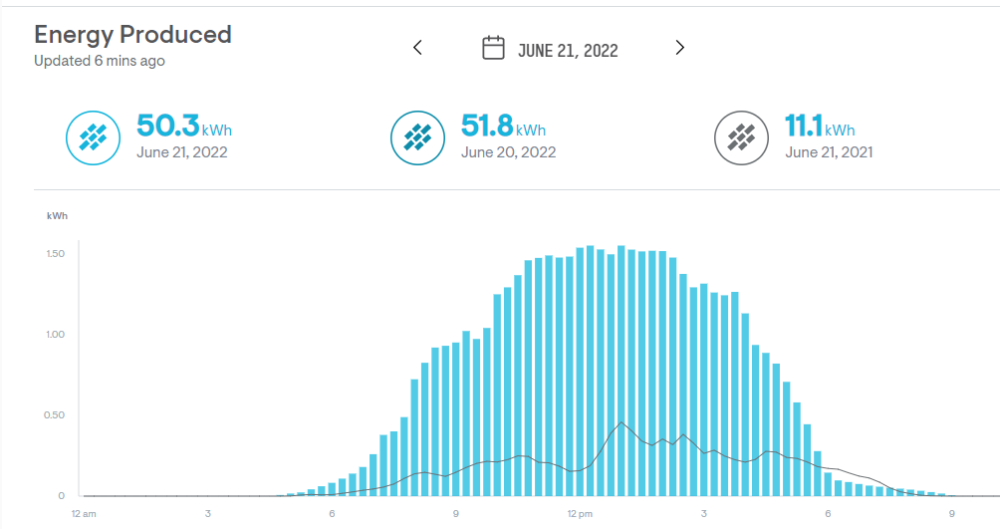
We have an 8.5 kW array with Enphase micro inverters, and managed over 50 kWh yesterday. Looks like about the third best day this year for us (best was 52.2 kWh on 14 June). Much better than the same date last year (the line on the same graph).
-
Zehnder ComfoAir Q450 vs Brink Flair 400
jack replied to Adsibob's topic in Mechanical Ventilation with Heat Recovery (MVHR)
Sorry, never used it - my unit is too old to have the app! -
There's zero way for him to charge you for the costs of any attempt at obtaining an injunction if he undertakes it before you've done anything. If he waits until you start building and you never do any of the things he says he's worried about, the situation is the same. If you start doing things he disagrees with, he is required to attempt to negotiate with you before seeking an injunction. If that fails and he seeks an injunction, you would likely be responsible for some (generally not all) of his costs if, and only if, you lose. I think it's too early to be worried about an injunction. I suspect what's more likely to be a potential problem is him impeding your use of this access, such as by placing things in the way. You'd then need to get your own injunction to force him to give back the access to which you believe have a right. It never ceases to amaze me the way people behave when it comes to anything even vaguely related to their property. It seems as though all sanity and reason goes out the window, along with any consideration of previously good personal relationships.
-
We should have installed air conditioning… now what?
jack replied to Adsibob's topic in Other Heating Systems
Having lived and worked in Australia (not without aircon, I'll add!), humidity definitely has an impact. But the main thing is that I just subjectively hate the heat. Always have, even on holidays. -
We should have installed air conditioning… now what?
jack replied to Adsibob's topic in Other Heating Systems
Warmer temps are fine when I'm outside and there's some air movement (either a breeze, or I'm moving around). But 24+ degrees inside and I'm dripping with sweat, and completely unable to concentrate. I've worked in non-airconditioned offices a couple of times, and I definitely didn't adapt. Thankfully my office (I work from home) is downstairs, where we have underfloor cooling and concrete floors. It's heaven during a heatwave. -
MVHR - Self install!?
jack replied to richo106's topic in Mechanical Ventilation with Heat Recovery (MVHR)
That seems unusually reasonable for an MVHR installation. Nice! -
Recession + building trade = ?
jack replied to DazRave's topic in General Self Build & DIY Discussion
The formal definition of a recession is two consecutive quarters of contraction. From my perspective, the two most likely outcomes are severe recession (and possibly depression) or massive (possibly hyper-) inflation. I don't see any way we go from the current situation to a situation of stable growth, inflation, and employment. It's like the punchline to that joke about the guy asking for directions from a farmer: "Well I wouldn't start from here". -
Most EVs allow you to program their charge times, so you can match that to, eg, the Octopus Go cheap period.
-
Bit late to the party, but for others who might follow: I believe you did need to use someone certified if you wanted to claim the home charging grant, but the system changed earlier this year, and only flat owners and renters qualify for the subsidy. I don't believe an electrician needs any special certification to install a charger. You do, however, need some special kit if you want to do the required testing. I don't know how common it is for a typical one-person-band electrician to have this kit. The electrician I use just bought the required equipment in the last few weeks, as he now has enough interest from his regular clients to make it worthwhile having.
.jpg.c21f3ac78c9b7efd90cbdcb312744dc5.thumb.jpg.7adcad4c0e384f5ecd7d56b0618df6e5.jpg)


