

.jpg.c21f3ac78c9b7efd90cbdcb312744dc5.jpg)
jack
-
Posts
7460 -
Joined
-
Last visited
-
Days Won
41
Everything posted by jack
-
.jpg.c21f3ac78c9b7efd90cbdcb312744dc5.thumb.jpg.7adcad4c0e384f5ecd7d56b0618df6e5.jpg)
Zehnder ComfoAir Q450 vs Brink Flair 400
jack replied to Adsibob's topic in Mechanical Ventilation with Heat Recovery (MVHR)
I change the filters every few months when the filter light comes on. Other than that, if it looks dirty when changing the filters I give it a good clean out and a wipe down with antiseptic. Sometimes it can get a bit grotty by the end of winter with all the condensation it deals with, so this is often a job for spring. I assume that I'll probably need to change the bearings at some point. If I can get through winter without any of the bearings going, I may take the whole unit out and give it a thorough once over - new bearings, cleaning out bits I can't get to easily get to while it's installed, checking as far up into the ducts as I can, checking inside the sound attenuator, that sort of thing. I haven't done any of those things since moving into the house just before Christmas 2015. -
Copyright dispute with timber frame company. Help.
jack replied to Paulp1's topic in General Self Build & DIY Discussion
Not even slightly. They have a written evidence trail showing that she engaged them to do design work for her, that they did the work and gave her the drawings, that she changed her mind and is now building something very similar with a couple of walls and a velux moved. The public planning submissions will show them exactly what she's planning to build, too, so she can't even rely on them being ignorant of her actual intentions. Even if she's paid a design fee, the amount paid may have been set on the understanding that she was going to use the TF company for the build. In that case, the amount she paid may not have been what she'd have expected to pay for just the design work alone. So not "free", but you can't conclude that just because something was paid that there's no moral case to be made against her using the plans. Also (and as you say), even having paid a reasonable fee might not grant rights in any circumstances other than the TF company doing the build. Many (most?) architects and architectural design companies will retain copyright in their designs even if they're paid for. No. Unlike some other forms of IP like patents and trademarks, there is a subjective element to infringing copyright. The clue is in the name: copyright. If you do what's in the claims of someone else's patent, or you use someone else's registered trademark, it isn't relevant whether you copied it or came up with the idea entirely independently. The question is simply whether what you're doing infringes the registered rights. Copyright is different in that you need to show actual copying. If a potential infringer can show that they came up with even exactly the same design without knowing about the earlier work, then they won't be found to infringe (look at the recent Ed Sheeran case, which dealt with this issue). This is why showing that what's being built is similar to something else found online is irrelevant to whether the design was copied. It was by definition "copied" because that's what the evidence says. The test allows for variations from what's been copied. Showing that you've made changes is not enough to show you haven't copied. Making changes specifically to avoid copyright is even less likely to get you off the hook. You also can't avoid infringement by showing that elements of the design are known. It's the work as a whole that needs to be assessed. -
Copyright dispute with timber frame company. Help.
jack replied to Paulp1's topic in General Self Build & DIY Discussion
Even if she was completely in the right, nothing can stop the company threatening her. However, in this case she's probably not in the right. Changing cladding, moving a velux, and adjusting a couple of walls upstairs is extremely unlikely to overcome copyright. More to the point, your friend has basically had the equivalent of an architect or at least architectural designer design her an entire house. Why would she expect to have the benefit of that work product for free? I base this on your statement that the timber frame company did the "plans and designs". If they just did construction drawings based off someone else's designs, that would likely be a different thing. A constraint that a different designer would likely not deal with in an identical manner. If you give 10 architects a footprint, you won't get 10 identical designs. I know, because we had a footprint constraint on our site, and the various initial sketches we got back from the architects we approached were different from each other (in some cases wildly so). Copyright is in the design, not the construction method. Changing construction method has zero impact on whether she'll infringe copyright in the original design. If she copies the design, minor changes like these will not save her, especially if it's seen that the changes are to try and get around copyright. -
Zehnder ComfoAir Q450 vs Brink Flair 400
jack replied to Adsibob's topic in Mechanical Ventilation with Heat Recovery (MVHR)
I've noticed over the last year or so that the fans are making a bit of noise. Perhaps the bearings are starting to wear nearly 7 years after installation. It still isn't loud though - it's in a cupboard in our pantry, and I can hear nothing with the doors closed (despite a small gap between the doors), and it makes just a small amount of noise with the door open. I can't hear it at all at any inlet/outlet unless it's on boost. It might be that most of the runs are fairly long, but I do run it at a pretty low speed as well. For reference, even very quiet sounds annoy me when I'm trying to get to sleep. Whether it's mosquito in the hallway or the slight buzz of the power supply for my wife's alarm clock on the other side of the bed, pretty much anything will keep me awake if I don't distract myself from it. Things keep me awake that my wife claims to not even be able to hear! -
That looks like a very supportive case. Good spot!
-
Yes, we have 2700k lighting and try to keep it turned on as low as possible in the evenings. Televisions can be really bad. Newer TVs (especially HDR) are massive and output an enormous amount of light across a huge proportion of your field of view. I have to turn ours down to the lowest brightness setting to watch it at night. If I don't, I find very bright scenes very painful.
-
I'm far from an expert, but my recollection is that implementing daisy chain wiring at the cabinet (basically star wiring but with terminations to convert to daisy chain) will cause issues due to noise caused by reflections. You could look up the spec - sometimes there's guidance about what's allowable where a star wiring approach is taken. Search for "star wiring modbus".
-
We have a flat roof with parapet wall (yes, I know). A couple of issues have arisen that I'd like to address before they get any worse. The problems are a combination of crappy installation detail and crappy actual installation. The first is the junction between the outer edge of the parapet wall and the EPDM-based membrane that covers the roof. The current detail is pretty poor. The parapet wall slopes inwards slightly. There's an aluminium drip trim that hangs over the outer edge, extending along the top surface towards the inner edge. The membrane is hot-welded to the top of the trim, such that it leaves about 100 mm of the trim exposed adjacent the outer edge. One problem is that the trims are in 3 m long sections, with an expansion joint between them. The welds have failed at several points at or adjacent to the joints, presumably due to the stresses of expansion and contraction. You can see where this has happened just to the right of the joint in the above picture. Because the top of the wall slopes towards the membrane, water tends to pool at the joint, meaning it can easily work its way under the failed sections. I'd like to fix this issue before it gets any worse. I've considered laying a strip of EPDM along the outer edge (i.e., right up to and maybe even slightly overlapping the edge itself), such that it covers the join between the existing membrane and the trim. While water might still pool a little bit, it would be on top of a solid layer of EPDM rather than being along a join. I was thinking of sticking the EPDM down with some sort of permanently flexible roofing sealant. Any thoughts about this as a plan? And if the plan looks okay, does anyone have any recommendations for specific products? I was thinking something like this, which is reasonably priced and stays quite flexible (I've used it for other stuff on the past). Thanks as always.
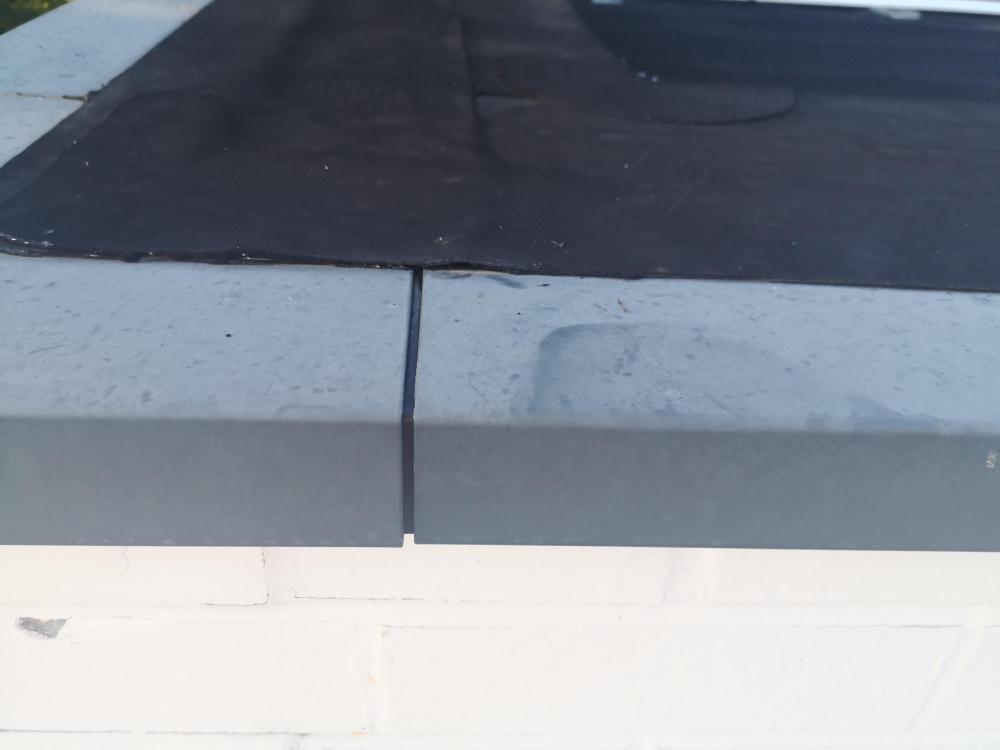
-
I assume you mean 1.1? 0.11 would indeed be impressive for Uw! And on a cloudy summer solstice, it'll be worth little to nothing in terms of solar gain. Also, even highly insulating windows are generally a net negative in terms of heating. Yes, they allow for solar gain (when the sun is out - obviously not always the case in a British winter!), but they leak heat 24/7. In your case, that's at a rate of something like 5-10 times greater than the rest of your insulating elements, and almost certainly more than any solar gain they enable. With large areas of south-facing glass, I'd be way more concerned about overheating in summer. Unless you have external shading, I'll bet dollars to donuts that you're going to cook without active cooling.
-
Where is the kWh price heading in 2022?
jack replied to epsilonGreedy's topic in General Self Build & DIY Discussion
It hasn't happened yet, so it won't happen. Got it. -
Where is the kWh price heading in 2022?
jack replied to epsilonGreedy's topic in General Self Build & DIY Discussion
So would I, but no government (any government, although the batch of Tories we've had for the last few years is particularly bad) is brave enough to be honest with people about what we need to do. I'd add that we're so far down the wrong path that I just don't see way out that involves less than a decade of significant pain. -
Where is the kWh price heading in 2022?
jack replied to epsilonGreedy's topic in General Self Build & DIY Discussion
With what though? Where is the money going to come from in the next handful of years given how deep in the hole we already are with energy, the NHS, etc (etc, etc, etc)? It's the apocryphal story of asking the farmer for directions and being told "Well I wouldn't start from here". Imagine if we'd spent all the HS2 money, and 90% of the track and trace + PPE scandal money on renewables? -
Where is the kWh price heading in 2022?
jack replied to epsilonGreedy's topic in General Self Build & DIY Discussion
[Deleted my response because I'm genuinely not interested] -
VAT reclaim being queried
jack replied to Ksev's topic in Self Build VAT, Community Infrastructure Levy (CIL), S106 & Tax
Not sure I agree with this characterisation of the situation. At best, HMRC's current practice (which is repeatedly rejected in several of the tribunal cases above) is to use entry onto the valuation list as prima facie evidence of completion. However, the notes themselves do not even hint that mere entry is enough. They say: "we'll accept one of the following documents" does not mean "we'll go and look up a database after you rely on the completion certificate". In plain English, it means if the applicant chooses to rely on a different document, the applicant can supply a copy of that document, and the three months runs from then. I take your general point though, and it's not a bad worst-case position to start from. If HMRC is willing to use the VOA date in this way (i.e., without you electing to rely upon it), then there is a real risk the valuation officer is in practice the one controlling the date HMRC will start with when deciding whether you've applied in time. It may be that you'll win on appeal, but there are no guarantees, and even if you win, appeals are highly stressful and time-consuming.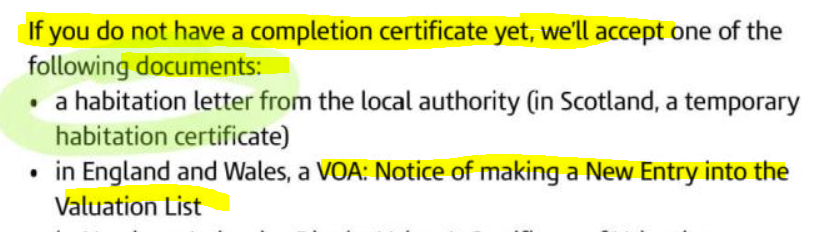
-
New series of Grand Designs 31st August 2022
jack replied to Thorfun's topic in Property TV Programmes
I remember one scene very clearly, where the wife was talking about how lovely it was to sit with a glass of wine and watch the ships go by. I thought (and probably said on here at the time) that they could have done that with a very pleasant four bedroom home that was half the size and a third the cost. It does seem like Grand Designs buildings come up for sale pretty often, sometimes not that long after they're built. -
Where is the kWh price heading in 2022?
jack replied to epsilonGreedy's topic in General Self Build & DIY Discussion
Of course! That said, we had beef stroganoff in the slow cooker last night, and both of my fussy teenagers (one of whom generally hates anything "sloppy" likes stews or casseroles) wolfed it down. -
New series of Grand Designs 31st August 2022
jack replied to Thorfun's topic in Property TV Programmes
Yes. It was highly unpleasant episode (discussed at the time on here, I think). He was diagnosed with a serious illness - I want to say it was a brain tumour. They decided to move away from the rat race and cut their costs so they could work less and live a better life so he could reduce his stress levels. But then they mortgaged themselves to the hilt and beyond to build an insanely oversized and overspecced property that would leave them in massive debt for the rest of their lives. It was difficult viewing. They came across as perhaps living a bit of a fantasy world, maybe as a reaction to the stress of his near-death experience. -
Where is the kWh price heading in 2022?
jack replied to epsilonGreedy's topic in General Self Build & DIY Discussion
We've had one of these for at least a decade and never really used it that much in the past. However, over the last few months my wife has started experimenting with it, and we've had some really tasty meals. Most of the time it's just a matter of dumping all the ingredients in and coming back a few hours later. It's a massive time saver. -
New series of Grand Designs 31st August 2022
jack replied to Thorfun's topic in Property TV Programmes
*high quality, family-friendly content -
New series of Grand Designs 31st August 2022
jack replied to Thorfun's topic in Property TV Programmes
I'm sure there are cases where they've engaged to work with a self-builder, filmed some or all of the build, and then not made an episode because they couldn't build a suitable narrative. Boring people building a nice enough house with no back-story, on time and on budget, doesn't really make for compelling TV. I remember that small house on Skye (I think it was), built by a local builder for two women. Unfortunately, while the house was nice enough, literally nothing went even slightly wrong. Everything was on time and on budget. They tried to manufacture an oo-er moment around the airtightness test ("the experienced builder has never had a house air-tested to such a tight standard before!!!"), but we came back from the break and it breezed through. Really dull TV. -
New series of Grand Designs 31st August 2022
jack replied to Thorfun's topic in Property TV Programmes
Some of the numbers that get bandied around on Grand Designs (both the estimates at the start and the answer to "so how much did it actually cost?" at the end) are insane. There was that one on the Isle of Wight where they budgeted something like £800k for an absolutely massive 6-bedroom house. The estimate included a pool, a ground source heat pump, Swiss (I think) 3G windows, and extensive stone cladding (plus that other odd hand-made cladding that took forever to make and install). They admitted to an actual cost of over £2m. -
Where is the kWh price heading in 2022?
jack replied to epsilonGreedy's topic in General Self Build & DIY Discussion
I don't know what Which actually said, but perhaps they were referring to minimum fill amounts. If you have to put in, say 400 mL to cover the element, then you have to boil a lot of excess water to make single 250 mL cup of tea (as compared with a kettle that will boil 250 mL of water, say). -
Our architect prepared a comprehensive design and access statement to accompany our application (Waverley Borough Council). I don't know what impact it had, but we went straight to allowance, despite replacing a small bungalow with a large two-storey house with flat roof (which I know Waverley hate, because one of the senior planners said as much when I visited them before starting the process). As you say, it focuses the planner's mind on how the various planning requirements are met, plus adds a bit of colour and context. For example, I very much doubt that it hurts if the planner learns you're building a high quality, low-energy, family home as a long term resident, rather than being a developer trying to build something as cheaply as possible.
-
VAT reclaim being queried
jack replied to Ksev's topic in Self Build VAT, Community Infrastructure Levy (CIL), S106 & Tax
Unless the notes have recently changed significantly, this isn't my recollection of what they say. The notes say that something along the lines of the completion certificate being the usual document that will be relied upon, but that the applicant may choose to rely on another document such as a valuation listing confirmation or a letter from their bank confirming that a final stage payment has been made. The three months runs from the date of the chosen document. Basing "completion" on the date of moving in or on which the property is added to the council tax valuation list is a complete distortion of the notes (note: not even the law) accompanying the form, but unfortunately this is what HMRC is doing. This has been repeatedly addressed by tribunals, the majority of which - particularly more recently - have ruled that the moving in or council tax listing date is not relevant to assessing whether the VAT has been reclaimed in a timely fashion. I should add that HMRC often aren't only relying on the valuation date. They're identifying the worst date they can reasonably infer from the facts. So they start with the council tax valuation date, because that's something they can easily and objectively determine from public records. If you can prove significant expenditure on building works after that, then they will likely move the date forward accordingly. I think that's what happened to us - we moved in and paid council tax for several years before getting a completion certificate, but had a couple of significant spends shortly before completion that I suspect dragged us over the line. This whole area is a disgusting mess. The only real way to guarantee that you get your money back is to finish the build promptly, see if you can get the council tax listing delayed until completion, not move in until you get your completion certificate, and then make the claim within 3 months of the completion date. Unfortunately, for a lot of self-builders this is a difficult if not impossible thing to achieve. Unless I've missed a recent case (possible, as I haven't been following it since we got our refund), this has not been tested in court. All of the relevant cases have been at the tribunal level, which means that they don't have the force of precedent. That means that the next tribunal is free to - and sometimes does - make a completely different determination on similar facts. Unless and until someone appeals it to a higher court, this is how things will be. In case anyone's interested, here are some notes I put together when I assumed we'd be arguing this in the tribunal. There may be more recent cases - if anyone knows, please tell me: Tribunal case: [2020] UKFTT 00157 (TC) - John McGarry and Monica McGarry Tribunal case: [2020] TC07553 - Simon & Joanne Cotton v HMRC https://www.accountancydaily.co/diy-expert-builds-winning-case-vat-refund HMRC vs Sansom – Timeline of events The Sansom family moved into the relevant house in 2013 (before work was completed), the final expenditure was incurred in 2016, however for a variety of reasons the certificate of completion was not obtained until June 2018 and the DIY claim was then submitted less than three months later on 1 September 2018. HMRC contended that the claim was made late, arguing that the completion of the building should be assessed by reference to a ‘multi factorial test’ and not just the issue of a completion certificate. https://www.casemine.com/judgement/uk/5e6881d62c94e041f1973047 - Proffit v Revenue & Customs - Latest case? Excellent outcome + refers to internal HMRC guidance about extensions. https://www.constablevat.com/diy-housebuilder-scheme/ - Summary of cases, including case where HMRC won. https://www.icas.com/landing/tax/the-most-expensive-tax-breaks - Another summary. https://www.rossmartin.co.uk/vat/vat-cases/4907-is-a-diy-claim-completion-date-decided-by-reference-to-the-certificate-of-completion https://www.taxationweb.co.uk/forum/vat-diy-rebate-rejected-t33423.html - Shows how the notes accompanying the reclaim form have changed over the years. Used to explicitly say that, in case of any doubt, applicant could safely rely on completion certificate + all building regs met. Because the form asks you what date you moved in on. You'd be game lying to HMRC in writing, given that they have the power to penalise you for making false statements. I saw one tribunal decision where someone had accidentally tried to reclaim VAT on a build where it wasn't appropriate (effectively, they weren't self-builders). It was a simple error on the claimant's part. They answered all the questions perfectly accurately, which was what allowed HMRC to correctly determine that they weren't eligible for a refund. For some reason, instead of just denying the claim, HMRC levied a significant penalty for attempting to falsely reclaim tax. The tribunal was damning in its decision for the applicant, but I'd still rather not have to fight HMRC. Plus as mentioned above, they can generally just look at the valuation date and infer that the house was complete then, without needing to refer to the moving in date. That said, I expect that if you give them a moving in date that's a lot earlier than the valuation date, they'll try to rely on the former to your detriment. -
Where is the kWh price heading in 2022?
jack replied to epsilonGreedy's topic in General Self Build & DIY Discussion
I know it's legal and makes business sense, but what utter cnuts. Where do you get 25p a mile? My absolute worst case in winter is better than 3.5 miles/kWh, and I can charge at 7.5 p/kWh for 4 hours a night at home (like anyone else on Octopus Go). That's a bit over 2 p/mile. I also average more like 5 miles/kWh at this time of the year. Even if I were to always pay the current typical rate of 55 p/kWh at a commercial charger, that still only amounts to about the 15 p/mile you're getting.
.jpg.c21f3ac78c9b7efd90cbdcb312744dc5.thumb.jpg.7adcad4c0e384f5ecd7d56b0618df6e5.jpg)



