.jpg.c21f3ac78c9b7efd90cbdcb312744dc5.jpg)
jack
-
Posts
7352 -
Joined
-
Last visited
-
Days Won
38
Everything posted by jack
-
Wow, 20 is a lot. I have a 4-way powerboard screwed to the underside of my desk, so all that is visible is the single power cord to that. Works really well. In your case, given that the power requirements for the whole desk are likely to be modest, I'd be tempted to install a couple of 10-outlet power boards in a similar way, with some decent cable management trays to keep things tidy. That way you only need two power cords from the desk, and two power outlets on the wall.
-
.jpg.c21f3ac78c9b7efd90cbdcb312744dc5.thumb.jpg.7adcad4c0e384f5ecd7d56b0618df6e5.jpg)
Self-centering internal pipe-cutter - for plastic
jack replied to ToughButterCup's topic in Tools & Equipment
I did exactly that when faced with this problem. Took no more than a minute or two per inlet/outlet. In my case, the vent completely covered the slightly ragged edge that was left. @ToughButterCup, is that door going to clear the outlet/inlet once it's installed? -
You missed a zero - mine's 0.04
-
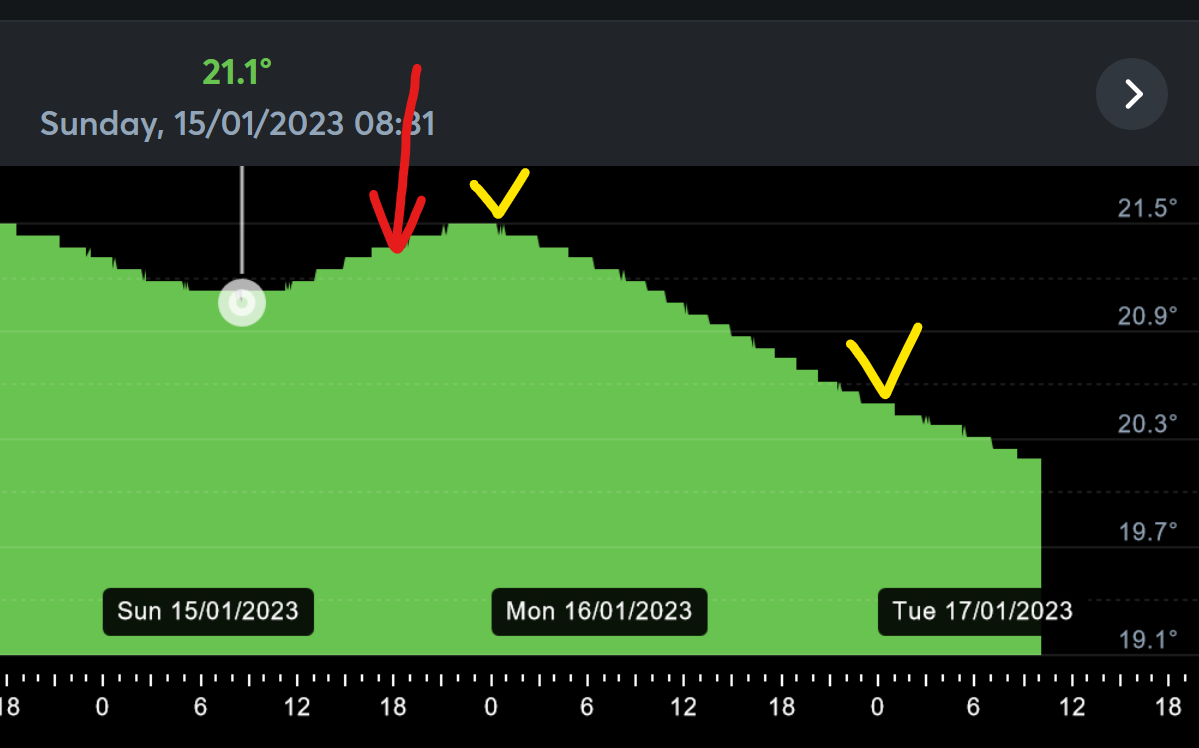
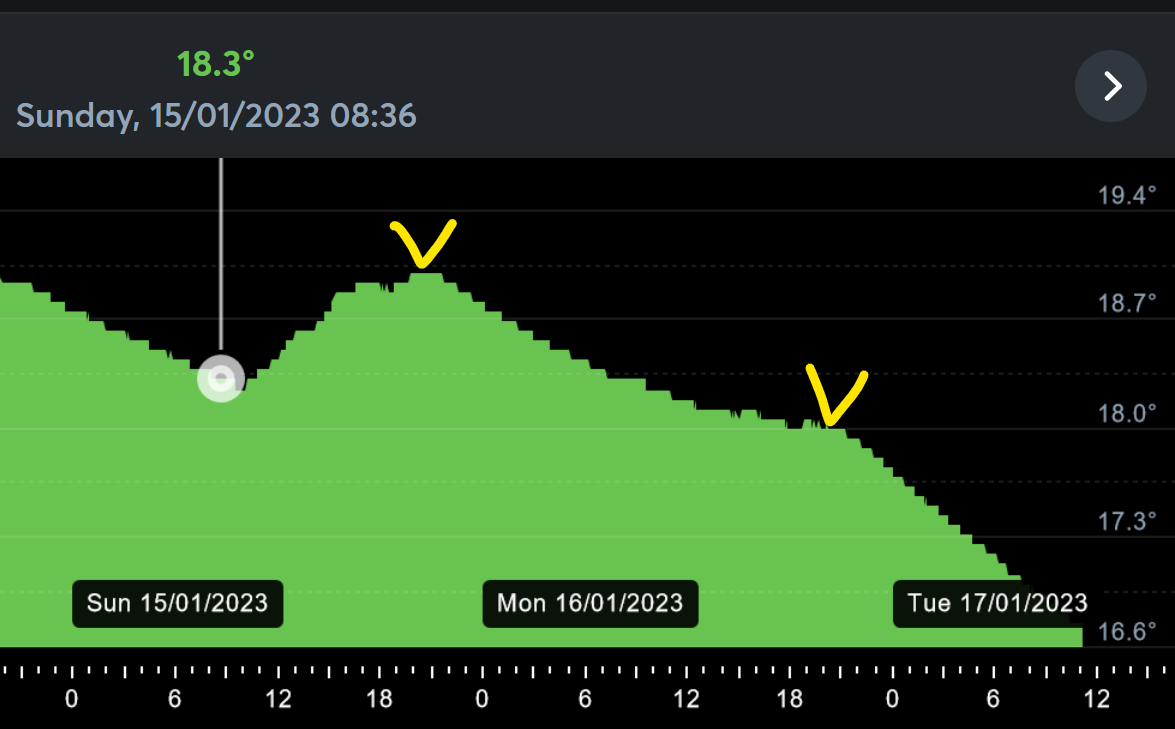
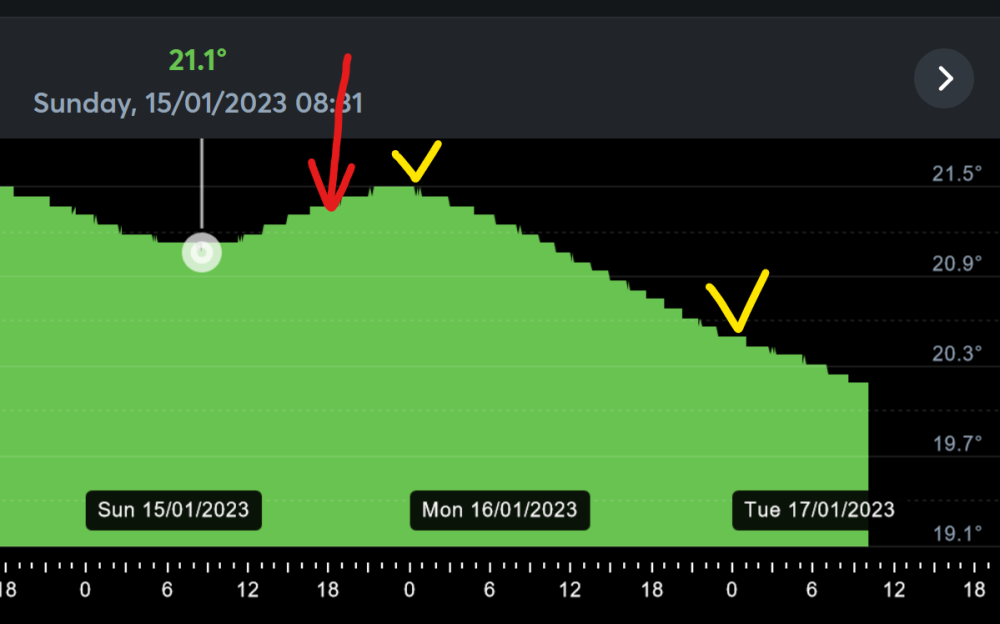
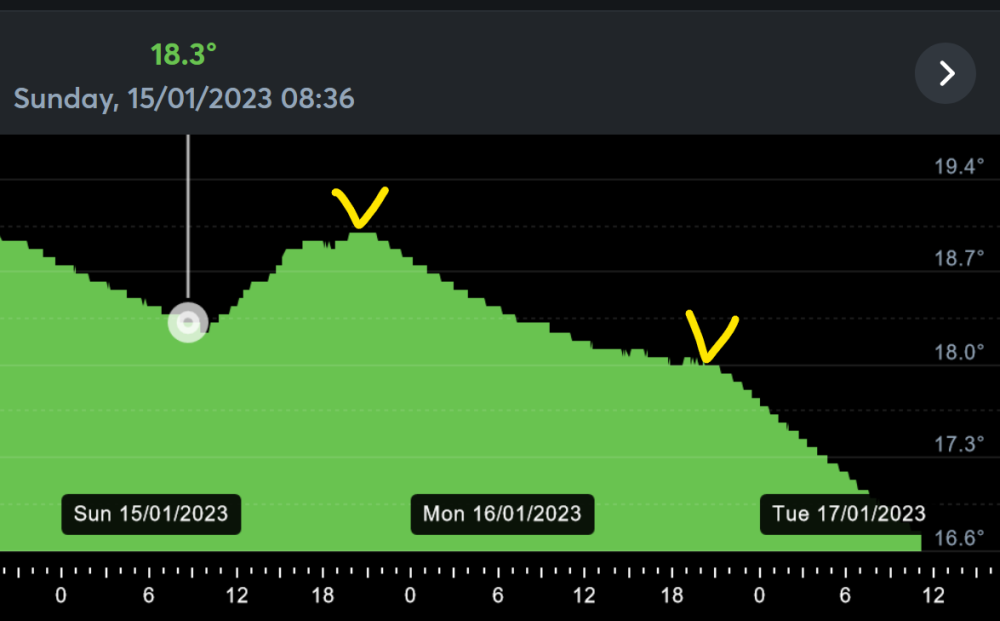
That seems like a lot to me. For comparison, I have a 289 m2 house with PassivHaus levels of insulation and airtightness. We aren't blessed with good solar gain, but we do have a lot of glass, much of which doesn't have any internal coverings like curtains to help keep the heat in. I think we use more energy per m2 compared to others with similar insulation etc. As it happens, I was mucking about with the ASHP settings recently and accidentally turned off the heating for over 24 hours. The heating went off in the early evening on Sunday (red arrow). This is a graph of the temperature on top of the (polished concrete) floor downstairs: The first yellow arrow is the temperature peak, which was about 6 hours after the heating turned off. The second arrow is 24 hours after the peak. The difference is 1°, so about .04° per hour. This is the air temperature upstairs in the landing: Still a 1° difference albeit at lower overall temperatures (no heating upstairs). It's been really cold the last couple of days. The last 24 hours, in particular, have been absolutely freezing (-6 overnight, I believe, and only -3 even now). I turned the heating on for a couple of hours last night and have turned it on again this morning. Because the UFH pipes are buried so deep in the slab, it takes several hours for the heat to appear at the surface - another reason why low, continuous heating makes more sense with such an arrangement.
-
It beggars belief they would spend this amount of money on something that failed planning when it was smaller, based on the expectation that they'd get retrospective planning permission. Either they were badly misled by someone, or they chanced their arm, the council got involved (off their own bat or via a complaint), and now they're going to have to pay. Ditto. It's genuinely unbelievable that even the original version could have been allowed, and they've built something a lot larger. As for tarmaccing literally the entire front and back gardens...
-
Pretty clear from the background digging @AliG did that they knew a lot more than they were letting on.
-
I was very happy with our architect. He was excellent on both the design front and the planning process (we replaced a 90 m2 bungalow with an ultramodern, flat-roofed house of 290 m2 in a very conservative area, and it sailed through planning with his assistance). I don't think he was particularly knowledgeable about PassivHaus principles when we engaged him, but we used MBC Timberframe as a builder, which short-circuited a lot of the potential issues around, e.g., airtightness detailing and cold bridges. I know he's used them a few times since so I guess he's happy with what they offer. He's based in Farnham, Surrey. I don't know what sort of budget he targets now (it's been over 8 years since we engaged him), but his speciality is ultra-modern family homes. Drop me a PM if you'd like his details.
-
If it had been your wall, sure, but it isn't your wall, it's theirs. Unless their deeds require them to maintain a wall on that boundary at their expense, you can't make them repair it if it's damaged. If it does fall down, all you can do is sue them for the cost of any damage (likely minimal if it doesn't hit anything) and clearing the land (not much given they can just pick the bricks up themselves).
-
Just seeing how much disruption and time has been involved in refitting gas mains around my town over the last decade, I don't imagine residential installations will ever happen in the UK.
-
I believe there's a common forward spinning reserve market that operates across several countries in the region, but yes, Danish generators are more likely to be bidding in this market with wind turbines. Low grade "waste" heat from power generation is used in some northern countries to heat water for district heating systems. I don't know how much that improves the overall effective conversion efficiency.
-
I've worked with a turbine manufacturer on and off for a few years and am pretty sure wind turbines are already providing spinning reserve in some Scandinavian countries.
-
How is that any worse than you arguing that using the grid to charge a car doesn't reduce fossil fuel consumption?
-
Gas is inherently a less carbon intensive (CO2/energy out) fuel than petrol/diesel, plus CCGT power plants make their use even more efficient. On top of that, most of the time, a significant proportion of the power provided by the grid comes from wind and solar etc. How does using grid electricity to charge a car mean you not "cutting use of fossil fuel"? Yes, but it will simultaneously reduce the amount of petrol or diesel burned by considerably more than that extra gas, for the reasons above. I feel like I'm missing something in the argument you're making?
-
2 years later and planning is approved - my long battle
jack replied to miike's topic in General Self Build & DIY Discussion
Someone who is required to recuse themselves from any decision involving them? -
2 years later and planning is approved - my long battle
jack replied to miike's topic in General Self Build & DIY Discussion
This makes my blood boil, but well done you for sticking it out. There ought to be an independent complaints body with the power to remove the right of councillors to be on a planning committee if they're shown not to follow the rules. -
Calculating for the use of sand for a thermal store.
jack replied to Marvin's topic in Boffin's Corner
I looked into adding an insulating "skirt" hanging down from the insulation under our slab, and heating underneath that as a sort of thermal store. Far too much excavation required to make it feasible. I did wonder about whether you could calculate the rate of heat movement and bury pipes at a depth sufficient to provide a ~6 month time offset. Add heat during the summer months, and have the heat "pulse" arrive at the slab during winter. Again though, expensive to do, experimental to say the least, probably huge round-trip losses, plus at best all you're doing is stopping/reducing heat loss through the floor. -
Calculating for the use of sand for a thermal store.
jack replied to Marvin's topic in Boffin's Corner
I considered this before we built our house as well. 10 mins of research to conclude there was no way it could make economic sense! -
I'm not sure whether you're interested in DIYing a solution, but it's probably still worth reading through what Jeremy Harris did with his borehole (he had hydrogen sulphide in the water, among other things). He explains a lot of what's going on and the different things he tried to solve various problems. He turned it into a PDF here: There have been other posts about this too - Google (note: may be less effective with other search engines) the following text: "hydrogen sulphide" buildhub
-
Merry Christmas all, and happy building for next year.
-
Welcome Steven, good to have you aboard. It's best to keep questions to a single sub-forum, so I've hidden one of the cross-posts you did on the topic you're asking about and removed it from the introduction above. For others, here's a link to your question:
-
Octopus Cosy - new tariff for ASHP owners
jack replied to George's topic in Air Source Heat Pumps (ASHP)
Not my experience. We run our tank at 50 degrees and there's no issue at all with the mixers, even as the tank draws down and the hot water temperature drops. They're Crosswater Mike, for reference. Actually, we have a cheap mixer set in the downstairs shower and it's fine too. -
I meant think about installing both heat and smoke alarms, specifically in the plant room. I'm not sure whether either is compulsory, but it's a small price to pay for a bit of extra safety.
-
I'd rephrase this as "should not, but definitely don't rely on it". Rather than re-hash a discussion that's been had in detail elsewhere on BuildHub, I'd point people here (I think you may need to have made a certain number of posts to access this sub-forum): It was a large number of claimants over many years. Originally, HMRC said on the claim form that if there was any question over the completion date, the date on the completion certificate could be relied upon. They removed that language from the form perhaps 10 years ago. Over time, they tightened up their approach until the reached the point they were interpreting the word "completion" or "complete" (can't remember which) in the relevant act to mean that any activity that could be mapped to that word started the three month clock. This was despite the claim form itself plainly stating that the clock started when the completion certificate issued, unless the claimant chose to use different evidence of completion. The trigger they most commonly used was being placed on the valuation register, presumably because that's easily verifiable information and is prima facie evidence that the house was complete enough to be habitable. But there's at least one example (it's somewhere on the forum) of them finding a Google streetview image and concluding that the house looked finished several months before the claim was submitted. ^^^ Now we're talking ^^^ I put my claim in 5 years after we were put on the council tax valuation register (which was around the time we moved in). I have absolutely no idea why our claim was allowed without so much as a murmur when others were still being rejected at that time, even for people who'd moved in only a few months before making a claim. One factor appears to be whether there are are receipts for significant amounts dated shortly before the claim is made. HMRC has lost a number of cases at the appeals tribunal over the last few years. Unfortunately, since the tribunal is administrative rather than judicial, every decision stands by itself and cannot be used as precedent for future cases. They should tend towards a consistent outcome over time, but for the time being there's always a risk of a particular tribunal going against you. That happened to one claimant shortly after a couple of the cases that were most damning of HMRC's behaviour. @bob the builder 2, I don't think there's a simple answer to your question, but hopefully the answers so far will help you identify the likely risks.
-
Update on Timeshifting to Minimise Heating Costs.
jack commented on TerryE's blog entry in The House at the Bottom of the Garden
From memory, it happened while they were filming, and you hear it in the background. -
Lg therma v r32 monobloc settings
jack replied to hopefully_toasty's topic in Air Source Heat Pumps (ASHP)
There's no need for a one-to-one correspondence between the falling outside temp and the flow temperature compensation. My flow temperature only increases by about 0.3 degrees per degree of (falling) outside temp change. You need to figure out what the appropriate gradient is for your house, which may need some experimentation. Maybe it's just how you've written this down, but this table isn't right. When it's -4 outside, you want 45 degree flow temp, and when it's 16 outside, you want 25 degree flow temp (ignoring, for the moment, my comment above about there not being a need for a one-to-one correspondence between the falling outside temps and the rising flow temps).