Mike
-
Posts
1565 -
Joined
-
Last visited
-
Days Won
9
Everything posted by Mike
-
The same as buying a washing machine with all those menu options, when you normally only use 2.
-
It may sound strange, but house manuals are (since January 2023) mandatory in France. You're not expected to write all the text (unless you've rolled your own controls), but as a minimum it has to contain (my abbreviated translation): Floor plans and cross-sections A list of all thermal insulation & airtightness materials used in the external envelope, their locations and their properties - material, brand, thickness, thermal resistance Plans, schemas and descriptions for all services - water, electricity, gas, heating, cooling, ventilation A list of the equipment installed that uses energy - brand, model, serial number, power, energy use, energy performance certificate Instructions on the functioning, maintenance & servicing of the above Serving & maintenance records for the above Other documents related to the thermal & environmental performance of the building, such as design documents & certifications, energy audits, energy performance certificates On completion the architect / builder is required to hand it over to the owner (on paper or digitally), who is then responsible for keeping it updated. When the property is sold, it must then be handed over at (or before) contract completion. It then has to be maintained by subsequent owners for the life of the building. For existing buildings, if there isn't already a file then it has to be started when any works are done that significantly affect the thermal performance of the building - insulation, new heating / cooling system, new windows, extensions, etc., including logging what work was done and when. Which means that I have one to prepare.
-
I'd just choose one or the other. Most likely the green felt as, being heavier, it will resist the wind more, though it would still need battening down.
-
No, it's not likely to be worth it. Just make sure that it's well ventilated with air bricks at regular intervals on two opposite walls. And preferably make the floor airtight and insulate it - there are plenty of threads on here about doing that
-
OK as a temporary covering for a few weeks / months, if well nailed down to resist the wind. Chances are that it will disintegrate with UV light over a long period.
-
They are a cheaper solution than MVHR but they do have some downsides: In winter, it's pumping cold outside air into the house They drive warm moist air to the outside through gaps in the fabric of the building, where it can cause condensation & mould You miss out on the other benefits of MVHR - air filtration, heat recovery, multi-speed control, sound attenuation, summer bypass, etc. There really aren't any circumstances in the UK climate where I'd recommend them these days. dMVHR would be the preferable, if full MVHR has to be ruled out.
-
Planning Approved - Feedback on proposed layout
Mike replied to Owain1602's topic in New House & Self Build Design
Good idea. -
Planning Approved - Feedback on proposed layout
Mike replied to Owain1602's topic in New House & Self Build Design
At the last trade show I went to they were plenty of window-cleaning robots being demoed - would be ideal for the main window. -
If it's stable, I'd be happy with it as it is. In fact, I'd dig some bigger gaps so that hedgehogs can get through (if they've not already been walled off by your neighbours).
-
A really interesting project! Good luck with the start; will look out for updates in due course
-
Planning Approved - Feedback on proposed layout
Mike replied to Owain1602's topic in New House & Self Build Design
Overall, it looks a big improvement on the initial design. A few initial points: The downstairs WC window needs repositioning from the living room I'd prefer wider downstairs corridors. Maybe make the entrance hall a little narrower (it can take it), so that the boot room & plant room can be longer, while cutting their depths from 2000 to the 1750-ish. I'd also prefer a wider upstairs corridor, but less so than downstairs. A door into the Bedroom 1 en-suite would be handy Organise the main bathroom layout before deciding on the door position - it may work better against one of the walls. Add a brise soleil to the south-facing windows, especially the big one. It could, provided that's a robust wall, but if the floor depth allows the ventilation ducts to pass from the outside then it would be good to move it to the plant room. It could be moved elsewhere but I like the central core concept. -
Yes, for noise + pollution this would be ideal. It would give you a single air intake & exhaust for the whole house away from the traffic noise plus the option of a sound attenuators ('silencers') and can filter the incoming air very effectively. There are plenty of threads about it on here and, as you're planning a renovation, now would be the perfect time to be installing it.
-
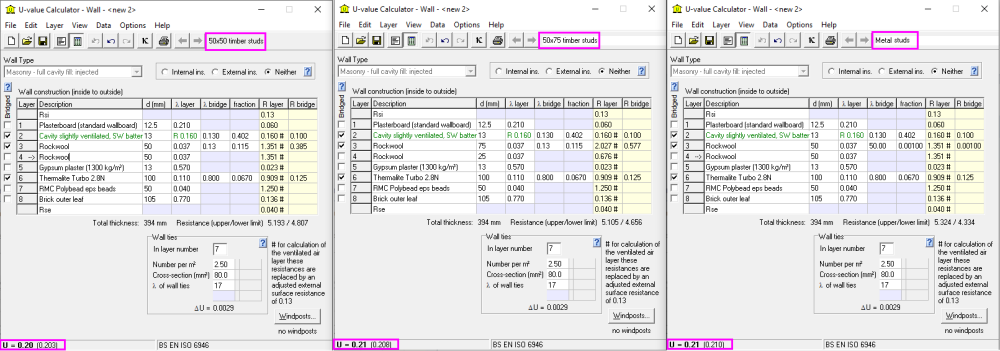
I guess they're making some different assumptions - or maybe not taking into room height, sole plates and the like - difficult to know. Anyway here's the same (excepting some small difference in material densities and the like) based on my assumptions above and using the BRE U-value calculator. As you can see, there's very little difference between them:
-
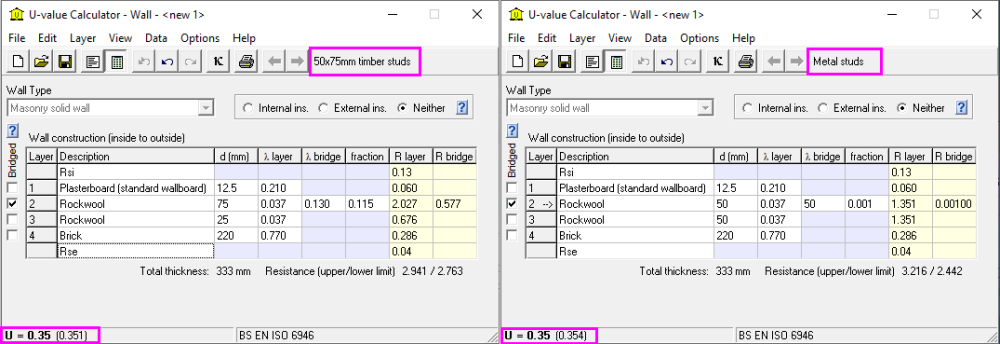
True, but only by a very small amount For example, with a room 2.4m high, vertical studs at an average of 400mm centres, plus sole and head plates and (for the timber only) one central noggin, then - for timber we have 5.5 linear metres of timber / 2.4m high x 50mm thick = 0.115m² timber / m² wall (a 11.5% timber thermal bridge) - for steel we have 4.5 linear metres of steel / 2.4m high x 0.5mm thick = 0.001m² steel / m2 wall (a 0.1% steel thermal bridge) Sticking those figures into my u-Value calculator for IWI on a solid wall, assuming 100mm Rockwool and that those timbers are 50x75mm, we get (timber on the left with λ 0.130 W/mK, steel on the right with λ 50 W/mK ) i.e. the difference in U-values is in favour of timber, but only in the 3rd decimal place. You could improve on that by using 38 x 75 timber studs, but the difference is still small (U-value 0.338). BTW, I wouldn't advise putting metal studs anywhere close to the face of the wall due to the higher condensation risk, whereas with timber you could, if you're short of space. The much bigger thermal bridge will be any internal walls that join the external wall. Ideally you'd insulate them for the first metre to reduce that, though that isn't always practicable or visually attractive.
-
Which internal doors have to be fire doors? if any
Mike replied to Post and beam's topic in Doors & Door Frames
Hi, and welcome to the forum :) Not sure why that's required for a regular UK domestic house? Unless I've missed something... For a domestic house, my interpretation is that the Building Regs are concerned about ensuring (relatively) safe egress from the building to the ground in the case of fire. Hence they call for either an emergency escape window (i.e you could drop to the ground without a major risk to your life) or a protected stairway (in other cases). Admittedly there would be a somewhat elevated risk of fire spread / ferocity due to the greater stack effect caused by the greater overall building height compared to a regular house. But that would also be the case in a house that had a double-height upper floor, which the Regs don't take into account - they only talk about the distance from ground level. -
Apart from the factors mentioned above: I'd run the pipes under the kitchen & utility units too. Then, if someone changes the layout at a future date they won't have cool patches on the floor (I've seen it happen). I wouldn't run the pipes directly under the WC. It will need screwing to the floor and you don't want to drill through a pipe!
-
Yes it's Android only. BTW, there's a choice of 2 different Android apps - 'Thermal Master' (the default), and 'Temp Master' by Raysen Microsystem Technology (similar logo, same company, different trading name, AIUI). I'm using the latter as it requires fewer permissions - just camera, photo, video).
-
The research evidence on security alarms
Mike replied to Adsibob's topic in Networks, AV, Security & Automation
Yes, that's the way it works. The same for window locks too. I had an alarm and windows lock on my last place but chose to say I had neither on my insurance application. I missed out on a small discount, but had the reassurance that I'd still be covered if I forgot to set the alarm / lock every window. -
Sounds OK to me :)
-
The risk is low for me but I'm fitting a Legrand 003951 in my consumer unit, to help protect my domestic electrical devices, rather than an ASHP. Not something that I'd have thought of in the UK, but they're much more common here in France - and mandatory in large parts of the country if you have an overhead supply.
-
Implication of not using MVHR
Mike replied to Indy's topic in Mechanical Ventilation with Heat Recovery (MVHR)
Not to mention 7. Avoiding the need for extractor fans 8. Eliminating the risk of condensation & mould 9. Improved indoor air quality due to removal of indoor pollutants - CO2, VOCs... That's really not very ambitions. Using the advice elsewhere on this site you should be able to get much lower than that. That doesn't sound too unreasonable for the parts; they do good quality kit. If you're practical and have the time, then it's not that difficult to fit it yourself. But even a cheap unit is better than none (and could be upgraded in the future). What's the payback on your kitchen units / bathroom suite / floor coverings? -
Not an issue. It's airtightness to the outside that is important to avoid. That timber frame is going to be rather spindly. You'd do better to use metal studs. See my comments in this interesting (but meandering) thread:
-
Yes, it's for future rewiring and to protect the cable from the plasterer, though the latter shouldn't be an issue in your case! 99% sure that it's not required by the Wiring Regs, but I'm not an electrician.
-
As per @Russell griffiths, nailing is with clout-head nails either side is by far the easiest. Personally I've never found it necessary to prime with PVA, but certainly squirt water to damp the chase well before filling. First, however, loose those gaps in the conduit to make it continuous and tight up against the back-boxes (there's no point in having a conduit that's blocked in 3 places). That could be replacing it, or just add another section, taping the sections together with insulation tape to make it continuous.
-
A good solution, but France isn't quite as DIY-friendly as the UK, so be aware of the French legal peculiarities of the garantie décennale and your liability for vice cahé (latent defects).