


Owain1602
-
Posts
44 -
Joined
-
Last visited
Owain1602's Achievements

Member (3/5)
9
Reputation
-
Not sure what you mean @Selfbuildsarah. What does “fine silicone finish” mean? It depends on the intended detail around the cladding/render and windows as to how this is finished. We also have Norrsken windows and doors, but decided against them doing the “final” silicone. I did an additional level of sealing around all windows and doors, on top of the basic sealing that Norrsken do during install. Used both sealant and tape. There is no visible sealant applied between the external reveals and windows.
-
Fire Safety Regs - Timber Cladding
Owain1602 replied to john0wingnut's topic in Building Regulations
Does that mean you aren’t ventilating the cavity above the window, nor allowing moisture that sits above the windows to make its way out? -
Fire Safety Regs - Timber Cladding
Owain1602 replied to john0wingnut's topic in Building Regulations
Not sure if there’s anything out of shot that we can’t see, but I’d say there’s no point putting intumescent strip above that window. Just use treated timber that’s 38mm or deeper to close it off, don’t think there’s anything worth ventilating there. -
Fire Safety Regs - Timber Cladding
Owain1602 replied to john0wingnut's topic in Building Regulations
I feel at the eaves is a sensible approach, but it does depend on the rest of the construction. What are you going to do at the heads of the windows? In my mind, the only real risk of fire getting behind the external cladding is from an internal fire escaping through an open window (hence why they like to see them at the heads of windows, for a ventilated cavity). Your external walls presumably have a 30 min fire rating on the inside? -
Fire Safety Regs - Timber Cladding
Owain1602 replied to john0wingnut's topic in Building Regulations
Apologies @Alan Ambrose, you are right, it is 0.5mm steel. We don’t have anything on the bottom of the cavity. I’m not sure what situation would be helped by a closure at the bottom, since the strips need fire to activate them. Nothing was needed at the wall to roof junction at the gables since this was completely sealed with timber, as the roof is ventilated from eaves to ridge. The comment from your BCO is similar to what I was referring to by being able to argue your case for not needing them in certain scenarios. -
Fire Safety Regs - Timber Cladding
Owain1602 replied to john0wingnut's topic in Building Regulations
The regs say 0.8mm steel (or thicker) and 38mm wide timber (or thicker). I agree, this can be quite a confusing topic. Whatever you do, don’t try and read the STA documents seeking clarity….it will confuse you even more! The cavity barrier element of the regs doesn’t have anything to do with the fire rating of your cladding, that’s a separate topic. They want to see how you will stop a fire from using the external cavity behind the cladding as a means of bypassing the internal fire resisting elements. There are numerous arguments and nuances that can be put forward such that the guidance as read do not apply in certain sections. Obviously, a lot of this came out after Grenfell. My understanding is that the fire service couldn’t understand at the time how fire was spreading throughout the building, especially from floor to floor so quickly. They couldn’t see the fact that fire was spreading inside the cavity behind the cladding. We had two different external claddings, one for the ground and another for the first floor, both had ventilated cavities. I specified a steel drip flashing between the two (which ended up 3mm thick). The ground floor cavity ventilates at the underside of the drip, and the start of the first floor cavity is above the drip. In the event of a fire, we wouldn’t fully close off either cavity, just that fire in the ground floor cavity would come up against a 3mm steel plate. It would have to come out of the ground floor cavity at the drip, come out 100mm to get around the drip then turn back on itself to get back to the first floor cavity. That is the detail around a lot of the house. at the heads of windows we have intumescent strips, side and bottom of windows is fully closed with 38mm or bigger timber. I had agreement from the BCO that the detail and argument I put forward for the eaves to roof was okay. But as I was doing the cladding, I had to change something to better attach the gutter. Rather than go through the whole approval loop again, I just ran intumescent strips around the whole of the eaves (not at the gables). Value my time and sanity more than about £500’s worth of strips. If you can post a bit more detail, I’m sure that we can come up with more specific suggestions. -
Batteries in plant room and 120 minute fire rated walls
Owain1602 replied to jimseng's topic in Energy Storage
Depends what you mean by “batteries like it hot”. The charge transfer processes can happen quicker at higher temperatures, so if your aim is to charge/discharge the battery at higher rates, then higher temperatures help with this. But high temperatures is the worst factor for increasing degradation rates for batteries. If the battery is LFP, then you have an already high baseline for the battery’s cycle life. -
Insect mesh and air gap for timber cladding?
Owain1602 replied to Great_scot_selfbuild's topic in General Joinery
I’m not sure if your picture is up to date, and reflects the words, but I can’t see double thickness battens around the windows for fire stopping? You need infill battens between your horizontal ones to act as a cavity barrier. Except for the obvious ventilation requirements, the thing that was always in the back of my mind when doing the detail for ours was any water running down the cavity above a window. I didn’t want a surface where this water would sit on, and potentially start migrating back towards the head of the window (or sit on a batten constantly). Might have been overly cautious, but I’d rather that than the other way around. The water could be condensation, wind driven rain etc. Cladding suppliers I have used previously typically want at least 10mm gap at the top and bottom of the cavity. -
@jimseng Are you dealing with BT or OpenReach? I’ve had a great experience dealing with OpenReach so far, for a new fibre connection in a rural area. Virgin quoted £100k, as their closest network was 16 miles away. OpenReach quoted £3k. Our area is not on any of the official development maps, so no plan to roll out fibre to the area within the next 5 years. I put in an application for a new connection, expecting it to be ridiculous. Luckily, the water pumping station that’s half a mile away has a massive fibre connection, which OpenReach can tap in to for our house. I need to trench and install junction boxes every 60m down our 250m driveway, but they are supplying all the ducting and boxes within the £3k.
-
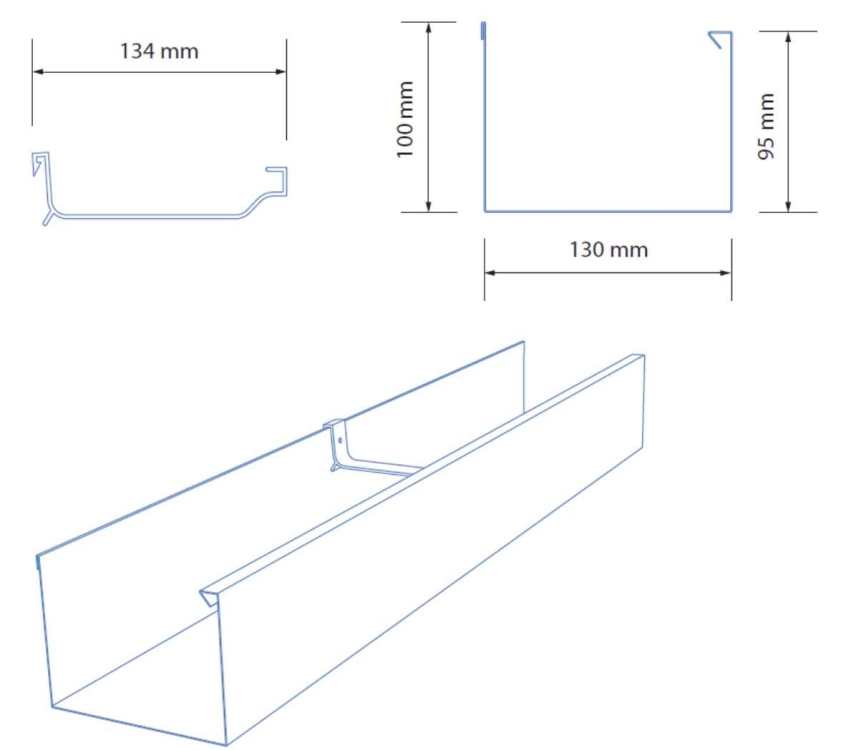
FYI, this is the gutter that Tata supply with their Catnic roof. I can’t make out from your drawing what is cladding, cavity etc. But my understanding is that they want to fix the gutter to the outside face of the cladding (or equivalent timber). I was told by our steel roof installers to bring the top deck of OSB3 out to the same projection as the external face of the cladding. They then make the overhang and drip edge with their metal eaves trim, and the gutter is fixed through the outside face of the cladding to the timber.
-
Cavity closure timber frame
Owain1602 replied to Selfbuildsarah's topic in New House & Self Build Design
You will need to provide ventilation behind both cladding types, MBC insist on it. I worked through all the details for our MBC house a couple of months ago, and put a case together for both building control and structural warranty inspectors to agree. It’s quite tricky if you want to provide proper ventilation, guard against insects, allow the cavity to drain any moisture that gets in there, conform to BR cavity barrier requirements and of course….look nice. Most examples I see just close off the heads of the window reveals, and moisture then just sit against the building. Do you have any section drawings to share what you have so far? -
Have you chosen the supplier for the metal roof yet? There will typically be an eaves trim that gets fixed to the edge of the top deck, with a downturn that sits in the gutter. The metal roof sheets are then swaged to this trim to lock it all together.
-
You are right @Gus Potter, that Protek on the Structural Warranty outsource the inspections and responsibility to another smaller firm. But the smaller company are controlled massively by Protek, and ultimately, it’s Protek that decide if they are happy with the evidence submitted to Surveyor Link. I had one instance where the smaller surveyor company weren’t sure what to do regarding a retrospective watching brief on excavations. They gave me the details and asked me to call the main man at Protek. Explained the situation to him, and he was happy. He told the smaller firm to accept my explanation, and we moved on. Coming back to the original question regarding build insurance, do you also have liability in the policy? As I say, we went around the houses with numerous other companies. Protek were the simplest to deal with (although quotes for rebuild costs over £1M took a long time!). We went with a price very similar to yours for 15 months cover. FYI, Protek are not the insurer, it’s a company called QBE
-
We had/have the same situation. Anything over £1M goes down a different pathway in these companies, and gets a more bespoke assessment. I found that the costs go up disproportionately for anything over £1M. Went with Protek in the end, after looking at others. @Gus Potter You seem to be discussing warranty, whereas the question is related to insurance.
-
We have just gone through this. As @ETC says, easiest thing in most cases is to put in a Radon membrane (Visqueen R400) and sometimes a sump (Damplas one was £50). Insulated raft foundation engineers included full Radon protection in their foundation drawings (as we’re in a high area). Building inspector and structural warranty inspector was all over the details like a rash. Wanted images to show the sump had been installed, gas tight joints on all pipework to the sump. Spent a while inspecting the R400 membrane joints, laps, and in particular the penetrations. We had top hats on most (which must also need a Jubilee clip to secure), but some more complex ones needed a specific Visqueen detailing strip, which is a sticky butyl backing with a thin layer of Aluminium. They also insisted the Radon membrane projects at least 1m out from the walls of the house (under ground obviously). Not much more hassle than using a DPM if done at the right time.


