Mike
-
Posts
1565 -
Joined
-
Last visited
-
Days Won
9
Everything posted by Mike
-
Having slept in a bedroom with a bath and over-bath shower against the wall (by coincidence in that split-level house), it was a problem for me.
-
It's true that it can impede mobility on the ground floor but, having lived in a split-level house, it was an interesting & worthwhile feature.
-
Overall it looks fairly well thought out. A few of minor points: Ditch the sliding doors off the Master Bedroom for something quieter. The wardrobe space in Bedroom 4 is not very generous. Ensure that the partition between Bedroom 4 and the adjacent bathroom sound-proofed Ensure that the partition between Bedroom 3 and the adjacent en-suite is sound-proofed Where will the SVP serving that en-suite run downstairs? For safety, move the hob away from the corner of the kitchen island Do you really need 3 sink bowls in the kitchen (and 2 more in the utility)?
-
Komfovent Domekt R400V MVHR
Mike replied to Street654's topic in Mechanical Ventilation with Heat Recovery (MVHR)
+1. If the Frankische unit is in good working order, then there is nothing to be gained by replacing it. Just build a well insulated enclosure around it - something that should have been done when it was installed and something that your 'specialist' should know. And something that a replacement unit should have too. Several Frankische units have PassivHaus certificates confirming their suitability in cool temperate climates. The larger version of the Komfovent has a similar certificate (and similar-ish performance - compare the Efficiency Ratios), so there's no particular reason to choose one over the other on those grounds. The common reason for choosing an MVHR unit with a rotary heat exchanger (such as the Komfovent) is that they can - if the right materials are used - recover moisture from the outgoing air and transfer it to the incoming air, preventing the air within the building from becoming too dry (which can be an issue in cold climates where the air already has low relative humidity). Komfovent suggest that their units can do that (they "regenerate[s] humidity in winter"), however the PassivHaus certificate for their larger unit makes no mention of this - which suggest that they didn't get that aspect tested & raises a doubt about how effectively it can do it. It also introduces another mechanical moving part which can go wrong. Perhaps, due to their large commercial range of rotary MVHR units, it was just easy for them to scale down their existing rotary technology for their domestic products? BTW, if the Frankische needs replacing for other reasons, then that PassivHaus database is a good place to look for quality alternatives. -
Zehnder aren't cheap, but that looks like list price. It should be possible to knock at least 30% off that. The supplier I used (in Germany but delivery to France, not sure if they'll deliver to the UK post-Brexit) are currently offering the main body at a 43% discount (€205 including VAT). You also only need one unit to silence 10 terminals.
-
Very useful results. So it is the lower end of the frequency range causing the problem. If I were choosing only between the 2 Zehnder options, I'd choose the silenced manifold. BTW, results would normally measured at 1m distance from the source of the noise (ceiling terminal in your case), so the chances are that the 14dB reduction provided by the silenced manifold at 250Hz would be enough, even if your chart suggests that you have 42.5dB of 250Hz noise a few mm away from the Bedroom 2 terminal. You could measure again at 1m to give help decide. No - that is for the manifold only. It helps to know that the manifold is modular - that is you can fit different 'end plates' to it depending on what you want to connect. The results in the table above are measured for the following: a connector plate for 1 x DN160 or 180 or 200 duct on one end (the first part in yellow) a connector plate with 10 x 75 or 90mm semi-rigid duct connectors on the other (the second part in yellow) the CW-S520 is the main body of the manifold (not in yellow). Note that there is a regular manifold body too, without the sound attenuation - the 'S' indicates that it's a silencer version. You would want a connector plate for a 150mm duct (Zehnder 990323568, by the look of it), which isn't one of the ones they used in the test, but the size is so similar to the ones that they did use that performance would undoubtedly be similar / identical.
-
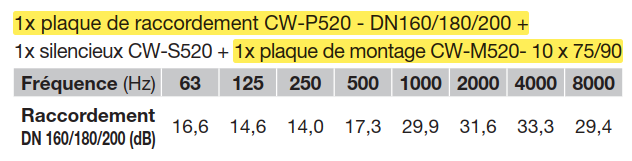
BTW, to illustrate why it's useful, compare the frequency attenuation of the Zehnder CSI (above) with this one for the Zehnder silenced manifold that I mentioned on the previous page: The silenced manifold beats the dedicated silencer at frequencies of 63, 125, 4000 & 8000 Hz.
-
There are for Android, so I'm sure there must be iPhone versions :)
-
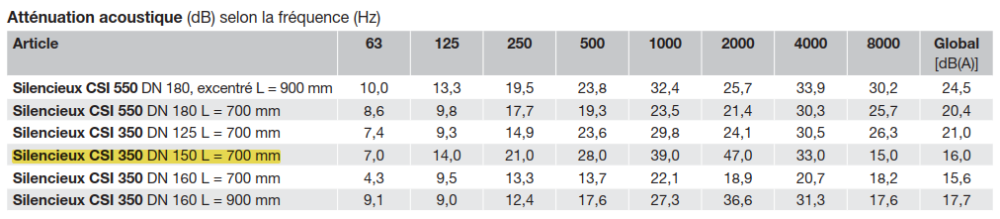
Since silencers attenuate the sound differently at different frequencies it would be worth sampling the noise with an audio spectrum analyser, so that you can compare that with the spec of silencers you consider. I only looked at attenuators that used foam to avoid the risk of blowing mineral / glass fibre through the ducting. I think the only one available in the UK is the Zehnder CSI, which comes in 700mm long for 150 diameter (Brink, Westaflex and Vasco were also on the shortlist):
-
MVHR ducting to outside
Mike replied to Moira Niedzwiecka's topic in Mechanical Ventilation with Heat Recovery (MVHR)
Yes, unless have a special terminal such as the Zhender. -
You still need an expansion strip around the walls + movement joints in doorways. I'd probably do the same, using clip rails to fix to pipes.
-
Another possibility is a quiet PC fan, though you'd need to provide it with a housing and a low voltage power supply. For example https://quietpc.co.uk/casefans
-
Air has a low specific heat capacity, so to warm the lounge to any great extent you'll need a fan that can move plenty of air - either a large one, or one that runs quickly - so my guess is that you'll have trouble finding one that's very quiet. As an alternative, and since the rooms area adjacent, maybe you could install a doorway between them and leave it open? Shouldn't be too difficult as it's a stud wall.
-
Covenants in plot sale contract
Mike replied to AshleyFae's topic in Party Wall & Property Legal Issues
Ofwat has something to say about that : Anybody who resells water or sewerage services must charge no more than the amount they are charged by the water company. They are also allowed to charge a reasonable administration charge. The administration charge is set to cover administration costs and the maintenance of meters. It can only be charged if it is not recovered by any other arrangement, such as through the rent or mobile home pitch fee. Resellers can recover around £5 each year for those without a meter and £10 for those with a meter. The administration charge applies to each purchaser and not to each occupant... ...If your reseller charges you more than the maximum resale price, you can refuse to pay the extra amount. You can take legal action against them in the civil courts to recover any overpayment. You can also recover interest on that amount. https://www.ofwat.gov.uk/households/your-water-bill/waterresale/ -
Because it's cheaper to centralize the attenuators, rather than installing them per-room. And noise generated within the duct would normally be due to excess air velocity, which shouldn't happen - but you seem to have found an exception :)
-
Ubbink- Blauberg compatibility ?
Mike replied to Post and beam's topic in Mechanical Ventilation with Heat Recovery (MVHR)
No, but I've looked it up. Generic 'own brand' green anti-static / anti-bacterial duct + Wolf sealing rings + Zehnder plenums (and everything else). -
Ubbink- Blauberg compatibility ?
Mike replied to Post and beam's topic in Mechanical Ventilation with Heat Recovery (MVHR)
Yes, that seems to be mostly the case, though it seems that there is a few mm difference in internal diameter between some. The only warning I've seen against mixing them is that the external corrugations are also a little different on some brands, so it's worth buying the sealing rings to match the duct. I didn't come across that until after I'd installed mine, which mixes them (fortunately without a apparent problem). -
It's a huge problem of staggering proportions. But it doesn't mean stripping the insulation off 98% of the affected houses, as some of the headlines implied.
-
It could be It's probably the cheapest intervention with the biggest payback that you could make. It's not difficult either, though it does require time and lots of attention to detail. There are various threads on here that give pointers.
-
An ideal time to install regular MVHR instead...
-
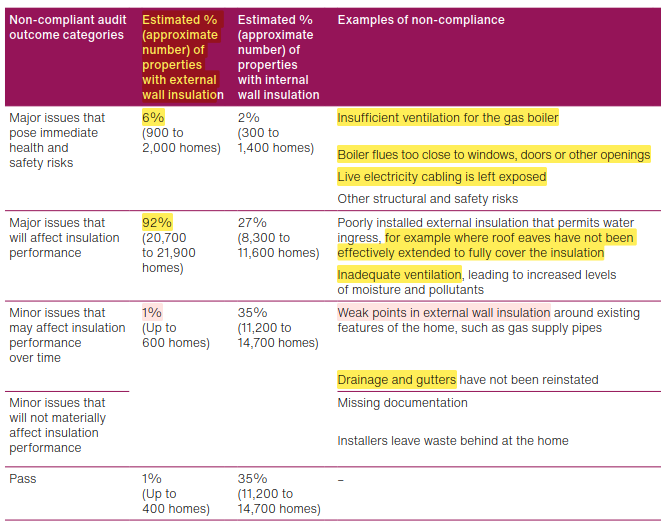
It is a shocking figure, but from the extremely limited examples given in the actual report, there may(?) only be a 1% problem with the actual insulation - everything else(?) being due to a failure to consider what else needs doing, including some items that were pre-existing. But it should have been be obvious to any competent contractor that these items needed fixing! Extract from Figure 6 below; full report at https://www.nao.org.uk/reports/energy-efficiency-installations-under-the-energy-company-obligation/
-
Your measurements are certainly far from ideal. You mention the existing air extraction methods, but I'm wondering how air is currently drawn into the building and, in particular, whether those triple glazed windows include trickle vents that are actively used. If not, that would be cheaper than installing MVHR and may bring down CO2 levels enough, though they do have drawbacks. There have been a couple of discussions about retrofitting MVHR here - it's mentioned in some posts with @Garald as a future project, but not sure if anyone has done it. It's possible but disruptive, so easier to do during a renovation, as I have. It would certainly be an effective way of bringing the CO2 levels down. Air has a low heat capacity so isn't great for moving heat around, so it's not going to help that much at normal MVHR speeds. It can help to bring in cooler summer night air if the MVHR unit has a decent bypass fitted but, if you live somewhere when you can open the windows, that's a cheaper option. There are remedial measures that can be taken to tackle Radon and I'd recommend looking into those: https://www.ukhsa-protectionservices.org.uk/radon/information/reducelevels
-
For me that makes a big difference. From your first images it was believable that this may have been a single storey building that had had a second floor added. From an angle that illusion is blown - it now looks like a house with two types of decorative cladding on the front. To regain some visual cohesion I'd probably forget the wood and render the upper portion to match the side, though it's not an ideal solution.
-
No problem - if the intake and exhaust are on the same elevation then both will experience similar wind pressure and remain balanced.
-
The wood, especially after it has toned down to a light grey.