


Mike
-
Posts
1565 -
Joined
-
Last visited
-
Days Won
9
Everything posted by Mike
-
Construction hours condition.
Mike replied to flanagaj's topic in General Self Build & DIY Discussion
Yes, something similar, but here in France it applies* to everyone undertaking 'noisy work', not just construction and not just on a particular site. And, being France, of course everything stops for lunch *subject to local implementation & variation. The national guidelines are 09:00 to 12:00 & 13:30 to 19:30 weekdays, 09:00 to 12:00 & 15:00 to 19:00 Saturdays, 10:00 to 12:00 Sundays & public holidays. -
Top advice when there's a cavity - but the brickwork under the window (and the original post) indicate that there isn't one to worry about in this case.
-
Downstairs Floor Plan - First Draft
Mike replied to Cheesus's topic in New House & Self Build Design
In addition to the above comments: The kitchen is out of proportion to the dining / living room (unless you're running an online cooking channel) Ditch the chimney, unless it's purely decorative. -
It could be done, but it would need care & extra cash to preserve the existing visual appearance - don't do anything that will harm that as it would undoubtedly cut the property value. So, use brick slips to retain the look of the bricks, and mimic the timbers on the gable. The small upstairs window will the the most difficult. I'd move it forward together with the dental courses above (to maintain the visual appearance and due to the angle at which it meets the wall) and would want the insulation below it sculpting into curves to look similar to the existing. The other windows would be OK as they are. I'd temporarily remove the porch, which would then need some adaption to reinstate it - or bring the whole thing forwards by the thickness of the insulation. If all that's too much, then just leave the front and insulate the other walls, where the energy savings will be greater as they presumably have more actual wall to insulate. I rather suspect that would be my solution. BTW, worth having a chat to your neighbour to see if they're interested in doing theirs at the same time, to keep it as a matching pair.
-
Not a direct answer, but I'd avoid pocket doors. They tend to be harder to clean & maintain, make more noise than regular doors, don't seal as closely to the frame, and it's quasi-impossible to fix things to the partition that conceals them as there's no space for fixings / cables / pipes (unless the partition is thick). I'd only use them for a door that rarely had to be closed, using premium kit.
-
Internal wall insulation upgrade during refurbishment (Part L)
Mike replied to Mos's topic in Heat Insulation
I agree that insulating the party wall isn't required. However, when insulating an external wall it is good practice to run the insulation for around 1m along any interesting walls if it's practical to so so, as that significantly cuts the heat loss at the junction, for minimal extra cost. For example, on a party wall, that often means running the insulation back to a chimney breast. -
Poured insulation! Am I missing a trick here?
Mike replied to Nickfromwales's topic in Heat Insulation
Similar products are common here in France. Point.P, one of the French builders merchants, stocks a dozen or so with polystyrene or expanded clay - however they mainly seem to be used for their light weight than for insulation. For insulation, it's much more likely that they'd use sprayed PU foam, as I did. It's much quicker and easier than cutting sheets, especially when nothing is flat or rectangular. Example: -
One option might be to replace it with the Zehnder Comfowell CW-S 520, which has inbuilt acoustic attenuators (and can also take 10 x 75mm ducts).
-
Can you make mortar with a paddle mixer
Mike replied to Tennentslager's topic in Bricklaying, Blockwork & Mortar
Yes, if you're not mixing too much at a time. -
Fine tuning my IWI Solid wall (Warm Batten) design
Mike replied to Annker's topic in Heat Insulation
I would add an airtight barrier across the full ceiling on the the warm side of the insulation in the position of that red line, probably using Intello (which is suitable for the task according to Pro Clima; 'traditionally' it would have been polythene sheet). The main reasons are the second and third ones that I gave for requiring a parge coat: it prevents wind blowing through any cracks in the ceiling, and stops air escaping out due to the 'stack effect' (warm moist internal air is more buoyant than the outside air, so will rise and escape through any gaps, drawing outside air in as it does so). Ideally you'd have a service cavity below the Intello and above the plasterboard. I'd also want eves ventilation trays above the insulation at the eaves, to deflect wind that would otherwise blow into the insulation - the eaves insulation is very exposed without that. -
A couple of years ago I build a spreadsheet for my last MVHR design. I've finally got round to making it more presentable, added some additional checks and - in preparation for a future project - have added a second section so that it calculates using PassivHaus guidelines & English Building Regs in parallel. Since it may be useful there's a copy attached. Mikes_MVHR_calculator_public_v2.xlsx
- 2 replies
-
- 5
-

-

-
- mvhr design
- mvhr calculator
- (and 2 more)
-
Fine tuning my IWI Solid wall (Warm Batten) design
Mike replied to Annker's topic in Heat Insulation
I'd run a timber underside the rafters (yellow below) and fix the vertical studs to the underside of that. The red would be the VCL but, since the wall isn't vertical, leave a little slack so that the insulation can push it flush with the wall. Where you joint the VCL isn't vital, as long as you can access it to make the join.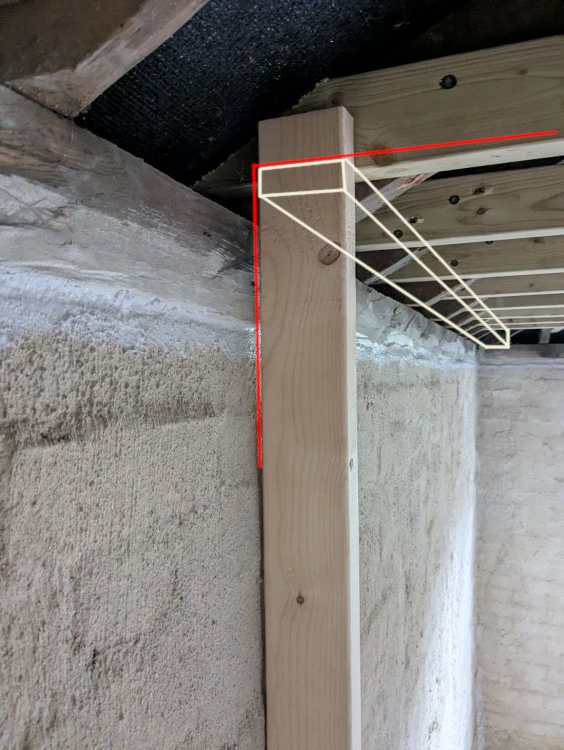
-
For 2 m I'd use a hammer and bolster.
-
PIV is a bad idea as it pushes internal moisture-laden air through gaps in the building fabric where it can to condense out and cause problems (except in old buildings where the gaps are so big that it flows out freely, or if the trickle vents are guaranteed permanently open in perpetuity). And when it's cold outside it's often not comfortable to be drawing in cold air. Central extract (MEV) would be preferable and is much used here in France. MVHR would be the gold-standard. dMEV is OK if all units are installed on the same wall, otherwise it tends to create an air tunnel from one side of the building to the other, which can be problematic when windy.
-
Fine tuning my IWI Solid wall (Warm Batten) design
Mike replied to Annker's topic in Heat Insulation
That's very likely and exactly how salts respond to moisture; the same as would happen if you were to leave out a heap of table salt on a plate. -
Most likely your aluminum windows were build without a thermal break. That means that there's pretty much nothing you can do to prevent condensation forming, short of leaving the heating on overnight or replacing the windows.
-
Fine tuning my IWI Solid wall (Warm Batten) design
Mike replied to Annker's topic in Heat Insulation
One thing I might consider doing then is to apply some cork insulation to the wall over that area, fixed with (NHL-based) Isovit E-Cork; cork isn't harmed by moisture but it, and the E-Cork, are breathable. I've used that solution on my chimney breasts, partly due to the higher risk of moisture ingress there (using 1 or 2 layers of 20mm cork, with additional hemp insulation in places). -
Fine tuning my IWI Solid wall (Warm Batten) design
Mike replied to Annker's topic in Heat Insulation
The corner of a building is often where rainwater pipes were fitted, and a leak in one of those could have been another source, even if subsequently removed. Past sources of moisture are relevant as they could have caused salts to migrate through the brickwork and be deposited on the interior as the moisture evaporated. And salts also absorb moisture from the atmosphere and so can appear damp - which could be what you have, even if the source of moisture was removed years ago. To know for sure, you'd need to get some tests for dampness and salts. It's possible to DIY them, but easier to get someone in; the first such company in my Google search appears to do that https://www.coreconservation.co.uk/technical-page/the-effect-of-salts-in-old-buildings/. One solution to salts is to apply a temporary coat of lime plaster ('lime poultice') to the wall, which will draw the salts out of wall and into the plaster, which then gets hacked off. However it will take time and possibly multiple applications - so not ideal. However I see that Core Conservation also sell a breathable salt-resistant lime plaster - I've not come across it before, but it looks a potentially quick solution. I wouldn't use either until this is resolved. -
Yes, that will help; I used to use wide-based concrete ones. However personally I'd likely skip the reinforcement. That's not something I'd have suggested until recently, but the need to add D49-style* reinforcement or reinforcing fibers, which was previously mandatory in France, was dropped from their Building Regulations in 2015 following an investigation what which concluded that neither served a useful purpose. Consequently it's something I've omitted on my current French project. *In fact the French used to use a lighter fabric than D49.
-
About Aviation, but interesting stuff about hydrogen and biomass
Mike replied to SteamyTea's topic in Boffin's Corner
Is anyone seriously suggesting that biofuels should power commercial aviation? Last I heard most research was going into synthetic fuels that would, in the future, be based on green hydrogen - though that's not going to be cheap. -
I can't think of one. Hmm. Home owners have a statutory right to choose their electricity suppliers - I guess that applies to anyone with a grid connection? If so you couldn't require a future buyer to use 'your' electricity supply, but AFAIK there would be nothing to stop you selling the house as being 'off grid'. Though that would certainly limit the number of potential buyers.
-
Rigid ducting in the standard outside the domestic sector where larger diameters are required to move more air, and where installation is less impeded - there's normally no need to thread it between joists, for example. In regular domestic situations the pros of semi-flexible ducting predominate and the performance differences aren't going to be very significant. Bigger factors are how the intake and exhaust ducts (to and from the MVHR unit from outside) are routed and insulated - keep them short and insulate them well - and the performance of the MVHR unit. The latter needs to take into account both the heat recovery rate (for which the standard way of measuring it is inadequate) and the electrical consumption of the fans (which will be running 24/7 for many years). The reliable resource for selecting those, based on independent real-life testing of both measures, is the PassivHaus database, where Efficiency Ratio = overall performance (heat recovery & electrical consumption). No idea, but there's plenty of information on here on DIY design.
-
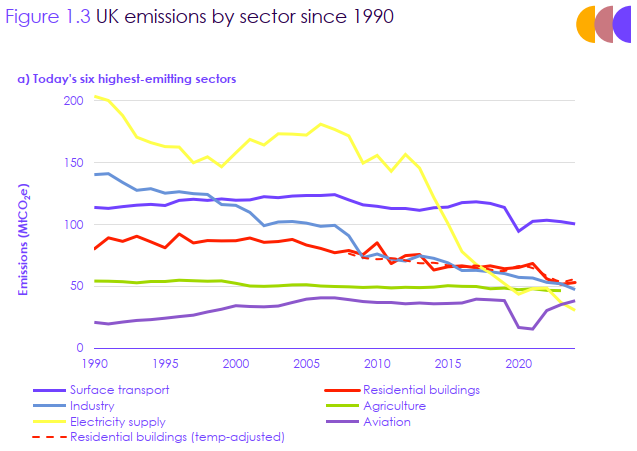
But it has - there's been a massive reduction. The 2025 report (PDF) from the Climate Change Committee includes the latest information on that (pages 10, 29 & 30) Progress to date [on emissions reduction] has been primarily driven by decarbonisation of the electricity system, with renewables replacing both coal and, increasingly, gas. The electricity supply sector has been the key driver of overall emissions reductions and has seen sustained progress over recent years. Emissions in the sector are now 82% lower than in 2008
-
Based on a suggestion by @Carrerahill from a couple of years ago, I've bought Tridonic GU10 modules (700lm, CRI 92, choice of 12° / 24° / 36° beam angles & 2700K / 3000K / 4000K temperatures) and Faro Fresh downlighters (plaster-in, adjustable angle, anti-glare recessed bulb position). Tridonic do more powerful modules (up to 1,500lm) but, from testing, the 700lm model is more than adequate for me. However they're not smart - they'll be controlled by dimmers (with a set switch-on-brightness + manual dim or brighten); 2 separate circuits in the living room so far but I may divide one to make 3. You also don't get dim-to-warm. That's not a problem for me as I don't like warm lighting (except in an old cottage); 4000K on a dimmer is my ideal.
-
I wouldn't attempt to do what you're planning either. If the rooms were larger I'd probably spread it over 3 days and, instead of pumping it, I'd shoot it in through the windows and have at least 2 people with muscles to barrow it into place. However as the rooms are smaller I'd probably bring in the materials and mix it on site. I'd have formwork in the doorways and create expansion joints. Either way, shroud the UFCH pipes with lengths of flexible conduit for 250mm or so either side of the junction, so that any movement is isolated from the pipes; if you've missed them out you can slit them lengthwise and clip them over the pipes, then tape up the slit.