Mike
-
Posts
1565 -
Joined
-
Last visited
-
Days Won
9
Everything posted by Mike
-
Or get a car where you can swap the batteries about as quickly as filling one with fuel, when they reach the UK: https://www.youtube.com/watch?v=WOsy_EvtHr4
-
Any love for CCT (i.e. changeable white) LED strips?
Mike replied to Alan Ambrose's topic in Lighting
I'd be with you for at least the fade-up feature, given a suitable controller to automate it. I hate dark days too, so if the alternative was a fixed CCT of 3,000 K or less, then this would be useful. However, with my personal preference for 4,000K I never have a desire to close the curtains before dusk. I can see the utility of this for some people. Though, as a night-owl, it wouldn't suit me at all, at least not until the last few minutes of the day. In short, I think that the value of changeable CCT lighting depends on how you like your lighting; I'm not a fan of cool lighting (except in limited circumstances) nor of warm lighting (unless it's in an old cottage or the result of real candles), but if you are, then go for it - in which case I'd recommend applying it to all lighting (that will be switched on together) so that you don't end up with an odd mix of colour temperatures. -
Infill panels with freestanding appliances
Mike replied to gaz_moose's topic in Kitchen Units & Worktops
I've used magnetic catches myself. Works well. -
In addition to the above, lime is also strongly alkaline, which inhibits growth of mold & fungi.
-
MVHR options and layout for small flat
Mike replied to Bryn P's topic in Mechanical Ventilation with Heat Recovery (MVHR)
That advice is for ceiling-mounted Coanda Effect vents; on a vertical surface things are different. Wall-mounted Coanda Effect vents are useful in large room used to direct air a long way across the ceiling of large rooms - but you don't what them in the position illustrated as that air will be directed down the ceiling & the wall. I'd be looking for a regular (not a Coanda Effect) vent, preferably with adjustable fins that give you the ability to direct the air flow. However check that you have enough space for a vent as drawn; it may be necessary to cut a hole through the RSJ for the duct (which would need to be part of the Structural Engineer's design) or to enlarge the boxing - or switch to a Coanda Effect vent on the horizontal part of the ceiling (probably the easiest option). From £1,651 +VAT at https://phstore.co.uk/zehnder-comfoair-160/ (20% cheaper than BCP - you may be able to negotiate it down further). Of course there are various other brands. For example those at https://database.passivehouse.com/en/components/list/ventilation_small which are independently tested to more accurate standards than normal (where a higher efficiency ratio = better economy). -
MVHR options and layout for small flat
Mike replied to Bryn P's topic in Mechanical Ventilation with Heat Recovery (MVHR)
My apartment isn't so different in volume, so overall no worries in principle. Ultimately it's about how much fresh air you need per person in a room. For example, at 'normal' fan speed a double bedroom requires from 15 m³ / person / hr; in a room measuring 3 x 4 x 2.5 that's 1 ach (air change / hour), but double the size of the room and that drops to 0.5 ach. Low fan speed is typically 40% below normal speed, so those figures become 0.6 & 0.3 ach. In short, in a smaller home the minimum acceptable ach will be higher than in a larger home. Probably not. I don't intend to be running mine lower than 0.33 ach; in your case that would translate to a little over 50m³/hr. The exception might be during an extended absence, but at least some controllers (including my Zehnder) allow a schedule to be set so that the average daily airflow could be cut well back by having it run for only certain hours per day; that's not recommended except for longer term absence. I have the Zehnder CA225 (similar to the CA220 that's sold in the UK) - 60 to 150 m³/hr according to the PH certificate & 50 to 200 according to Zehnder. That's partly because I also wanted to sling it from the ceiling where I have some more space. That doesn't seem unreasonable if you plan to use semi-flexible ducting, to keep the airspeed (and hence the noise risk) low. You could experiment using my MVHR calculator. It wouldn't be my first choice; I'd probably make that shower tray shorter to create a cupboard off the corridor. But in an enclosure with good sound insulation & anti-vibration mounts it should be OK in principle... Choose ceiling mounted Coanda Effect vents - Zehnder Luna, for example - and there should be no problem; keep them away from the walls by at least 350mm (750mm better, centre of room ideal subject to light fittings taking precedence). -
+1 to plastering but, in case it's not obvious, done after first sealing the junctions with other materials & components
-
Not answering your question, but why would the alucald ones need replacing after only 9 years?
-
That's an interesting proposition and an attractive price. I wouldn't recommend it to someone unfamiliar to the industry though, not unless they're confident taking on the contracting + payment + variation processes by themselves, or unless their architect is going to get involved in them.
-
That's an unusual octagonal access hatch...
-
MVHR external vent placement?
Mike replied to Alan Ambrose's topic in Mechanical Ventilation with Heat Recovery (MVHR)
And Ubbink have a 180mm pipe / duct adapter to suit? So you'd screw the tile upside down (sideways?) - I guess physically that could work, provided you can get the duct connections within the space. However if upside down then the upturned cowl would be liable to collect snow / leaves / other debris which might cause a maintenance problem, and you'd also need the exhaust duct sloping back towards the MVHR unit (it couldn't fall towards the vent as otherwise there's a risk that the upturned cowl would collect condensate too), but that may not be a problem to achieve. Sideways would probably be preferable. However, what's the problem you're trying to solve & why are you trying to avoid regular wall terminals? -
It's not an exciting topic, but here's a YouTube video that illustrates, in detail, how a Bill of Quantities is prepared in accordance with the common NRM2 standard: https://m.youtube.com/watch?persist_app=1&app=m&v=nshlJXDRZds The BoQ reflects the architects / engineer's drawings, so it will only be as right as they are. If they change / have items missing / don't reflect actual conditions on (or in) the ground, then they will no longer be right. Based on the BoQ, a QS can use their experience to provide you with an indication of the expected cost of the work. If they have recent experience of similar projects in the same geographical area, then the chances of them being in the right ball-park are fairly good (except when market conditions and prices are rapidly changing), but they won't be 'right' (spot on). It's also worth knowing that small contractors may not be used to pricing BoQs item-by-item due to the time and money it takes, so may not do so; they may normally price from drawings alone. If they give you a lump sum instead (or anything less than a fully priced BoQ) then the BoQ will be less useful (perhaps not useful at all) in assessing the value of work undertaken (for payments) & the cost of variations once construction starts. On the other hand, if you do get fully priced BoQs from more than one contractor (3 are typically asked), then you or your QS can usefully compare them and also sport potential errors in pricing. And, as @saveasteading says, if you get different contractors to price different parts of the BoQ, rather than going to a single contractor for the whole, then there will be items that fall through the gaps. Not to mention that any delays by one contractor that impact another will likely result in additional costs - and the same if it's you that's causing the delay. So using a QS isn't a panacea, but can be useful - particularly if you plan to choose a single contractor.
-
MVHR external vent placement?
Mike replied to Alan Ambrose's topic in Mechanical Ventilation with Heat Recovery (MVHR)
Not sure what you man by 'under', but first check that they can support the required airflow rate No problem, provided they respect the distances from windows required by the Building Regs. -
MVHR Enthalpy Exchangers, BS or SB?
Mike replied to LnP's topic in Mechanical Ventilation with Heat Recovery (MVHR)
Yes, I'm sure they must (in Europe, at least) to avoid damaging the heat exchanger. Here in France we get extended sub-zero temperatures from time to time and, since I have an apartment, it doesn't take long for the air quality to deteriorate without the MVHR air supply or an open window. As that's the worst time of year to open a window, it was definitely worth the the extra €300 for the preheater. But, in a larger home and/or somewhere with milder winters, that would be a lesser concern. -
MVHR Enthalpy Exchangers, BS or SB?
Mike replied to LnP's topic in Mechanical Ventilation with Heat Recovery (MVHR)
Just pulled up the standard text on the topic from the PassivHaus certificate, which provides some guidance: Indoor air humidity can be increased by using a system with moisture recovery in a cool, temperate climate, especially during the winter. These higher humidity levels will reduce evaporation from building elements and furniture during the heating period and thus have a positive effect on the building’s heating demand. In order to account for this effect, the heat recovery efficiency is increased by a certain percentage, depending on the achieved level of moisture recovery. In case the unit’s moisture recovery rate is larger than 60 % its airflow rate must be controlled based on the indoor air humidity, in order to prevent temporarily elevated humidity levels. Application of humidity recovery: ■ In cool temperate climates, heat exchangers with moisture recovery should generally only be used if the moisture load inside the building is comparatively low (e.g. in a residential building with an occupancy rate significantly below the average). ■ If moisture recovery > 60 % is to be used in a building with an average occupancy rate and typical use, the energy balance of the building is to be calculated with an increased airflow rate. While the heat recovery efficiency may be increased, enthalpy units have no advantage in that respect compared to standard units, when looking at their database as a whole (though Efficiency Ratio, not heat recovery rate, is the key figure). -
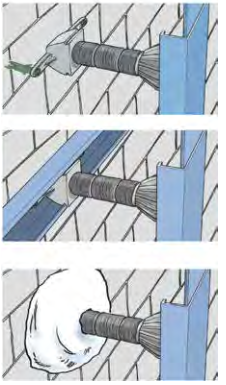
My knowledge of the French industry is limited, but I've not come across any reference to that profile being fixed with adhesive over here. I've only seen them used standing off the wall (so that insulation can be fitted) on adjustable nylon brackets - though the brackets can be fixed with with adhesive in new build, as per the 3rd of these images.
-
MVHR Enthalpy Exchangers, BS or SB?
Mike replied to LnP's topic in Mechanical Ventilation with Heat Recovery (MVHR)
+1. I seem to recall that they're more commonly used in Nordic countries. -
A few options: Have a structural engineer design a heavy traditional cut roof the roof capable of resisting wind loads without straps (Building Regs Approved Doc A says 'vertical strapping may be omitted if the roof: a. has a pitch of 15° or more, and b. is tiled or slated, and c. is of a type known by local experience to be resistant to wind gusts, and d. has main timber members spanning onto the supported wall at not more than 1.2m centres') Cast a suitably heavy reinforced concrete ring beam around the top of the wall and fix the roof to that - again, a Structural Engineer would be required for the design and to prove it is adequate Fix the straps to the cavity face of the inner leaf, subject to the knock-on impact of this on insulation / cavity closure & satisfying your BCO.
-
Not the first time we've had that stupidity. Since it's presumably too late to reposition the post here's one potential solution - search for others. The cold will still travel through the steel, bypassing the insulation so not going to solve the problem.
-
Very entertaining! Never has I seen such cheer in the face of such financial pain. Great architecture though and yes, the site manager was a star. Looking forward to the follow-up in 5 / 10 / 15 years time...
-
Rear Extension with incorporated W/C advice
Mike replied to M_Wels's topic in House Extensions & Conservatories
+1 to a door between entrance & kitchen - in fact I'd probably make a full hallway: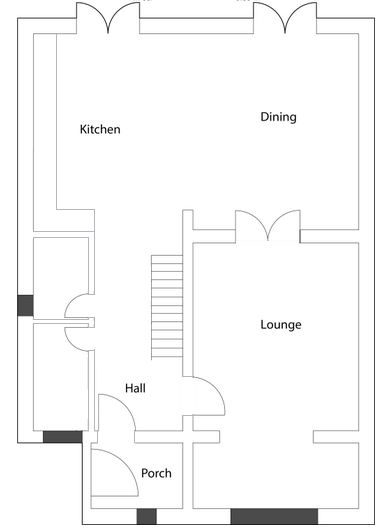
-
Ubbink - what are they like?
Mike replied to lizzieuk1's topic in Mechanical Ventilation with Heat Recovery (MVHR)
Prior to looking at active cooling solutions, consider passive measures to minimizing the build-up of summer heat within the building. In particular solar shading of windows and the use of wood fibre or hemp insulation to maximize decrement delay, plus the use of appliances with high energy efficiency ratings to minimize their heat output. For active cooling, take a look at using underfloor central heating in cooling mode. -
You can - floatovoltaics :)
-
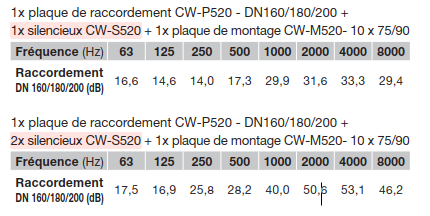
The main box is an attenuated manifold - item 990323502. Plus you need one end plate with a 150mm connection to suit your 150mm duct (item 990323568, by the look of it), and one end plate with 10 pipe connections (75 or 90mm - 990323614 / 990323615 depending on what you have). So yes, 3 items in total. Check those codes though! Yes, something counter-intuitive happening there - something to do with the extended dimension -v- the wavelength, I suppose. However I note that the figures on the last line - with the 10 x 75/90mm end plate - are different to those in the French brochure. Either the English or the French figures have to be wrong (though whichever is correct still gives good attenuation). I just went looking for the German version, but the one I found doesn't quote any figures at all... Looking again at the French figures, they give them for two connected boxes (160mm end plate + manifold core + manifold core + 10 x 75/90mm end plate) as well as for the single arrangement; the result is more intuitive: 32Hz is really low - I guess it's not normally a concern. I don't think you actually mentioned which MVHR unit you have, BTW?
-
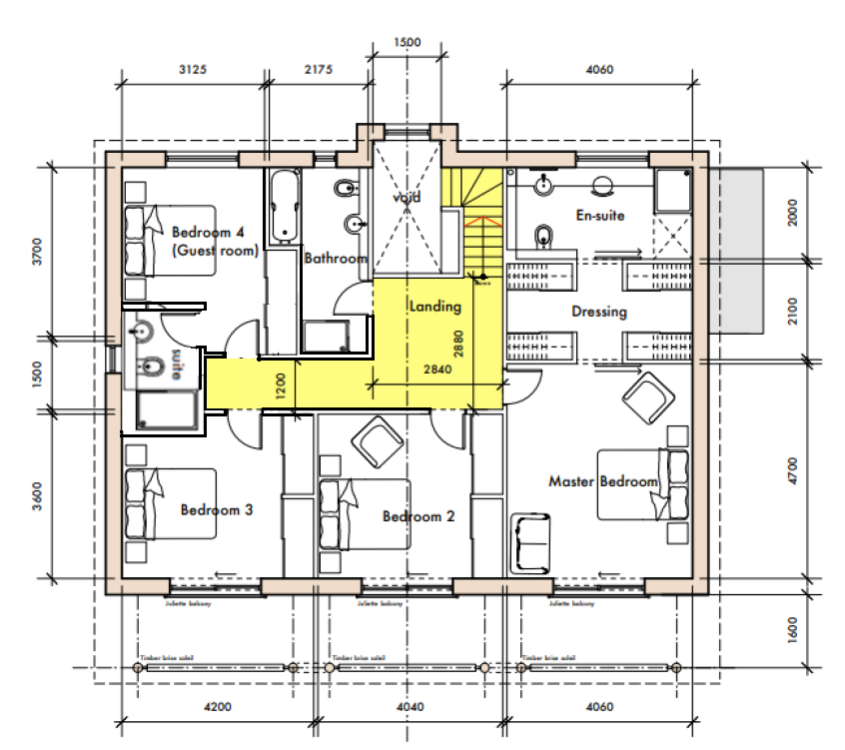
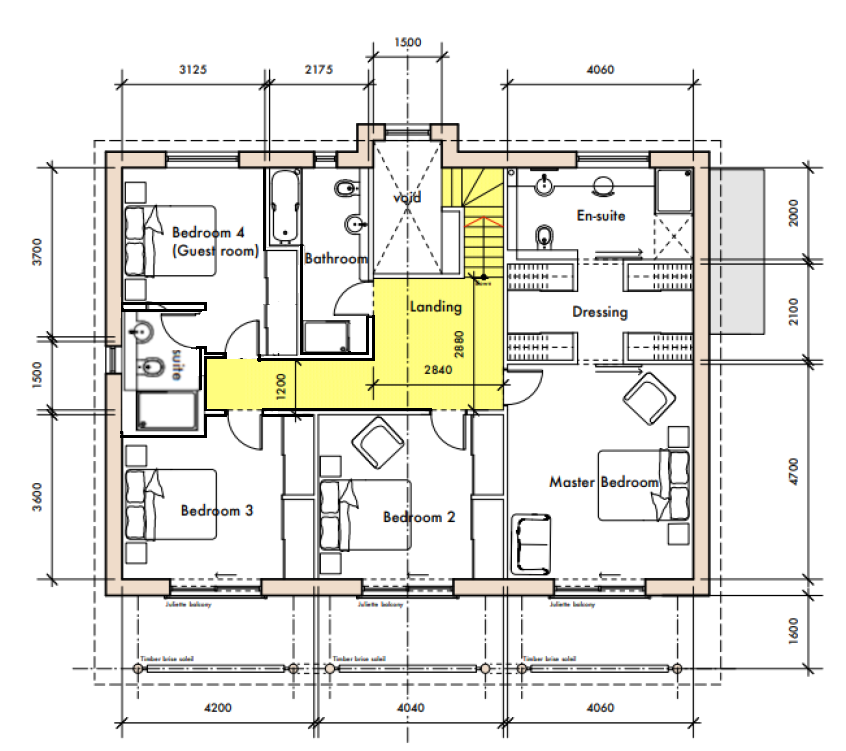
Here's an alternative for the North East corner that doubles the wardrobe space in Bed 4, and removes the WC from the Bed 3 wall, albeit at the expense of bedroom width in bedrooms 3 & 4. You could probably rework the en-suite & corridor end to avoid cutting space from Bed 3. But everything's a compromise. There's space at the end of the corridor for a shallow storage cupboard.