
Ed Davies
-
Posts
1674 -
Joined
-
Last visited
-
Days Won
1
Everything posted by Ed Davies
-
Yes, when I looked at 21:16 BST (20:16Z that is, UTC or, if you must, GMT) weatherHQ was showing the last observation as 16:50 (whatever time zone they use, BST I'd guess). When I look on checkwx it gives a much more recent observation at 19:50Z (20:50 BST so about 25 minutes ago). You don't need an API key just to look on the web, only to use the API for easy programmatic downloads: https://www.checkwx.com/weather/EGPE/metar BTW, adding a bit of whitespace for readability, this is the JSON you get back from the checkwx API for Inverness: { "results":1, "data":[{ "wind":{"degrees":0,"speed_kts":2,"speed_mph":2,"speed_mps":1}, "temperature":{"celsius":21,"fahrenheit":70}, "dewpoint":{"celsius":15,"fahrenheit":59}, "humidity":{"percent":69}, "barometer":{"hg":29.76,"hpa":1008,"kpa":100.79,"mb":1007.92}, "visibility":{"miles":"Greater than 6","miles_float":6.21,"meters":"10,000+","meters_float":10000}, "elevation":{"feet":29.53,"meters":9}, "location":{"coordinates":[-4.0475,57.5425],"type":"Point"}, "icao":"EGPE", "observed":"2019-07-26T19:50:00.000Z", "raw_text":"EGPE 261950Z VRB02KT 9999 FEW035 21/15 Q1008", "station":{"name":"Inverness"}, "clouds":[{"code":"FEW","text":"Few","base_feet_agl":3500,"base_meters_agl":1066.8}], "flight_category":"VFR","conditions":[] }] }
-
But even with defrosts, would the COP go below 1? Even if it's sometimes down to 1.1 it's still a win over using an immersion.
-
Sowwy. OTOH, I'm sure ProDave, who I was answering, had at least a rough idea what I was talking about.
-
https://www.checkwx.com/ Needs an API key to do automated access. I just emailed them to ask and they sent one in a couple of days. They seem fairly relaxed about what you're using it for so long as you don't hammer their website with lots of requests. Results come back as JSON. My Python code stores that directly in my SQLite database timestamped with the time it fetched it then some other code extracts various fields (date/time of the actual observation, temperature, wind speed, wind gusts) and posts to the same database but timestamped with the actual date/time of the observation. Generally the readings at Wick are taken at 20 minutes past the hour so I do my query at 33 minutes past the hour (triggered by a cron job). They don't do readings all the time (not all night) so sometimes two fetches get the same set of observations each time.
-
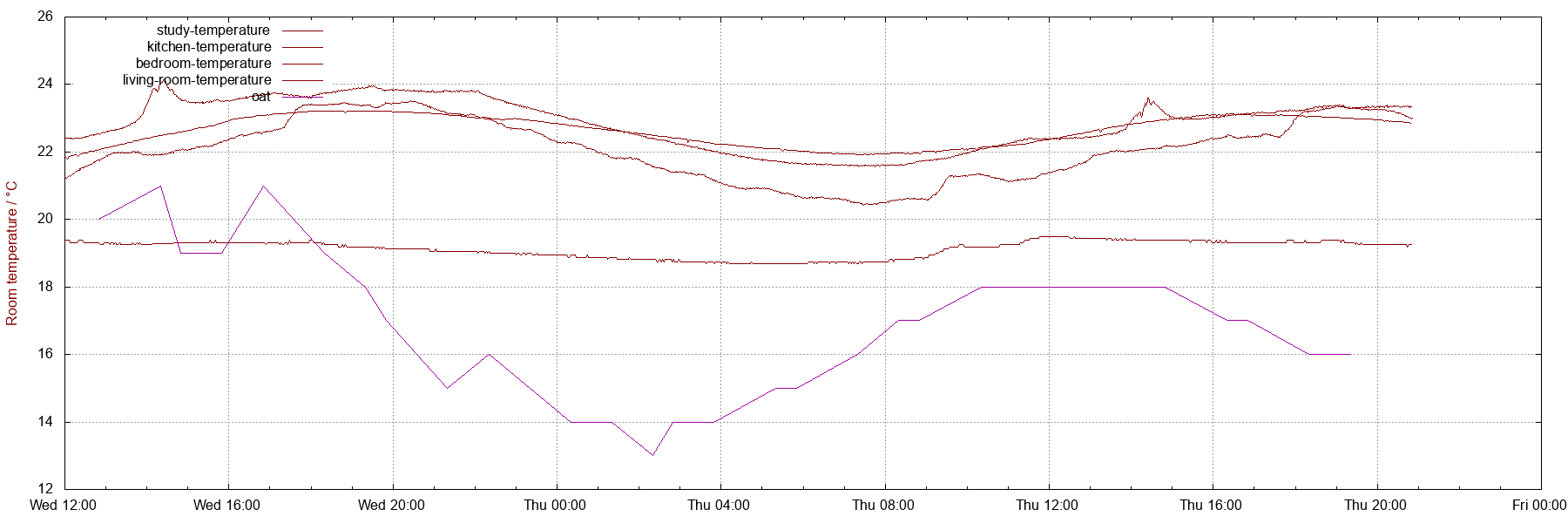
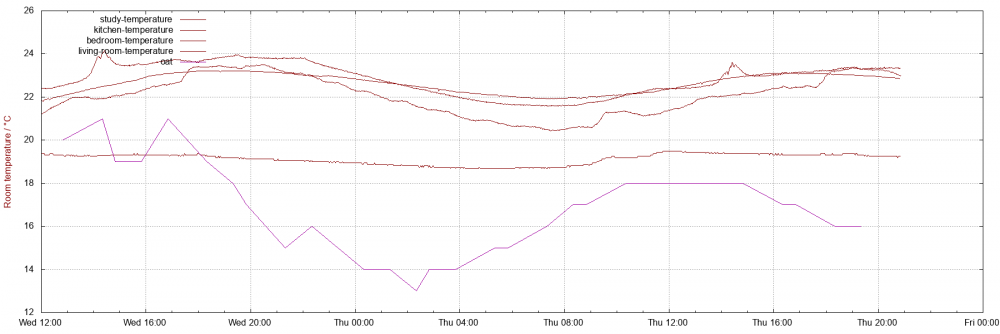
Bit humid but otherwise very pleasant working on the roof this afternoon. Bright sunshine but a strongish SE breeze off the sea. “OAT” below is outside air temperature, actually the temperatures being reported at Wick airport about 30km away.
-

PV Self-Comsumption Model for sizing system + battery.
Ed Davies replied to Dan F's topic in Photovoltaics (PV)
I'm completely with @ProDave here. Nothing's changed. It used to be that there were two limits: 1) The 16 A/phase limit (3.68 kW, or even 3.84 kW, in practice) for maximum you could feed to the network without prior notification or cost. If you wanted to feed more than that you had to notify them and they could charge you for any network strengthening required. If your (and your neighbour's) inputs were all within the 16 amp limit and the result was an overvoltage (over 253 volts) then the DNO had to pay for the fix. This is defined in paragraph 22 of the The Electricity Safety, Quality and Continuity Regulations 2002. Whether the electricity comes from PV, wind, hydro, diesel, or whatever is irrelevant though the DNO could have a say in what equipment was used to ensure that the limit was obeyed. E.g., some DNOs allowed larger PV systems (both panels and inverters) combined with an appropriate diverter which limited the output to the network to less than 16 amps or 3.68 kW, others didn't. 2) The original FiT scheme had a big drop in pennies per kWh paid when the capacity of the PV panels went over 4kW such that there was a “dead band” from 4 kW up to somewhere around 6 kW when you didn't get more money even if you were feeding in more electricity. You could have, say, 8 kW of panels and get more money than somebody with 4 kW's worth but less than twice as much. Because these were similar limits lots of people got muddled between the two. The only thing that's changed is that 2 became progressively less important as the FiT rates dropped and the difference in rates decreased and the whole scheme has now gone away completely. AFAIK, nothing's changed with respect to the connection to the DNO (1, above). -
PV Self-Comsumption Model for sizing system + battery.
Ed Davies replied to Dan F's topic in Photovoltaics (PV)
4kW (no H or h). The actual limit is 16 amps which equals 3.68 kW. But that's the output limit on the inverter, you can have more PV than that as the inverter will just throw away the excess for the short times when the panels are generating the full nominal amount. Also, might be worth asking the DNO what the limit for you would be. It depends very much on the local network and they might be happy for you to feed in more than 16 amps. If they need to increase the local capacity to allow you to feed in they have to pay, beyond 16 amps they can (and would) charge you. -
My recollection is that Tony (of GBF and Tony Tray fame) did this for some of his windows but I can't immediately see any reference to it on his web site: http://tonyshouse.readinguk.org/air-sealing-windows-and-doors/ Perhaps a search of GBF would turn up something. (GBF = Green Building Forum).
-
Single Room Air Conditioner or similar
Ed Davies replied to Ferdinand's topic in Other Heating Systems
-
Not really, as an exhaust air heat pump exhausts the cooled air, sucking more warm air in from outside. If it had the option to blow the air in the opposite direction or re-circulate it then maybe. Yes, optimizing operation on sunny days doesn't make a lot of sense. Particularly in the UK.
-
Pity the heat extracted by the slab cooling can't be used to heat the water. Instead you have to pump heat out of the slab into the outside air then at other times pump heat from the outside air into the DHW.
-
While we're on the subject, I bought two Vanon BL1840 Makita-clone batteries the other day. Plan A had been to get a 5Ah genuine Makita battery to extend my collection but at the same time I got a Makita 36V lawn mower (Flymo let out the magic smoke and I really wanted a cordless mower - managing the cable on the Flymo made doing the sloping lawn here's a pain) so a pair of new batteries seemed in order. I balked a bit at buying two new Makita batteries so thought I'd give the clones a try, though with some serious trepidation. Both the lawn mower and the batteries were through Amazon. I did the first quarter of the lawn with the Vanon batteries until they ran out (brand new, arrived charged, topped up in seconds in my charger). Then I put in my two Makita 4Ah batteries (bought 2015) and did almost all of the rest of the lawn. By that time the first of the Vanon batteries had fully recharged so I put it in with my Makita 3Ah battery (bought 2014) to do the last little strip of the lawn and the entrance track down the side. The Vanon battery ran out first. Conclusion: for all I know the Vanon might actually be 4Ah but that's a smaller 4Ah than the 3Ah provided by a relatively old Makita battery.
-
I have the DTD152Z. Not had it for long and only used it for moderate sized screws into softwood so not a good test for you purposes but quite happy with it. It's very compact. If you're getting a separate replacement drill I'd suggest the DHP481 rather than the DHP453. The 481 is much beefier and feels more controllable. I had a 453 which I burned out doing something silly (drilling concrete - finished that job with an SDS drill), got another 453 as a replacement then decided I wanted a heavier one as well, not least because having a pair would be good for pilot holes and screws without changing bits all the time, so got the 481. Not actually used them in that combination much and now I have the impact driver as well I doubt I will so the replacement 453 has been a bit of waste.
-
There's a divergent sub-thread on the cost of “plain” hobs, without ventilation.
-
£260 from IKEA: https://www.ikea.com/gb/en/p/matmaessig-induction-hob-black-30368822/
- 114 replies
-
- 1
-

-
- ex875lx34e
- kmda7774fl
- (and 3 more)
-
Your Home Base Load / Background Power Draw
Ed Davies replied to MrMagic's topic in Photovoltaics (PV)
@SteamyTea, Nope, @ProDave said 39kWh per week. -
Do the water regulations apply to you @JSHarris? AIUI, they only apply to buildings on mains supply so if you're on a private supply, like a borehole, spring or rainwater harvesting, then they're at most advisory. https://www.wras.co.uk/consumers/advice_for_consumers/what_are_the_water_regulations_/
-
If you block out more than a certain percentage of the roof it'll no longer be considered a conservatory. That might have planning and building regs implications.
-
It certainly seems the wired sensors are less common. Arduinos do come with wired Ethernet connections but most have them as shields which plug on top. There was the Nanode which was an Arduino with a built in Ethernet connection (I have two kits, only made one of them up IIRC. It worked OK but I haven't made much use of it - doesn't seem a lot of point in developing much code for it if there aren't more available.) https://www.amazon.co.uk/TOOGOO-ENC28J60-ethernet-Arduino-Webserver-Red/dp/B0721K1QZY 1-wire can, in theory, be run over quite long distances though I've always found it pretty flaky as wires get longer. Another option would be serial networking to Arduinos but if you want lots of sensors you'd need to work out how they multiplex to the central machine. There are lots of existing protocols but I don't really know of one that would be easy to implement in quantity. Modbus? CAN bus? Not sure of the likes of the Orange Pi. Probably a lot of power consumption if you want quite a few round the house. I'm not bothered about EMF one way or the other but still would prefer things to be wired where possible for security and robustness.
-
Yes, I have my own system. Most of the work happens on a Raspberry Pi. Basically, various sensor inputs around the house get flung into an MQTT broker then some Python code reads it from there, stores it in a SQLite 3 database and serves it via HTTP (and websockets though I don't use that except for experiments, yet). Sensors talking via Wi-Fi are a few ESP8266 devices made by VAir (http://shop.vair-monitor.com/) who doesn't seem to be coming back from the break in producing these devices, unfortunately. Two do temperature and humidity in the study and kitchen. Another does temperature, humidity, CO₂, pressure and light level in the bedroom. There's also an ESP32 which I coded myself in the living room measuring the temperature there and a Sonoff TH16 in the kitchen (again running my own firmware) logging the temperature in the fridge salad tray and controlling power to the fridge (because its thermostat seems poor). Directly attached to the Pi is a DS18B20 1-wire sensor on the study radiator flow pipe and the desktop part of a CurrentCost meter which measures the current into the house (clamp round the feed between the main fuse and the meter). Part of the Python code queries checkwx.com for data from the nearest airport (Wick) once an hour and adds that to MQTT to be logged. There are also a couple of associated Python programs which query the database via HTTP. One (houseplot.py) takes the data and feeds it into gnuplot to produce the sort of plots I show on here. Normally I have an instance of this program running in the background showing the main data for the house, updated every 30 seconds, on my second monitor which is handy for lots of things, like seeing what the heating's doing or when the washing machine's finished. The other (httpreader.py) gives a more numeric output, typically a CSV list of one or a few sensor topics which can be piped into ad hoc code for more detailed looks at particular subjects (e.g., for this: https://edavies.me.uk/2019/01/continuous/) but it can also do integration, averages and so on producing a JSON result. It all just grewed and I think of it as the prototype to throw away. I like Python but it does get a bit unwieldy as code evolves and I'm currently thinking about a re-write in Rust but I need to get a bit more familiar with that language before diving in.
-
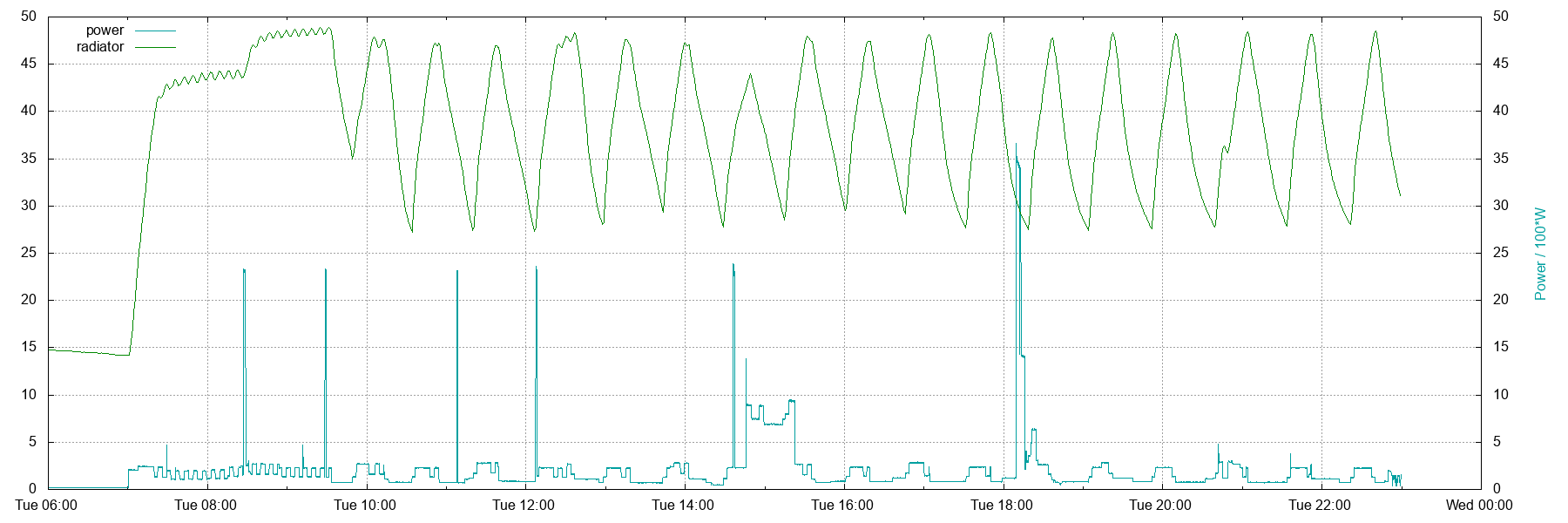
OTOH, it's likely that a lot of radiator systems short-cycle, too. Here's my rented house for New Year's day this year. Blue line is the overall household electricity consumption and green line is the temperature of the flow to the radiator in the bedroom I use as a study. The heating comes on at 07:00. It runs steadily for about 20 minutes then starts to short cycle as you can see from the castellated power consumption as the blower and oil pump switch on and off. The spike at 08:30 would have been the kettle for tea with breakfast. Not sure why the flow temperature to the radiator changed at about that time, maybe removing something left on a radiator to dry? It continues to cycle until 09:30 when the the thermostat in the living room was satisfied and both the boiler itself and the circulation pump turn off. Some of the other pulses of heating needed early in the day also have a few short cycles. I think there's a problem that plumbers are motivated to oversize boilers. No customer is likely to call them back for a bit of short cycling but if the boiler is underpowered for the coldest days they'll get it in the neck. When the boiler here was replaced I showed a graph like this to the plumber and suggested if he had a choice to round down on the boiler power compared with the previous one. He didn't seem much interested.
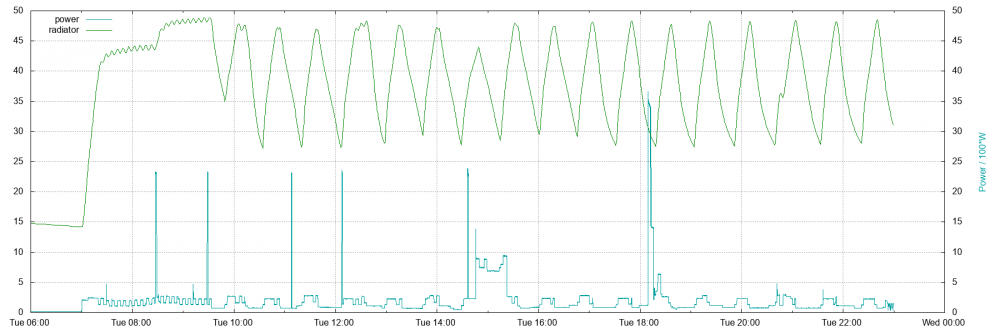
-
No, the system requires 3 kW of POWER input, so 6 kWh of ENERGY over two hours. He clearly meant energy. It's really not that difficult but I do wish we used MJ (megajoules) rather than kWh as they do seem to confuse people a lot. (1 kWh = 3.6 MJ).
-
6 kWh input Sorry, pedantic I know, but it's no wonder so many are confused on this subject when even the professionals who know better are sloppy about it.
-
Yep. Some relevant blog posts: https://edavies.me.uk/2015/03/2015-6/ https://edavies.me.uk/2015/03/bolted-to-scotland/ https://edavies.me.uk/2016/03/first-frame/ One difference, though, is that Walter Segal (and CAT and I) put up the whole frame then clad it whereas @iSelfBuild seems to be more building a platform then going up from there.
-
Your Home Base Load / Background Power Draw
Ed Davies replied to MrMagic's topic in Photovoltaics (PV)
My thought too. I can't see how anything other than a faulty thermostat would cause excess freezing.