
Ed Davies
-
Posts
1674 -
Joined
-
Last visited
-
Days Won
1
Everything posted by Ed Davies
-

Your Home Base Load / Background Power Draw
Ed Davies replied to MrMagic's topic in Photovoltaics (PV)
Yep, that's what I did last year and earlier this year. Reached the end of the scale. In this case the Sonoff TH16 has turned the fridge off externally so it can't be doing that. Not even the internal light works when it's off. Still, I was fairly confident it didn't do that before I added the Sonoff (otherwise I'd have been a bit more circumspect about just switching it externally) because it turned on and off so cleanly as seen by my energy logging. BTW, the Sonoff is running my own code, not the standard internet connected stuff. I have some code to not turn the fridge on or off too often (run for at least 10 minutes and be off for at least 6 minutes, IIRC) on top of the hysteresis implemented for the temperature. Interesting, I wonder how that happens. -
Your Home Base Load / Background Power Draw
Ed Davies replied to MrMagic's topic in Photovoltaics (PV)
It's possible that a clean round the back of the fridge would help with whatever's causing the problem with the fridge freezing the contents of the salad tray but I doubt it's the main problem. It happened a bit last summer but is worse this year. What I think is happening is that the thermostat is right at the top of the fridge and the insulation is probably not that great by modern standards (only A+) so when the temperature in the kitchen is reasonably high it makes the fridge run too long. A previous fridge I used had a switch for warmer/cooler outside operation but I can't see one on this one, either in the actual fridge or in the manual. BUT, the extra consumption I was referring to, the step up from below 20 watts to above, is during the time the fridge is not running. Any problem with the evaporator on the fridge might affect the consumption when the fridge is running or the length of time it runs (so the overall overnight average, which is about 45 W, BTW) but not the fridge-off total consumption. That means with the Sonoff is drawing about 5 W or so when it's idle, which seems a lot, or there's another phantom load plugging in somewhere that I've forgotten about. -
Blocks to 2.4m high before the facing bricks, gotchas?
Ed Davies replied to epsilonGreedy's topic in Brick & Block
Because water could then run across? -
It's good practice to control it if there's a risk to horses or other grazing animals but you're only legally required to do anything if a specific order is made against you. https://www.gov.uk/government/publications/code-of-practice-on-how-to-prevent-the-spread-of-ragwort
-
Your Home Base Load / Background Power Draw
Ed Davies replied to MrMagic's topic in Photovoltaics (PV)
Between 20 and 30 watts when the fridge is off, about 80 watts when it's running. It used to be a bit less, about 15 to 20 watts, when the fridge was not running. I've recently added a Sonoff TH16 switch with temperature sensor to override the thermostat in the fridge as that was freezing the contents of the salad tray. Bit (small bit) worried that that's accounting for the extra watts which would be annoying. More investigation required.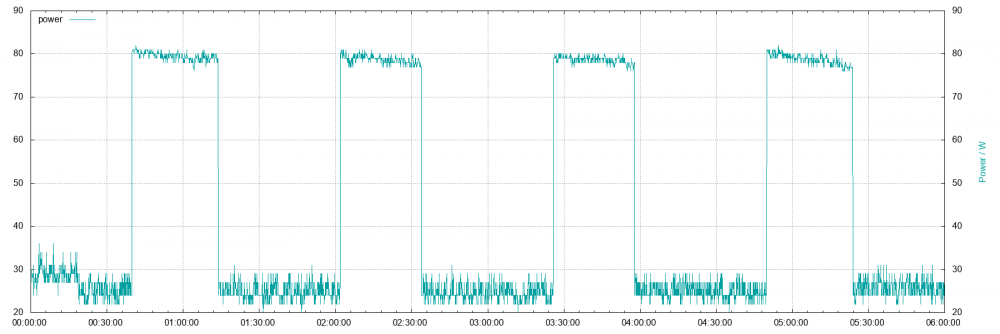
-
PUR pushed in against the OSB with the VCL wrapped in to form a 30mm service void?
-
Yep, rockwool is cheaper per R-value both financially and environmentally. Have you considered putting the PIR/PUR on the inside? I.e.: Plaster 5mm Plasterboard 12.5mm 30mm Kingspan or similar (this is flexible) VCL 150mm rockwool or similar (in 150mm stud) OSB 11mm Breather membraneBatten & Counter batten => 50mm cavity softwood cladding 20mm That's essentially what my house design is, though with thicker layers. VCL could probably go either side of the PIR/PUR (or even be its foil face if appropriately taped). Advantages of putting the VCL against the studs: holds the rockwool in place until the inner layers are added and the PIR/PUR protects it from some damage from screws in the wall, etc. No service cavity? With the PUR on the inside you'd at least have something to bury cables in (after checking compatibility, I think PVC cable sheathing is OK in PUR, though not in EPS).
-
That's a strange build up, having a relatively vapour impermeable layer (the Kingspan) outside the very permeable rockwool. I can't explain the different U-values but it doesn't surprise me that you're getting odd results for the dew point values as it'll all be very sensitive to assumptions made on the gas tightness of the VCL and the Kingspan (i.e., any allowance for possible leakage points). How about using EPS for the outer layer? It's a lot more vapour open (though not as much as rockwool) so ought to make things quite a bit safer. You'd need a bit more and might have to think about fire safety, though.
-
Sorry Steamy, but your previous arguments, elsewhere, against thermal IR radiation being significant have totally failed to convince me of much (other than that you don't understand the inverse square law when it's applied to spread-out sources). There are benefits to heaters which produce a larger proportion of their output via thermal IR vs ones which mostly just heat the air. E.g., UFH (about 50% thermal IR) vs traditional radiators (a lot less than 50% via radiation). OTOH, in a reasonably airtight house with MHRV this advantage is tiny.
-
No, he doesn't have an ASHP. Some of this discussion is about his calculations of what the costs and benefits of adding one would be.
-
Strange Cemex claim about their flow screed.
Ed Davies replied to epsilonGreedy's topic in Underfloor Heating
That is for 10% compression, though. Typical values for a more-realistic 1% strain are a little less than half that: (i.e, EPS 100 = 45 kPa, EPS 200 = 90 kPa). But, yes, it doesn't take a lot of spreading for these to take a lot of load. https://www.insulationshop.co/image/catalog/pdf/Jablite/Jablite-EPS.pdf -
Electric cars create more carbon dioxide than diesels.
Ed Davies replied to K78's topic in Environmental Building Politics
First non-ad search result for “tesla battery embodied co2“ says otherwise (once you finish playing whack-a-mole with the pop-ups): https://www.forbes.com/sites/quora/2016/04/22/the-carbon-footprint-of-tesla-manufacturing/#46e009466096 I wonder what the background of the “Institute for Energy Research” is. A couple I spoke to last summer had just driven up from Edinburgh (240 miles) in their few year's old second-hand Leaf (so 24 or 30 kWh, I forget which, but definitely not one of the newer ones with bigger batteries) with one stop to fast charge at Aviemore. Seriously considering a second-hand Leaf once my house is done as I hope they'll be fairly cheap as newer, longer-range, BEVs are available. Biggest downside is the inability to tow a trailer. Discussions like this are one of the reasons I'm so in favour of a significant carbon tax. Let the market sort it out. -
Probably true for a building-regs house but likely not for an efficient one. By the time you've paid the gas standing charge and for a boiler service you've taken a noticeable chunk out of the electricity cost for a house like @TerryE's, never mind the depreciation on the boiler and the cost of the gas.
-
…unless the tank's inside the thermal envelope, of course. But, more generally, any plausible “inter-seasonal” store really has to start with the notion that a significant proportion of the heat will be harvested during the winter half of the year. It should only be discharging at a significant rate during the worst few weeks of the winter, say the worst 6 or 7 weeks in the period from the middle of November to the end of February. That is, of those 14 or so weeks you'd hope that about half have at least the odd bright day or two meaning your net losses over the week would be small.
-
Yep, you need to handle dihydrogen monoxide with great care; it has the highest pH of any acid.
-
Some have the notion that the PCM in a Sunamp is like that in a hand warmer where heat is stored by the phase change but the material then sits at ambient temperature. I've not seen any evidence to support this notion and don't think it's true because it appears that once a hand warmer has a few particles change state (solidify) they act as a seed to spread the phase change to the rest of the contents. In other words, they're either fully liquid or (on the way to being) fully solid whereas the Sunamp can clearly sit in part liquid, part solid states and therefore must be at around the phase-change temperature to keep the liquid bits liquid. So, I think it's likely there is a continuous loss from the PCM, just quite a lot less than from even a well insulated tank of water storing the same amount of energy mainly because the volume is smaller so the surface area can be smaller which means a) directly less loss and b) more effective insulation (vacuum panels) are affordable.
-
Free Planning Permission and Pre-Application Advice?
Ed Davies replied to RobinH's topic in Planning Permission
Highland Council won't do meetings (on site or in their offices) or even phone calls for pre-app advice but if you put in a detailed written proposal they'll give a detailed response for free. I found the response on mine very helpful. E.g, it probably saved me a good few thousands on the routing of the entrance track. -
Double check valves. Why? Where? Says who?
Ed Davies replied to ToughButterCup's topic in General Plumbing
Does doing that get rid of the requirement that the shower head can't reach within 50mm (or whatever it is) of the water level in the bath, basin, etc? -
Yep, it's so standard in the software industry now that most people seem to accept it as normal. The sad thing is that the bad habits of the software industry are spreading to more hardware-based industries rather than good practices going in the opposite direction.
-
For constant resistance, power is proportional to v², not v, 'cause when the voltage increases the current does too. >>> (253/230) * 2.8 3.08 >>> (253/230)**2 * 2.8 3.3880000000000003
-
Nearer 3.388 kW, neglecting the slight drop in current due to increased resistance at the higher temperature.
-
Also, dormers shadow PV.
-
…but probably not by a BCO signing off a new build, I imagine.
-
What @epsilonGreedy says. Insulation and (to a lesser extent) on-site renewables are amongst the few index-linked pensions available to most of us.
-
AFAIK, planning permission lasts until it expires, even if there's a separate planning permission in place. After all, anybody can get planning permission for any piece of land (so long as they tell the owner they're applying for it); it'd be unreasonable if that cancelled some other permission the owner already had. What I don't think you'd be allowed to do is mix, building bits of one permission and bits of the other even if you complied with all the conditions of both.